Sophie la girafe Teether: Care, Safety & Alternatives Compared
At a glance
- Sophie la girafe teether: natural rubber – clean it gently and dry it well.
- The CE mark & age recommendation are must-check items for every teether.
- Chilling: the fridge is usually enough, the freezer is often too hard and cold.
- Quick check before every use: cracks, sticky spots, loose parts?
- If natural rubber gets a bit “musty”: wipe it down gently, don't boil it hot.

The best way to clean the Sophie la girafe teether is gently, with a damp cloth and mild soapy water. That's also exactly why parents like it: soft, easy to grip, lots of chewing edges – but it's a natural material with its own rules. In this guide you'll get practical orientation: what makes Sophie (Vulli) special, how a NIP teether holds up in everyday life, what we look at when comparing – and which alternatives suit which family rhythm.

Ulli & Flo
Owners of bieco · Hamburg · parents themselves
Teething started for us back then – and suddenly everything was interesting to “nibble on”. With a few care and safety habits, a teether quickly becomes a relaxed helper in everyday life. Feel free to browse our Teethers collection.
Why is the Sophie la girafe teether so popular?
It's popular because it's soft, fits nicely in little baby hands and offers lots of spots to chew on. The typical shape with “ears/horns” and ring elements means babies can always latch on somewhere – even when their hand coordination is still in trial mode.
Important to know: natural rubber is a natural material and is more sensitive to heat. According to the manufacturer Vulli, Sophie la girafe (natural rubber) should be cleaned with a damp cloth and soapy water; dishwasher, sterilizer and prolonged soaking are not recommended (Vulli / Sophie la girafe FAQ).
Practical tip: If a natural rubber toy “smells funny”: wipe it with mild dish soap, wipe again with clear water, then let it dry really well (don't roast it on the radiator).
How we compare teethers (no drama, but with a checklist)
We look at material, cleaning, grip, safety and everyday practicality. It's not rocket science – more the question: “Can you realistically manage this between breakfast and a diaper change?”
- Material: Natural rubber, silicone, plastic or wood – and what that means for care.
- Cleaning: Hand washing okay? Dishwasher possible? Are grooves/textures easy to reach?
- Gripping & chewing: Weight, shape, multiple chewing surfaces, non-slip.
- Safety: CE, age recommendation, no loose small parts, condition before use.
- Chilling: suitable for the fridge, without the “ice block effect”.
And yes: we bring the parent's perspective into it. Ulli & Flo write here as parents for parents – and as a family business from Hamburg, we've been close to what works in everyday life for 66 years.
NIP teether: What's practical about it in everyday life?
A NIP teether is often designed for straightforward use and easy gripping. For certain models, NIP describes textured surfaces and lists chilling in the fridge as an option (NIP manufacturer information).
What many parents like about it: less sensitive, quickly ready to use again. Especially if the dishwasher is already a “family member” in your home, easy-care materials are often worth their weight in gold – always according to the manufacturer's instructions, of course.
A fair point: material and care instructions differ from model to model. That's why it's worth a look at the packaging or the manufacturer's website – not because you have to be fussy, but because babies test everything very directly: with saliva, little teeth and perseverance.
What does the CE mark mean – and what doesn't it?
CE means: the manufacturer declares that the product meets EU requirements. According to the European Commission, the CE mark is mandatory for toys in the EU and shows that the manufacturer declares compliance with the safety requirements (European Commission: Toy safety).
CE is not an independent quality seal, but it is an important minimum check. It doesn't say “this is the best toy in the world”, but rather: “It's intended for the EU market and the manufacturer stands behind it.”
The Toy Safety Directive 2009/48/EC sets out basic safety requirements. These include requirements intended to reduce the risks of swallowing or inhaling parts – particularly relevant for products for children under 36 months (EUR-Lex: Directive 2009/48/EC).
Safety note: Check the teether briefly before every use: cracks, sticky spots, swollen areas or loose parts? Then get rid of it. And please use it only under supervision.
Material check: natural rubber, silicone, plastic – what suits you?
The best material is the one that fits your daily life and your care routine. There's no single “right” choice – only the one that doesn't end up annoyed in the drawer after three days.

Natural rubber is an elastic material of natural origin and needs gentle care. In practice that means: wipe or hand wash, don't sterilize with heat, let it dry well – exactly as Vulli describes for Sophie la girafe (Vulli / Sophie la girafe FAQ).
Silicone is usually very easy to care for and stays stable even with frequent washing. Whether a silicone teether is dishwasher-safe is always stated for the specific product, though – there's no universal rule.
Plastic teethers are often sturdy and lightweight, but care depends on the model. Some are smoother (easy to clean), others have lots of textures (exciting for baby, a bit more work for you).
If you'd like to dive deeper: we've compared the materials side by side. Wood, silicone or natural rubber teether? The big comparison.
Cleaning & care: how to keep the teether practical for everyday use
The best routine is one that's short and that you'll actually stick with. Because honestly: nobody feels like 12 steps when baby has just discovered “I'm chewing EVERYTHING now”.

Step by step: quick cleaning after use
- Rinse or wipe off roughly: get rid of saliva, lint and snack leftovers.
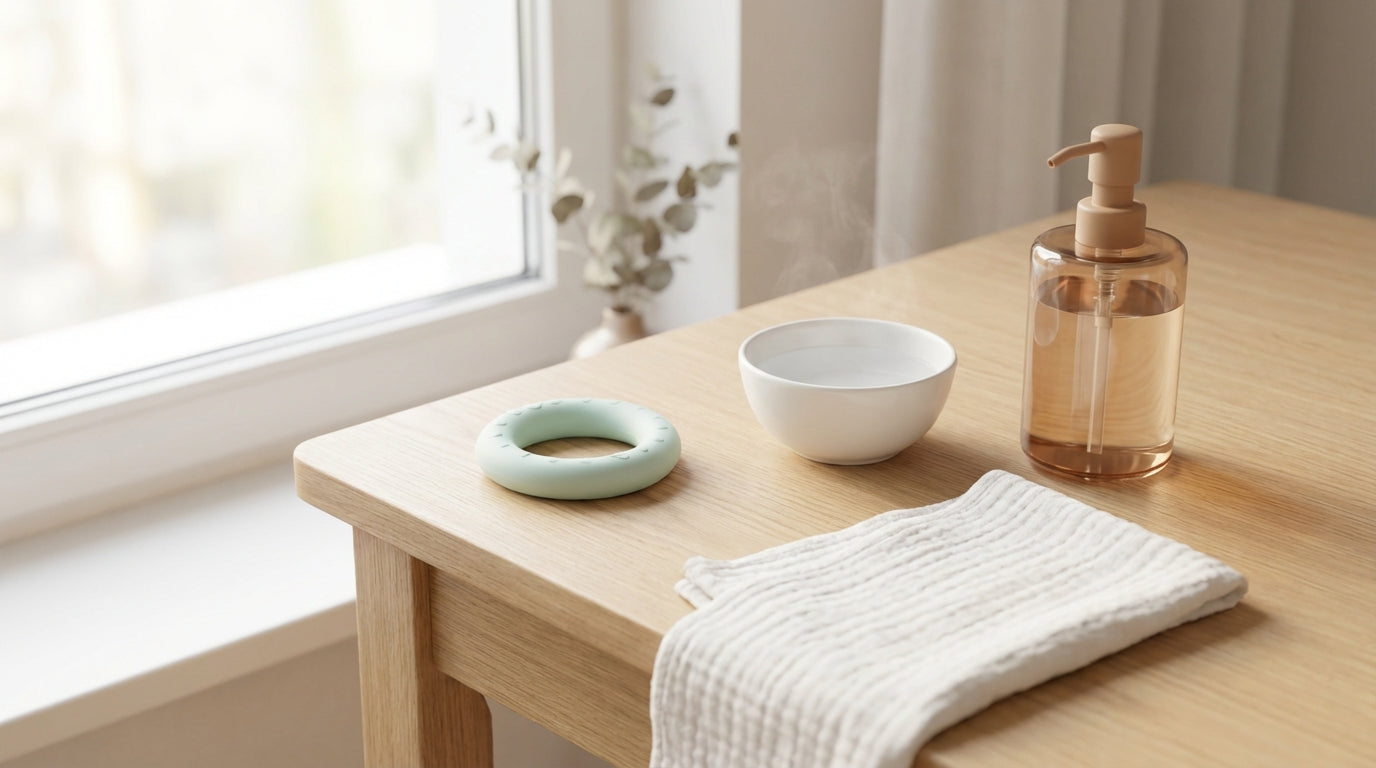
- Clean gently: warm water + mild dish soap (or as per the manufacturer's instructions).
- Wipe/rinse with clear water: so no soap residue is left.
- Dry thoroughly: especially for natural rubber and for grooves/textures.
For natural rubber, the rule is: wipe rather than bathe. Vulli explicitly advises against sterilizing Sophie la girafe or immersing it in water; a damp cloth with soapy water is recommended (Vulli / Sophie la girafe FAQ).
Practical tip: For textured teethers: a soft baby bottle brush (or a small, clean kitchen brush) gets into grooves better than a cloth.
If you're looking for a detailed routine: we've written it all down neatly here. How to clean a teether properly and use it safely.
Chilling: fridge vs. freezer (and why “ice cold” is not a good idea)
For a gentle cooling effect, the fridge is usually perfectly sufficient. NIP lists chilling in the fridge as an option for certain teethers (NIP manufacturer information).
The freezer is not a good idea for many teethers because they can get too hard and too cold. Extreme cold can also make materials seem more brittle – and babies usually find an “ice block” in their mouth interesting only for a short while.
- Chill briefly: 10–20 minutes in the fridge is often already pleasant (if the manufacturer allows it).
- Temperature test: check it once on your wrist before it goes into baby's mouth.
- Store cleanly: ideally in a clean container/bag so it doesn't taste like the cheese drawer.
You'll find more about cooling models and typical pitfalls here. Cooling teethers for babies: benefits, risks & tips.
Neutral assessment: Sophie (Vulli) vs. NIP vs. alternatives
Sophie is a natural rubber classic, NIP often the pragmatic everyday buddy. If you want a rough classification, this “kitchen table” perspective helps:
- Sophie la girafe (Vulli): natural rubber, soft, iconic shape – but more sensitive to care (no heat, no soaking; see Vulli care instructions).
- NIP teether: often textured surfaces, lightweight, fridge cooling depending on the model – often uncomplicated to handle (see NIP information).
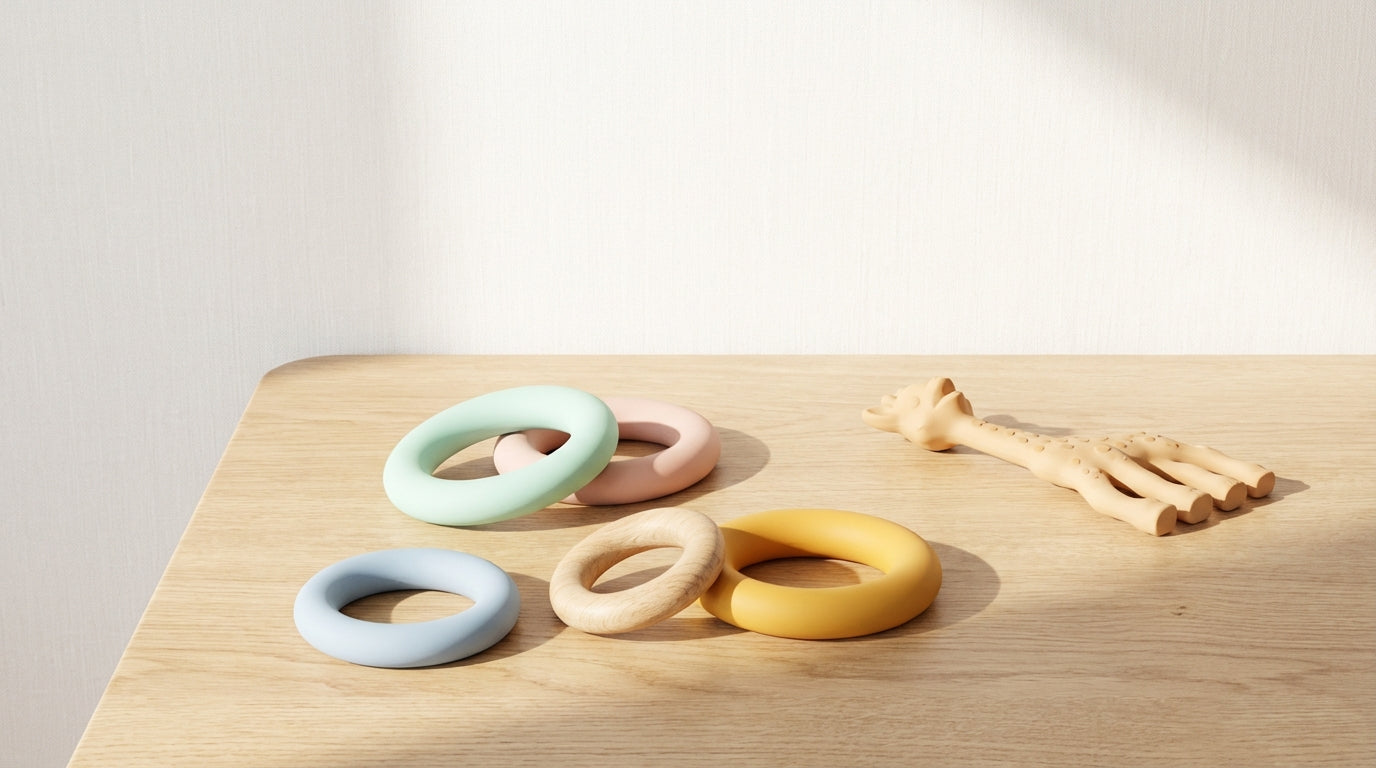
- General alternatives (material focus): Silicone is often easy to care for, wood is more “dry” and simple, plastic can be very sturdy – each depending on the product.
If you just want to see different shapes: here's our overview. Teethers.
A quick look behind the scenes: why we're so sober about safety
We've been making baby & toy products for 66 years – that makes you pleasantly calm. As a family business from Hamburg, we're fans of clear information: materials, care instructions, labeling. Not because we enjoy the fine print – but because parents already have enough surprises in everyday life.

And one more parent's thought to close this section: perfection is not the goal. If the teether is clean, intact and suitable for your baby's age, you're already well ahead.
FAQ
When does a teether make sense?
A teether usually becomes interesting once babies deliberately bring things to their mouth and chew on them. This is individual and can start early or later. What matters are the product's age recommendation, good grip and an intact condition. You'll find more details here: When does a teether make sense? Materials, care & cooling tips.
Is the Sophie la girafe teether really made of natural rubber?
Sophie la girafe is listed by the manufacturer Vulli as a natural rubber toy. Since there are different products/variants in the Sophie universe, it's still worth checking the packaging and the manufacturer's information for the specific model. For care, exactly these instructions are what matter (Vulli / Sophie la girafe FAQ).
How do you clean natural rubber (e.g. Sophie) properly?
Gentle wiping is usually the best choice for natural rubber. Vulli recommends a damp cloth with soapy water for Sophie la girafe and advises against sterilizing, the dishwasher and immersion (Vulli / Sophie la girafe FAQ). Afterwards, let it dry well so no moisture “stays behind”.
Fridge or freezer: Which is better for chilling?
The fridge is generally the gentler and more practical option. NIP lists chilling in the fridge as an option for certain teethers (NIP manufacturer information). In the freezer it can become too cold and too hard – that's rarely pleasant and not suitable for every material.
How can I tell if a teether is safe?
Look for the CE mark, an age recommendation and sturdy workmanship without loose parts. The EU states that toys must meet safety requirements and that the CE mark is mandatory for this (European Commission). In everyday life, also check briefly before every use for cracks, sticky spots or damage.
What should I do if the teether gets sticky or develops cracks?
Then it's time to declutter – even if it's annoying. Sticky spots, cracks or swollen areas can be a sign that the material is giving way or was stored incorrectly. In that case, it's better to replace it than to hope “it'll be fine”. Babies are very consistent chewers – and you notice the material quickly.
Bottom line: the right teether is the one you can keep clean and that your baby enjoys using. If you'd like to compare different shapes and materials, you'll find a calm selection in our overview: Teethers. And if it ends up being the wooden spoon after all: welcome to the club.