Wooden, Silicone or Natural Rubber Teething Ring? The Big Comparison
At a glance
- A teething ring made of wood, silicone or natural rubber is the right choice when the grip, care and safety fit your everyday life.
- For quick hygiene, silicone is often the easiest option, wood feels especially grippy, and natural rubber is soft and springy.
- For babies under 36 months: no detachable small parts, and check regularly for cracks and edges.
- A strong or “chemical” smell is a warning sign: better not to use it, and to make a complaint.
- Many families do best with two teething rings: one for home and one for on the go.

Wood, silicone and natural rubber all make sense – as long as they suit your daily routine and the way you care for them. Your baby won’t test things “carefully”. They will chew, drool, throw and chew again with total dedication. That’s why it’s worth taking a calm look at the differences: How does the material feel? How will you realistically clean it? And how can you tell whether a teething ring is still safe? That’s exactly what we’ll sort out here – practically, without drama. (Family life already has plenty of that.)

Ulli & Flo
Owners of bieco · Hamburg · parents themselves
We still remember the phase when absolutely everything had to go into the mouth. With the right material and a simple cleaning routine, it gets noticeably more relaxed. Feel free to browse our Teething ring collection.
Baby teething ring: How to spot a “good fit” right away
A good teething ring is lightweight, easy to grab and stays in one piece. Sounds simple, but it really is half the battle. Babies need something they can bring to their mouth on their own – and you need something that doesn’t develop “mysterious edges” after three days.

A teething ring is a baby toy for chewing, grasping and feeling. It helps mainly through mechanical pressure and texture – not through magic.
- Grip & shape: Does it fit into small hands? Is there a ring, bar or several grasping points?
- Surface: Smooth plus texture (nubs/grooves) is often more interesting.
- Weight: Too heavy = it ends up on the floor faster than in the mouth.
- Everyday care: Can you really manage the cleaning – even with a baby on your arm?
Practical tip: Keep two teething rings ready: one “clean for home” and one “for on the go, allowed to see some sand”.
What safety for teething rings means in the EU (short & important)
For children under 36 months, detachable small parts are a real risk. According to the EU Toy Safety Directive, toys for this age group must be designed so that no swallowable parts can arise or come loose (Directive 2009/48/EC, EUR-Lex).
The CE marking is the manufacturer’s declaration that EU safety requirements are met. It is not a quality seal “from the authorities”, but it is an important mandatory signal on the EU market.
A quick practical check: nothing may come loose, tear or stick out. The Bavarian consumer portal clearly explains why swallowable parts are critical in toys for under-3s and how the idea behind the test cylinder works (Verbraucherportal Bayern).
Safety note: Only use teething rings that are undamaged. If you notice cracks, sticky spots, protruding edges or loose elements: throw it out – no discussion.
Wooden teething ring: Natural, grippy – but care is done by hand
Wood is firm, grippy and offers clear counter-pressure when chewed. Some babies love exactly that: “Ah, there’s something I can really bite on.” Wood often sits well in the hand and is pleasantly light.

- Pros: sturdy, grippy, usually light, clear chewing feel
- Typical drawbacks: do not soak, usually not dishwasher-safe; the surface must stay intact
- What to look for: clean workmanship (no splinters), smooth edges, clear care instructions
Wooden teething rings are a bit like wool socks: lovely, but delicate. In everyday life that means: wipe with a damp cloth and let dry well, rather than “quickly” boiling it. If your baby keeps dropping the teething ring (so… always), a second one as a backup is worth its weight in gold.
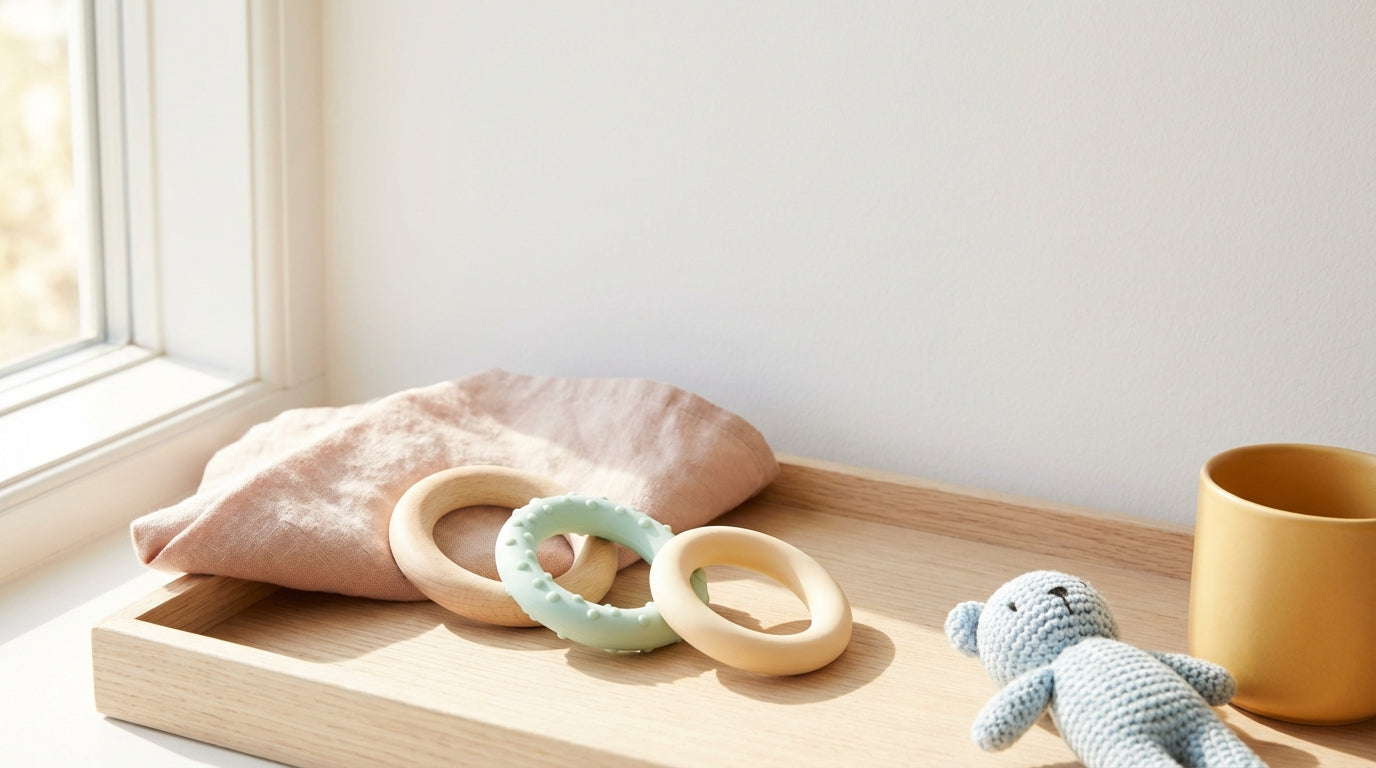
If you want to compare different shapes, a calm overview helps. In the teething rings collection you’ll find different variants – many families like combinations, because wood sits nicely in the hand and other materials add variety when chewing.
Silicone teething ring: Easy to care for, soft – and please without a “weird smell”
Silicone is often the everyday champion because it’s easy to clean. It is soft, flexible and forgiving. Many babies find textured surfaces (nubs/grooves) exciting because they feel “different” in the mouth.

- Pros: easy to care for, soft, flexible, often textured
- Typical drawbacks: attracts lint/dust; quality sometimes shows through smell
- What to look for: clear manufacturer information, no noticeable odors, intact surface
With silicone, smell is a serious practical indicator. The Verbraucherzentrale NRW (North Rhine-Westphalia consumer advice center) advises making a complaint about silicone products with a noticeable smell (Verbraucherzentrale NRW). The LGL Bayern (Bavarian health and food safety authority) notes that when BfR Recommendation XV for silicone elastomers is met, there are “no concerns” (LGL Bayern).
If you’re thinking about “cooling”, a quick reality check is worthwhile. Not every teething ring is meant for it, and not every kind of cooling feels good to a baby. You’ll find our calm assessment here: Cooling teething rings for babies: benefits, risks & tips.
Natural rubber teething ring: Soft, springy – and sensitive to storage
Natural rubber is soft and “springy” and feels very yielding. Many babies like that, especially when they seem particularly sensitive. But a natural material also means it reacts more strongly to light, heat and time.
- Pros: soft, elastic, pleasant chewing feel
- Typical drawbacks: more sensitive to heat/UV; can age over time
- What to look for: take care instructions seriously, store dry, check regularly
Natural rubber is not a “forever” material, but a “please check regularly” material. If you notice changes (cracks, sticky spots, brittle areas) or the smell clearly turns, that is a clear sign to replace it.
A reliable reference point is the recommendations for materials that come into contact with food. The German Federal Institute for Risk Assessment (BfR) publishes recommendations on elastomers that can be used for assessment (BfR, recommendations on food contact materials).
Practical tip: Don’t leave natural rubber on the windowsill in the blazing sun. Store it in the shade and dry – and give it a quick check during diaper changes.
Comparison table: Wood vs. silicone vs. natural rubber in everyday life
The differences show up less in the brochure and more during cleaning and when you’re out and about. So here is “parent reality” as a table: What feels like what, how easy is it to care for, and where do you need to look more closely?
| Criterion | Wood | Silicone | Natural rubber |
|---|---|---|---|
| Chewing feel | firm, clear counter-pressure | soft to medium-firm, flexible | very soft, springy |
| Grip in small hands | often very good (grippy) | good, depending on shape | good, depending on shape |
| Everyday cleaning | wipe, dry well | usually very uncomplicated | gentle, don’t store “too wet” |
| Sensitive to… | long soaking/heat | smell/quality differences | UV, heat, aging |
| Typical “reason to replace” | splinters/edges/surface | cracks, sticky spots, smell | cracks, brittle spots, change in smell |
Which material suits which everyday life? (a small decision guide)
The best choice depends less on trends and more on your routines. Some babies want something firm (wood), others something soft (silicone/natural rubber). And some switch depending on how they feel that day – just like us with coffee.
- You want it super easy to care for: Silicone is often the relaxed choice for every day.
- Your baby likes firm counter-pressure: Wood can feel more “targeted”.
- Your baby seems very sensitive: Natural rubber is often especially yielding.
- You’re out and about a lot: Pick something you can realistically get clean on the go.
And now a brief word from Hamburg, dry as northern Germans are: What works is perfect. We are a family business from Hamburg, making baby products and toys for 66 years – and we see again and again that parents ultimately aren’t looking for “the one material”, but for a reliable everyday solution. For us, that also includes clear material information, understandable care instructions and an honest note: when something wears out, it’s allowed to go.
Cleaning step by step: How to do it without a big fuss
Cleaning is good when you actually follow through – not just in theory. So here is a simple routine that works even on days when you’re already glad if all the socks match.
1) Quick check (10 seconds)
Look for cracks, edges, sticky spots and loose parts. If you find something: throw it out. Don’t make a heroic story out of it.
2) Remove coarse dirt
Rinse/wipe first, then clean – otherwise you’re just spreading it around. On the go, a clean cloth is often enough; at home, briefly rinse under running water (if the material allows it) or wipe with a damp cloth.
3) Clean according to the material
Follow the manufacturer’s instructions, because not every product is the same. As a rule of thumb: wipe wood with a damp cloth and dry it; clean silicone as instructed; clean natural rubber gently and don’t “pack it away” damp.
4) Dry well & store properly
Storing dry is often more important than yet another extra cleaning step. Especially with natural rubber and wood, it’s worth remembering: not wet in a container, not permanently warm, not in the sun.
If you want to dive deeper, we’ve collected everything neatly in one place. Here you can read How to clean and use a teething ring safely: here’s how.
Safety note: Teething rings are not a “cooling pack for continuous use” and not a toy for unsupervised sucking at night. Please only use them when you have your baby in view.
Why we’re so picky about teething rings (and yes: for good reason)
Transparency means: clearly naming materials, care and limits. Ulli & Flo write as parents for parents – and we believe it helps no one if you only say “sounds good” without explaining what matters in everyday life.
We pay particular attention to clear information and traceable safety standards. For us, that includes understandable care instructions, workmanship without sharp edges and a consistent approach to “throw it out if it’s damaged”. And because we’ve been doing this for 66 years, we know: that’s not nitpicking – that’s relaxed prevention.
FAQ: Frequently asked questions about teething rings (short & practical)
How do I clean a wooden teething ring?
It’s best to wipe wood with a damp cloth and then let it dry well. Soaking it for a long time can make wood swell and change the surface. If something becomes rough or splinters threaten, that’s a reason to replace it. Follow the manufacturer’s care instructions, because wood types and surfaces differ.
Can a teething ring go in the dishwasher?
That depends on the material and the manufacturer; as a blanket rule it’s not a good idea. Wood is usually not dishwasher-safe, because heat and water stress the surface. With silicone it’s more often possible, but not automatically. Check the manufacturer’s information – it’s really the best compass here.
Can I chill or freeze a teething ring?
Cooling can feel pleasant, but only if the teething ring is meant for it. Some materials react sensitively to strong cold or moisture, and not every baby likes the feeling. If you want to cool it, only use products with clear approval and make sure nothing becomes too hard or too cold.
My teething ring smells: What should I do?
If a teething ring smells strong or “chemical”, it’s better not to keep using it. The Verbraucherzentrale NRW recommends making a complaint about silicone products with a noticeable smell (Verbraucherzentrale NRW). With natural rubber, too, a slight natural smell can occur, but if it turns or gets stronger, replacement or a complaint makes sense.
When should I replace a teething ring?
Replace it as soon as you notice cracks, sticky spots, edges or loose parts. Babies chew with quite some force, and material can age. A teething ring is not a “one-time purchase for eternity”, but an everyday item. Better to replace it once too early than to wonder too late.
Which teething ring is better: silicone or wood?
Silicone is often easier to care for, while wood often feels grippier and firmer. For on the go, many choose silicone because it can be cleaned faster. At home, wood can be pleasant if your baby likes firm counter-pressure. If you’re unsure: alternating between two materials is the most relaxed solution for many families.
Conclusion: Which material for which everyday life?
If you have little time for care, choose silicone; for firm counter-pressure, wood; for soft chewing, natural rubber. In the end, what counts is: safely made, suited to your routines and checked regularly. If you’d like to get an overview in peace, take a look at our teething ring selection – comparing is more relaxed than making a complaint later.