Cooling Teething Ring: How to Chill It Safely, Clean It Properly & Spot the Risks
At a glance
- A cooling teething ring belongs in the fridge – not in the freezer.
- Do a quick wrist check: pleasantly cool is good, “icy” is too much.
- Hygiene is simple: clean after use, store dry, and check regularly.
- Cracks, sticky spots or warping: please replace it – no negotiating with the teether.
- Toy safety standards such as DIN EN 71 can serve as a guide (depending on the product information).

A cooling teething ring is safe when it is chilled only in the fridge and checked before every use. That's already half the battle in this “everything gets chewed” phase. In this guide you'll get a practical, everyday-friendly walkthrough: how to chill it properly, how to keep it clean (without needing a PhD in dish soap), and how to tell when a teething ring has truly reached the end of its life. Plus: alternatives in case your baby isn't a fan of cold or the teething pressure is especially nasty right now.

Ulli & Flo
Owners of bieco · Hamburg · parents themselves
During the teething phase we learned: fewer tricks, more routine. With the fridge, the wrist test and a quick visual check, things get relaxed pretty fast. Feel free to browse our teething ring collection.
What is a cooling teething ring – and what does it actually do?
A cooling teething ring is a teething aid that is chilled in the fridge. Babies can chew on it and put pressure on their gums – and for many, the coolness feels pleasant for a short while.
The coolness isn't magic, just a brief “distraction moment” for the gums. Some children visibly relax with it, while others look at you as if you'd offered them a cold washcloth (it happens).
A definition to remember: a “teething aid” is an object that babies can safely chew on. It should allow chewing, be easy to grip and be hygienically cleanable.
Cooling teething ring: benefits (honest, no miracles)
The biggest advantage is the combination of chewing and gentle coolness. Babies control the pressure themselves – and you don't have to keep pulling “one more trick!” out of your hat.

- Short-term soothing: Coolness can feel pleasant when the gums are irritated.
- A good chewing stimulus: The pressure from chewing can feel relieving for some babies.
- Something to do for hands and mouth: Grabbing, turning, chewing – sometimes that's enough for a little breather.
It's also handy that you can control the intensity through the cooling time. If your baby likes it “only slightly cool”, the teething ring simply doesn't stay in the fridge forever. As we say up north: no need to overdo it.
Risks: when a cooling teething ring is not a good idea
The main problem is “too cold” – and that usually happens in the freezer. Very cold surfaces can irritate or injure sensitive lips and the lining of the mouth. According to the Verbraucherzentrale (German consumer advice organization), teething rings should not be placed in the freezer because they can get too cold there.
Safety note: Only chill cooling teething rings in the fridge – never in the freezer. Before handing it over, do a quick check: pleasantly cool, not “icy”.
A second risk is damage to the material – and you can often see it sooner than you think. Cracks, sticky spots, warping or “nibbled” edges aren't just unsightly; they make cleaning harder and, in the worst case, can lead to loose parts.
And yes: supervision is part of the deal, even if it's annoying. A teething ring isn't an activity you hand to your baby so you can do your taxes in peace (wouldn't that be nice). Staying close is the relaxed option – for everyone.
Dos & Don'ts when chilling (short, so they stick)
If you keep these five points in mind, you're in the safe zone.

- Do: Chill it in the fridge and touch it briefly before handing it over.
- Do: Check for cracks, glued seams and warping before every use.
- Do: Clean after use, dry thoroughly and store clean.
- Don't: Put it in the freezer (too cold, can irritate).
- Don't: Pass on damaged teething rings “just this once”.
Practical tip: Keep the teething ring in a small container in the fridge. That way you'll find it again at 3:17 a.m. without waking the butter.
How to use a cooling teething ring safely (step by step)
Safe use is less “science” and more a small routine. Here's a sequence that works in real life:
- Look-and-feel check: Smooth, no cracks, nothing sticky, nothing wobbly.
- Chill in the fridge: Not in the freezer. According to the Verbraucherzentrale, teething rings get too cold in the freezer.
- Temperature test: Hold it briefly against your wrist. Pleasantly cool = okay.
- Hand it over – and stay close: Especially with small babies or when they're chewing in a real fury.
- Clean & dry afterwards: Follow the manufacturer's instructions, then let it dry thoroughly.
If you're wondering when this makes sense: what matters is the need to chew, not the calendar. You'll find guidance (including more tips) here: When is a teething ring useful? Materials, care & cooling tips.
Cleaning & hygiene
Keeping it clean matters – but please keep it practical. Depending on their construction, cooling teething rings aren't always suitable for boiling or the dishwasher. So the rule is: the care instructions on the product are the boss.

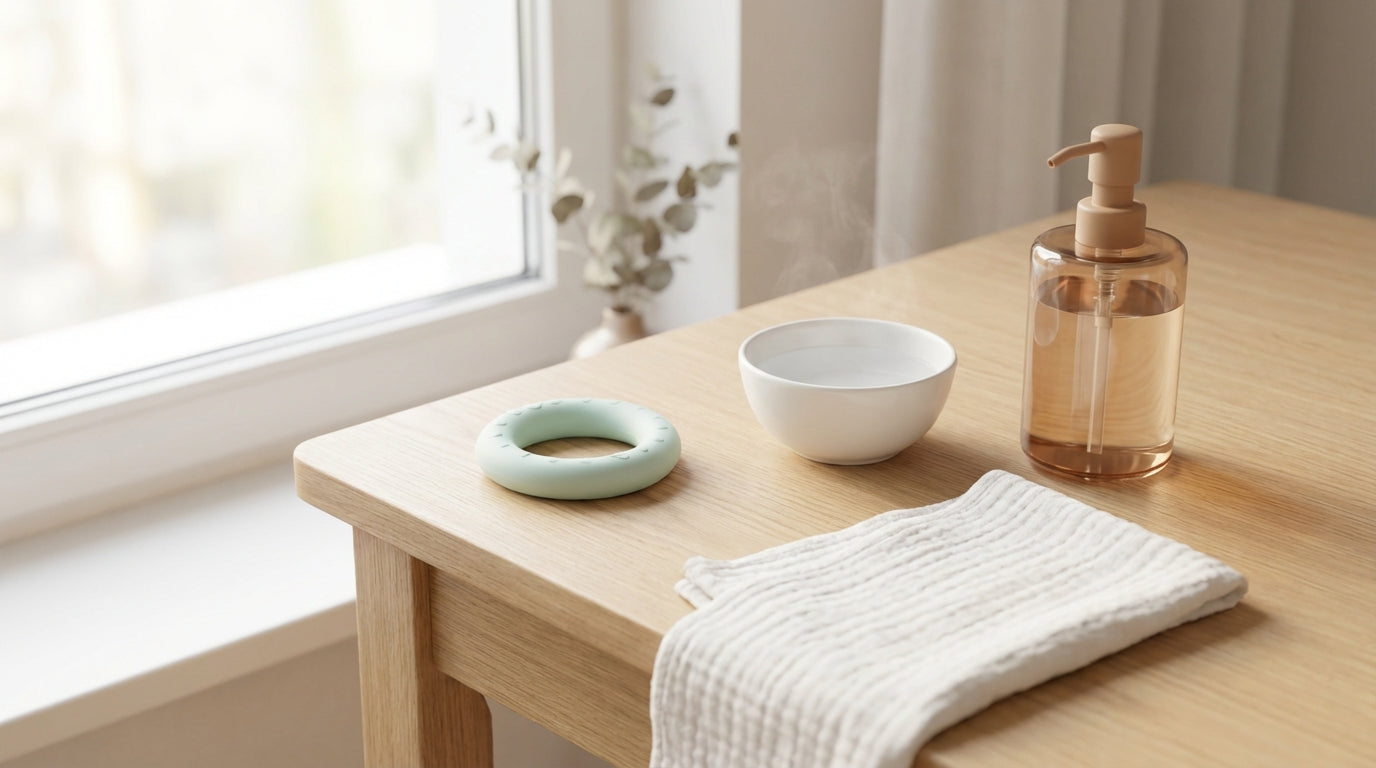
- Rinse after every use: Warm water, mild dish soap, rinse well.
- Dry thoroughly: Moisture in crevices is the fastest route to “musty”.
- Look more closely from time to time: Discoloration, cracks, sticky spots → replace.
A definition to take with you: “cleaning hygienically” means removing visible dirt and drying the item well. It's about practical cleanliness – not sterile lab conditions in everyday family life.
If you like a short checklist, here it is. We've summarized the topic neatly (ha) in one place: How to clean and use a teething ring safely: here's how.
How long should you chill it?
Until the teething ring is pleasantly cool – not ice cold. A fixed number of minutes is difficult because fridges differ in temperature and teething rings differ in thickness. The wrist test is simple and reliable: if it feels pleasantly cool to you, it usually works for your baby too.
Practical tip: If your baby only likes cold for a short while: better to chill briefly more often than once “really hard”. That saves tears (for both of you).
When to replace it
You should replace it as soon as you see or feel damage. That includes cracks, porous spots, sticky surfaces, warping, or parts that could come loose. Even if it hurts: a teething ring is an everyday item – and at some point it's simply done.
Set up a mini routine: a quick check once a day is usually enough. Many parents do it automatically when taking it out of the fridge. It takes five seconds but saves stress.
Which materials are common – and what should I go by?
Cooling teething rings often involve plastic, because it allows for cooling elements. Whether a material is “good” depends less on beliefs and more on whether it is cleanly made, easy to clean and suitable for babies.
A sensible point of reference is toy requirements such as DIN EN 71. TÜV SÜD describes DIN EN 71 as a central series of standards for toy testing, covering among other things mechanical/physical properties and the migration of certain elements (EN 71-3). According to TÜV SÜD, EN 71-1, EN 71-2 and EN 71-3 are among the frequently relevant parts of this series.
A definition to remember: “migration” means that substances can transfer from a material into contact media. EN 71-3 tests whether certain elements “migrate” out of the material only to a very limited extent.
If you want to understand material differences better, a comparison helps. Here's our overview: Teething ring made of wood, silicone or natural rubber? The big comparison.
Alternatives for strong teething pain (without hocus-pocus)
If cold doesn't help, pressure, closeness and distraction are often the better cards to play. You don't have to find “the one trick” – sometimes it's a small package of several things.
- A regular teething ring without cooling: Some babies simply don't like cold.
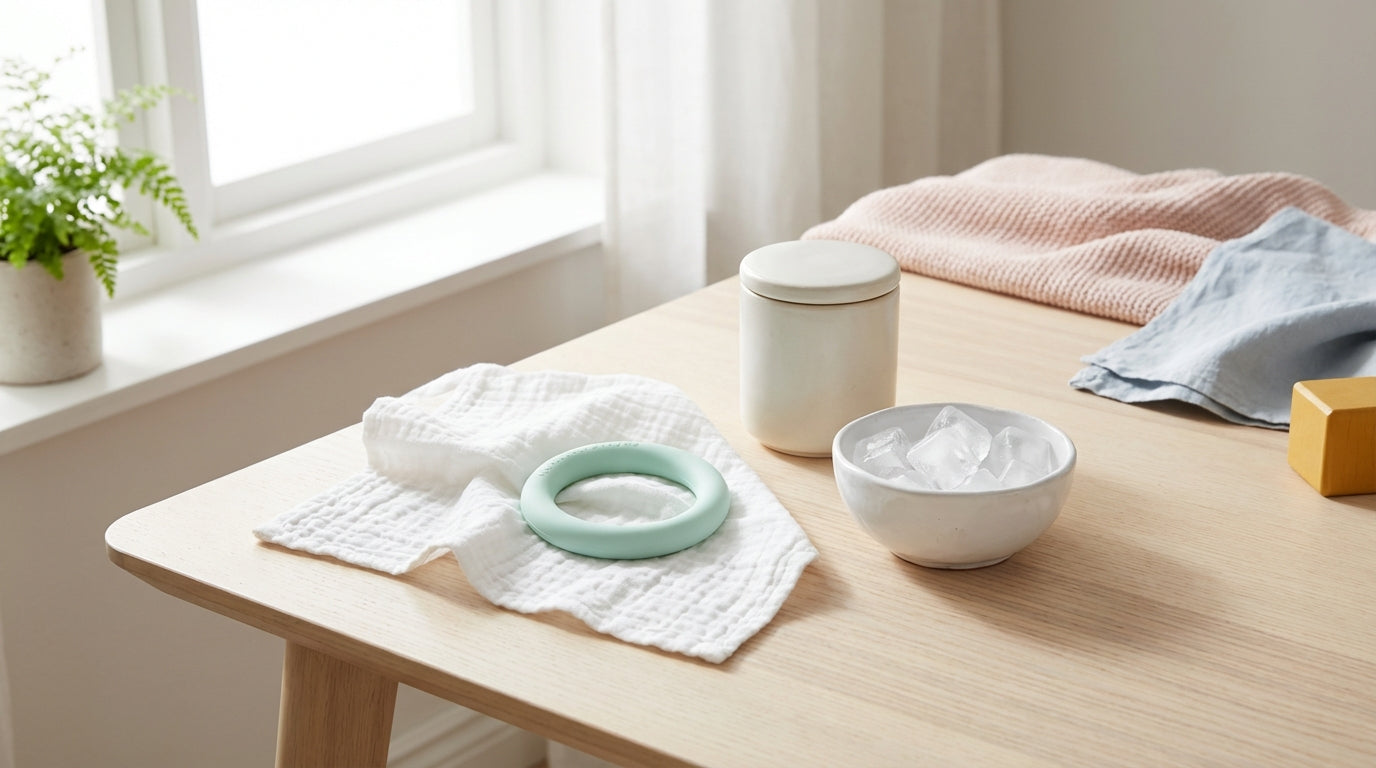
- A cool washcloth for chewing: Clean, slightly dampened, briefly chilled (not frozen) and under supervision.
- Gentle gum massage: With a clean finger, if your baby allows it.
- Calm rituals: Carrying, cuddling, a soft voice – yes, it sounds simple, but it often works best.
If fever, severe persistent pain or major drinking problems are added to the mix, please have it checked out. According to the BZgA (kindergesundheit-info.de), discomfort can occur during teething; if you're unsure or symptoms are severe, medical advice makes sense.
How do I recognize a good cooling teething ring?
A good cooling teething ring is sturdy, easy to grip and clearly described. In everyday life, look out for these points:

- Clear cooling instructions: Fridge yes, freezer no – ideally stated explicitly.
- Easy to grip: Babies should be able to hold it themselves, without constant assistance from you.
- Clean workmanship: No sharp edges, no odd seams, nothing that tears easily.
- Care instructions: Understandable and realistic (and not “please clean only at full moon”).
- Orientation to testing: References to relevant toy requirements can help, e.g. DIN EN 71 (if stated).
At Bieco we're pretty down-to-earth about this: clear, safe and practical is better. As a family business from Hamburg, we've been doing this for 66 years – and we know that parents don't need a show, but things that work and are honestly explained.
FAQ
Can a cooling teething ring go in the freezer?
No, because it can get too cold there and irritate the lining of the mouth. According to the Verbraucherzentrale, teething rings should not go in the freezer, as they would otherwise get too cold. Chill it in the fridge instead and briefly check the temperature on your wrist.
How long should a cooling teething ring stay in the fridge?
Until it is pleasantly cool – there is no fixed number of minutes. Fridges differ in temperature, and teething rings cool at different speeds. Be pragmatic: feel it briefly (wrist test) and then hand it over. If it feels “icy”, better wait a little longer.
Cleaning & hygiene: how do I clean a cooling teething ring properly?
The safest way is to clean it according to the manufacturer's instructions, usually with warm water and mild dish soap. Many cooling teething rings are not suitable for boiling or the dishwasher. What matters afterwards is thorough drying, so that no moisture collects in crevices.
When should I replace it – how do I recognize wear?
If you see cracks, sticky spots, warping or heavily nibbled edges, it should go. Then cleaning becomes harder and the material may give way further. Better to replace it once too early than to sit next to your baby later with a gut feeling and a furrowed brow.
Which standards are a good point of reference?
DIN EN 71 is a central series of standards for toy testing. According to TÜV SÜD, it covers among other things requirements for mechanical/physical properties (EN 71-1) and tests for the migration of certain elements (EN 71-3). Whether and which standards are mentioned is stated with the respective product.
What if my baby doesn't like cold or has very strong discomfort?
Then a regular teething ring, a cool washcloth or closeness is often the better choice. Not every baby finds cold pleasant. If fever, severe persistent pain or drinking problems are added, it makes sense to have it checked out. According to the BZgA (kindergesundheit-info.de), discomfort can occur during teething; if you're unsure, it's better to ask a doctor.
If you'd like to look around further, feel free to start with the overview. There you'll find different variants and can browse at your leisure: Teething rings.