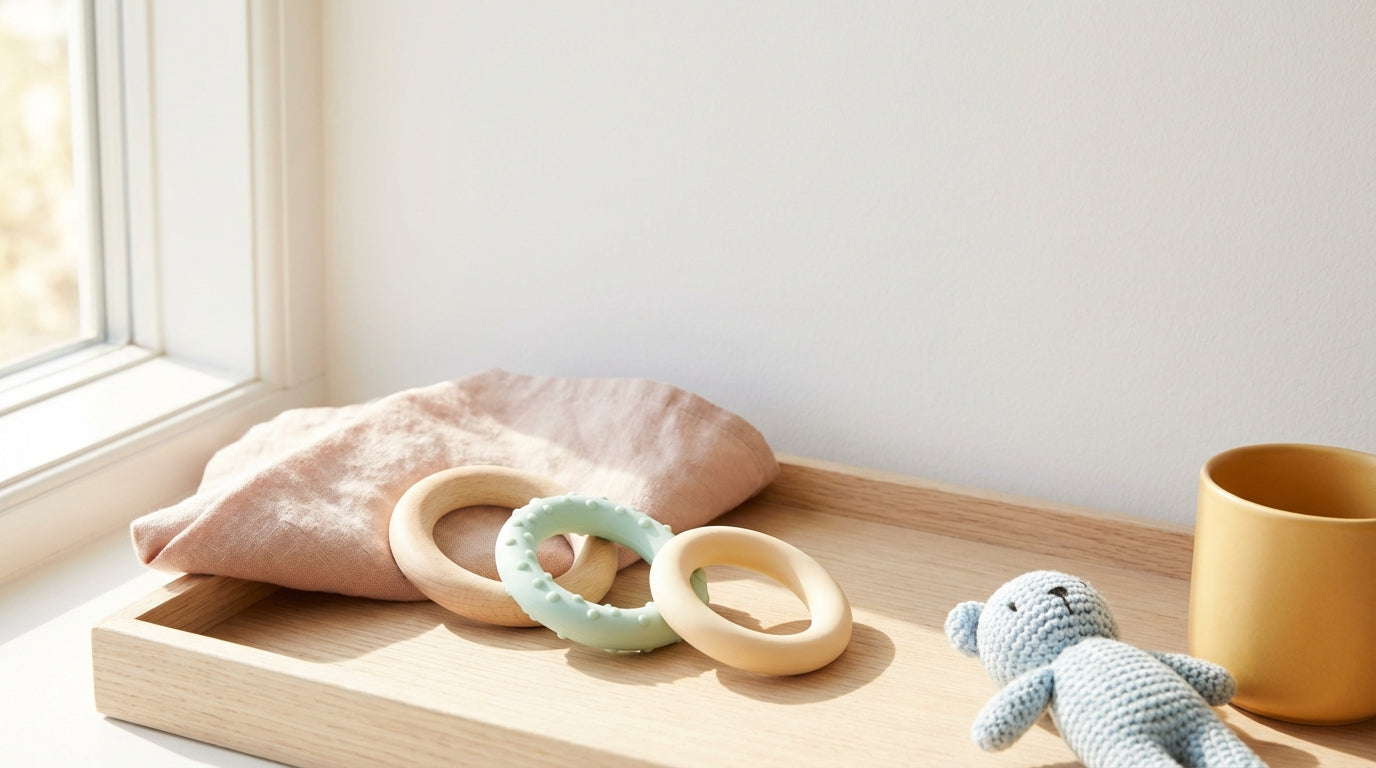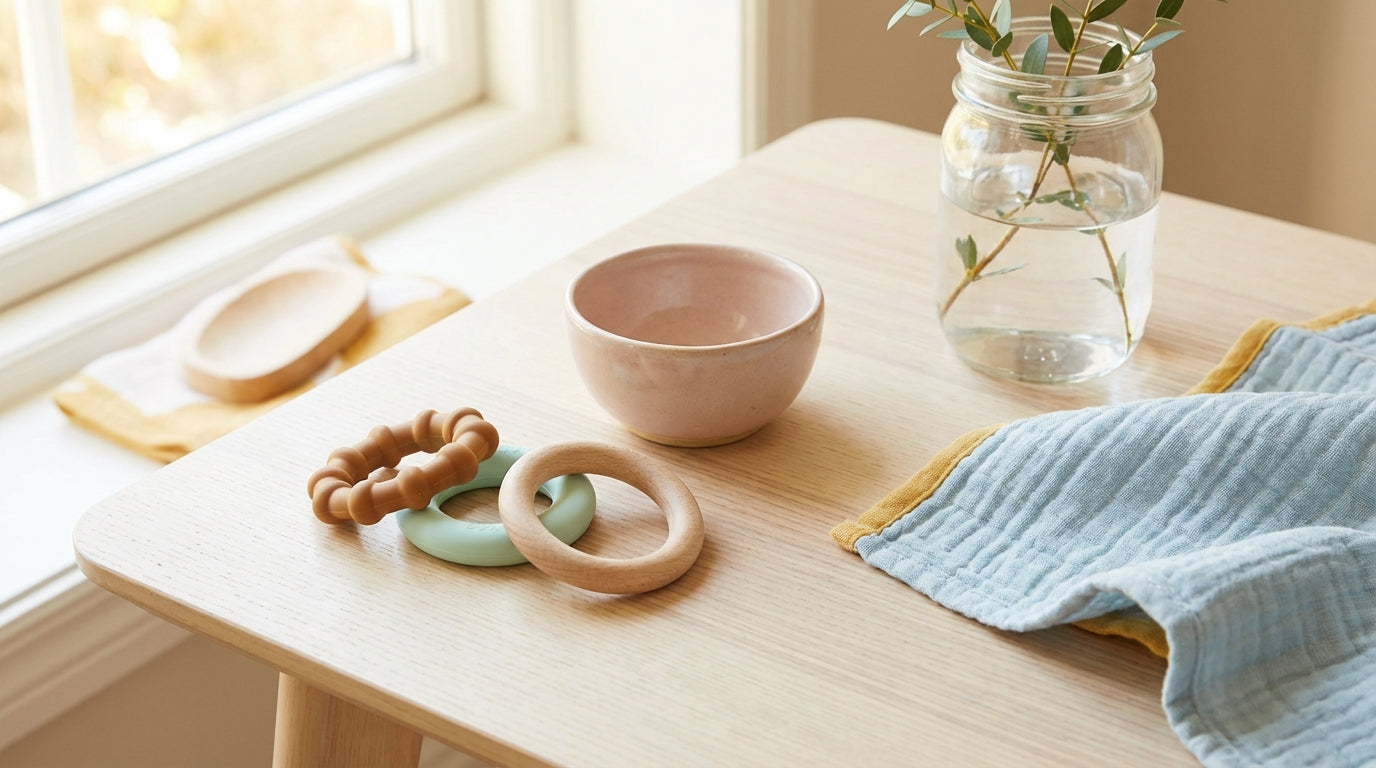
When Is a Teething Ring Useful? Checklist, Materials & Cooling Tips
At a glance
- When is a teething ring useful? When your baby chews on things on purpose and drools a lot (often from 3–6 months).
- Cooling models: chill them in the fridge, don't freeze them.
- Choosing a material: wood is firmer, silicone is softer, natural rubber is elastic.
- Hygiene: clean according to the manufacturer's instructions, dry well, and check regularly.
- On the go: store it clean and replace it without hesitation if you spot any cracks.

A teething ring makes sense as soon as your baby deliberately brings things to their mouth and chews on them. For many babies this happens around the 3rd to 6th month – sometimes earlier, sometimes later. In this guide you'll find practical orientation: how to tell it's time, how to cool a teether (without freezer drama), how the different materials feel, and how to keep teething rings clean and safe.

Ulli & Flo
Owners of bieco · Hamburg · parents themselves
When our little ones were teething, we would have loved a simple checklist – no panic and no perfectionism. That's exactly what you'll find here, plus a few everyday tricks. Feel free to browse our teething ring collection.
And don't worry: you don't have to do anything "perfectly" here. If you end up finding a teething ring that is safe and does your baby good, that's already a big win – and you'll have a hand free again for coffee (or laundry, let's stay realistic).
When to start with a teething ring: how to tell it's the right time
A teething ring is a good fit when your baby grabs things on purpose, brings them to their mouth and chews on them. It's less a question of the calendar and more of an "aha, something's happening" observation. Typical signs are also more drooling, more fingers in the mouth, and a baby who suddenly treats your sweater like a delicacy.

- Your baby keeps putting hands, cloths or toys in their mouth.
- They chew "on nothing", even though no teeth have come in yet.
- They seem fussier at times and clearly look for pressure on their gums.
Important: a teething ring isn't a must, but it's often a handy everyday helper. Closeness, babywearing and cuddles are of course unbeatable – the teething ring simply guides the urge to chew in a safe direction.
Teething ring for babies – from what age? Time frames that really help parents
Many babies start with a teething ring somewhere between 3 and 6 months. During this phase, grasping and hand-to-mouth coordination get better – and the urge to chew often increases. Does that coincide exactly with the first tooth for you? It might, but it doesn't have to.
If your baby only shows interest later, that's completely normal. Some babies are Team "Everything goes in the mouth", others prefer to watch calmly first. Both are part of development – and you don't need to turn it into a science.
Practical tip: Keep 2–3 teething rings in fixed places (changing station, sofa, stroller). That way you won't be fumbling around in the dark at night like a raccoon.
Which signs point to teething – and which don't?
Teething often shows up as drooling, chewing and sensitive gums. Some babies also have restless phases or a need to constantly have something in their mouth. These are typical observations – but no proof that a tooth is about to break through "any minute now".
A teething ring is a tool for pressure and occupation, not "the solution". It can bring short-term relief, but it doesn't take the work off the body. (It would be too good if you could simply organize teething away.)
- Helpful: offering a teething ring, cooling it, short chewing breaks, lots of closeness.
- Not helpful: a teething ring non-stop without breaks, "the harder the better", the freezer.
Cooling teething rings: how to cool them properly (and gently)
Cooling teething rings are most pleasant when chilled in the fridge. The coolness can soothe the gums for a short while – often "pleasantly cool" is enough, no need for "arctic".

Please don't freeze it: a teething ring that is too hard can hurt the gums. According to the National Health Service (NHS), a teething ring should not go in the freezer because it can become too hard and damage the gums; it recommends chilling it in the fridge and following the manufacturer's instructions (NHS: Tips for helping your teething baby).
- Chill in the fridge (not in the freezer).
- Check briefly before handing it over: cool, but not "freezing" cold.
- Only chill intact teething rings: no cracks, no split areas.
Materials: natural rubber, silicone or wood teething rings – what does it mean in everyday life?
The best material is the one that is safe and fits your daily life. Babies are surprisingly consistent about this: today wood is adored, tomorrow wood is "yuck" and only silicone will do. That's why it helps to know the differences – without tying yourself in knots.

Natural rubber is elastic and gives springily when chewed. Natural rubber (made from natural latex) is often perceived as soft and easy to grip, and can be pleasant for babies who like some "counter-pressure", but not too hard.
Silicone is soft, keeps its shape and is usually very easy to care for in everyday life. In baby products it is often made so that it's easy to grip and simple to clean – handy when the teething ring seems to need to go everywhere with you.
Wood is firm, easy to grip and comes without plasticizers. Wooden teething rings or grasping toys often feel "warm" and are sturdy – but they don't like long baths in water and should be checked regularly for splinters or rough spots.
Wood vs. silicone teething rings: a quick comparison (no sugarcoating)
Wood is firmer and more natural, silicone is softer and easier to care for. Both can work great – what matters is what your baby likes to have in their mouth and what you can keep clean and safe in everyday life.
| Material | Feels like… | Advantage | What to look out for? |
|---|---|---|---|
| Wood | firm, warm, easy to grip | sturdy, simple | don't soak, check the surface |
| Silicone | soft, flexible | often easy to clean | replace if cracked |
| Natural rubber | soft, elastic | springy chewing resistance | follow care instructions, check the material |
If you're unsure: offer two materials and let your baby decide. That's often the quickest agreement in the household – no parents' meeting required.
Cleaning a teething ring: how to keep it hygienic (without drama)
Clean teething rings regularly and always according to the manufacturer's instructions. Depending on the material, hot water, the dishwasher or certain cleaners may be fine – or an invitation to cracks, warping or a sticky surface.
- Clean before first use (following the instructions).
- In everyday life: clean with warm water, rinse thoroughly, let dry well.
- After it has fallen on the ground outside or touched "exciting" surfaces: better to clean it once more.
- If there are cracks, sticky spots, discoloration or loose parts: replace it.
EN 71-3 is a European standard that describes tests for the migration of certain substances from toys. The EN 71-3 standard describes requirements and test methods for the migration of certain elements from toy materials (e.g. from material that has been detached or worn off) (EN 71-3 text (law.resource.org)).
And now, honestly, from family life: "sterile" is rare, "clean enough" is doable. Cleaning regularly, drying well and checking the condition does more than frantic scrubbing after every drool contact.
Practical tip: On the go, a small, clean tin just for the teething ring helps. That way it won't be lying loose in the diaper bag next to the applesauce lid.
Buying & safety checklist: what you should really check
Above all, a teething ring must be safe: sturdy, easy to grip, without small parts. Babies don't chew "carefully". They test material and workmanship with their whole body – and that's their job, too.
- Size & shape: so that it can't be swallowed and fits well in small hands.
- No loose parts: no decoration that can come off, no wobbly connections.
- Surface: smooth, without sharp edges; with wood, also watch for rough spots.
- Smell: strongly perfumed or "chemical"? Better to leave it.
- Manufacturer's notes: age recommendation, cleaning, cooling, material details.
Fragrances are better avoided in toys for small children. According to the German Federal Institute for Risk Assessment (BfR), toys for children under three years old should, where possible, not contain fragrances, in order to avoid allergy risks (BfR: Kinderspielzeug darf nicht zu Allergien führen).
@@BIECO_SICHERHEIT_2@@Everyday no-gos: what you're better off skipping (even if well-meant)
A teething ring helps best when it's safe, clean and not "overstrained". A few real-life classics you can spare yourself:
- Putting the teething ring in the freezer (too hard, uncomfortable, potentially harmful).
- Attaching the teething ring to long ribbons or hanging it around the neck.
- Continuing to use cracked or sticky teething rings "just for a bit longer".
- Soaking wooden teething rings for a long time (wood rarely likes that).
- Sharing or "lending" a teething ring between children without cleaning it.
If your baby just angrily throws the teething ring around, that's also an answer. Then it's better to offer it again later – or briefly switch to alternatives.
DIY alternatives for in between (when the teething ring has gone missing)
Sometimes the best teething ring is the one you can find right now – but please make sure it's safe. If you're out and about or everything is in the dishwasher, simple, controllable alternatives can help.
- A clean, damp washcloth chilled briefly in the fridge (not frozen) and offered for chewing under supervision.
- A clean muslin cloth for sucking and chewing (without knots, without long ties).
- An easy-to-grip, age-appropriate grasping toy that is intended for mouth contact.
On the go & storage: how to keep the teething ring "ready to use"
Stored dry, clean and separate from crumbs, a teething ring lasts the longest. Sounds trivial, but it's the difference between "still fine" and "why is this thing sticky?".

- At home: let it dry well after cleaning, then put it in a clean box or drawer.
- On the go: a separate tin or bag just for it (and rinse it out once in the evening).
- Don't store it permanently in direct sunlight (the material can age).
- If you're cooling it: cool first, then put it in the tin – don't pack it wet and warm.
A word about us (because trust is part of the safety conversation)
We are a family business from Hamburg and have been doing this for 66 years – with respect for real family life. Ulli & Flo write here as parents for parents: clear tips, honest limits and northern German composure rather than pressure to be perfect.
The BfR assesses the risks of ingredients in toys and thereby supports the health protection of children. When we talk about materials and safety, this kind of transparent assessment helps us – and hopefully you too (BfR: Gesundheitliche Bewertung von Spielzeug).
FAQ
When should I give a teething ring?
Give a teething ring as soon as your baby increasingly brings things to their mouth and chews on them. This is often the case from around 3–6 months, but it can be earlier or later. Make sure it's a safe size, has no small parts and that the teething ring is undamaged.
Teething ring for babies: when is it "too early"?
It's too early mainly if the teething ring isn't age-appropriate or isn't safe. If your baby shows interest and the teething ring is sturdy, large enough and without loose parts, you can generally offer it. Also follow the manufacturer's instructions on use and cleaning.
Cooling teething ring: fridge or freezer?
The fridge is the safe choice – better to leave the freezer alone. According to the NHS, a frozen teething ring can become too hard and damage the gums; it recommends chilling in the fridge and following the product instructions (NHS: Tips for helping your teething baby).
Natural rubber teething ring: what to look out for?
Natural rubber is soft and easy to grip – care instructions and visual checks are what matter. Make sure the teething ring doesn't become cracked and doesn't develop sticky spots. Clean it according to the manufacturer's instructions and store it dry so the material stays stable for as long as possible.
Wood vs. silicone teething ring: which is better?
Neither is better across the board: wood is firmer, silicone is softer and often easier to care for. Some babies like firm counter-pressure, others prefer soft chewing. A small selection is practical – then your baby quickly decides for themselves what feels good right now.
Cleaning a teething ring: how often and how?
Clean regularly, and give it an extra clean whenever the teething ring is visibly dirty or falls on the floor. Exactly how depends on the material – please follow the manufacturer's instructions. It's also important to let it dry well and to replace it without hesitation if it shows cracks, discoloration or a sticky surface.
How do I know when a teething ring needs to be replaced?
If the teething ring is cracked, sticky, discolored or damaged, replace it. Babies chew with a lot of force, and material can age. As soon as the surface or shape changes or parts seem loose, it's not a case of "oh, it'll do" – it's a clear end.
If you'd now like to browse in peace: in our overview you'll find various shapes and materials for your daily life. Feel free to visit Teething Rings – and if you'd like to dive deeper, these guides will help: Wood, Silicone or Natural Rubber Teething Ring? The Big Comparison, Cooling Teething Rings for Babies: Benefits, Risks & Tips and How to Clean Teething Rings and Use Them Safely.