Wooden or Metal Xylophone? Differences, Volume & Buying Guide
At a Glance
- A wooden xylophone usually sounds warmer and less “sharp” than metal.
- Metal bars often ring on for longer, which quickly feels louder in everyday life.
- For toddlers, safe edges, sturdy mallets and a stable stand matter most.
- A “metal xylophone” is often really a metallophone/glockenspiel with metal bars.
- With a rug or blanket and clear rules, it stays living-room friendly.

Wood usually sounds softer, while metal usually sounds brighter and rings longer. That's exactly why the question of material for children's instruments is less about “music theory” and more about everyday life: How loud does it get, how pleasant does it stay – and how long will you enjoy it? Here you'll find a relaxed comparison, a little decision guide by age and living situation, and practical tips for sound, care and safety.

Ulli & Flo
Owners of bieco · Hamburg · parents themselves
What worked best for us was when the xylophone quickly brought a sense of achievement – and when we kept the volume under control with a rug and clear rules. That way, music stays a pleasure and doesn't become a constant ringing in your head. Feel free to browse our Xylophone collection.
We're a family business from Hamburg – and we've been at it for 66 years. Ulli & Flo write here as parents for parents: practical, honest, and without a wagging finger (on a xylophone, that finger is better used holding the mallet anyway).
What Is a Xylophone – and What Is a Metallophone?
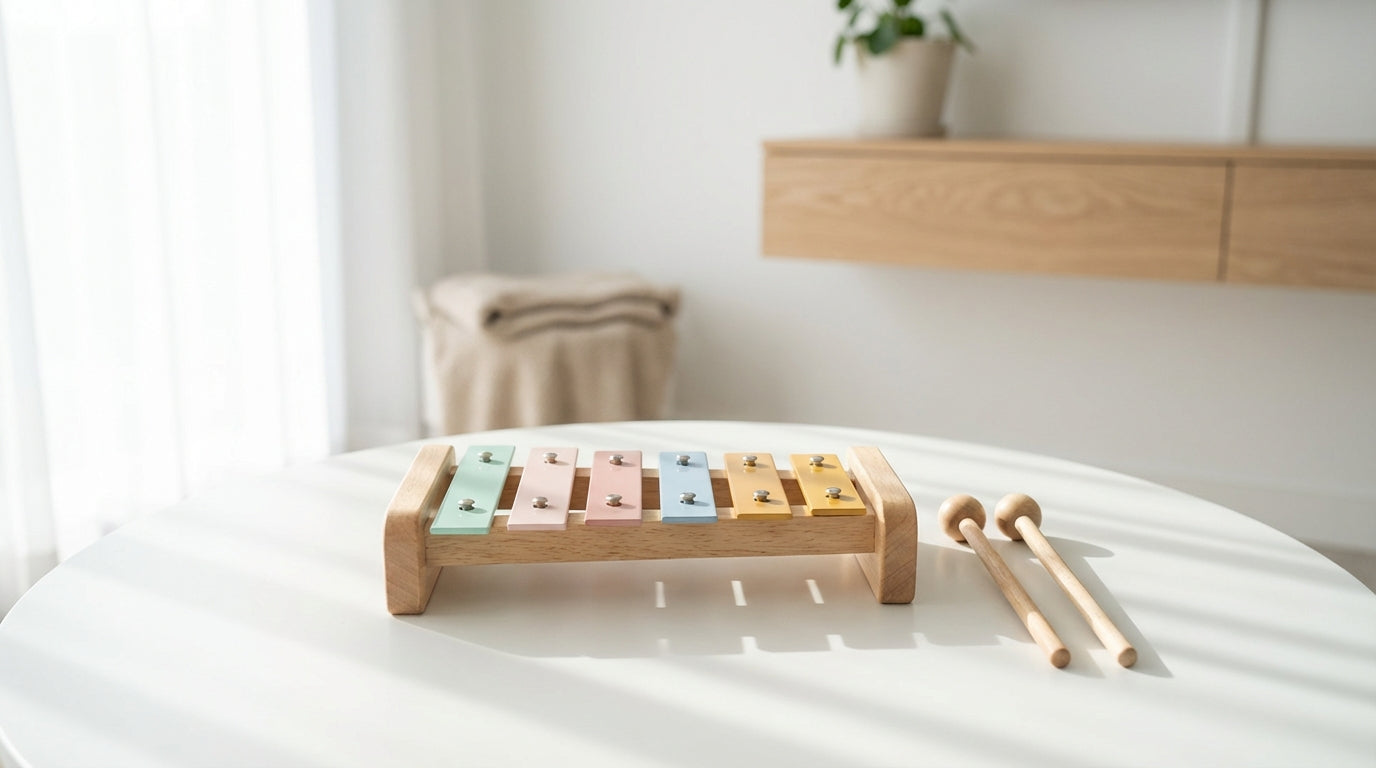
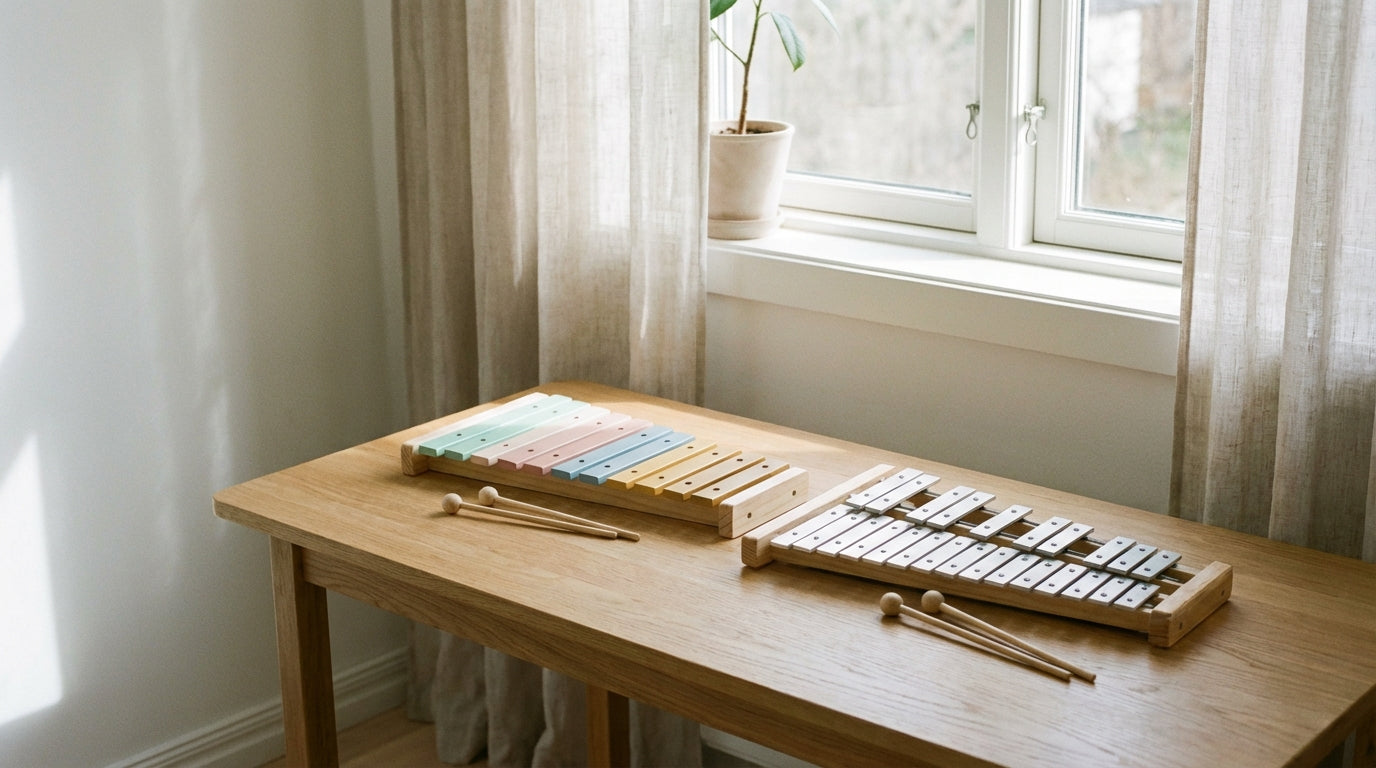
A xylophone has tuned wooden bars that are struck. That's not just casual usage but the classic definition: According to Encyclopaedia Britannica, a xylophone consists of “tuned wooden bars.”

A metallophone has tuned metal plates or bars and often rings on for longer. According to Encyclopaedia Britannica, metallophones are percussion instruments with struck metal bars/plates.
Definition (quotable): A xylophone is a percussion instrument with tuned wooden bars that are struck with mallets.
Definition (quotable): A metallophone is a percussion instrument with tuned metal plates/bars that usually ring on for longer when struck.
What Does a Wooden Xylophone Really Sound Like in a Child's Room?
A wooden xylophone often sounds warm and less shrill, but not automatically quiet. Wood often takes some of the “ringing” out of the tone – which can be worth its weight in gold in an apartment or terraced house. Still, when a child is excited, they're excited. The material makes it more pleasant, not silent.

In everyday life, wood scores above all with its friendly tone color. Many parents describe the sound of wood as rounder and less “sharp” – and that makes longer play sessions easier to bear, even when you're cooking, on the phone or negotiating a sibling's bedtime at the same time.
Advantages of Wood (Practical, Not Romantic)
- Sound often feels softer: Less “ping” – which can be easier on the nerves.
- Pleasant feel: Wood feels “right” to many children.
- Visually calmer: Often blends in unobtrusively in a child's room (grandparents breathe a sigh of relief).
Disadvantages of Wood (So You're Not Surprised)
- Wood can be loud, too: Especially on laminate or a tabletop.
- Tuning can vary: Very cheap instruments are sometimes not tuned cleanly.
What Does Metal Sound Like – and Why Does It Often Seem “Louder”?
Metal usually sounds clearer and carries further because the bars vibrate for longer. That's not a bad thing in itself: children get immediate, clear feedback (“I hit it!”). That's exactly why many children love the sound of metal – it rewards quickly.
The catch is the sustain: it fills the room faster. In an apartment with thin walls, that can make the difference between “nice tinkling” and “I can still hear notes after my child is already in bed.”
Practical tip: Put a folded blanket or a rug under the instrument. This dampens vibrations and often makes the sound noticeably more pleasant.
Which Type Suits Which Age?
For small children, safe details matter more than “perfect” notes. A toddler first wants to hit, listen and repeat. That's completely normal – and even useful, because it builds a sense of rhythm, hand-eye coordination and control of strength.

Rough Guide (No Stress)
- From about 18 months: Short, supervised play sessions. Important: a large, easy-to-grip mallet and a stable stand.
- From about 2–3 years: Patterns and repetition become exciting (“the blue note again!”). First mini songs work with some help.
- From about 4 years: Many children want to play more deliberately: sequences, simple melodies, “I'm practicing!” (yes, it happens).
Safety note: With toddlers, please only play with supervision and put the mallets away afterwards. Mallets are for making music, not for testing furniture.
What We Look For in Practice (Ulli & Flo, Hamburg)
We look first at workmanship, edges, mallets and stability. That's our down-to-earth “parent's perspective” – and it's surprisingly often more useful than any sound debate.
Our Little Checklist
- Edges & transitions: Nothing should look sharp or splintery – especially at the corners.
- Mallet: Sturdy, easy to grip, no loose parts. And: where is it stored?
- Stand: If it slides away, it gets frustrating. A mat underneath almost always helps.
- Material information & transparency: Good providers clearly state what the body, bars/plates and mallets are made of.
- Testing and safety information: Look for traceable details on standards/testing. At BIECO, this information is in the product safety details.
An example from our range: metal bars, wood all around – popular for getting started. On the Mini Xylophone (e.g. Deer), the bars are made of metal, while the body and mallet are made of wood; it's recommended from 18 months and lists EN 71-1-2-3-9 in the safety details. According to the BIECO product page, “use under supervision” is also stated, along with independent testing and testing for harmful substances.
And yes: we'd rather be too clear than too relaxed here. Not because we're party poopers – but because children come up with creative ideas in seconds that adults wouldn't think of in 66 years.
Educational Value: What Children Learn While Playing the Xylophone
Playing the xylophone trains motor skills, a sense of rhythm and attentive listening. It happens along the way, without a “practice plan.” Children learn: if I strike differently, it sounds different. If I repeat, a pattern emerges. And if I wait, I can listen.
The nice thing for family life: music is a screen-free activity. Sometimes it's only five minutes – but those can be exactly the five minutes in which you set the table or take a quick breather.
Care & Durability: Wood and Metal in Everyday Life
A damp cloth and a little patience will usually get you furthest. Children's instruments often look “loved” after a few weeks – that's okay. What matters more is that nothing swells, rusts or comes loose.
Wood: How to Keep It Looking Good
- Cleaning: Wipe lightly damp, then dry.
- Avoid water: Don't soak it or hold it under the tap – wood can swell.
- Storage: Don't store it permanently on a radiator or in a damp corner.
Metal Bars: How to Keep the Sound Clear
- Fingerprints: Wipe with a soft cloth – done.
- Moisture: Dry after wiping so nothing “tarnishes.”
- Screws/connections: Check now and then that everything is secure (without turning things wildly).
DIY: Make Mallets Quieter or Replace Them Quickly (No Crafting Degree Needed)
You can often influence the sound through the mallet – not just through the material. If a metal sound is too prominent, a slightly softer strike or a minimally dampened mallet head sometimes helps.
Option 1: “Quieter Mallet” with Felt (Quick to Make)
- Materials: A small piece of felt (craft felt), scissors, a bit of tape or a strong rubber band.
- Wrap: Place the felt around the mallet head (not around the handle, which should stay grippy).
- Secure: Fasten it with a rubber band or tape so that nothing flaps loose.
- Test: Play a few notes and see if it sounds more pleasant.
Safety note: Only use DIY wraps if they are really firmly attached. Loose parts don't belong in children's hands – when in doubt, leave it out.
Option 2: Emergency Replacement Mallets
- For very small children: Better not to use a “replacement” from household items (spoons, etc.). It often ends in dents – or tears.
- For older children under supervision: A soft wooden spoon can help briefly, but it's not a permanent solution.
Notes, Colors, Songs: How to Keep Children Interested
Sheet music isn't a must – but it helps when your child wants to play melodies on purpose. For getting started, free experimenting is perfectly enough. When the wish comes, “I want a song!”, color dots, symbols or simple cards are great because they bring a sense of achievement.
If you'd like to browse: In our Xylophone Notes & Songs section you'll find ideas, and in the guide Xylophone Notes & Children's Songs: The Loveliest Pieces and Playing Tips there are playing suggestions for different age groups.
Practical tip: Mark the starting note with a small dot of washi tape. Then your child will find their way back in faster after breaks.
Quick Decision Guide: Wood or Metal – Which Suits You?
Decide based on your living situation, your sense of volume and your child's temperament. That saves brooding and often leads to “that's the one” faster.

- Apartment with thin walls: A wooden xylophone or an overall gentle sound is often more pleasant.
- Child loves clear tones: Metal bars give very direct feedback and motivate quickly.
- You're on the go a lot: Compact instruments with few notes are practical and quickly stowed away.
If you just want to see what's out there: In the overview of xylophones you'll find different variants – from small to “Grandma, we're giving a concert.”
FAQ
From What Age Does a Wooden Xylophone Make Sense?
Many children start in toddlerhood, once they can strike on purpose and listen. This often works from around 18 months in short, supervised play sessions. More important than the exact age are a good grip, a stable stand and clear rules for the mallet.
How Loud Is Metal Really Compared to Wood?
Metal often seems louder because the tone rings on longer and is more present. The actual volume depends heavily on the surface, the mallet and the way of playing, though. With a rug/blanket underneath and a gentler strike, you can usually make the sound much more living-room friendly.
Metallophone vs. Glockenspiel: Is It the Same Thing?
In everyday life, the two are often mixed up because both have metal bars. Both are percussion instruments with a metallic sound, and the terms are used differently depending on the manufacturer. According to Encyclopaedia Britannica, “metallophone” describes instruments with struck metal bars/plates.
How Well Tuned Do Children's Instruments Need to Be?
For free play, it's enough if the notes are pleasant and distinguishable. If your child wants to play songs on purpose, cleaner tuning and a clear order of notes help. Perfect concert tuning is rarely the goal in a child's room – fun and motivation matter more.
How Can I Tell a Safe Children's Xylophone?
Look for clean workmanship, traceable safety information and sturdy parts. What matters are smooth edges, a safe mallet and an instrument that doesn't constantly slide away. At BIECO, you'll find notes on standards and use in the product safety details, e.g. for the Mini Xylophone Hedgehog.
And finally, true to our northern German roots: it doesn't have to be perfect, just fitting. When sound, safety and everyday life come together, “hitting it once” often turns into a little favorite pastime. If you like, take a look at the Wooden Xylophone section or the big Xylophone overview.