Baby Stacking Cups: How They Differ from a Stacking Tower & Everyday Tips
At a glance
- Baby stacking cups are all-rounders: stack, nest, pour, splash in the bath.
- A stacking tower is more structured: pieces are placed onto the post one by one.
- For the bath, sandbox and on the go, cups are often more relaxed.
- For calm moments at the table and first sorting games, the tower scores.
- Look for clear age recommendations, good workmanship and proper labeling.

Baby stacking cups are usually more versatile, while a stacking tower is more guided. If you're torn between “cups or tower?”, you can't go wrong – it's simply about what fits into your daily life. In this guide you'll find help with deciding, play ideas by age (including “stacking cups: from what age?”) and tips for the bath, sand and traveling. And honestly: sometimes the toy that's quickest to rinse off simply wins.

Ulli & Flo
Owners of bieco · Hamburg · parents themselves
We like toys that keep up with real family life: bath, kitchen, sandbox. And because things tend to go astray during play (and meals), you'll also find stacking towers as well as bibs in our bib collection and practical sleeved bibs.
What is the difference between stacking cups and a stacking tower?
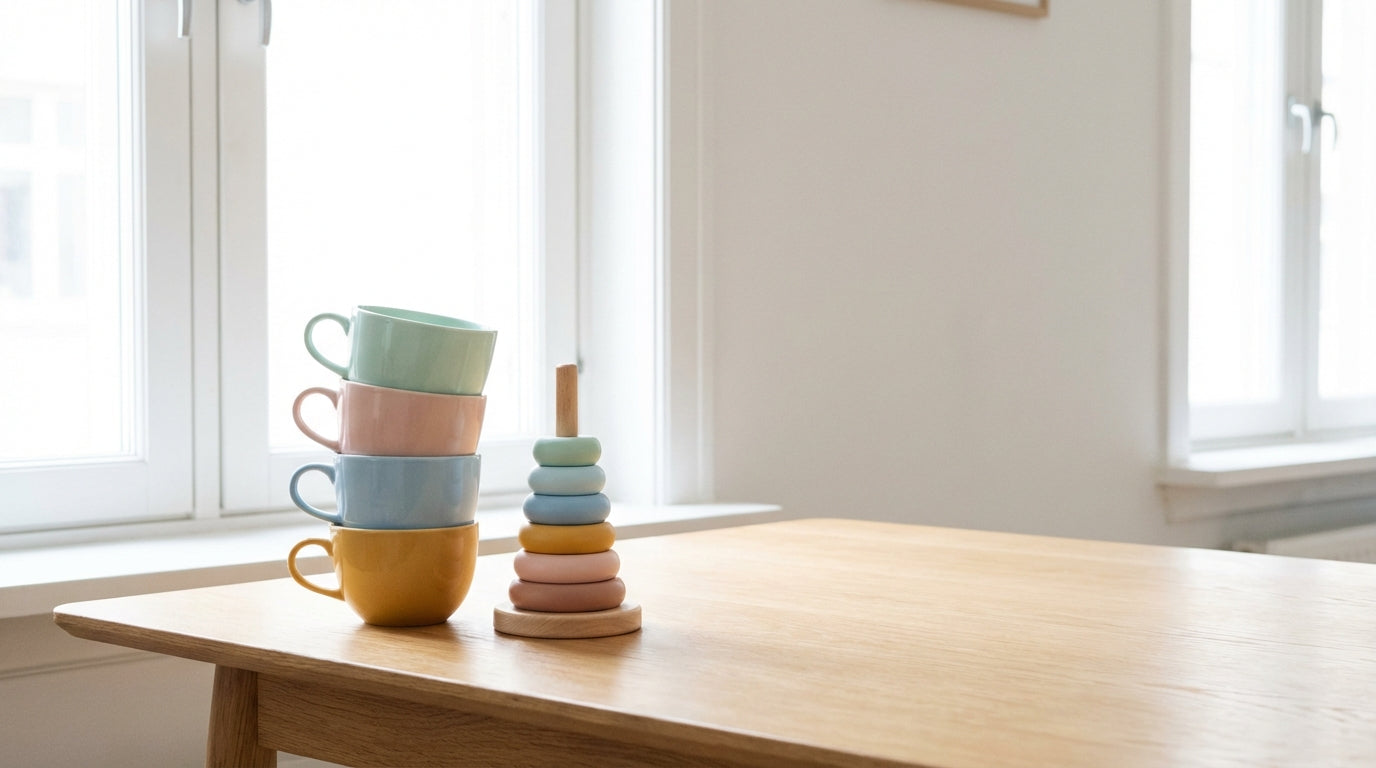
Stacking cups are open cups, while a stacking tower usually has a post. That's the main difference: cups work in many directions (nesting, stacking, filling, pouring out), while the tower sets one task (placing pieces onto the post in order).
| Comparison | Baby stacking cups | Stacking tower |
|---|---|---|
| Best for… | Free play, pouring, “in/out” | Sorting, order, hitting a target |
| Tricky if… | you don't like lots of small pieces (there are often more cups) | your child is having an “everything off” kind of day |
| Everyday places | Bath, sand, on the go, kitchen | Table, play mat, quiet corners |
| Play principle | stacking & nesting | placing onto a post (often by size) |
| Bath tip | with a perforated bottom = mini shower | better for afterwards on the towel |
| Taking along | a few single cups are often enough | more fun as a complete set |

A stacking tower is “goal-oriented” and demands more precision. Your child has to hit the hole and often tell sizes apart – great for practicing, but depending on the mood of the day, also a classic little frustration trigger.
Stacking cups are more forgiving and invite free play. If stacking doesn't work yet, the cups simply get shaken, tapped, knocked over or used to “cook”.
Which skills do stacking cups support – and which does a stacking tower?
Both are motor skills toys, but with a different focus. Cups encourage experimenting (tipping, filling, cause and effect), while the tower is more about sorting, order and targeted placing.
Stacking cups often encourage early exploring in everyday life. A cup becomes a measuring cup, a drum, a watering can or a “telephone”.
A stacking tower supports an understanding of size and hand-eye coordination. When the pieces are sorted by size, there's a little puzzle hidden inside.
Practical tip: If the tower is causing frustration right now: let your child play without the post first (rolling, stacking, sorting) – and add the post later.
Baby stacking cups: from what age do they make sense?
Stacking cups are often interesting early on because no “target to hit” is needed. Many babies enjoy them as soon as grasping and intentional letting go get better – this varies from child to child. The advantage: cups work even when real stacking is still a long way off.

With the stacking tower, placing the pieces onto the post adds an extra hurdle. That takes more coordination and patience.
| Typically interesting from… | What many children like to do then |
|---|---|
| 6+ months | grasping, tapping, turning over, watching them roll away |
| 9+ months | “in/out”, nesting cups, tipping them out |
| 12+ months | stacking, copying, first sequences |
| 18+ months | role play (kitchen/construction site), small “tasks” |
Important: The manufacturer's age recommendation always comes first. Development is individual, and the age labeling is part of the safety information.
Play ideas by age: 6, 9, 12 months (and beyond)
The best play ideas are the ones that fit your mood of the day. Here are a few ideas that have worked for many families – no big ambitions, more along the lines of “works in everyday life”.
Around 6 months: grasping, tapping, marveling
At this age it's often about cause and effect and sounds. Place 1–2 cups within reach: touching, turning over, tapping on them, watching them roll. With the stacking tower, individual rings can be exciting for rolling or holding, without having to be placed on the post yet.
Around 9 months: in, out, knock over (the classic)
“In and out” is often the favorite game before “stacking” comes along. Cups are great for nesting or for putting large cloths in and taking them out again. With the tower, your child can pull off rings, turn them, sort them – placing them on the post can wait.
Around 12 months: stacking, sorting, copying
Now imitation becomes more important. Show 1–2 simple steps: “big at the bottom, small on top” or “we build a tower and blow it over”. With the stacking tower, placing pieces often works better if your child only has to “hit” a single ring at first.
From toddlerhood: role play and small tasks
Cups then often turn into kitchen and construction site accessories. “Cooking soup”, “baking sand cakes”, “carrying water from A to B” – stacking cups stay interesting for a long time. The stacking tower often becomes an “I can do it already!” game once sorting and order become fun.
Which one suits which daily routine? Bath, sand, on the go, table
The best purchase is the one that actually gets used in your home. And that depends less on the product name than on your typical situations: bathtub, kitchen, car, playground.

Stacking cups in the bath
In the water, stacking cups are usually a real hit. Little trick: cups with holes make a mini shower, cups without holes are better for pouring. Make sure to shake out any leftover water after bathing and let everything dry in the open.
Bath hygiene in 60 seconds
- After every bath: shake out, rinse briefly, stand open to dry.
- Once a week: clean thoroughly with warm water + mild dish soap.
- Drying: don't store in a closed bag, let air get to them.
- Smell/residue: take it seriously and, if in doubt, throw the toy out.
Stacking cups in the sand
In the sand, cups quickly become molds, shovels and measuring cups. The nice thing: even if a cup gets buried now and then, the game goes on. With a stacking tower, it's often exactly that one piece that's missing when you're out and about.
Stacking cups on the go
On the go, cups also work individually – that's what makes them so practical. If they nest compactly inside each other, they often even fit into a small pouch or the side pocket of the stroller.
Stacking tower at the table
For calm moments at the table, a stacking tower is often a good fit because it provides structure. “First big, then smaller” is a clear task that's easy to guide.
Practical tip: At the table, put out only 3–4 pieces. Fewer choices = fewer “everything off” impulses (usually).
Buying checklist: What we look for in stacking cups & stacking towers
- Age recommendation: does it really suit your child (and it takes priority over gut feeling).
- Manufacturer information: name/address, notes, warnings easy to read.
- CE marking: present and verifiable.
- Workmanship: no sharp edges, no cracks, nothing wobbly.
- Size & grip: easy to grasp, not too small for little hands.
- Number of pieces: fewer is better if you're often on the go or want to tidy up quickly.
- Bath design: perforated bottom (shower) vs. no holes (pouring) – which would you prefer?
- Drying: can water be shaken out easily, can everything dry in the open?
- Cleaning: can you reach everywhere, does nothing stay “trapped”?
- Smell: if it smells bad permanently, something is usually wrong.
Materials, care & safety: what you should really pay attention to
With baby toys, sturdy workmanship, clear labeling and easy cleaning matter. Whether cups or tower: look for smooth edges, stable parts, understandable age recommendations and complete manufacturer information.
Safety, short & important: Look for CE and clear age recommendations, check regularly for cracks/loose parts and consistently throw away anything damaged. After bathing: empty out the water and let dry in the open.
Learn more: Official information/links
If you want to read up on what many safety terms refer to, these are good starting points:
Care is often simple: warm water, mild dish soap, dry thoroughly. Follow the manufacturer's care instructions, especially for wood or special materials.
Terms explained briefly (so everyone is talking about the same thing)
Stacking toys are toys that are built on top of or inside each other. The benefit: children practice grasping, aligning, balance and frustration tolerance in small doses.
A shape-fitting or peg toy is a toy where pieces are deliberately placed into openings. The benefit: it trains hand-eye coordination and hitting a target – often a bit more “demanding” than pure stacking.
A stacking tower is a peg toy with pieces that slide onto a post. The benefit: children practice precise placing and (depending on the set) size sequences.
Stacking cups are open cups that can be stacked and nested inside each other. The benefit: pouring, getting a feel for volume and free play – especially practical with water and sand.
How to make the right choice: a little decision guide without the drama
The right choice is the one that makes your daily life easier. Here's some pragmatic guidance:

- If your child likes to tip, pour and splash in the bath: baby stacking cups are usually the easier start.
- If your child likes to sort and enjoys “tasks”: a stacking tower often fits wonderfully.
- If you're looking for a gift: cups are often more universal because they work in more situations.
- If you already have sorting or peg toys: cups bring variety (water/sand/everyday life).
And if you don't want to decide: that's allowed. Many families have both – and use them in different phases.
How we look at safety & everyday practicality at bieco
We choose play ideas so that they work in real family life. Ulli & Flo write here as parents for parents – with the question in mind: “Can it be cleaned quickly, does it hold up, and is it clear what it's meant for?”
Transparency matters to us: materials, labeling and notes must be easy to follow. As a Hamburg family business that has been doing this for 66 years, we know: trust doesn't come from big words, but from clear information and honest expectations.
FAQ
What is better: stacking cups or a stacking tower?
The better toy is the one that suits your child's current phase. Stacking cups are often more versatile (tipping, filling, bathing), while a stacking tower is more structured (placing onto a post, sorting). If your child gets frustrated quickly, cups are often the more relaxed way to start.
Baby stacking cups: from what age can my child really play with them?
Often as soon as grasping and intentional letting go work. “Really playing” doesn't mean stacking at first, but knocking over, turning, tapping, putting things in and taking them out again. For clear guidance: always follow the age recommendation and instructions of the manufacturer.
How do I use stacking cups in the bath without it getting unhygienic?
Rinse them out regularly and let them dry completely. Especially after bathing, water likes to stay behind. Shaking them out once, cleaning them with warm water and mild dish soap and letting them dry in the open usually helps a lot already. Also follow the manufacturer's care instructions.
How can I recognize safe toys when it comes to stacking cups and stacking towers?
Look for age recommendations, clean workmanship and complete labeling. Stability, smooth edges and verifiable manufacturer information are important. According to DIN, harmonized standards play a central role in assessing toy safety. (DIN info)
Why is the topic of chemicals in toys so present?
Because children use toys intensively and often put them in their mouths. Among other things, the BfR assesses phthalate plasticizers, PAHs and allergenic fragrances in toys and supports the development of limit values. (BfR)
Is a stacking tower “safer” as a gift than stacking cups?
No, safety doesn't depend on the type, but on the design and labeling. Both can be very safe if they are age-appropriately designed and tested. As a gift, stacking cups are often more universal because they work in more everyday situations.
Bottom line: baby stacking cups are the everyday all-rounders, the stacking tower is the sorting pro. If you'd like to browse now: at bieco you'll find a selection of stacking cups and, in the stacking tower section, an overview of the tower variants – depending on what fits your day better right now.
And if you like things tactile: wood just feels lovely. Take a look at the wooden stacking tower section – and feel free to follow your gut feeling.