Wooden or Silicone Stacking Tower? A Material Comparison for Parents
At a glance
- Wooden or silicone stacking tower: what matters most is the mouthing phase, your floors, care and noise level.
- Silicone is soft, quiet and often quicker to get clean in everyday life.
- Wood scores with its feel, stability and “stays for ages” appeal.
- More important than the material: the age rating, clean workmanship and reliable test information.
- With a little checklist, you can quickly find the right material for your family.

Wooden or silicone stacking tower is mostly a question of everyday life: noise, care, feel and age. If you’re looking for a toy that feels like “real” play equipment, can happily sit on a shelf and will even outlast siblings, you’ll often end up with wood. If your home is more “teething meets tile floor”, silicone plays to its strengths: soft, quiet, quickly clean. Here’s a clear guide to help you decide – no wagging finger, but plenty of real-life parenting (crumbs included).
If the mouthing phase and a hard floor (tiles, floorboards) come together: go for silicone. If you want stability and the toy is meant to stay around for a long time: go for wood. If you’re unsure: look at the age rating and workmanship first.
And as a safety rule of thumb: better a simple, well-tested toy than a fancy one with wobbly parts.

Ulli & Flo
Owners of bieco · Hamburg · parents themselves
We love toys that make everyday life easier: quiet, easy to clean and no drama when they fall on the floor. And because play (and mealtime) so often go hand in hand, you’ll also find bibs and sleeved bibs with us – for those “oops, not again” moments.
What is a stacking tower – and why does the material matter so much?
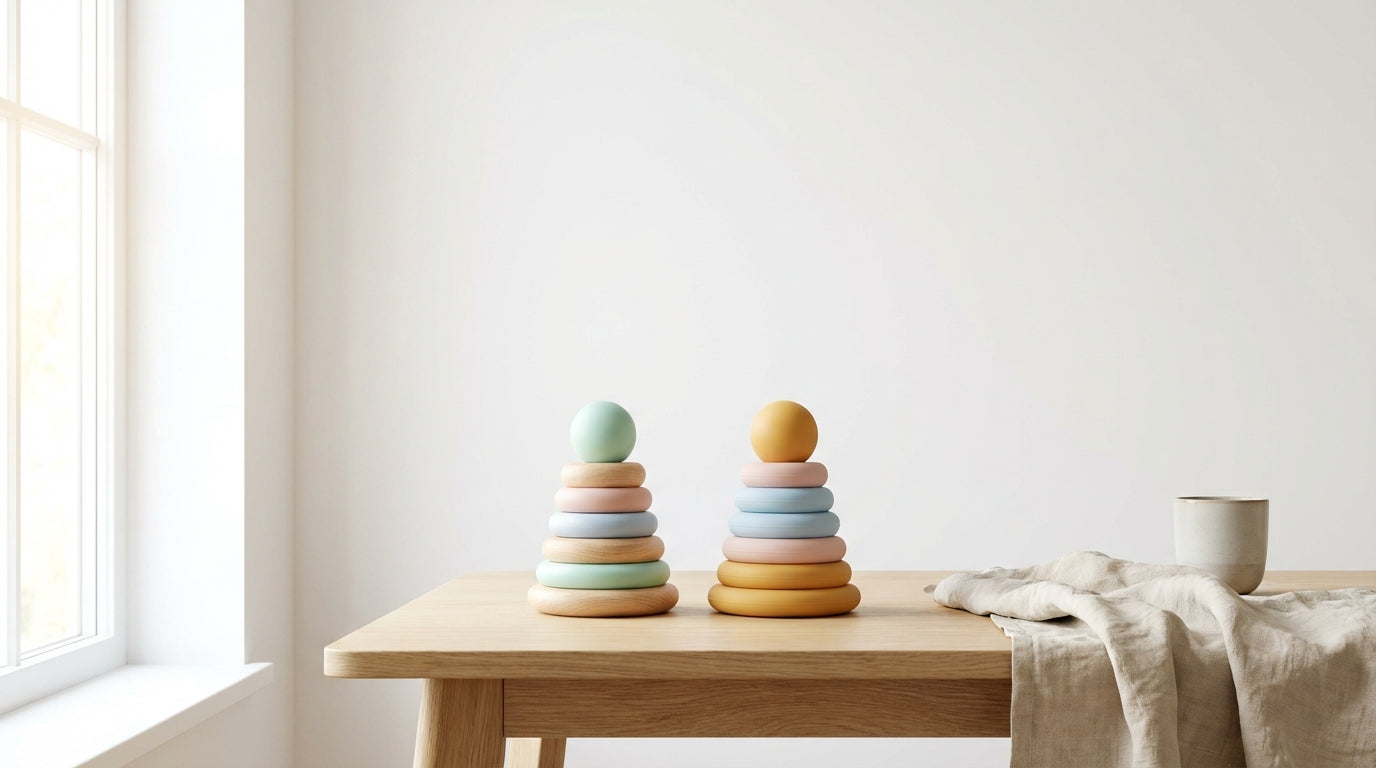
A stacking tower is a stacking or nesting toy that practises grasping, sorting and first problem-solving. Usually rings or pieces are slotted onto a pole in order of size – or pieces are stacked on top of each other. And that’s exactly where you notice the difference: wood gives clear feedback, silicone is more forgiving.
Wood is firm and gives a distinct “it fits!” feeling. Silicone is flexible, sometimes slips a little and takes crooked attempts in its stride. Both can be great – depending on how your child is playing right now (and how much “throwing practice” is involved).
Wooden stacking tower: strengths you notice in everyday life
Wood feels warm, sits nicely in little hands and often seems like a toy that grows along with your child. Many children love that clear feeling: ring on – it sits. Ring off – it clacks. Simple, yes. But often exactly right.

- Fine motor skills: Wood doesn’t give way when grasped – that can help with “hand training”.
- Stability: Thanks to its weight, not everything topples over at the slightest nudge.
- Play feel: Wood often feels “real” and stays interesting for longer in many families.
What to look for with wood (without the jargon):
- Edges: smooth, rounded, no rough spots.
- Surface: cleanly finished, nothing sticky, nothing flaking.
- Colours/varnish: preferably saliva-proof, water-based paints; no chipping layers.
- Smell: Wood may smell like wood, not like a “chemical cupboard”.
If you’d like to browse: wooden stacking towers.
Practical tip: If wood on wood goes “bang”, put a small towel or a felt mat underneath – it saves your nerves and your neighbours.
Trade-off with wood: Poor workmanship can lead to rough spots, splinters or flaking paint. If you spot anything like that: don’t just think “it’ll be fine” – rather stop using it and make a complaint.
Sustainability isn’t automatic with wood – certificates help put things into context. If you want to look out for more responsible forestry, FSC is a well-known system. According to FSC Germany, certification is repeated at least annually after review by independent third parties (FSC Germany).
Silicone stacking tower: when you want it soft, quiet and practical
Silicone is soft, grippier and makes less noise when in doubt. Especially in phases when everything ends up in the mouth, silicone feels more relaxing to many parents. (And yes: it will also end up in the sink, along with half the dinner dishes.)

- Quiet: When silicone falls, it’s usually more “plop” than “bang”.
- Mouthing phase: Happily chewed on – without little lips complaining right away.
- Cleaning: Quick to wash; thorough drying is important.
What to look for with silicone:
- Surface: smooth, without a sticky feel or “film”.
- Smell: as odourless as possible; a strong smell is a warning sign.
- Care instructions: clearly stated (including the “silicone stacking tower dishwasher” question).
- Material information: reliable and traceable; “BPA-free” is a handy search term, but doesn’t replace proper testing.
To browse: stacking tower.
Trade-off with silicone: It can attract dust and fluff, discolour (e.g. from tomato sauce) or taste “soapy” after incorrect cleaning. Usually it helps to rinse thoroughly, let it dry completely and, if needed, clean it gently once more.
With silicone, it’s worth checking for reliable material information, especially when there’s a lot of contact with saliva. The German Federal Institute for Risk Assessment (BfR) publishes recommendations on food contact materials and also lists silicones as a material group (BfR).
Which material for which age? (No stress, promise)
The age rating on the toy is the best shortcut on the shelf. It doesn’t tell you “what your child must be able to do”, but what the toy is designed and tested for – and which risks (e.g. small parts) have been taken into account.
Mouthing phase means: babies explore things mainly with their lips and tongue. That’s normal and rather clever. And yes, it sometimes looks like “non-stop sucking”.
- Lots of chewing: Silicone is often nicer because it gives way and is quieter.
- Deliberate slotting and sorting: Wood gives clear feedback and often stands more firmly.
- Siblings join in: Wood often stays exciting for longer; silicone is more relaxed when things get wild.
Safety & standards: short, clear and genuinely helpful
With “EN 71 stacking tower” and CE, it’s not about bureaucracy, but about clear minimum rules for toys. CE is the manufacturer’s self-declaration: the manufacturer states that the toy meets EU requirements. EN 71 is the key series of standards used to test, among other things, mechanical safety and certain substances.
If you want to read more: the EU explains the toy safety rules here (European Commission).
How you can often spot it quickly on the packaging or shop page:
- CE marking: visible and not hidden “somewhere”.
- Age recommendation: clearly stated, including warnings.
- Manufacturer/importer: name and contact details are traceable.
- Description: material and care instructions are specific, not just “high quality”.

If you come across DIN EN 71-3: it deals with the migration of certain elements from toy materials. DIN explains it in an easy-to-understand way (DIN).
Cleaning & care: how to keep it hygienic without driving yourself crazy
Wood likes “wipe damp”, silicone likes water – but both like to be dry afterwards. Wood can swell or become rough if it stays wet for a long time. Silicone can pick up odours if it disappears into a box while damp (hello, changing bag).
- Wood: Clean with a slightly damp cloth, then rub dry and let it air-dry well.
- Silicone: Clean with warm water and mild washing-up liquid, rinse thoroughly and let it dry completely.
Quick guide: 5 typical care questions from everyday life
- Dishwasher? Only if the manufacturer expressly allows it. Otherwise, hand washing is better, because heat and dishwasher tabs can damage surfaces.
- “Soapy” taste/film on silicone? Rinse very thoroughly with clear water and let it dry completely. Boiling only if it’s approved.
- Discolouration (silicone)? Tomato, carrot & co. can stain. This is usually cosmetic, not automatically a safety issue – it often helps to rinse promptly and not leave it sitting in sauce.
- Dust & fluff (silicone)? Give it a quick rinse with water or wipe it with a damp cloth. Rubbing it dry reduces the “attracts everything” feeling.
- Wood rough/splintering? Stop using it if there’s a risk of splinters. For new items: make a complaint; for older pieces: only smooth very carefully if it makes sense and the surface stays clean afterwards.
Practical tip: If a toy smells musty: let it dry completely first, then clean it again – leftover moisture is often the secret culprit.
If you’re out and about a lot, silicone is often easier. At home, wood scores by being allowed to “lie around nicely” without immediately looking like a baby corner.
Wood vs. silicone side by side (table)
The best comparison is the one that suits your floors, your noise tolerance and your cleaning routine. Here’s the short version to check against:
| Feature | Wood | Silicone |
|---|---|---|
| Feel | firm, grippy, “clear” | soft, flexible, grippier |
| Noise | more of a “clack” | more of a “plop” |
| Stability | often higher thanks to weight | lighter, more likely to slip away |
| Care | wipe, don’t soak | wash, dry well |
| Typical stumbling blocks | can become rough/splintery if quality is poor | attracts dust, can discolour or leave a “film” |
| On the go | can be “loud” in a café | often more relaxed in bags & co. |
| Look | classic, often timeless | modern, often soft design |
Quick recommendation by household type
If you don’t feel like pondering right now: pick the line that sounds most like your home.
| Your home is more … | Then rather … |
|---|---|
| Tiles + mouthing phase | Silicone |
| Old building/thin walls + “please keep it quiet” | Silicone |
| Lots of travel (bag, café, holidays) | Silicone (only with suitable care instructions) |
| Siblings/handing down/“should last a long time” | Wood |
| Shelf/decor + classic play feel | Wood |
| You want to cover both | Wood at home, silicone for on the go |
Checklist: how to make a good choice (without tying yourself in knots)
A good decision is one you’re happy to pick up in everyday life. Use this list as a little cheat sheet – not as an exam.
- Age: Does the age rating really suit your child?
- Mouthing phase: Is there a lot of chewing? Then “soft & easy to clean” is often worth its weight in gold.
- Floor & noise: Tiles/floorboards are honest. Carpet is the diplomat.
- Care: Can you realistically manage it in everyday life? (The answer is allowed to be “just quickly”.)
- Workmanship: Smooth transitions, nothing wobbles, no sharp edges.
- Information: Material, manufacturer and care instructions are clearly stated.
And now, honest the Hamburg way: sometimes your floor simply decides. Old-building floorboards plus wooden toys can get musical. Tiles too.
DIY play ideas with a stacking tower: more than just “ring on pole”
A stacking tower can be great fun even without “proper stacking”. Especially if your child prefers tipping, rolling or sorting: all fine. That’s not “playing it wrong”, that’s learning in the wild.
- Colour hunt: “Give me the lightest/darkest ring” (or: “the one that looks like porridge”).
- Size line-up: Lay the rings side by side – from big to small – without the pole.
- Hide and seek: Ring under a cloth, child finds it (yes, it’s simple – but babies love it).
- Roll test: Which pieces roll, which don’t?
FAQ
At what age does a wooden stacking tower make sense?
Go by the manufacturer’s age rating – it matches the construction and the testing. For very young children, what matters most is: large pieces, a stable base, nothing wobbling. If your child is currently throwing a lot or chewing heavily, a silicone stacking tower in the same age range can be more relaxed in everyday life.
Wooden stacking tower splinters: what to do?
If wood becomes rough or splinters, take the toy out of play for now. For new items: make a complaint, this is a no-go. For older pieces, very careful sanding can help – but only if there’s no risk of splinters afterwards and the surface stays clean.
Silicone stacking tower dishwasher: is that okay?
Only if it’s expressly stated in the care instructions. Dishwasher heat and tabs can change silicone surfaces or leave a film. If it’s allowed: choose a gentle programme and then really let it dry completely.
Why does silicone sometimes taste “soapy” or feel slimy?
That often comes from washing-up liquid residue or too little rinsing. What usually helps: rinse very thoroughly with warm water, rub dry and let it air out. Please only boil it if the manufacturer approves.
How can I tell whether a stacking tower has been reliably tested?
Look for CE, a clear age rating and traceable manufacturer information. If EN 71 is also mentioned, that’s a good sign, because it describes the common test standards for toys. If specific material and care information is provided as well, it makes things much easier for you as a parent.
In conclusion: how to find your stacking tower
If you’re torn between wood and silicone, decide by noise, care and mouthing phase – and then look at workmanship and test information. To browse, you’ll find a good starting point with us in the stacking tower overview. If you’re more after “tip, fill, stack”, take a look at the stacking cups – and for a classic wooden feel, there’s also a selection of wooden stacking towers.