Baby Bibs: Which Ones Suit Drool, Weaning & Daycare Life?
At a glance
- Baby bibs: plan on a small mix rather than “the one perfect bib”.
- For drool & spit-up, soft fabric or terry cloth styles are usually the most comfortable.
- For weaning, wipe-clean styles (often with a catch pocket) are especially stress-free.
- Sleeve bibs are worth it as soon as “I do it myself!” is on the menu.
- Rule of thumb: 2–4 bibs per day plus a reserve to match your washing rhythm.

The best baby bib is the one that really makes your daily life easier. For newborns, soft fabric bibs are often enough; once weaning starts, wipe-clean bibs (ideally with a catch pocket) suddenly become worth their weight in gold; and with finger food, sleeve bibs regularly save the peace at home. Here you get a clear comparison, a little checklist and a simple rule of thumb for quantities – so you play less laundry Tetris and enjoy more “everyone's fed, everyone's okay”.
You can find our bibs for babies here.

Ulli & Flo
Owners of bieco · Hamburg · parents themselves
When we started weaning, we learned that a wipe-clean bib at the table and a soft fabric bib for in between make a pretty relaxed combination. Feel free to browse our Bibs collection.
A bib is a washable protector for neck, chest and sometimes sleeves. It keeps clothes drier, catches food and saves you from changing outfits – and yes, that counts as real luxury in parent life.
Table of contents: jump straight in if it's urgent. When do you need one? – Material comparison – Shapes – How many? – Cleaning – Checklist – FAQ
When does a baby need a bib?
A baby needs a bib as soon as drool or milk regularly soaks their clothes. That can happen in the first weeks (spit-up, milk likes to come back the other way), or later during teething, when drool suddenly creates its own weather systems.
The best start is simple: put one on when things get wet. If you notice you're changing the bodysuit several times a day, a bib is usually the faster solution.
Practical tip: Keep 3–4 bibs at the typical “hotspots” (changing table, sofa, stroller). That way you search less and change faster.
From what age do babies wear bibs – and which ones for newborns?
A bib is fine from birth, as long as it's soft and doesn't get in the way. For newborns, flat fabric bibs are usually the most comfortable because they're light and don't “bulk up” around the neck.

Which bibs suit newborns is decided by the neck: nothing should press or chafe. Look for soft edges, a gentle closure (e.g. a snap button instead of scratchy Velcro) and a size that doesn't reach down to the belly button.
A bandana bib is a triangular, neckerchief-style bib for drooling phases. It's less of a “food catcher”, but often great when the main goal is staying dry.
Safety note: As a rule, leave bibs off during sleep so nothing slips or ends up in an unfavorable position.
Which material is best for baby bibs?
The best material depends on whether you want to “manage” drool, milk or weaning food. Here's the comparison as it looks in real life – not in the catalog.

| Material | Best for | Cleaning | Typical stumbling blocks |
|---|---|---|---|
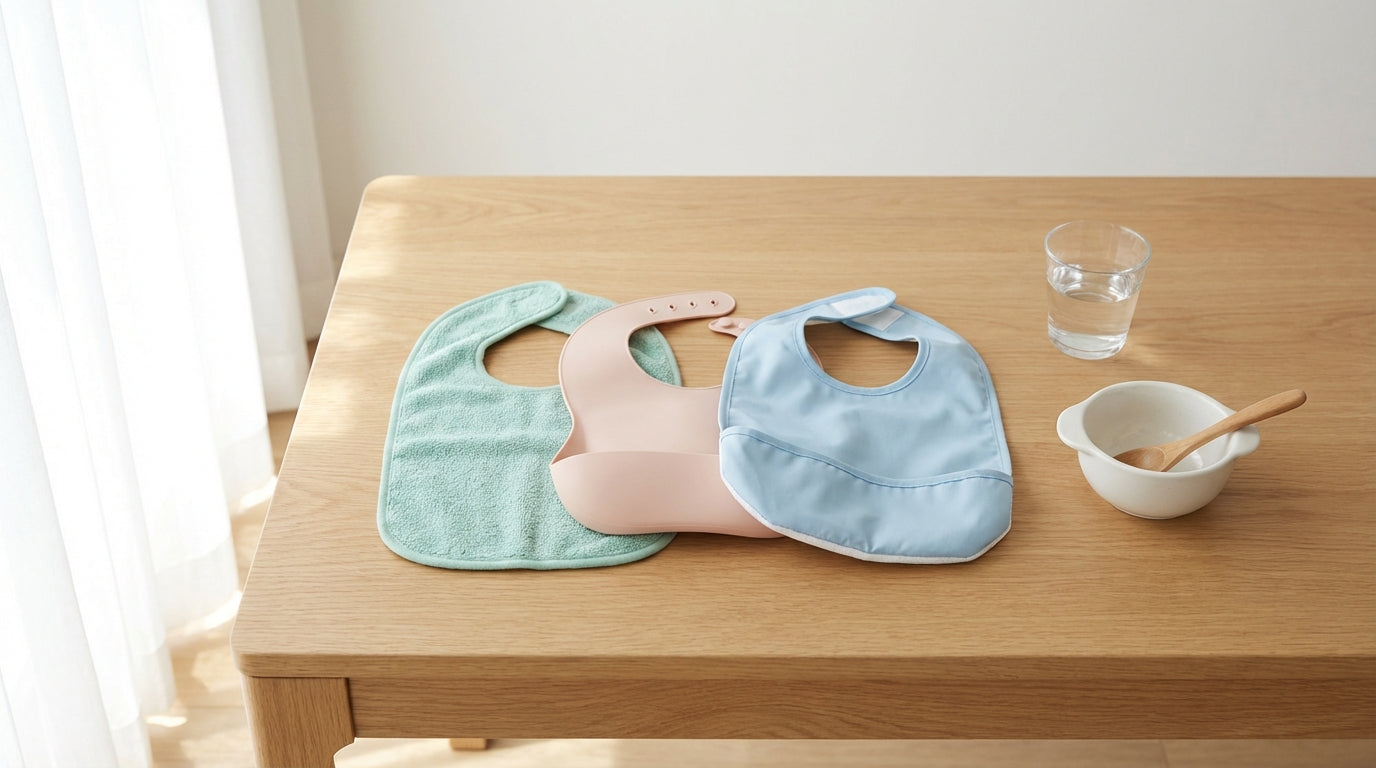
| Cotton/muslin (fabric) | Drool, spit-up, everyday use | Washing machine according to label | Stains like to soak in with purée |
| Terry cloth | Lots of moisture (teething) | Washing machine according to label | Quickly looks “well used” – that's normal |
| Silicone | Weaning, on the go, quick cleaning | Wash by hand (dishwasher if the manufacturer allows) | Can absorb odors if not dried well |
| Coated fabric | Mealtimes + daycare, when it has to be quick | Wipe clean, partly washable (see label) | Washing too hot can stress the coating |
Fabric (cotton, muslin & co.)
Fabric bibs are soft, breathable and great for drooling and spit-up phases. They feel pleasant on the skin, are usually easy to wash and, as “always on” bibs, are often the most relaxed choice.
- Good for: newborns, drooling, milk spit-up, as a backup on the go
- Less good for: mushy weaning food (soaks in, stains possible)
- Everyday tip: Several thin ones are better than a few thick ones – they dry faster.
Terry cloth
Terry cloth bibs are highly absorbent and take “milk lakes” in stride. Thanks to their looped structure, they soak up a lot of moisture – handy in phases when your baby feels like a constantly running tap.
- Good for: teething, lots of drool, spit-up days
- Less good for: carrot, tomato & co. (stain favorites)
- Everyday tip: Light terry cloth visibly ages – but it often withstands a lot.
Silicone
Silicone bibs are wipe-clean and often the most nerve-saving option for weaning. Many have a catch pocket that collects the bits – saving outfit changes and sometimes even a vacuum run.
Silicone in contact with food should be made so that no questionable amounts of substances migrate into the food. According to the German Federal Institute for Risk Assessment (BfR), the BfR recommendations describe conditions for the suitability of materials (including silicones) in food contact: BfR: Recommendations on materials for food contact.
- Good for: starting weaning, purée, on the go (wipe, done)
- Less good for: very small babies (some find it heavy/stiff)
- Honestly: Odors are possible – cleaning thoroughly and drying completely often helps.
Whether silicone can go in the dishwasher is stated in the manufacturer's care instructions. If you're unsure: warm water, mild dish soap, rinse well and really let it dry.
Coated fabric bibs / wipe-clean fabric
Coated bibs are the middle path: softer than silicone, easier to care for than fabric. They're often lightweight, can be wiped clean and – depending on the model – can even go in the wash.
- Good for: weaning & daycare, when it has to be quick
- Less good for: washing too hot or the dryer, unless approved
Are silicone or fabric bibs better?
For drool and spit-up, fabric is usually better; for weaning, silicone is often more practical. Many families do best with a small mix: fabric “on the side” in everyday life, silicone or coated for mealtimes.
A bib is good when it reduces change-of-clothes stress. That's the measure that counts: less changing, less laundry, less annoyance at the table.
Sleeve bibs: what are they – and when are they worth it?
Sleeve bibs are bibs with sleeves that also protect shoulders and upper arms. They work like a little eating or painting smock: ideal for finger food, spooning on their own and everything that “should actually end up in the mouth”.

Sleeve bibs are especially worth it from the start of weaning and in the “I do it myself!” phase. If your child loves to squish, stir, slap or lovingly drag a noodle along their sleeve – welcome to the club.
For an overview, you'll find suitable options collected in our category. This way: Sleeve bibs.
Practical tip: Rinse briefly after eating, hang up, done. Machine wash only when it's really necessary – that saves time and nerves.
Which shape is best suited for a baby bib?
The best shape is the one that covers your child's “impact zone”. Some mostly hit the chest, others the lap, and others… well, the wall.
- Classic bib (Velcro/snap button): All-rounder for drool and eating.
- Pullover bib: Goes on over the head, often sits securely and gets pulled off less. Example: Pullover bibs.
- Bib with catch pocket: Practical with purée and finger food – less ends up in the lap.
- Bandana bib: Great for drool, less for “catching food”.
- Sleeve bib: Maximum coverage for clothes and sleeves.
How big a bib should be depends on age, seating position and eating speed. For small babies, go compact and soft; for weaning and daycare, go larger so chest and belly are really protected.
How many bibs does a baby need? Rule of thumb & sample setups
A simple rule of thumb is 2–4 bibs per day plus a reserve for laundry gaps. That sounds unspectacular, but it's the best insurance against “ugh, everything's in the wash”.
How many bibs you really need depends mainly on two things: how often you change and your washing rhythm. If you wash every two days, you need more buffer than someone who runs a load daily (respect, honestly).
| Phase | Practical basic set | Why this works well |
|---|---|---|
| Newborn / lots of spit-up | 10–14 fabric or terry cloth | Frequent changing, soft on the neck, quick to grab |
| Teething / peak drool | 14–20 (mix bandana + terry cloth) | Moisture spread across the day, changing without a full outfit change |
| Start of weaning | 6–10 fabric + 1–2 wipe-clean | Fabric for in between, wipe-clean for mealtimes |
| Daycare / on the go | 2–3 wipe-clean + 2 fabric as reserve | Quickly clean, less laundry-bag chaos |
| “I eat on my own” | 2–4 sleeve bibs + 1–2 wipe-clean | Large-area protection saves changing clothes after every meal |
How long you need bibs varies a lot – often into toddlerhood. Some are “done” at 18 months, others still use one at mealtimes at 3 years, especially for soup, pasta or on the go.
How do you clean bibs properly (without making it a science)?
The most hygienic approach: get leftovers off promptly and let everything dry well. Dried-on food is the real final boss – after that it gets tough, whatever the material.
- Fabric/terry cloth: Wash according to the care label, rinse stains out as early as possible.
- Silicone: Clean with warm water and dish soap, rinse thoroughly, dry completely.
- Coated: Wipe clean; only wash if explicitly permitted.
If a bib smells strongly, “clean immediately + completely dry” often helps more than special products. According to the BfR, there are also questions and answers on the BfR recommendations for materials in food contact that can serve as guidance: BfR: Questions & answers on recommendations.
Buying checklist: what to look for in baby bibs
You can tell a good bib by the fact that you like using it – not by how “special” it sounds. These points help when choosing (or sorting out):
- Closure: Snap buttons are often gentle; Velcro can be quick but sometimes scratches.
- Size/coverage: Covers chest/belly without bothering the neck.
- Catch pocket: With weaning, often a real crumb collector.
- Cleaning: Does it fit your daily life (wipe vs. wash)?
- Material information: Clearly legible, including care instructions and warnings.
- Several bibs instead of “one”: Changing is normal – you're not “disorganized”.
A word on safety & transparency (without the drama)
For baby products, clear information on material, care and warnings matters more than big promises. In the EU, the General Product Safety Regulation (GPSR) is the central rule for general product safety of consumer products; an overview can be found, for example, at GOV.UK: GOV.UK: EU Regulation on General Product Safety (2023/988).

Standards make requirements verifiable and therefore easier to compare. For certain children's eating and feeding articles, for example, DIN EN 14372 is listed as a standard covering safety requirements and testing: DIN Media: DIN EN 14372.
At Bieco, we keep it northern German: transparent rather than polished. As a family business from Hamburg, we've been doing this for 66 years – and we know that parents need honest information, not one more thing to worry about.
Our everyday experience (short, but honest)
Most stains don't happen during the meal, but in the “afterwards”. Once the bib dries on or disappears somewhere in a backpack, it gets difficult – whether fabric or silicone.
Ulli & Flo always test recommendations with one question: does it save changing and hassle? Only things that work in family life end up on our table – with quick steps, clear care information and no secret knowledge.
FAQ
How many bibs do I really need if I only wash twice a week?
Then a bigger buffer is worthwhile so you don't run out mid-week. Roughly count on 2–4 bibs per day plus a few reserve pieces. With lots of drool or weaning, 14–20 pieces (mixed) are realistic for many families.
How do I get the smell out of a silicone bib?
Usually it helps to clean thoroughly and let it dry completely – odor often comes from moisture. Wash with warm water and dish soap, rinse clear and really let it dry through. Whether the dishwasher is allowed is stated in the manufacturer's care instructions. If it stays stubborn: replace it more often instead of “saving it at all costs”.
Which bibs are suitable for daycare?
For daycare, wipe-clean or coated bibs are often the most practical. They're quickly ready to use again and don't end up as a “wet surprise” in the bag. Add 1–2 fabric bibs as a reserve – in case there's more drool than planned.
From what age is a sleeve bib really worth it?
At the latest when your child wants to spoon on their own or loves finger food, a sleeve bib is worth it. It protects sleeves and shoulders, exactly the spots that regular bibs tend to forget. Many families are well covered with 2–4 pieces if they're rinsed in between.
Which is better: pullover bibs or Velcro/snap bibs?
Pullover bibs often sit more securely, while bibs with closures are quicker to put on and take off. If your child likes to pull at the bib, a pullover is often more relaxed. If it has to be quick (or your child doesn't like things over their head), snap/Velcro is often more practical.
How long do you need bibs in everyday life?
Many children use bibs until about 2–3 years – some longer for “tricky” dishes. A good time to cut back is when clothes mostly stay clean after eating. Then it's often enough to use a bib only for soup, pasta, yogurt or on the go.
If you'd like to look at different options in peace, you'll find them collected in our overview. Here's the way to the overview: Bibs. And for a personal gift with a wink: Painting bibs: creative DIY ideas for a personal gift.