
Wooden Baby Walkers
Sort by
1 product
recently viewed
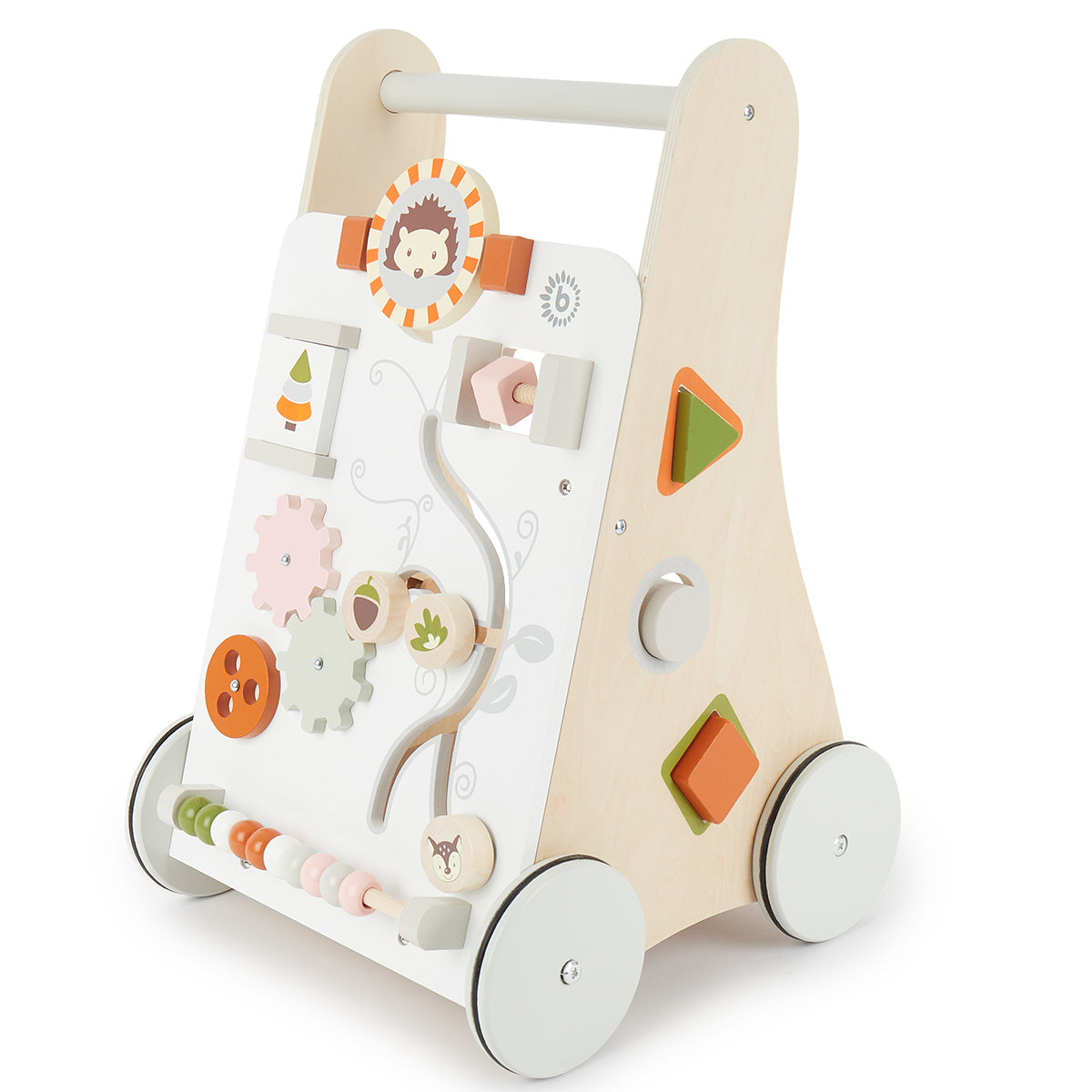
A wooden baby walker is a push-along cart that gives support while your little one practices their first steps. Wood often feels pleasantly "calm": a bit more weight, a sturdy feel at the handle – and it usually looks wonderful in a nursery. One important note up front (so nobody clicks into thin air): There are currently no products available in this wooden sub-collection – but you'll find suitable alternatives. The quickest way is via the parent hub Baby Walkers or – if you're more in the mood for "push & pull" – via Pull-Along and Push Toys.
If you'd still like to know what matters in a wooden baby walker, here is our compact guide. You'll find the longer background (including more in-depth comparisons) in our guides linked further below.
How can I tell a good wooden baby walker?
In short: Stability, controlled rolling behavior, and clean craftsmanship are what count. A wooden push walker is suitable for everyday use if it doesn't "run away" when your child leans on it, and if nothing feels sharp-edged or wobbly.
- Stable & tip-resistant: Wide wheelbase, sturdy body, no wobbling when leaned on.
- Baby walker with brake/speed reducer: ideal if your child tends to start off at full speed.
- Rubber tires / rubberized wheels: protects parquet floors and makes less noise.
- Easy-to-grip handle: easy to hold, not too thin, not slippery.
- Craftsmanship: Countersunk screws, smooth edges, nothing coming loose.
"Tip protection" means in everyday life: The walker stays put when your child pulls themselves up on it. It's not an official certification term, but a great search term for your gut feeling: If it wobbles during testing, it's usually too early for beginners or simply not the right fit.
Wood, wheels, brake: What really makes the difference in everyday life?
In short: For smooth floors, rubberized wheels and an adjustable brake are often worth their weight in gold. On parquet or tiles, what matters isn't "wood or plastic" but whether the walker stays controllable – and whether your nerves survive the noise level.
Rubber tires mean: less sliding, less clattering, more grip. Especially in rental apartments (or when a baby is sleeping next door), this is a real plus. On carpet, on the other hand, it's fine if it rolls a bit more easily – otherwise your child will tire themselves out before the walker moves forward.
A baby walker with a brake or speed reducer helps when the speed doesn't yet match the sense of balance. Some models have a brake, some have an adjustable rolling brake – what matters isn't the name, but that you can adjust the rolling behavior to your child.
From what age can a baby walker be used – and what's the difference from a baby bouncer walker?
In short: A push walker usually only fits once your child can stand securely and pulls themselves up. Then a wooden baby walker can support practice – but it doesn't replace free crawling, standing up, falling down, and getting back up again (yes, unfortunately that's part of it).
A push walker is something different from a walking aid (baby walker with a seat). According to BZgA/Kindergesundheit-info, walking aids in which children "sit and roll" are discouraged, because transitional phases can be shortened or skipped and the risk of accidents increases (e.g., falling down stairs). (Source: kindergesundheit-info.de)
If you're unsure whether "from what age" is already now: Better to start a notch slower. Alternatives such as pull-along toys, stacking toys, or wooden puzzles are often just as exciting at first – and less "speed-prone".
Safety & harmful substances: What guidance makes sense (without going into panic mode)?
In short: CE is mandatory, GS is a plus – and EN 71 helps with classification. For you as parents, this means: pay attention to clear information, warning labels, and reputable retailers rather than wading through standards texts.
CE is not a test mark, but it is required in the EU. The consumer advice center (Verbraucherzentrale) explicitly explains that the CE mark on toys is a manufacturer's declaration and not a test mark – nevertheless, you shouldn't buy toys without CE, because it is mandatory in the EU. (Source: Verbraucherzentrale, as of 28.11.2024)
GS can additionally help you, because it indicates independent testing. According to the Verbraucherzentrale, you should look for the GS mark when buying toys; it also explains that this indicates tested toys that meet legal requirements for safety and harmful substances. (Source: Verbraucherzentrale)
EN 71-3 is the part that describes chemical "release" (migration) from materials. DIN explains that DIN EN 71-3 deals with the migration of certain elements, naming among others heavy metals such as arsenic, lead, and mercury as well as further elements such as aluminum and nickel. (Source: DIN, 30.09.2019)
- For parquet: rubberized wheels + brake reduce sliding and noise.
- For carpet: better to have it roll easily, otherwise motivation gets "stuck".
- For getting started: always stay close by – especially near steps.
If there's no wooden baby walker available right now: good alternatives at BIECO
In short: For similar motor skill ideas, push toys, ride-on vehicles, and wooden toys are the quickest alternatives. A baby walker is just one building block – and kids are wonderfully pragmatic about it: as long as it rolls, stacks, or jingles.
- Push & pull: Pull-Along and Push Toys (often lighter and more flexible).
- More movement: Ride-On Vehicles (for kids who like to "step on the gas themselves").
- Wood in everyday life: Wooden Toys (motor skills toys that also work on the floor).
- Calm counterbalance: Wooden Puzzles (when concentration is called for rather than speed).
About BIECO: We are a family business from Hamburg – for 66 years. With us you'll find toys in modern Scandi design, made for family life: uncomplicated, easy to combine, and with clear product information so you don't have to guess.
Mini glossary (so the terms stick quickly)
Short definitions help when you're comparing products tired in the evening. Here it is in "parent-speak":
- Wooden baby walker / wooden push walker: Hold on, push, practice steps – without the child "sitting in" it.
- Activity baby walker: Push walker with play elements (board, spinning discs, sorter) – handy for breaks.
- Baby walker with brake: Rolling behavior can be slowed/calmed – good for beginners and smooth floors.
- Rubber tires: Rubber rings on the wheels that provide grip and dampen noise.
FAQ on wooden baby walkers
From what age can a baby walker be used – is there a rule of thumb?
A push walker usually only fits once your child can stand securely and pulls themselves up. Then they can control their weight through their hands and stop the walker better. If your child is still very wobbly, floor play, crawling, and standing up are often the more relaxed "motor skills booster".
What does an adjustable brake on a baby walker do?
A brake makes rolling more controllable – especially on parquet or tiles. If the walker rolls away at the slightest push, beginners quickly lose their balance. With a speed reducer/brake, the pace stays more at "I'm practicing" than "I'm chasing".
Are rubberized wheels really important?
For many homes, yes: Rubber tires are quieter and more slip-resistant. On smooth floors, this can make the difference between the baby walker "walking along" or "running away". On carpet it's less critical – the floor often provides enough braking already.
How can I recognize a tip-resistant wooden baby walker?
A tip-resistant walker has a wide stance and doesn't wobble when leaned on. Test (if possible) with light pressure on the handle forward/sideways: If it immediately lifts or wobbles, it's probably not for getting started. And of course: Especially at the beginning, always stay close by.
What guidance is there on safety and harmful substances in toys?
CE is mandatory, GS is a helpful extra – and EN 71 classifies chemical aspects. The Verbraucherzentrale explains that CE is not a test mark but is required; in addition, the GS mark is cited as tested guidance. (Source: Verbraucherzentrale)
Finally: If you want "everything at a glance" again, the quickest way is via the hub. In the parent hub Baby Walkers you'll see all variants – and as soon as wooden models are available again, you'll land back here from there.
More knowledge (if you're in research mode right now): Baby Walkers: Worthwhile or Not? From What Age for Babies? • The Best Baby Walker 2024: What to Look for When Buying? • Baby Walkers Made of Wood or Plastic • Using a Baby Walker Correctly
By Ulli & Flo · Owners & parents More about us ↓

About this page
Ulli & Flo
Owners of bieco · Hamburg · parents ourselves
What we like about wooden push walkers is that they often run quietly indoors, especially with rubber tyres. And if there's no suitable model right now: no stress, motor skills can be encouraged wonderfully "without a walker" too.