Wooden Push Walker: Wood or Plastic – How to Choose the Right One
At a glance
- A wooden push walker often feels calmer because it usually has a bit more weight.
- More important than the material: wheels, speed control and a safe place to practise.
- The right time to start is usually when your child can stand steadily and pull up to standing.
- EN 71 helps you check whether the basic toy safety requirements are met.
- The best way to decide between wood and plastic is by looking at your floors, space and your child's temperament.

Wood or plastic: the “right” choice is the one that rolls safely and calmly in your home. If you have a wooden push walker in mind, everyday life comes down to three things: speed (please, no race car in the hallway), stability (so your child doesn't tip over forwards) and your living situation (floors, space, stairs). Here you'll find a practical decision guide, a small comparison table and clear criteria – no wagging finger, but with an eye for those typical “just for a second” moments.

Ulli & Flo
Owners of bieco · Hamburg · parents themselves
We've noticed that as soon as a walker is too fast, it gets stressful for everyone. With a few simple checks (floor, wheels, speed), the decision becomes really relaxed. Feel free to browse our push walkers collection.
What is a push walker – and what isn't it?
A push walker is a walking aid that your child pushes in front of them while standing. Your child holds on to the handle and sets the pace themselves – ideally slowly and in a controlled way. A push walker is therefore something different from a classic sit-in baby walker.

A sit-in baby walker is a seat frame on wheels that moves differently. In this article we stick to push walkers, because control over posture and speed works in a completely different way here.
Wooden push walker: when does wood make sense?
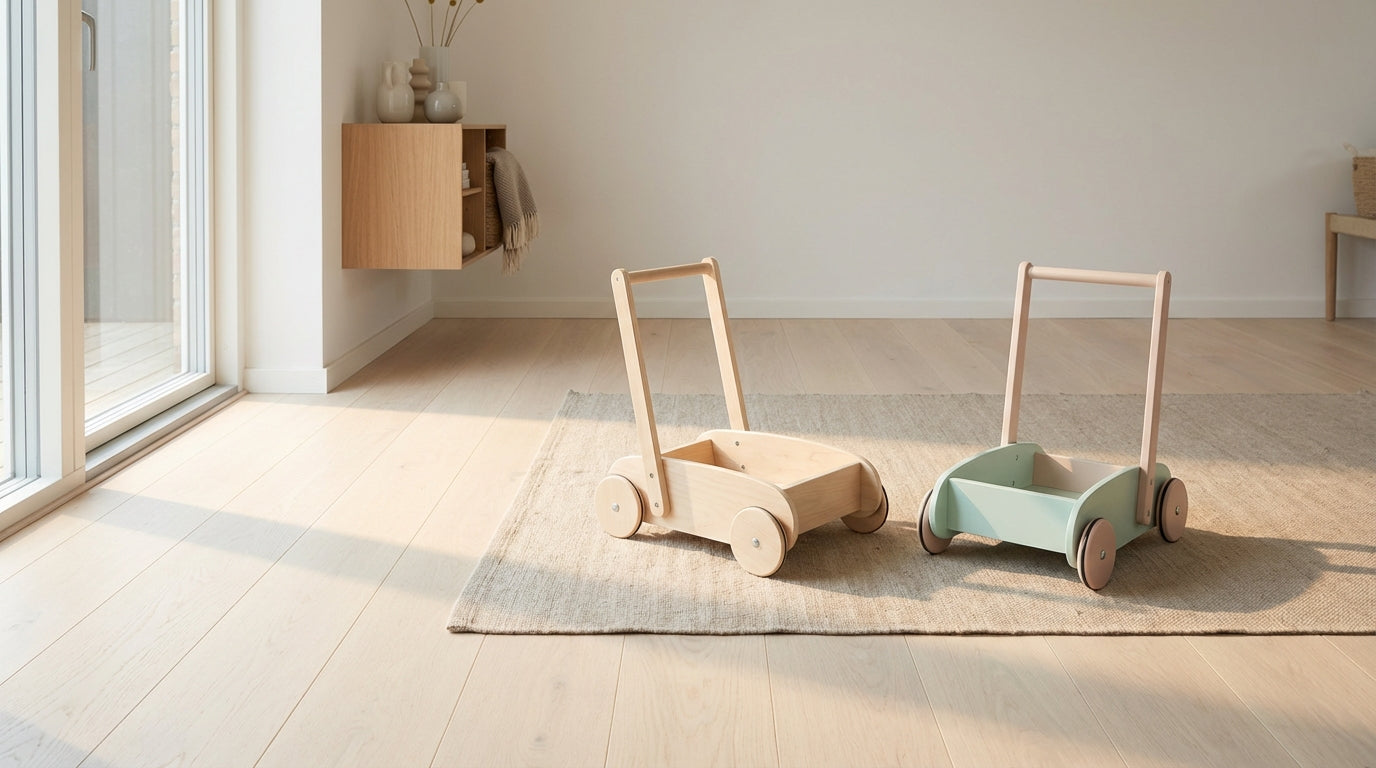
A wooden push walker makes sense when stability and “calm rolling” matter. Many wooden models are heavier – that can help at the start, because the walker doesn't shoot forward with every tiny push. Especially if your child is still wobbly, this often feels safer.

Wood isn't automatically “better” – workmanship and details are what count. Look for neatly sanded edges, firmly attached parts and a construction that doesn't feel wobbly. According to the consumer advice centre Verbraucherzentrale NRW, with toys you should make sure that no small parts come loose and that paints and varnishes meet the requirements of the toy standard (e.g. DIN EN 71-3), according to Verbraucherzentrale NRW.
Practical tip: If you're unsure, put the walker on your own floor and give it a push with one finger. “Gentle” is good, “zoom, straight to the skirting board” is not.
Plastic push walker: when is plastic more practical?
Plastic is practical when you need light weight and quick stowing away. If you rearrange often, have little space or regularly carry the walker into another room, you'll be glad of every kilo saved. And yes, wiping it clean is often quick – which in family life is about as welcome as a quiet cup of coffee.
But light can also mean “speedy” – which is why wheels and speed matter. On smooth floors, a very light walker can roll away faster. Then non-slip wheels, a good footprint and (if available) a brake or speed control help.
From what age does a wooden push walker make sense?
A wooden push walker usually makes sense once your child can stand steadily and pull up to standing. That is often more important than a specific number of months. Many manufacturers give an age recommendation – it's a good starting point, but in everyday life your child's motor skills decide.
A good “start test” is: pulling up works, standing looks stable, hands stay on the handle. If your child can hold on to the handle without immediately tipping forward or hanging their full weight on it, chances are good it will be a success story. If they're still very wobbly, it quickly gets frustrating – for child and parents alike.
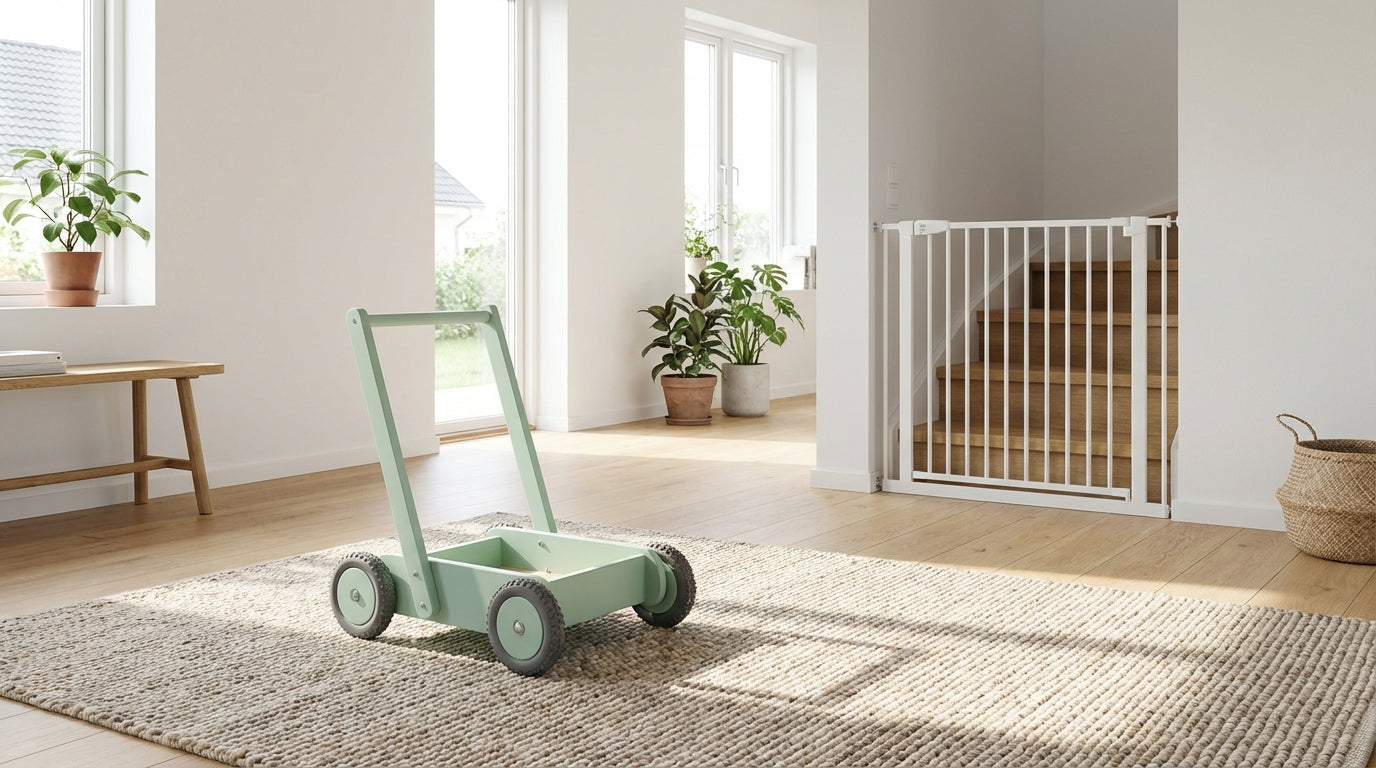
Safety note: Don't practise near stairs, edges or open doors – the “just for a second” moments are sadly the least reliable.
How can I tell a safe push walker (wood or plastic)?
Safety depends less on the material than on construction, standards and use. A solid walker has a stable base, no sharp edges, no easily detachable small parts and rolls in a controllable way. And it fits your child's size – handle height and stance are real spoilers when they're not right.

The EN 71 series of standards describes basic safety requirements for toys. According to DIN, EN 71 covers, among other things, mechanical/physical properties, flammability and (via EN 71-3) the migration of certain elements, according to DIN Deutsches Institut für Normung e. V..
In everyday life, speed control is often the single most important point. Non-slip wheels (for example rubber tyres) help on laminate, tiles or parquet. If a model has a brake or adjustable rolling speed, that's a real stress reducer in many homes.
Wood vs. plastic: decision matrix by living situation & child
The best choice comes from floors, space and temperament – not from gut feeling. Take a quick look around your home (yes, the hallway too) and think: where will you practise? How smooth is the floor? How fast is your child when something looks “exciting”?
| Your situation | Wood may be the better fit if … | Plastic may be the better fit if … |
|---|---|---|
| Smooth floors (laminate/tiles/parquet) | … more weight + non-slip wheels keep the speed calm. | … the wheels really grip well and the walker isn't too light. |
| Lots of rugs / raised edges | … the walker stays stable without catching on edges. | … you want something light that is easy to move around. |
| Little space / frequent tidying away | … you have a permanent “parking spot” and the weight doesn't bother you. | … you often have to carry the walker or put it in a corner. |
| Child is cautious, feels their way forward | … the walker stands calmly and gives confidence. | … the model is sturdy and doesn't feel “wobbly-light”. |
| Child is very fast / “full steam ahead” | … speed and tip stability are easy to control. | … there is good speed limiting and the wheels don't slip. |
| You want long play use (even after walking) | … sturdy workmanship and play value (activities/box) are right. | … the play value is high and the surface stays practical for everyday use. |
Practical tip: For the first few days, a “practice path” is often enough: 2–3 metres of clear space, a rug as a brake, no cables – and things get much more relaxed.
Everyday life: typical floor scenarios (and what really helps)
Most stumbling blocks aren't the material, but your floor and surroundings. From experience (and yes, also from the typical questions that keep coming up among family and friends), these three classics come up most often:
- Hallway = runway: Smooth, long, “runs” well. Non-slip wheels and speed control are especially important here.
- Rug edge = mini mountain: Some walkers get stuck or tip more easily. A calm, sturdy walker helps – and if possible, smooth out the edges.
- Living room = toy slalom: The more little things lie around, the more “practising” turns into an obstacle course. Clearing the way briefly works wonders.
A multi-activity push walker combines pushing with play elements on the walker. That's handy if your child likes to stand and play, but when it comes to walking still thinks: “You go ahead, I'll watch.”
Why we at BIECO are so picky about this
We are a family business from Hamburg – and have been making children's products for 66 years. That's why, with wooden push walkers (and plastic ones too), we're more Team “honest and safe” than Team “looks pretty, it'll be fine”. Ulli & Flo write here as parents for parents: if details on age, care or standards are missing, asking isn't mistrust – it's common sense.

Transparency matters with toys: materials, care and test information should be clearly stated. When you look at models, check whether standards information (such as EN 71) and care instructions are clearly given – that helps in everyday life more than any superlative.
If you'd like an overview, feel free to start here. In the push walkers collection you'll see different variants, and under wooden push walkers you'll find wooden models specifically.
And if you're still stuck on the basic question “walker – yes or no?”, the guide next door can help. Read Push walkers: Worth it or not? From what age for babies? – and if you'd rather start without a walker: Alternatives to push walkers.
FAQ
Is a wooden push walker worth it?
Yes, if stability and controlled rolling are what matter most to you. Wooden models are often heavier and therefore feel calmer to push. Workmanship remains important, though: no detachable small parts and suitable paints/varnishes; Verbraucherzentrale NRW explicitly points this out for toys.
From what age can a wooden push walker be used?
Usually when your child can stand steadily and pull up to standing with stability. Many manufacturers give an age recommendation (often around the time children start walking), but in everyday life motor skills count: hands stay on the handle, your child doesn't tip forward and can regulate the speed at least a little.
Is a wooden push walker safe?
It is safe when construction, standards information and use fit together. Look for stability, no sharp edges, no easily detachable parts and controllable rolling behaviour. EN 71 helps with orientation: according to DIN, the series of standards describes requirements for safe toys.
Wood or plastic for a push walker – which is better?
The better material is the one that rolls slowly and steadily in your home. On smooth floors, wood often has a calming effect thanks to its higher weight, while plastic is often easier to carry and put away. What matters are the wheels, speed control, handle height and whether you have stairs, edges or very little space.
What is more important than wood or plastic?
Wheels, speed and your surroundings are the real stars of the show. Non-slip tyres, a stable centre of gravity and enough clear space make the start safer. Add to that the classic: stairs and edges are no-go zones, and a short “practice path” without cables and clutter saves your nerves.
How long can you use a wooden push walker?
Often beyond the first steps, if the walker also has play or transport value. Many children later push soft toys, building blocks or “important deliveries” around the house. For that, look for sturdy wheels, easy-care surfaces and a build that doesn't wobble even after many laps.
Conclusion: A wooden push walker is a good choice if you need stability and calm rolling. If, on the other hand, you rearrange a lot or have little space, plastic can be more practical – as long as wheels and speed are right. If you'd like to take a look now: in our push walkers you'll find various variants, and under wooden push walkers the wooden models specifically.