Baby Walker Alternatives: The Best Ideas Instead of a Baby Walker
At a glance
- Baby walker alternatives: floor time is usually the biggest step forward.
- Only use a push-along animal or push wagon once your child can stand steadily.
- DIY walking course: low, soft, non-slip – and quick to rearrange.
- Fewer "seated devices", more free movement: the NHS gives a guideline of no more than 20 minutes at a time.
- Take warning signs seriously (asymmetries, standstill, pain) and check in with your paediatrician.

The best alternatives to a baby walker are free, safe movement time on the floor – plus a few simple play ideas for pulling up and balancing. It sounds like "bought nothing, yet achieved something" – but that is exactly what babies need to learn to walk. Here you'll find a practical guide: when a push-along animal makes sense, how much floor time per day is realistic, how to build a DIY walking course, and how to tell when it's better to ask once more than once too few.

Ulli & Flo
Owners of bieco · Hamburg · parents themselves
We would have loved a shortcut back then, too – but in the end, a rug, cushions and patience worked best for us. And yes: rearranging counts as entertainment. Feel free to browse our walking wagons collection.
A "baby walker" is a seated walking aid on wheels that babies are placed into. It is the type that lets babies zoom through the home quickly – and that is why safety experts view it critically, above all for safety reasons.
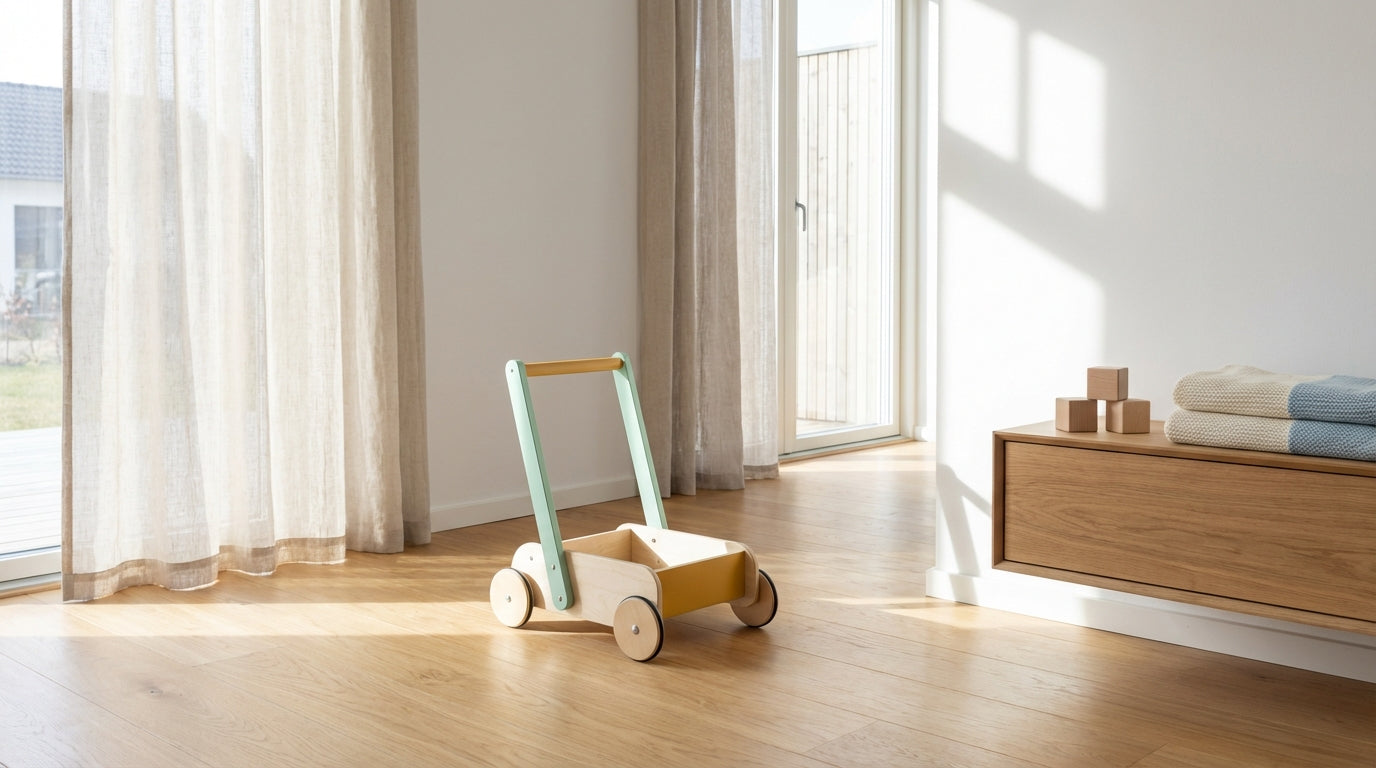
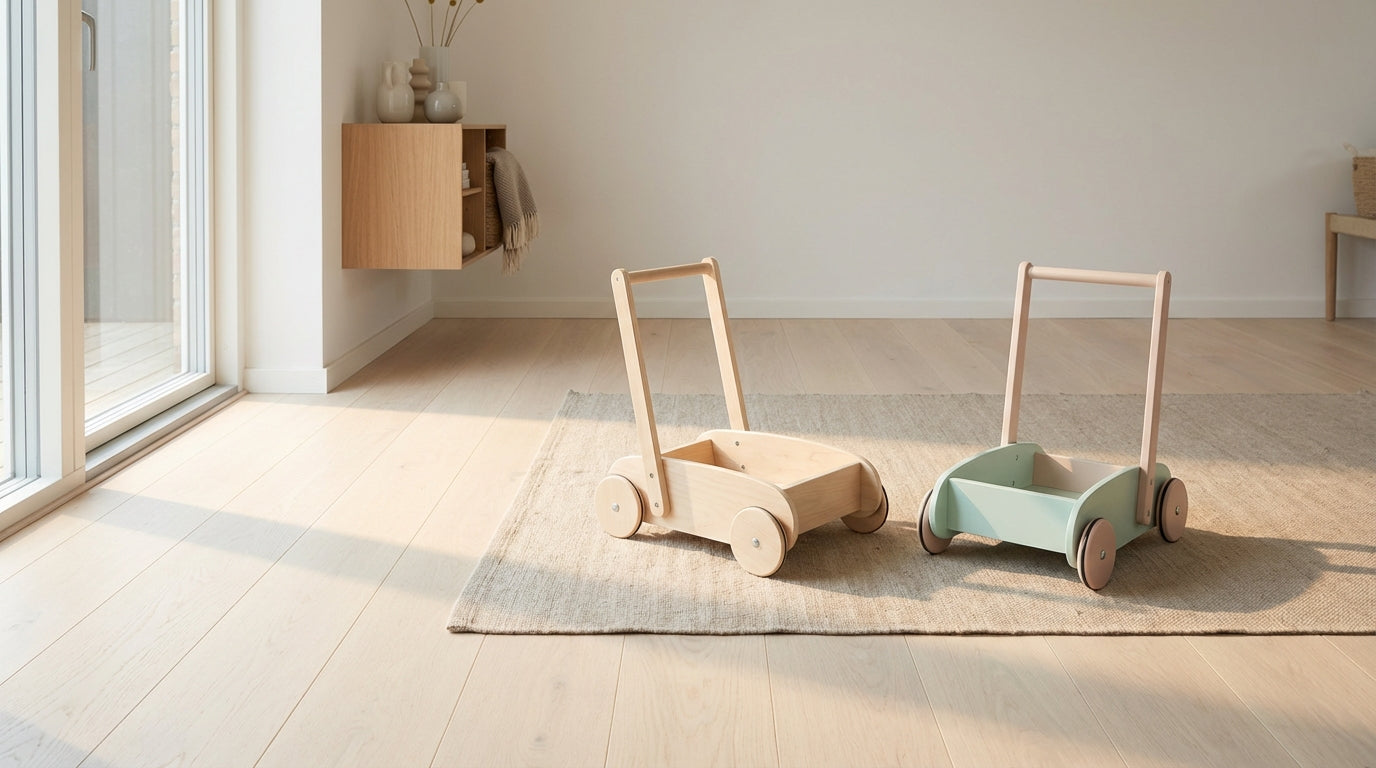
A push-along walking wagon is a wagon your child holds onto while standing. Its benefit is that your child sets their own pace, can let go at any time and practises balance along the way – in everyday life, that is an important difference.
What alternatives are there to a baby walker?
The most useful alternatives are all those that enable movement rather than "take it over". Babies learn to walk through many small intermediate steps: rolling, crawling, creeping, pulling up, cruising sideways along furniture – and only then the first free steps. According to the NHS, babies should not spend too long at a stretch in seats/walkers/bouncers; as a guideline they say "no more than 20 minutes at a time" (NHS).
- Free floor time on a non-slip surface – room to roll, creep and crawl.
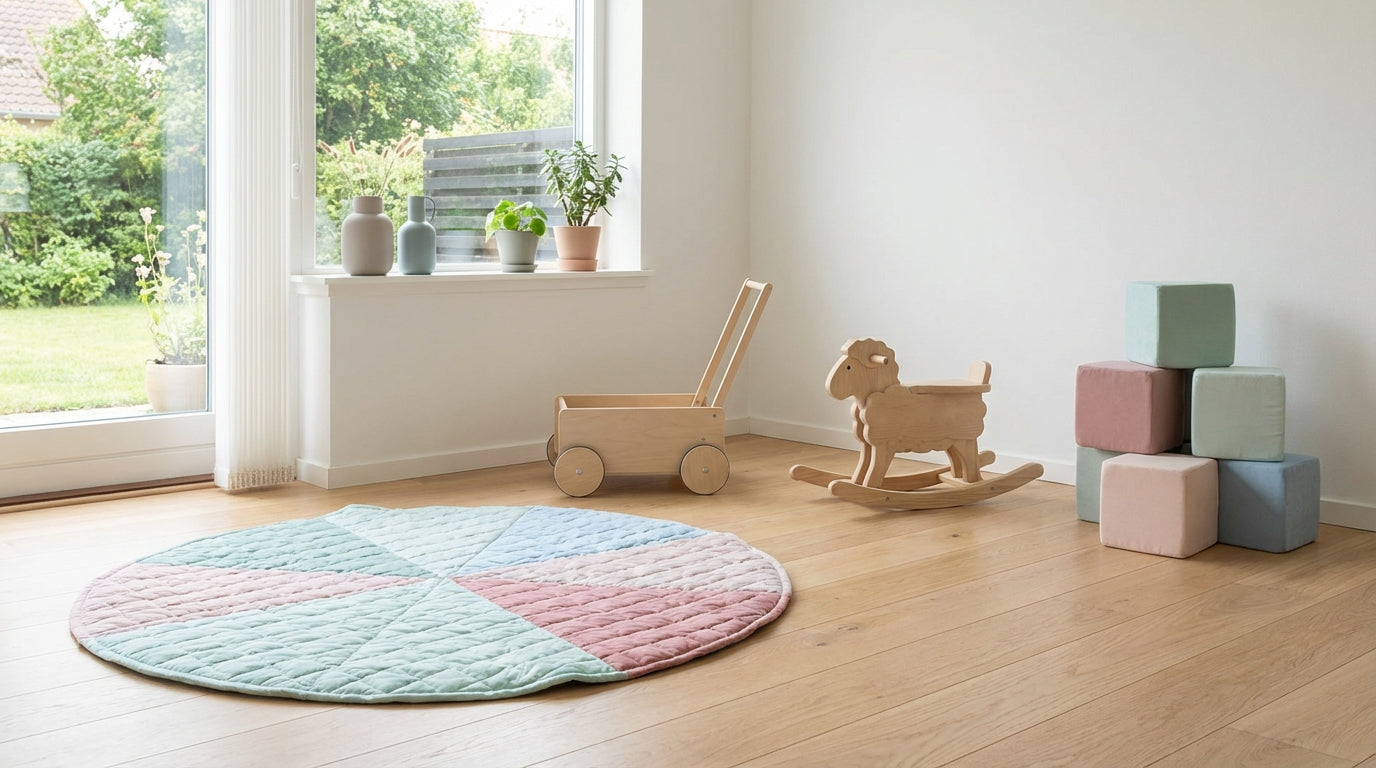
- Crawling and climbing course made of cushions & boxes – low, soft, easy to oversee.
- Sturdy furniture for pulling up – secured, without a tablecloth, with no risk of tipping.
- Push-along animal or push wagon – only once your child can stand steadily.
- Stationary activities (short!) – for when you need both hands, but without the "rolling speed".
Practical tip: If your baby seems "under-challenged": move 2 safe things around (cushion, laundry basket, box). New world, same rug.
When does a push-along animal or push wagon make sense?
A push-along animal usually only makes sense once your child can stand securely and steadily. Not "because it looks cute", but because while pushing, your child shifts their weight, lets go, grabs again and doesn't constantly tip forward. Many babies in the "pulling up & cruising sideways" phase are still better off with a furniture edge, the sofa and floor time.
- Good sign: Your child pulls themselves up and stands steadily for a few seconds.
- Wait a little longer: They hang in a hollow back, often stand on tiptoes or tip forward quickly.
- Make the start easy: Short distances first, ideally on a rug rather than a smooth floor.
How much floor time per day makes sense (without driving you up the wall)?
Many short bouts of floor time spread throughout the day are more practical than "one big session". Babies learn through repetition – and parents through coffee cups that finally don't get knocked over. As a rough guideline: less "parked", more freely moving. The NHS also gives as a guideline not to leave babies in seats/walkers/bouncers for longer than 20 minutes at a time (NHS).

- Mini portions count: 5–10 minutes here, 5 minutes there – it all adds up.
- Floor time can happen "on the side": while you sort laundry or rescue dinner.
- Change position: on the back, tummy time (awake & supervised), on the side, crawling.
What really supports babies instead of a baby walker (and why)
Motor skills develop through strength, coordination and balance – not through speed. When babies play on the floor, they automatically train core tension, shoulder girdle, hip stability and balance. That is the foundation for walking freely. According to Nationwide Children's Hospital, baby walkers increase the risk of injury and offer no real "learning advantage" for walking; they advise against using baby walkers (Nationwide Children's Hospital).
- Tummy time – strengthens neck, back and shoulders (only when awake & supervised).
- Crawling – promotes coordination, weight shifting and body symmetry.
- Pulling up & cruising sideways – trains balance and leg-axis control.
- Barefoot on a safe surface – feet "work" better when they can feel.
DIY: Walking course step by step (safe, soft, quickly built)
A good DIY course is low enough for a "plop" and soft enough to keep laughing. You don't need gym equipment – more the courage to let your living room look like a small building site for 20 minutes. (As we say in northern Germany: it passes. Mostly.)

Materials list (from around the house)
You only need things that are sturdy and won't slide away. This is perfectly enough in most homes:
- Non-slip surface (rug, play mat)
- 2–4 large sofa cushions (no small decorative cushions with buttons)
- 1 sturdy cardboard box (without staples, secure edges with tape if needed)
- 1 laundry basket (turned upside down as a "cave" or "gate")
- 1–2 favourite toys as a "goal"
Set-up in 10 minutes
Build the course so that your baby can always reach a "safe zone". That keeps motivation high – and you have less "rescuing" to do.
- Lay out the surface: rug/mat as a non-slip base.
- Build cushion islands: 2 cushions flat, 1 cushion slightly raised – like little hills.
- Tunnel or gate: cardboard box as a tunnel (leave the sides open) or laundry basket as a gate.
- Pull-up station: sofa or sturdy coffee table (without tablecloth, decorations or wheels).
- Set a goal: place a toy so that your baby has to move – but doesn't get frustrated.
Safety note: Watch out for exposed edges, no strings/cords, no small parts, and secure the area against stairs. According to Nationwide Children's Hospital, falls and reaching sources of danger are key risks with baby walkers (Nationwide Children's Hospital).
3 course variations (when you need some variety)
Variety comes from rearranging, not from buying new things. Three ideas that can be rebuilt in 1–2 minutes:
- Cushion snake: cushions as a "trail" to crawl along, with the goal toy at the end.
- Cave loop: laundry basket cave + cardboard tunnel one after the other, with a free mat in between.
- Stand-and-reach station: pull-up point at the sofa, with toys nearby at a low height to grab.
Practical tip: Course rule no. 1: better to spend 2 minutes rebuilding than 20 minutes persuading. Babies are brutally honest about this.
A safe space instead of a "device": what helps most in everyday life
A child-safe area makes practising motor skills easier – for your baby and for your nerves. Because when you don't constantly have to call "No, not there!", there's more room for real exploring. And yes: that is a form of support, too.

- Secure the stairs – stair gate, doors closed.
- Hot & sharp things out of reach – cables, pots, oven front, drinks.
- Secure wobbly furniture – shelves/chests of drawers fixed to the wall, no tablecloths as a "pull rope".
- Create a non-slip zone – rug/mat instead of a "sock-skating rink".
Warning signs: when is it better to ask once more?
If something really makes you wonder, your paediatrician's practice is the best place to turn. Not because something serious must be going on, but because a quick look from professionals is often very reassuring. And sometimes a small tip on posture or practising is worth its weight in gold.
- Clear asymmetry (e.g. always only one side, a pronounced "lopsidedness")
- Obvious pain when moving, standing or sitting up
- Sudden standstill or regression over a longer period, without illness/developmental leap as an explanation
- Very noticeable foot position or permanently walking/standing on tiptoes
If you still want "something": what to look for in push wagons & co.?
If you want to buy something, choose something to hold on to rather than sit in. For many families this is the pragmatic middle path: your child stays active, you have a clear play offer, and it feels like support – without your baby suddenly being faster than you.
- Stability – wide stance, no "tipping feeling" when leaning on it.
- Calm rolling behaviour – better slow than a "rocket in the hallway".
- Suitable handle height – so your child doesn't fall into a hollow back.
- Clean workmanship – no sharp edges, no small parts that could come loose.
If you'd like to look at push wagons: you'll find an overview in our category. Head over to walking wagons; and if you like wood, you'll also find wooden walking wagons there.
And because trust is worth something too: we are a family business from Hamburg and have been doing this for 66 years. Ulli & Flo write here from a parent's perspective – and when it comes to materials, standards and safety, we try to stay clear rather than sound polished.
Are baby walkers banned in Germany?
In Germany there is (as far as we currently know) no general ban like in Canada, but there are clear safety warnings. Canada banned baby walkers in 2004; the Canadian government published this via Health Canada (Health Canada). Regardless of the legal situation, the key point is risks and home safety.
FAQ
What alternatives are there to a baby walker?
The best alternative is free movement on the floor in a safe environment. Crawling and climbing set-ups, pulling up on sturdy furniture and, later, push-along animals help as additions. According to the NHS, babies should not spend too long at a stretch in seats/walkers/bouncers; as a guideline they say a maximum of 20 minutes at a time (NHS).

What is the difference between a walking wagon and a walking aid (baby walker)?
A baby walker is a seated device on wheels, while a walking wagon is pushed while standing. With a push wagon, your child stays active, sets their own pace and posture and can let go at any time. With a baby walker, the child is "made mobile", which can be problematic above all for safety reasons (Nationwide Children's Hospital).
When does a push-along animal make sense?
Usually only once your child can stand securely and hold on in a controlled way. Good signs are steady standing and first sideways steps along furniture. Start with short distances on a non-slip surface. If your baby tips forward strongly while holding on, it's better to wait a little longer.
How much floor time per day is good?
Many short sessions spread throughout the day are the most realistic option for most families. The aim is: let your baby move freely as often as possible and keep "seated devices" rather short. The NHS gives as a guideline not to leave babies in seats/walkers/bouncers for longer than 20 minutes at a time (NHS).
Does a baby walker delay walking?
According to experts, a baby walker offers no learning advantage for walking. Nationwide Children's Hospital writes that baby walkers offer no benefit for walking and increase the risk of injury; they advise against using them (Nationwide Children's Hospital). If you're unsure, rely on floor time and pulling up instead.
When should I see a doctor if my baby doesn't want to walk?
If clear asymmetries, pain or a longer standstill worry you, ask at your paediatrician's practice. Many differences in pace are normal, but a quick professional look can be reassuring and helps if support is really needed. You don't have to "google" it all on your own.
Conclusion: baby walker alternatives are mostly simple – and that's exactly why they work so well. With safe floor time, a small DIY course and (later) a sturdy push wagon, you give your baby what they really need: practice, freedom and a little courage. If you're looking for suitable companions, feel free to take a look at our walking wagons.