The Best Baby Walker: How to Find the Right Model
At a glance
- The best baby walker: sturdy, controllable, and suited to your flooring.
- Check first: tip resistance, smooth rolling, and an easy-to-grip push handle.
- Rubber wheels are often quieter and gentler on floors than hard wheels.
- A brake or rolling resistance helps especially on parquet, laminate and tiles.
- Look for clear age recommendations, warning notices and traceable testing information.

The best baby walker is the one that stands securely and doesn't race away. That's exactly what this guide is about: a practical selection aid for your home, your flooring and your child's speed – with a checklist, mini tests and a little decision guide at the end. And don't worry: you don't need to be an engineer or a wood whisperer. A bit of common sense is enough (and as a parent, yours is already running around the clock).

Ulli & Flo
Owners of bieco · Hamburg · parents themselves
We still remember the first “whoosh!” across the tiles – that's when you suddenly learn to appreciate speed control. With the checklist here, you'll find a model that rolls smoothly and saves your nerves more quickly. Feel free to browse our baby walkers collection.
What is the best baby walker?
“Best” means safe, sturdy and right for your child's stage of development. A baby walker is a push aid that children hold on to while practicing free walking. Definition (quotable): A baby walker is a pushable walking aid with a handle that accompanies children while they practice walking, without holding or carrying the child.
What makes one “the best” has less to do with design (even though we've all fallen for “cute” at some point) and more to do with three basics:
- Stability: The walker doesn't tip over when your child leans on it from the side.
- Controllable rolling: It rolls evenly and not like a shopping cart with a mind of its own.
- A good grip: The push handle is easy to hold, with no sharp edges or splinters.
For basic safety requirements, the EU Toy Safety Directive 2009/48/EC applies, according to EUR-Lex. (Source)
Quick reality check: Who is a baby walker actually for?
A baby walker is a good fit when your child can stand securely and pulls up to standing. Then pushing can be a lovely addition – without pressure, without any “come on, let's go.” Some children love it right away, others find cardboard boxes, chairs or your knees far more exciting. That's okay too.
Above all, it's important not to see the walker as an “accelerator,” but as a companion. And to think about your everyday life: narrow hallways, rug edges, door thresholds – those are the real final bosses.
Safety note: Only use baby walkers on even, clear surfaces and stay within arm's reach. Secure or avoid stairs, edges and thresholds beforehand.
Which baby walkers are good? The 60-second checklist
A good baby walker feels “calm”: sturdy, straight, no rattling. If you only have a moment to test (in the store or right after unpacking), these four mini checks will help:
- Wobble test: Push the walker gently from the side – does it stay stable or tip quickly?
- Roll test: Give it one push – does it roll evenly or pull to one side?
- Grip test: Is the push handle smooth, easy to grip and free of nasty edges?
- Screws/parts: Is everything firmly in place? Nothing may stick out or be loose.
Practical tip: Test the walker on your “worst” floor. Carpet is forgiving – tiles and parquet are honest.
If you'd like to get your bearings first: in the baby walker overview you'll see different designs (classic, with activity elements, with storage space). And if you prefer wood, wooden baby walkers are a good place to start.
Tip resistance: What makes a baby walker truly stable?
Tip resistance comes from a wide wheel stance, weight and a low center of gravity. “Tip-resistant” doesn't mean “indestructible,” but rather: the walker is more forgiving when your child leans on it from the side or briefly steers with their upper body while turning.

Definition (quotable): Tip resistance means that a baby walker doesn't easily tip over under lateral load and stays steady on its track while being pushed.
Pay particular attention to:
- Wide footprint: The wider the wheel stance, the more stably the walker stands.
- Weight: A bit of weight helps against tipping and rolling away.
- Low center of gravity: A low body rather than a tall, narrow structure.
- Wheels with grip: More friction can reduce slipping.
Wheels, brake, rolling resistance: So the walker doesn't “run off”
On smooth floors, the wheel combination determines speed and control. Many people only notice after the first “whoosh!”: the child holds on – the walker doesn't. Here, either a brake or adjustable rolling resistance (wheels that deliberately run a bit more heavily) can help.

Brake vs. rolling resistance – what's the difference?
A brake stops the walker on demand, while rolling resistance slows it gently and continuously. In everyday life, rolling resistance is often the more relaxed option, because the walker doesn't suddenly “lock up” but simply becomes less speedy. A brake can make sense when you really want to stop it (for example when parking it).
Rubber wheels, hard wheels, “quiet wheels” – what does what?
Rubber wheels are often quieter and slip less on smooth floors. Hard wheels can be faster on parquet/tiles and make more noise. Which option fits best also depends on how “fast” your floor is and how much space you have.
Floor types: parquet, tiles, laminate, carpet
The same walker behaves completely differently depending on the floor. Here's a little guide so you're not surprised in the living room:
| Floor | Typical behavior | What to look for |
|---|---|---|
| Tiles | Very smooth-running, fast | Rolling resistance/brake, wheels with grip |
| Parquet | Smooth-running, can be slippery | Rubber wheels, floor-friendly wheels, keep an eye on speed |
| Laminate | Similar to parquet, often “fast” | Rolling resistance/brake, steady straight-line tracking |
| Carpet | More resistance, slower | Easy-rolling wheels, not too heavy to push |
If you'd like “gentle rolling”: some products explicitly mention rubber tires and testing information – for example the Black & White Baby Walker (its product page describes rubber tires, water-based paints, standards information and independent testing for harmful substances, among other things).
Material & workmanship: wood, finishes, edges – everyday life decides
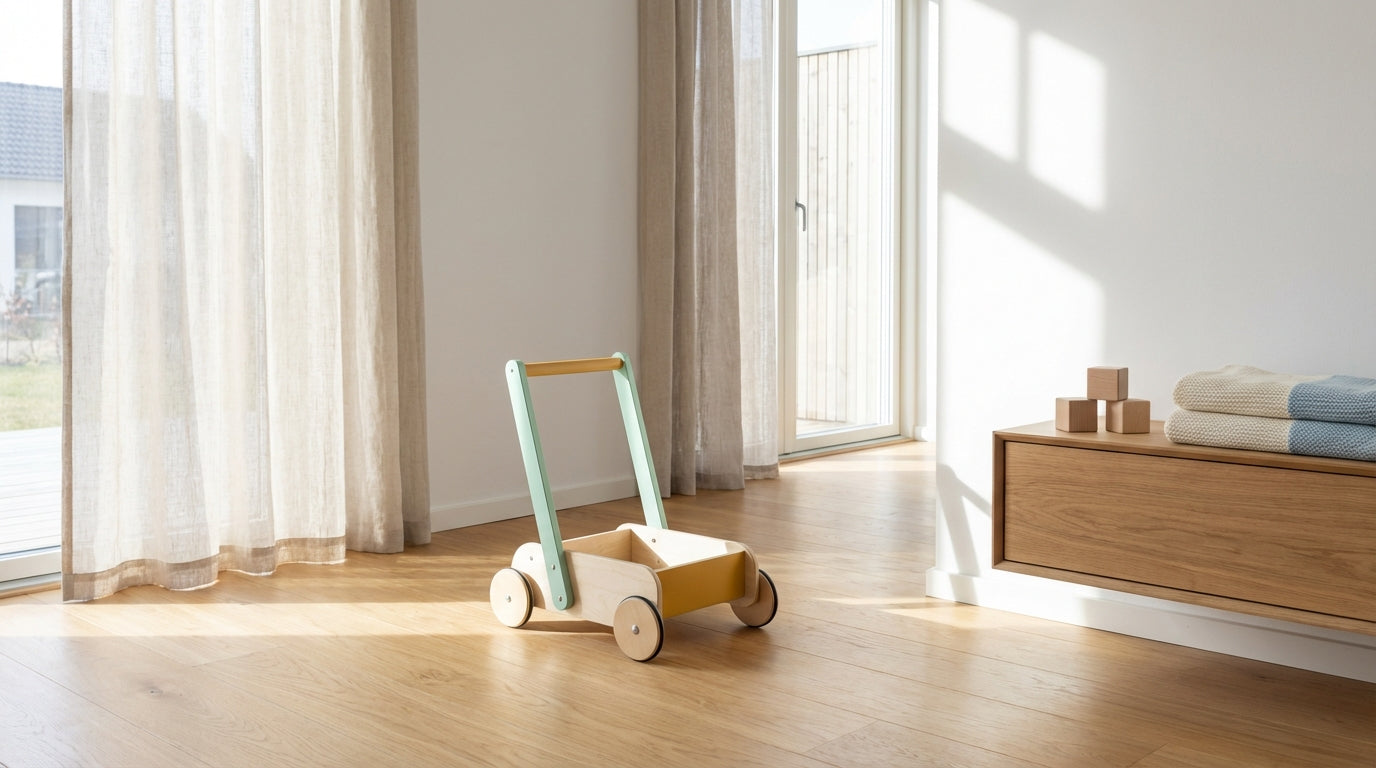
You can recognize good workmanship by smooth edges, firm joints and a neutral smell. Whether wood or a mix of materials: what matters is that everything is cleanly made. With wood, many people look at feel and durability – and at whether the walker still runs straight after months.

- Edges & corners: Round and smooth beats “ouch.”
- Surface: Can it be wiped with a damp cloth without everything suffering?
- Wheels: Quiet, grippy, floor-friendly – that saves your nerves.
- Screws/joints: Tightening them is normal; constantly loose is a warning sign.
Practical tip: Plan a “re-tightening moment”: after 1 week and after 1 month. After that, many walkers stay put for a good while.
If you'd like to look into the material question in peace: Wooden or plastic baby walker: What's better for my child? weighs up the pros and cons in an everyday-friendly way.
Standards & testing information: What you should really read
More important than a logo are clear age recommendations, warning notices and traceable testing information. In the EU, basic safety requirements for toys apply via Directive 2009/48/EC, according to EUR-Lex. (Source)
The EN 71 series is a family of standards for toy safety; Part 1 covers mechanical and physical properties, according to DIN Media. (Source)
Translated into practical terms, that means for you:
- Age recommendation: Does it really suit your child (not just the occasion)?
- Warning notices: Read them once – it saves arguments with yourself later.
- Transparency: Specific standards information and references to testing are a good sign.
Extras: useful, nice – or more of a tripping hazard?
Extras are good if they don't make pushing harder or less safe. Motor-skill elements can be fun, but the walker is first and foremost a walking aid. If there's a lot of “action” at the front, some children tend to stand at the side – and that's often wobblier when pushing.
Everyday-friendly extras:
- Storage space: For teddy, building blocks and that one sock that's always left over.
- Quiet wheels: For your nerves, the neighbors and nap time.
- Easy assembly: Saves the classic “Where is part C?!” search.
If storage space is high on your list: the Baby Walker Box combines pushing and carrying. (Whether that counts as tidying up is up to your child. Usually not.)
Mini decision guide: How to quickly find “your” model
The best choice is the one that fits your floor, space and your child's speed. Here's the little checklist we promised – to save in your head or in the family chat.
| If you… | Then pay special attention to… |
|---|---|
| have a lot of tiles | Rolling resistance/brake, wheels with grip, steady straight-line tracking |
| have parquet or laminate | Rubber wheels (quieter, floor-friendly), speed control |
| have a lot of carpet | easy-rolling wheels, not too much weight (otherwise it becomes hard work) |
| have little space | compact design, good maneuverability, no “front attachments” that get caught |
| have a very brave child | wide footprint, sturdy construction, speed control |
A word from family life (without the big fuss)
We've been making toys for 66 years – and we test a lot of them the way families actually use them. As a family business from Hamburg, we keep getting feedback in everyday life about what really counts: quiet wheels, sturdy workmanship and clear safety information. And yes: we like to be transparent – when we say something about materials, standards or testing, it should be traceable.

FAQ
What is the best baby walker?
The best baby walker is the one your child can push safely and in a controlled way. Look for stability, smooth rolling (ideally with grippy wheels) and an easy-to-grip push handle. “Best” doesn't mean “most expensive,” but right for your floor, space and pace.
Is a baby walker with a brake necessary?
A brake isn't always necessary, but it can help a lot on smooth floors. If you have a lot of tiles, laminate or parquet, a brake or rolling resistance takes the speed out. What's important is that the effect is even, so the walker doesn't pull to one side.
Which baby walkers are good for parquet?
For parquet, grippy, floor-friendly wheels and speed control are especially important. Parquet is often “fast” and immediately shows whether a walker rolls away too easily. Also look for clean workmanship so nothing scratches or has sharp edges.
How can I recognize a tip-resistant baby walker?
You can recognize tip resistance by a wide wheel stance, solid weight and a stable construction. Do the sideways push test: if the walker tips right away, that's not a good start. And in everyday use: clear space, no thresholds, and you stay nearby.
What's better: wood or plastic?
“Better” depends less on the material than on workmanship, wheels and stability. Wood is often chosen for its feel and durability, while plastic can be lighter. What matters are smooth edges, all parts sitting firmly, and controllable rolling on your floor.
How do I care for a baby walker in everyday life?
Usually, wiping with a damp cloth and occasionally re-tightening the screws is enough. Remove dust and crumbs from the wheels so nothing grinds. If the walker creaks or wobbles, check the joints and re-tighten them according to the instructions. When in doubt, it's better to check once more than to think “it'll be fine.”
Conclusion: The best baby walker makes things safer – not faster. If you prioritize stability, controlled rolling and clean workmanship, you're on the relaxed side. To browse, you'll find different models in our baby walker overview – with clear information on materials and product safety.