Is a Push Walker Worth It? When Is Your Baby Really Ready?
At a glance
- A push walker usually makes sense only once your baby can stand steadily and “cruise”.
- A sit-in baby walker (a seat on wheels) is considered unnecessary and accident-prone.
- Stability + braked wheels + a stair-free space are half the battle.
- Short, happy sessions are enough – learning to walk happens along the way.
- Alternatives like floor time, climbing and push toys without wheels always work.

A push walker is worth it when your baby can already stand steadily and hold on securely. At that point it is more of a “walk-along companion” for pushing – not a shortcut to the first step. Many of the debates are actually about a different device: the sit-in baby walker (a seat on wheels). Child safety organizations and pediatricians have viewed it critically for years. Here you get a calm, practical overview: when it fits, what to look out for in terms of safety, which alternatives exist – and how to avoid adding extra stress for yourself along the way.

Ulli & Flo
Owners of bieco · Hamburg · parents themselves
We remember that mix of “Hooray!” and “Oh dear…” at the first steps very well. With a little calm, a safe environment and short sessions, things get more relaxed for everyone. Feel free to browse our push walkers collection.
How useful is a push walker, really?
A push walker is mainly useful as support for walking along and pushing. Many children love that “I can do it myself!” feeling when the walker rolls along in front of them. That can be motivating – and motivation is sometimes the hardest currency in baby life. Still: a push walker is not a must-have, and it is not a magic wand either.

A push walker is a toy, not a training device for walking. In practical terms, that means it can give your child safe support while they are practicing anyway. But actually learning to walk comes from lots of free movement: turning, crawling, creeping, pulling up, plopping down, getting back up.
If your baby is still wobbly, the walker quickly becomes a slippery ride. Then it isn’t the child pushing the walker, but the walker pushing parents’ nerves to the limit. (And yes: the big toe reliably finds every table edge in the process.)
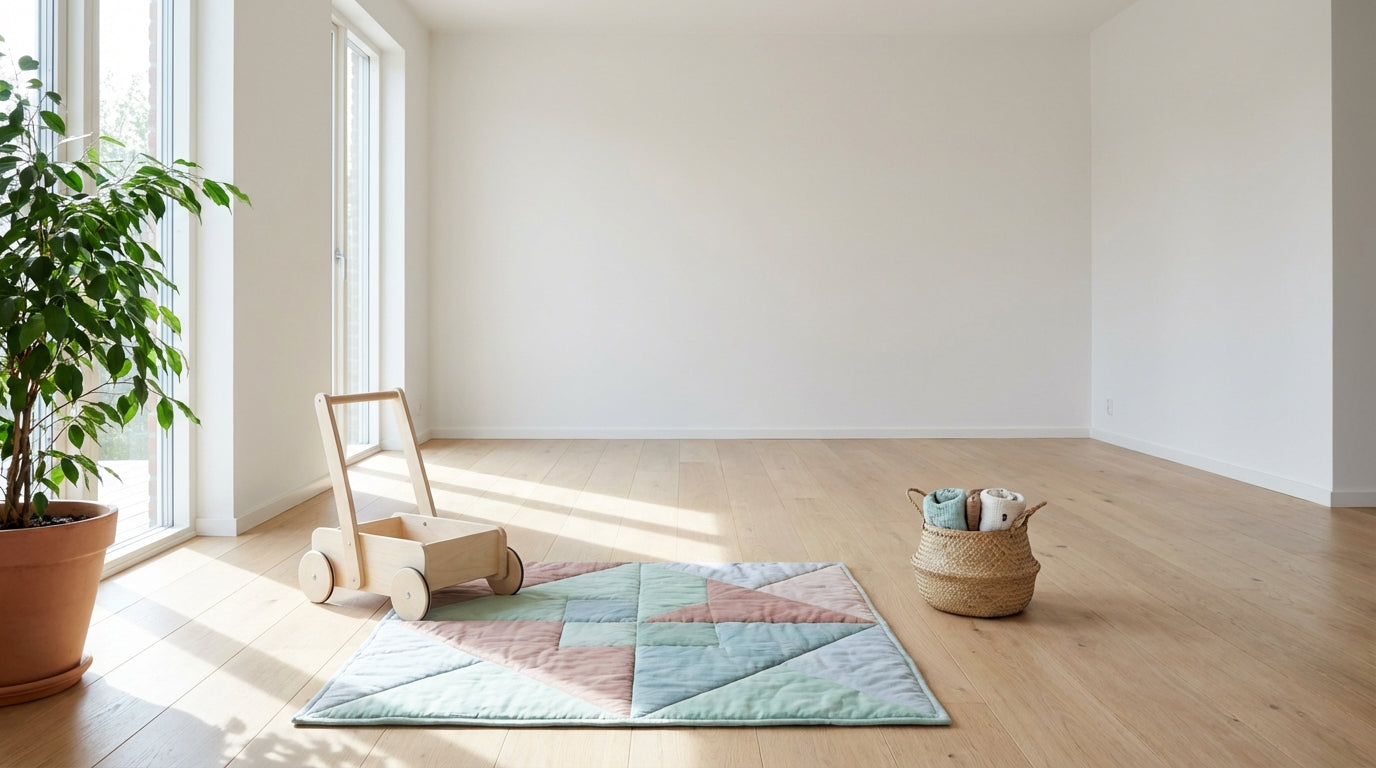
Practical tip: To start, place the walker on a rug or play mat. That naturally slows it down and makes the first “pushing meters” more relaxed.
The difference between a push walker and a sit-in baby walker (please don’t mix them up)
A push walker is pushed by the child – a sit-in baby walker carries the child in a seat. It sounds like splitting hairs, but it is the heart of the whole debate.

A push walker is a toy for holding on to and pushing in front of you. It only fits once a child can already stand and support themselves in a controlled way – otherwise it rolls away or tips over more easily.
A sit-in baby walker is a walking aid with a seat in a rolling frame. According to the German Federal Association for Child Safety (BAG Mehr Sicherheit für Kinder e.V.), such walking aids are not suitable for learning to walk and carry a high risk of accidents (Kindersicherheit: walking aids / sit-in baby walkers).
Many warnings online are aimed at the sit-in baby walker – not at the push walker. The BAG Mehr Sicherheit für Kinder explicitly names as an exception the walker that a child merely holds on to, especially when the wheels can be adjusted to run stiffly (Kindersicherheit FAQ on walking aids).
Why are sit-in baby walkers controversial?
The main issue is the risk of accidents from speed, tipping and falls down stairs. In a sit-in walker, a child can get very fast; the BAG Mehr Sicherheit für Kinder describes that babies can reach speeds of up to about 10 km/h in them (BAG Mehr Sicherheit für Kinder e.V.).
In addition, your child’s reach suddenly becomes “grown-up” – and that is dangerous at home. The Bavarian consumer portal describes typical risks such as tipping over at thresholds, falls and head injuries, as well as the fact that children can reach things that were previously out of reach (Verbraucherportal Bayern: children’s walking aids).
Pediatricians have repeatedly advised against them because serious accidents can happen even under supervision. The parents’ portal of the German Professional Association of Pediatricians (BVKJ) once again warns against walking aids in a news item (Kinderaerzte-im-Netz (BVKJ)).
Safety note: Please don’t use a sit-in baby walker “just for a moment” – stairs, thresholds and edges are enough for serious falls. The risk stays high even with supervision.
When does a push walker make sense? (Skills instead of months)
What matters is not age, but whether your baby can stand steadily and support themselves in a controlled way. Babies have their own timetable – and it is rarely compatible with “from month X”. In practice, a little checklist helps more.
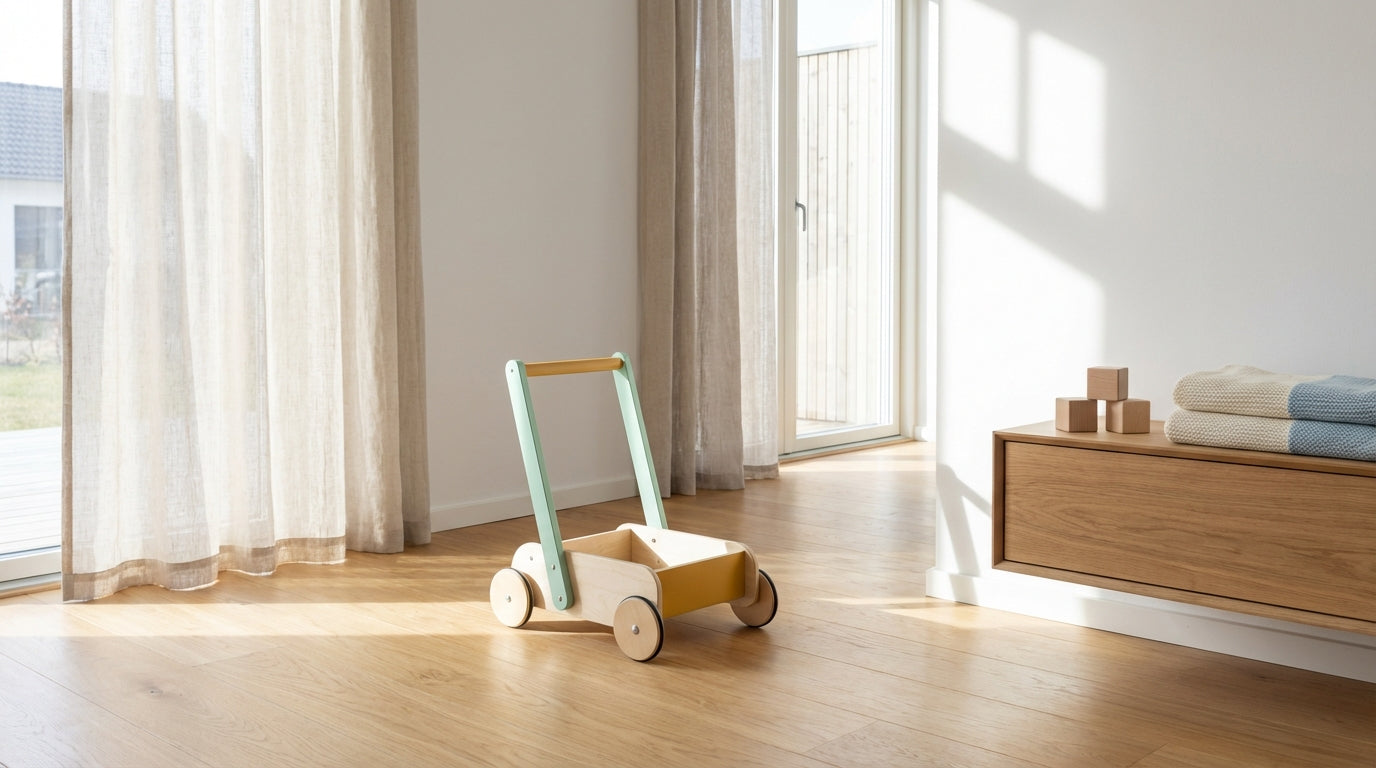
A push walker fits well when your child pulls up and walks along furniture. This “cruising” shows that the legs can already carry them, the hands are looking for support, and balance is being diligently practiced.
It is usually too early if your baby hangs on the walker or immediately sinks at the knees. Then the stability in the trunk and legs is still missing – and the walker becomes more of a pulling object than a pushing object.
- Fits better: Pulling up works, standing works, and taking a few steps sideways along the sofa works too.
- Wait a little longer: Standing only with a lot of “clinging on”, the walker rolls away, your child gets frustrated.
- A good sign: Your child laughs while pushing and can also let go and sit down again.
Practical tip: Start with 5–10 minutes when your child is in a good mood. Short, happy rounds beat “we’re doing this for an hour now” – this is not a fitness program.
Safety & buying criteria: What you should really look for in everyday life
A good push walker is stable, not too free-rolling, and suits your flooring. That alone clears 80% of the typical “oops” moments out of the way.

Stability means: a wide base, decent weight, and no tipping when leaned on. Children don’t use a walker the way we use a shopping cart. They hang off the side, turn abruptly, test limits – and that’s okay, as long as the walker can take it.
Braked wheels are worth their weight in gold, because your child can then truly control the speed. For push walkers, the BAG Mehr Sicherheit für Kinder explicitly recommends stiff-running wheels or adjustable rolling resistance (Kindersicherheit FAQ).
The environment is part of safety: stairs, thresholds and cables are the classics. Create a little “pushing corridor”: one room, door closed, floor clear. It sounds fussy, but it’s the kind of fussiness that saves nerves later.
Safety note: Only use a push walker in a secured area: no stairs, no open exterior doors, no hot drinks within reach.
Toy standards help as a baseline, but they don’t replace your own look at your home and your child. In Europe, basic safety requirements for toys apply through the Toy Safety Directive 2009/48/EC and harmonized standards such as EN 71; however, that doesn’t automatically tell you whether a walker is “too speedy” on your smooth hallway floor (EN 71-1 (Safety of toys) – full text).
Our Hamburg tip from 66 years of everyday life with toys: solid beats spectacular. We are a family business from Hamburg, we’ve been doing this for 66 years – and Ulli & Flo write here as parents for parents: stable, easy to grip, no nasty edges, and for wheels, preferably with some resistance. It’s not glamorous, but it’s very living-room-friendly.
Wood vs. plastic: What makes the difference in family life?
Wood often feels heavier and steadier, plastic is often lighter and more maneuverable. Both can work – it depends on how your child pushes and what your flooring is like.
More weight can help, because the walker “shoots away” less. Especially on smooth floors, that is sometimes the difference between relaxed practice and constantly chasing after it.
Lightweight can be practical if you often put the walker away or have little space. Then it’s especially worth paying attention to braked wheels – so that light doesn’t automatically mean fast.
More important than the material is the workmanship: no splinters, no sharp edges, no loose parts. It sounds obvious, but in everyday life that’s exactly what counts: children’s fingers are small, curious and surprisingly quick.
If you’d like to look at models, here is an overview. At Bieco you’ll find the hub for push walkers and specifically wooden push walkers – for comparing in peace, ideally with a coffee in hand.
Alternatives: What helps with learning to walk (even without a walker)?
The best thing for development is often simply: lots of free movement on the floor. It’s not fancy, but very effective – and costs (almost) nothing except patience.
Floor time means: room to turn, crawl, creep, pull up and sit back down. Exactly these transitions train coordination, balance and strength. And along the way, you as a parent learn the high art of not leaving toys in the middle of the walking path. It doesn’t always work for us either.
Push toys without a “learn-to-walk” claim can work just as well. The main thing: easy to grip, not too fast, and your child enjoys moving themselves forward.
At home, a clear “movement corner” often helps more than 20 gadgets. A non-slip surface, a few sturdy pieces of furniture to pull up on, and things that don’t tip over right away. If you’re looking for a soft surface for this: play mats are a quiet hero in everyday life for many families.
How to start relaxed: A mini guide for the first few days
The best start is short, safe and without an audience – babies are not a circus act. When everyone is watching, things often get tense. When nobody is watching, it suddenly works. That’s life.

- Prepare the room: Door closed, floor clear, no thresholds in the way.
- “Brake” the walker: Use a rug/mat or adjust the rolling resistance, if possible.
- Position it: Walker in front of your child, not to the side. From the side, it tends to get pulled and tipped.
- Accompany the first steps: Don’t pull, don’t push – just be there. A towel around the handle (for better grip) can sometimes help, but it must sit securely.
- Take a break: A few minutes is often enough. Tiredness makes them wobbly.
If you notice your child is only “hanging on” now, that is a signal to take a break. Then it’s better to get down on the floor, play for a bit, and try again later. That’s not a step backward – that’s good timing.
FAQ
How useful is a push walker?
It is useful as support when your baby can already stand steadily and walk along furniture. Then a push walker can provide motivation and help with practice without “placing” your child in position. If your baby doesn’t stand steadily yet, it is usually too early and more of a source of slipping and frustration.
When is a push walker worth it?
From the point when your child can pull up, stand steadily and hold on in a controlled way. A fixed age is less helpful than these skills. If the walker rolls away as soon as it’s touched or your child hangs heavily on the handle, it’s usually still too early. Start short and observe.
Are walking aids harmful?
Sit-in baby walkers are considered particularly accident-prone, which is why they are often advised against. According to the BAG Mehr Sicherheit für Kinder e.V., they are not suitable for learning to walk and carry a high risk of accidents (BAG Mehr Sicherheit für Kinder). A push walker is something different and depends heavily on how it’s used and the environment.
Which brake makes sense?
Anything that slows the rolling and gives your child control makes sense. Stiff-running wheels or adjustable rolling resistance are practical, as child safety organizations name them as helpful for push walkers (Kindersicherheit FAQ). On smooth floors, a rug or mat helps in addition.
Why no push walker?
Many “why not…” arguments actually refer to the sit-in baby walker, not the push walker. With a push walker, the main concerns are speed (slipping away) and the risk of tipping. With a stable model, braked wheels, short use and a secured area, the risk can be reduced significantly.
What is the difference between a push walker and a sit-in baby walker?
The push walker is pushed, while the sit-in baby walker rolls along with the child in a seat. With a sit-in walker, the child sits in a frame on wheels; child safety and pediatric sources warn especially about accidents here (VIS Bayern). The push walker suits the phase in which babies can already stand.
Bottom line: A push walker can be worthwhile – but only as a companion, not as a yardstick. If you’re currently swinging between “oh, come on” and “better not”: look at your child and at your floor. And if you’d like to keep browsing, besides the push walkers you’ll find helpful extras at Bieco, such as how to use a push walker properly or alternatives to the push walker.