Push Walker Safety: How Long to Use It and What to Watch For
At a glance
- Push walker safety means: only start once your child can stand steadily.
- A push walker is something your child pushes – a baby walker is a different thing.
- Several short rounds are better than one long "marathon pushing session".
- Speed becomes safer with grip, a brake (such as a screw brake) and a clear path.
- Stop signals: climbing, hanging off to one side, or full speed into furniture.

A push walker is safest when your child uses it as a support to push and you have childproofed the space around them. The question "How long can a baby use a push walker?" can't be squeezed into a fixed number of minutes – children (and homes) are simply too different. Here you'll find a practical guide: how to tell whether it's the right time, how to keep speed and tipping risk under control, and when the walker is better off taking a break. As we say in northern Germany: prepare properly once, then stay relaxed. We're a family business from Hamburg and have been doing this for 66 years, so we know wobbly first steps from more than just hearsay.

Ulli & Flo
Owners of bieco · Hamburg · parents themselves
During our own children's first steps we learned that doing less and preparing well is often the best safety strategy. A clear path and a slower pace put everyone at ease. Feel free to browse our push walker collection.
What is a push walker – and what is a baby walker?
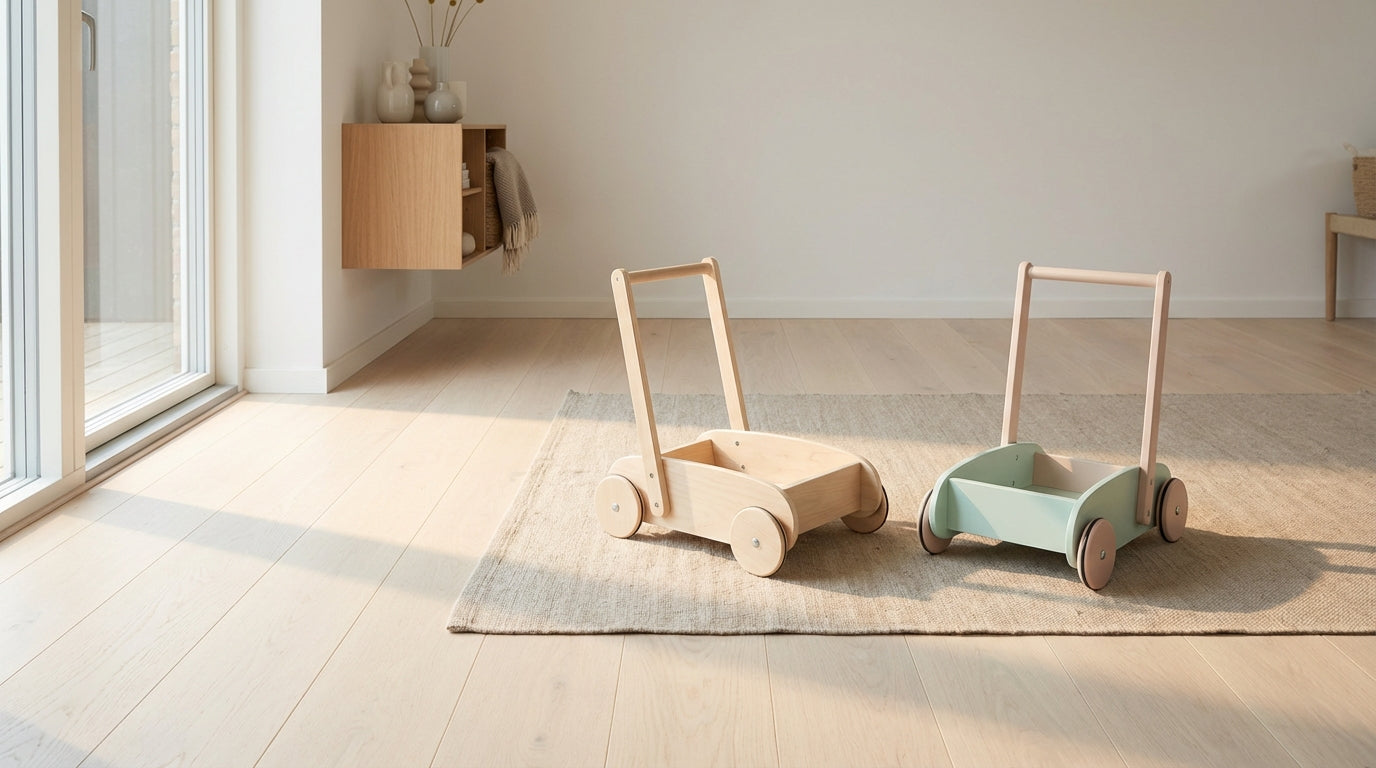
A push walker is a cart that children push in front of them while standing. Your child stands with their feet on the floor, holds on to the handle and controls speed and direction themselves.
A baby walker is a walking aid with a seat and wheels, in which the baby "sits and rolls". These rolling seat walkers are viewed critically by experts: according to the American Academy of Pediatrics, baby walkers with wheels are associated with a risk of injury and offer no benefit for learning to walk (AAP via HealthyChildren.org).
A line for the family chat: pushing is not sitting and rolling. When Grandma says "walking aid", it's worth a quick check which device she actually means.
Safety note: In this article, "push walker" refers to push carts. A baby walker (seat + wheels) comes with different risks – and doesn't belong near stairs, edges or in the kitchen.
How long can a baby use a push walker?
As long as your child pushes steadily, isn't tense, and you stay close by. With a push walker, the clock matters less than your child: do they look focused and in control – or are they getting frantic, tipping forward and just "ramming" things?

In practice, short sessions are often the more relaxed choice. Many families do well with 5–10 minutes of pushing followed by floor time again: crawling, sitting down, pulling up, off they go again. It's also more realistic in everyday life – nobody feels like a workout programme with a stopwatch every single day.
Good stop signals are frustration, stumbling, raised shoulders or wild speed. That doesn't mean it went badly – it simply means that's enough for today.
Practical tip: Set up a fixed "parking zone" (play mat or edge of a rug). When the walker arrives there, it's automatically break time – no negotiation summit required.
When does a push walker make sense?
A push walker usually fits when your child pulls up confidently and can stand freely for a short moment. This is often around the phase when children "cruise" along furniture – but your child sets the pace, not the calendar.
Age recommendations are a guideline, not an exam with a stamp. On product pages you'll often find details such as "from 12 months" and notes on testing against toy safety standards (example: Forest Animals Push Walker).
If your baby immediately "sags" when standing, floor time is more valuable for now. Crawling, getting up at the sofa, sitting down, up again – that's the real training camp for coordination.
How to start safely: step by step (no magic needed)
A safe start consists of a clear path, a suitable surface and controlled speed. That sounds like a lot – but it's done in 10 minutes once you know what matters.

- Clear the path: Cables, small stools, loose rugs and wobbly decorations should all be out of the "driving lane".
- Choose the surface: To begin with, carpet or a play mat often slows things down nicely, while smooth floors make the walker faster.
- Watch the handle height: Hands on the handle, shoulders relaxed. If your child hauls themselves up as if on a gym bar, the walker (or the moment) isn't ideal.
- Tame the speed: Anti-slip wheels (e.g. rubberised) help and – depending on the model – so does an adjustable brake or screw brake, so the walker doesn't "shoot away".
- Stay close: Not out of mistrust, but because children come up with ideas in seconds that adults only have after their coffee.
Safety note: Please don't put loose weights (books, dumbbells, cans) in the walker if they can fall out. If you need more stability, only use a solution intended by the manufacturer, or safe, flat, non-small-part items placed so that nothing can slide or tip.
Push walker safety: checklist for home
The biggest risks are stairs, edges, too much speed and climbing. Here's the short checklist that really helps in everyday life:

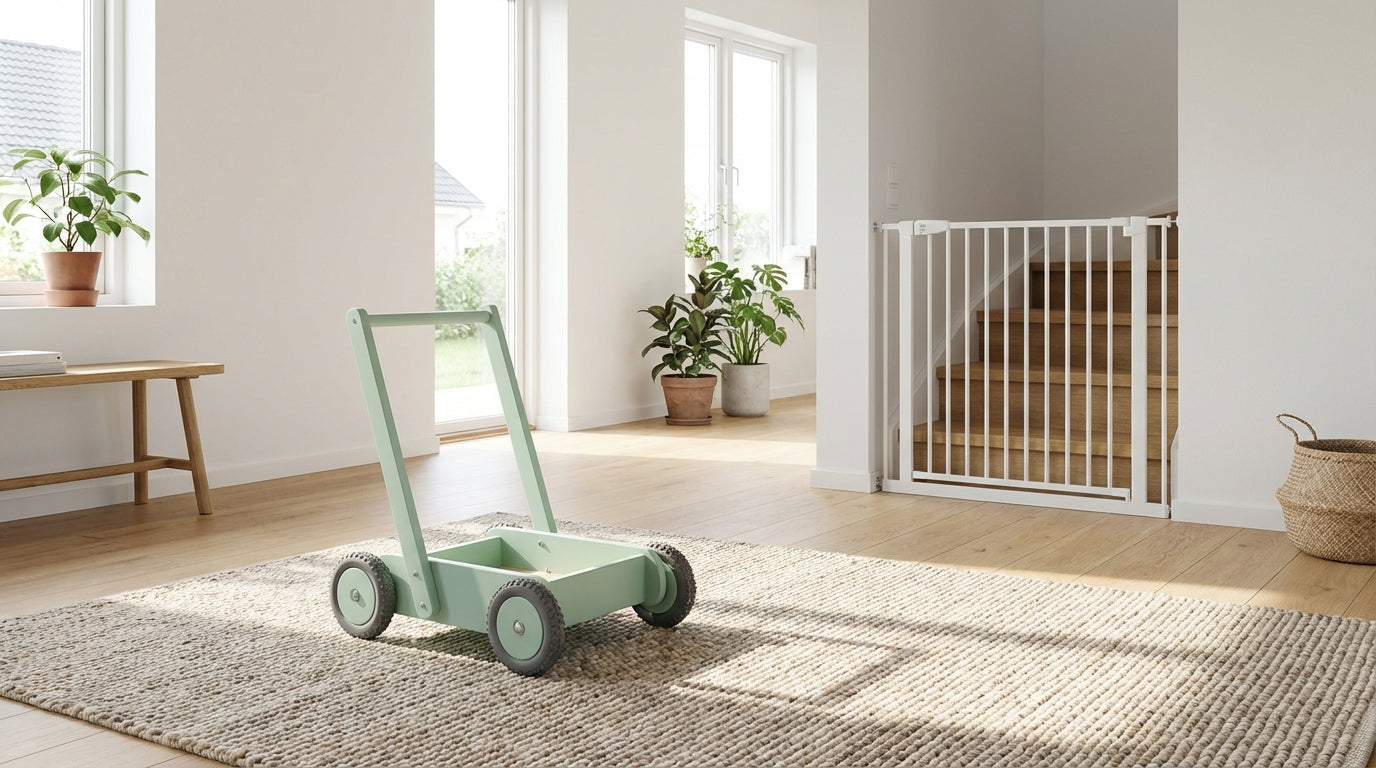
- Secure the stairs: Use a stair gate – and install it exactly as the manufacturer intends for that location.
- Watch steps & edges: Even a single step can be enough to make a walker stop abruptly or tip over.
- Clear driving lane: No rug edges, no piles of toys, no slippery socks on smooth floors.
- Check wheels & screws: Is everything tight, does nothing run "wobbly", is there enough grip?
- Test tipping stability: Does your child push in a controlled way – or hang off to one side and pull?
- Play parts secure: Nothing may come loose, splinter or have sharp edges.
Toy standards help you assess a product, but they don't replace your own eye in everyday life. In the EU, the Toy Safety Directive 2009/48/EC sets out basic safety requirements; in Germany it is implemented through the 2nd ProdSV, among other things, as explained by the BMUKN (BMUKN: Safe Toys).
EN 71 is the central series of standards for toy safety in Europe. Depending on the part, it covers things such as mechanical/physical requirements, flammability and certain chemical requirements (BMUKN).
Transparency helps parents: clear information beats pretty words. On our product pages you'll find, for example, the recommended age, warnings and the listed standards/test notes (example: Product information on the Forest Animals Push Walker).
Which features make a push walker safer?
It gets safer when your child can control the speed and the walker stays stable. When looking at one (or trying it out at home), pay particular attention to these points:
- Wheels with grip: Anti-slip or rubberised wheels can give more hold on smooth floors and are often quieter.
- Brake/screw brake: An adjustable brake can noticeably reduce rolling away – especially in the first few days.
- Weight & centre of gravity: A walker that isn't "featherlight" often tips less easily when a child leans on it.
- Wide base: More width can mean more tipping stability (without the walker blocking the whole hallway).
- Easy-to-grip handle: Not too thin, not too high, comfortable in small hands.
- Workmanship: No splinters, no sharp edges, nothing wobbling.
Wood or plastic isn't automatically "better" – what matters are workmanship and testing. If you'd like to compare materials in peace, you'll find an overview here: Wooden or plastic push walker: which is better for my child?
How long can a push walker be used – and when is it time to stop?
Many children use a push walker for months: first as a support, later as a play cart. At the beginning it's "I hold on and push"; later it likes to become a transporter for cuddly toys, building blocks and things that actually live on the shelf.

As a walking aid, it's time to stop when your child walks freely and confidently or the walker only causes stress. If your child has long been walking steadily, they no longer need the walker for support – then it's more of a toy.
A clear break makes sense when the walker turns into a climbing frame or a race car. Typical signs: hanging off to one side, climbing up, full speed into furniture, "I'll push you down the ramp" ideas. In that case, it's better to put it away and bring it out again later as a play cart, under supervision only.
Baby walkers: why many experts advise against them
With a baby walker, the problem isn't the duration but the speed and reach. According to the AAP, children in baby walkers can move quickly and suddenly reach things that would otherwise be out of reach (e.g. hot drinks or tablecloths) (AAP via HealthyChildren.org).
Supervision alone may not be enough, because you often can't react fast enough. The AAP stresses exactly this as well (AAP via HealthyChildren.org).
A side note for context: in Canada, baby walkers (with wheels) are banned. Health Canada states that manufacturing, selling, importing and even advertising or giving them away is prohibited (Health Canada).
FAQ
When can a child start using a push walker?
Usually when your child pulls up and can stand freely for a short moment. This is often around the first standing and "cruising" phases. Age recommendations on products are a guideline; more important are stability, how your child holds the handle, and a pace your child can control.
How long can a baby use a push walker?
As long as your child pushes safely and doesn't seem overwhelmed. Many families do well with short rounds (for example 5–10 minutes) followed by floor time again. Stop if your child becomes tense, stumbles, gets frustrated, or the walker is only being used as a battering ram.
How long per day makes sense?
Several short sessions are often better than one long one. Children learn movement through many small repetitions: pushing, sitting down, getting up again, crawling, standing. If you notice that concentration is gone or the speed shoots up, that's a good sign for a break.
Which brakes are good on push walkers?
Adjustable brakes that noticeably slow the rolling are helpful. Depending on the model, there are screw brakes or other solutions that increase rolling resistance. In the end, what matters isn't the name of the brake, but that your child can push the walker in a controlled way – even on a smooth floor.
When should a baby stop using a push walker?
If climbing, hanging off to the side or full speed take over, it's time for a break. The risk of tipping and collisions then rises significantly. It's better to put the walker away and offer alternatives that safely channel the urge to move (floor obstacle course, cushions, a crawling track).
How long can a baby stay in a baby walker?
Many experts generally advise against baby walkers altogether. According to the AAP, baby walkers with wheels are associated with a risk of injury and offer no advantage for learning to walk (AAP via HealthyChildren.org). If you do have such a device in your home, take the risks very seriously.
If you're now looking for a safe start: choose a walker that suits your home – and your child. You'll find an overview in our push walker category or – if you prefer wood – under wooden push walkers. And if you're still weighing things up in general: Push walker: worth it or not? From what age for babies?