What Age Is a Stacking Tower For? Age Guide & Safety
At a Glance
- When can a baby use a stacking tower? It often suits babies from around 10–12 months – start simple, then build up.
- Real “stacking with a plan” is often seen between 15 and 24 months.
- Knocking over, feeling and sorting count just as much – that's learning, not a step backwards.
- Look for the CE mark, the age recommendation and warnings right on the product or packaging.
- Big, easy-to-grip pieces and sturdy shapes make getting started more relaxed.

When can a baby start with a stacking tower? Usually from around 10–12 months, once grasping and letting go start to work. Before that it's not “off limits” – it's simply more of a feel-and-explore toy (with lots of tipping over, which is perfectly fine). Here you'll find a down-to-earth guide to the right age for a stacking tower, play ideas without pressure, and a clear look at safety & labelling in the EU. And yes: this is written for real living rooms, not glossy catalogues.
You can find our stacking towers here.

Ulli & Flo
Owners of bieco · Hamburg · parents themselves
At our place, stacking often ends with everything in the mouth – and shortly after, on the floor. That's why we always think about toys together with everyday life at the table: if you like, take a look at our bibs collection or our sleeved bibs – when things get messy, they often save more nerves than any cloth.
Table of Contents
- Short answer: What age is a stacking tower for?
- Age guide: How to play at each stage
- How do I know if my child is ready?
- Play ideas without frustration (for kids and parents)
- Wood, silicone or cups – what suits when?
- Care & cleaning: keeping it hygienic
- Safety & labelling: CE, warnings, standards
- Why we at bieco are so picky about safety
What Age Is a Stacking Tower For – the Short Answer
As a rough rule of thumb, a stacking tower makes sense from about 10–12 months. By then, many children can pick things up on purpose, put them down and pick them up again – the foundation for the first “piece on piece”. For orientation: according to the Centers for Disease Control and Prevention (CDC), most children stack at least two small objects (e.g. blocks) by 15 months. CDC: Milestones by 15 Months

Age recommendations are a guide, not a timetable with a stamp on it. Some children stack early, others later – and both are usually perfectly fine. What matters more: does the toy match your child's stage of development, and is it properly labelled?
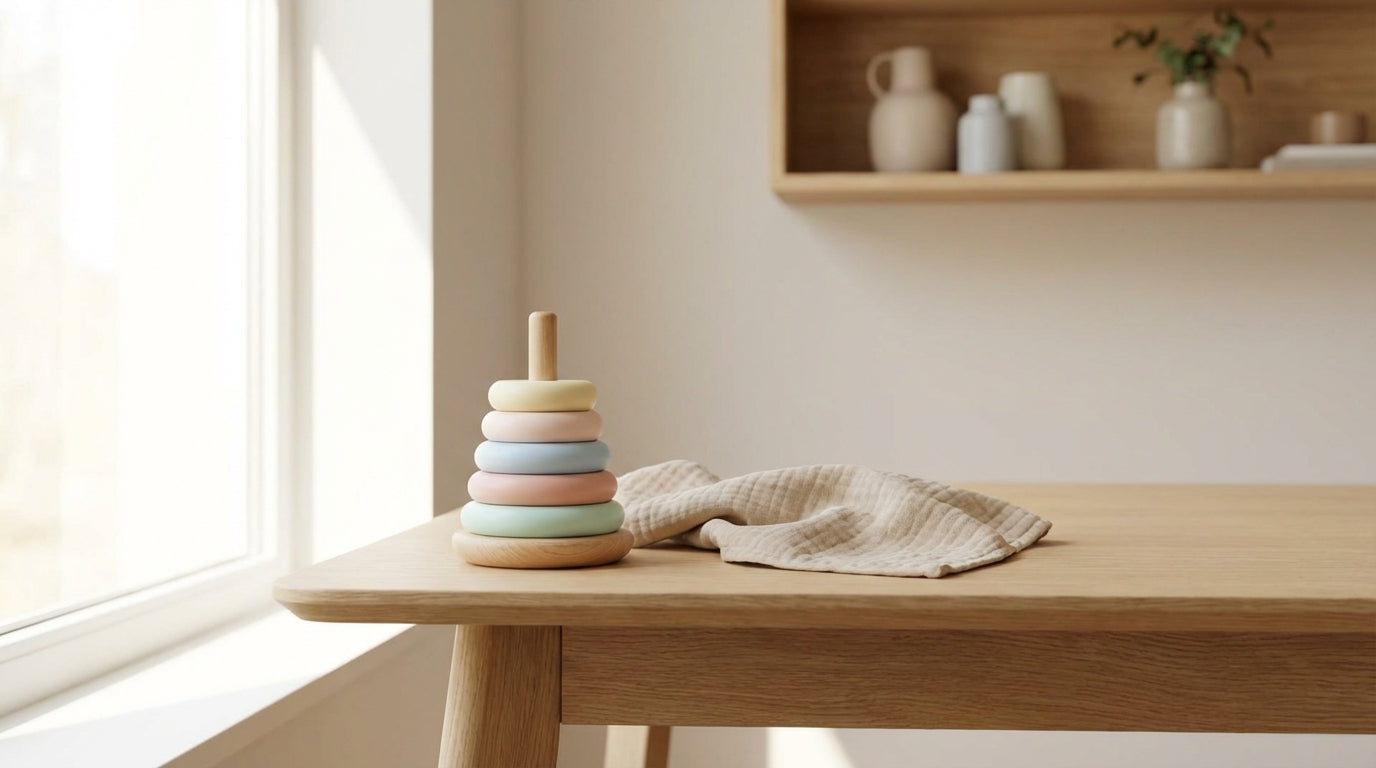
A stacking tower is a stacking or nesting toy with graduated pieces. Children can sort the pieces by size and put them on top of each other – or at first simply touch them, turn them and knock them over.
Buying Guide in 30 Seconds
- Check the age recommendation (on the packaging or product page).
- Piece size: better big and easy to grip, especially at the beginning.
- Stability: wide base, nothing wobbling even without a child.
- Centre pole (if there is one): preferably flexible/short rather than long and rigid.
- Read the warnings (e.g. “not suitable for children under 36 months”).
Age Guide: How to Use the Stacking Tower at Each Stage of Development
You adapt the game to your child, not the other way around. That keeps it playful – and you don't have to say “No, the other way round!” every five minutes (which nobody likes to hear anyway).

Quick Guide: What to Look For by Age (Buying & Design)
- 6–9 months: very large pieces, soft/rounded edges, light weight, easy to clean, no small individual parts.
- 10–12 months: 2–4 pieces to start, easy-to-grip shapes, wide base, centre pole rather short/flexible, nothing that slides away the moment it's banged on.
- 13–24 months: more pieces possible (5–8), clear size differences, stable tower base, rings/cups without sharp edges, material to suit your daily life (wood is calmer, cups/silicone more forgiving).
About 6–9 Months: Looking, Grabbing, Putting It in the Mouth (Totally Normal)
At this age, the stacking tower is mainly a discovery toy. You can build a mini tower and your baby gets to knock it over, feel it and bang on it. If the pieces are designed for it, they may also land in the mouth for a moment – that's exactly what age recommendations are for.
Safety note: Only use pieces that are expressly suitable for the age, and never leave babies unattended while they play.
About 10–12 Months: First Attempts at Stacking or Putting On
Now “letting go on purpose” often works better – and with it, the first success. Many children manage this: pick up a piece → put it on top of something → it falls over → again. Set up the stacking tower so your child sits securely, and start with only a few pieces.
Practical tip: Lay out just 2–3 pieces and keep the rest out of sight – it makes play calmer and more successful.
About 13–18 Months: “I'll do it myself!” (and you please just watch)
Now it helps to accompany rather than correct. Instead of “The big one has to go at the bottom!”, try: “Oh, that's wobbly – let's see.” Children learn a lot from that wobbling. And yes: for some, knocking it over at the end is part of the drama.
If you demonstrate, do it slowly and in tiny steps. One piece, a short pause, the next piece – children copy movements much better than long explanations.
About 18–24 Months: Sorting by Size Becomes More Realistic
Now “ordering by size” becomes truly graspable for many children. You can build in small tasks: “Give me the smallest cup” or “Which ring fits here?” It stays play, but with a bit of brainwork.
If you're looking for a versatile option, stacking cups are often real everyday heroes. You can find them here: Stacking cups.
From 2 Years: Building, Role Play, “A Tower for the Cuddly Toys”
From around 2 years, the stacking tower often becomes part of imaginative and role play. Then it's an ice cream cup, a car park or a hat for the teddy. That's handy: toys stay exciting for longer without you constantly having to bring in something new.
How Do I Know If My Child Is Ready?
Your child is ready when they can grasp things on purpose and put them down in a controlled way. In everyday life, that often looks like this:
- They pass an object from one hand to the other.
- They put something on top of something else (crooked counts too).
- They stay with it for a moment instead of crawling straight off.
- They enjoy “again!” – that's usually the best sign.
If that isn't working yet, it's no drama, just “not today”. Then you simply play with the stacking tower as a grab box or a knock-over game.
How to Keep the Stacking Tower from Becoming a Frustration: Play Ideas That Really Work
It works best when the game is short, easy and repeatable. Here are a few ideas that survive in real homes (even when the pasta is boiling over in the background):
- “You hand, I stack”: your child hands you a piece, you put it on. Then swap.
- “Target”: lay the biggest ring/cup down and your child tries to hit “inside”.
- “Two-piece game”: offer only two pieces: “Which one is the small one?”
- “Tower for the cuddly toys”: a cuddly toy gets to “live at the top” – motivation works wonders.
Practical tip: If it tips over, don't rush to rescue it – that's often exactly where the learning moment happens.
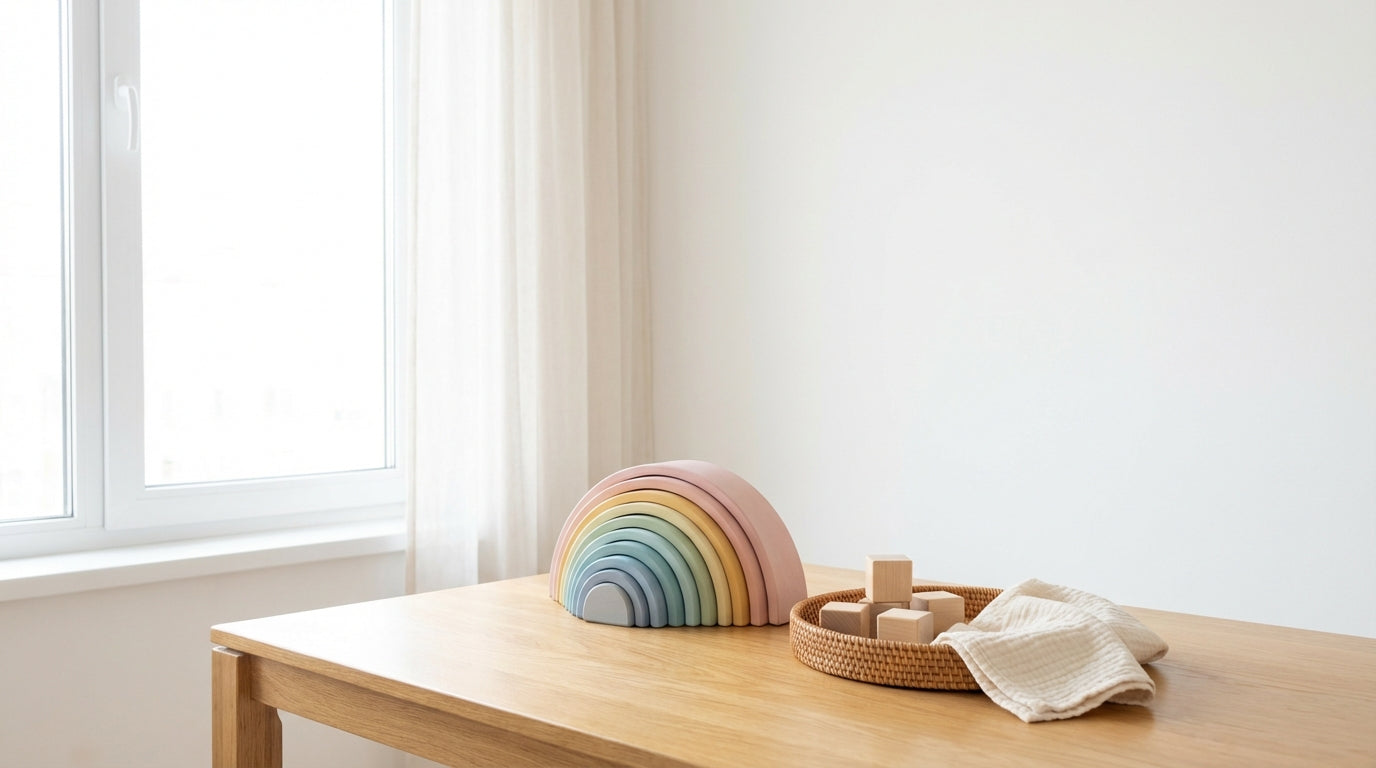
If your child is more of a “free building” fan, open-ended toys can be a good way in. This also fits: Grimm's Rainbow: The Best Play Ideas & Creative Possibilities.
Wood, Silicone or Cups? What Suits Which Age?
The material shouldn't make your daily life more complicated. A few practical guidelines:

- Softer materials are often pleasant when there's a lot of chewing, throwing and “taking along”.
- Wood stands steadily and feels high-quality – depending on the child, it sometimes needs a bit more calm during play.
- Stacking cups are usually very forgiving: stack, nest, tip out, put back in.
If you want to compare in more depth, the everyday material check will help. Take a look here: Wooden or Silicone Stacking Tower? Materials Compared and for an overview: Wooden stacking tower.
Care & Cleaning: Keeping the Stacking Tower Hygienic
Cleaning is especially worthwhile when there's a lot of sucking, spilling or bath-time play. So that you don't have more work than necessary:
- Read the packaging/product info: it tells you how to clean it (and whether water is okay).
- Gentle instead of harsh: mild dish soap and a soft cloth are often enough in everyday life.
- Dry thoroughly: let the pieces dry completely after cleaning before they go back in the toy box.
- Check regularly: if something has cracks or pieces are coming loose, better to sort it out.
And yes: sometimes “not today” is also a valid cleaning strategy. Then just wipe it down quickly and do it more thoroughly tomorrow – parenting life is no wellness hotel.
Safety & Labelling: What to Look For in a Stacking Tower
A safe stacking tower is clearly labelled and built to suit the age. In the EU, toys placed on the market must carry the CE mark; with it, the manufacturer declares compliance with the applicable requirements.
Official Info (Short & Reliable)
- Germany's Federal Office of Consumer Protection and Food Safety (BVL) explains which labelling elements matter for toys: BVL: Important labelling elements for toys (in German)
- The EU page on toy safety bundles the legal framework: European Commission: Toy safety
How to Check CE & Warnings in 20 Seconds
- Look for CE: on the packaging, hang tag or directly on the product.
- Find the age: “from … months/years” or a 0–3 notice.
- Read the warnings: “Attention …” is usually right next to the age recommendation.
- Check the manufacturer: name + address/contact must be given.
- Something missing? Better not to use it – contact the shop or return it.
Typical Risks by Design (and How to Check Quickly)
- Centre pole/stacking rod: can be unfavourable when tripping or when a child throws themselves on it wildly – look for short, rounded or flexible solutions.
- Small rings/parts: a no-go for younger children – pieces should be clearly large and easy to grip.
- Paint/chipping: if anything flakes off or becomes rough, sort it out immediately.
- Splinters/edges (especially with wood): run your hand all the way around once, including the edges.
- Cords (if present): better to have none at all on toys for little ones – and if there are, very short and firmly attached.
Safety note: If a toy is damaged (cracks, loose parts, chipping), it's better to pause and replace it – especially for children who still put a lot in their mouths.
And yes: the direction is clear – stricter rather than looser. Germany's Federal Ministry for the Environment (BMUKN) describes how a new EU Toy Safety Regulation (EU) 2025/2509 is meant to improve protection against hazardous substances, among other things. BMUKN: Safe toys (in German)
Why We at bieco Are So Picky About Safety
We're a family business from Hamburg and have been doing this for 66 years. That doesn't mean we know everything better – but we know pretty well which questions parents are still googling at half past ten at night, when the little one has finally fallen asleep.

Our attitude: clear information rather than smoke screens. For every toy (no matter whose), look at the product info and the packaging: that's where you'll find the age recommendation, warnings and material details that really matter for your everyday decision.
FAQ
When does a stacking tower make sense?
Often from around 10–12 months. That's when grasping and letting go on purpose become steadier. If your child already likes to investigate things earlier, the stacking tower (if approved for the age) can also join in sooner as a feel-and-knock-over toy.
How many pieces should I give at the start?
2–3 pieces are completely enough to begin with. It makes play calmer, and your child gets small moments of success sooner. You can add the rest later.
My child just knocks everything over – is it too early?
No, that's a normal part of learning. Many children are testing cause and effect. You build briefly, your child clears it away – and at some point the deliberate stacking comes along on its own.
If you'd like to browse now: you'll find different variants in our overview. Take a look here: Stacking tower – and if you can't decide between cups and a tower: Stacking Cups or Stacking Tower? Differences & Recommendations.