
Rattles for Babies
Sort by
6 products


recently viewed
A baby rattle is a grasping toy that makes cause and effect tangible through gentle sounds. You put it in their hand – and suddenly something “happens”: shake, listen, marvel, repeat. That's exactly why baby rattles are so popular as a first toy (and as a gift, when you don't want to bring the 17th pair of socks). According to BZgA Child Health (Germany's Federal Centre for Health Education), parents should choose toys that babies can safely explore with their hands and mouth, and check them regularly for damage (kindergesundheit-info.de).
In this collection you'll find 17 rattle products at BIECO: teethers with rattles, dumbbell rattles (often in sets), fabric and velour versions, and play figures with rattles – plus two velour balls with rattles. If you want to get through quickly: first look at how easy it is to grasp, then at cleaning, then at sound. That saves your nerves – and yes, at the beginning several “dropping rounds” per day are easily part of the routine.
The Key Points at a Glance
- To start with, light, easy-to-grasp baby rattles without loose parts are ideal.
- Fabric is soft and often quieter, while wood feels firmer and “grippy”.
- If it sounds shrill to your ears, rather choose a gentler sound.
- A quick check for cracks, seams and loose parts is part of the routine.
- On the go, grasping toys and small rattles are often more practical than large figures.
How to Quickly Find the Right Rattle (4 Filters That Really Help)
Short answer: With four filters, you'll find the right baby rattle in 30 seconds. You don't have to read everything – just take this mini route through the selection.
- Material: Wood (grippy, sturdy) or fabric/velour (soft, often gentler).
- Shape: Teether with rattle, dumbbell rattle, classic rattle or play figure.
- Occasion: Gift (classic rattle/play figure) or on the go (teether/dumbbell).
- Age/grasping phase: “Just holding on for now” (dumbbell/teether) vs. “grasping with purpose” (smaller shapes).
Mini cheat sheet (if X, then Y):
- If your baby still grasps a lot “by accident”: choose a dumbbell rattle or an open teether.
- If you're out and about a lot: choose a light rattle that you can wipe clean quickly.
- If your baby gets startled by noises: choose fabric/velour with a gentle sound.
- If you're looking for a gift: choose a classic rattle or a play figure with a rattle.
From What Age Does a Rattle Make Sense for a Baby?
Short answer: A baby rattle gets exciting as soon as grasping and holding become more purposeful. That doesn't happen “overnight”, but step by step. According to BZgA Child Health, once children start to grasp, things in different shapes and materials become interesting – for touching and exploring with lips and tongue (kindergesundheit-info.de).
And in case you'd like a rough guideline: according to BZgA Child Health, a baby at around 7–8 months can already pick up small objects between thumb and forefinger (pincer grasp) (kindergesundheit-info.de). That means: many baby rattles already work before then – but from that point on it often becomes truly “intentional”.
If you'd like to read up on the topic at your leisure: explained in detail in our guide “From What Age Does a Rattle Make Sense for Babies? Development & Tips”.
Fabric, Wood or Set: Which Baby Rattle Suits Your Everyday Life?
Short answer: The best baby rattle is the one that fits well in small hands and can be cleaned easily in everyday life. Sounds unspectacular – but it's the difference between “is loved” and “sits on the shelf”.
Teether: A teether is a baby toy shaped so that small hands can easily wrap around it and hold on.
Dumbbell rattle: A dumbbell rattle has two easy-to-grasp ends – perfect when left and right hands take turns.
Wooden rattle: A wooden baby rattle feels firm and grippy and often sits securely in the hand.
Fabric rattle: A fabric rattle is soft, light and pleasant against the face – often with a gentler sound.
Wooden Rattles, Fabric Rattles & Co.: Pros and Cons Without the Overthinking Marathon
Short answer: With 2–3 rattle types, you're usually fully covered in everyday life. And yes: you're allowed to be pragmatic about it – babies are complicated enough.
- Fabric rattle / velour
ul>
li>Pro: soft, often quieter – good for the sofa and for cuddling - Con: can quickly look like it has “seen it all” – a regular check is worthwhile
Safety & Good Signs: What Matters for Baby Rattles
Short answer: A safe rattle has no loose parts and is checked regularly for damage. That's exactly what BZgA Child Health recommends: repeatedly checking toys for damage such as loose parts or torn seams (kindergesundheit-info.de).
- EU regulations: Toys in the EU are subject to safety requirements; the Toy Safety Directive 2009/48/EC is the well-known basis (EUR-Lex).
- Update (for context): The European Commission describes that the Toy Safety Directive is being replaced by the Toy Safety Regulation; it entered into force on 1 January 2026 and applies after a transition period from 1 August 2030 (ec.europa.eu).
- EN 71 as a practical standard: The DIN EN 71 series of standards is the common testing framework for toy safety; DIN mentions, for example, DIN EN 71-1 (mechanical/physical properties) and refers to corresponding tests (din.de).
- Chemical safety (example): DIN describes that DIN EN 71-3 specifies requirements and test methods for the migration of certain elements (including heavy metals) (din.de).
- Understanding CE correctly: The consumer advice centre (Verbraucherzentrale) explains that the CE mark is not an independent test mark, but a manufacturer's declaration (verbraucherzentrale.de).
On the topic of volume: Depending on the source and measurement method, there are different limit values – when in doubt, rather choose quiet. And quite down-to-earth: if a rattle sounds unpleasantly shrill to your own ear, “gentler” is usually the better idea.
Rattle as a Musical Instrument: First Rhythm Moments (Without Concert Mode)
Short answer: A rattle as a musical instrument practises a sense of rhythm quite incidentally – in tiny portions. Two or three shakes to a song, and often that's already enough “rattle music” for everyone involved. If you'd like more ideas: in our guide “The Rattle as Your Child's First Musical Instrument” you'll find simple games for everyday life and the evening routine.
Rattle eggs: A rattle egg (yes, that's really what it's called) is a small shaker egg for rhythm games – several are called rattle eggs. If you're looking more in this direction: feel free to take a look at Rattle Eggs & Rattle Instruments or read more in “Rattle Socks & Rattle Eggs: Musical Development for Babies”.
Oball Rattle: What Is It – and Does BIECO Have Something Similar?
Short answer: An Oball rattle is a grasping ball with many openings – good when grasping is still “slippery”. Whether we carry exactly this type depends on the range; in this collection, however, you'll find open, easy-to-grasp alternatives such as teethers with rattles and velour balls with rattles. If your baby likes “ball + sound”, take a look at Velour Ball Ella with Rattle or Velour Ball Football with Rattle.
What Will You Find in the BIECO Rattle Collection?
Short answer: In the BIECO rattle collection you'll find teethers, dumbbell rattles, classic rattles and play figures with rattles. That's practical for everyday life because you can choose by shape and feel – instead of struggling through “one toy for everything”.
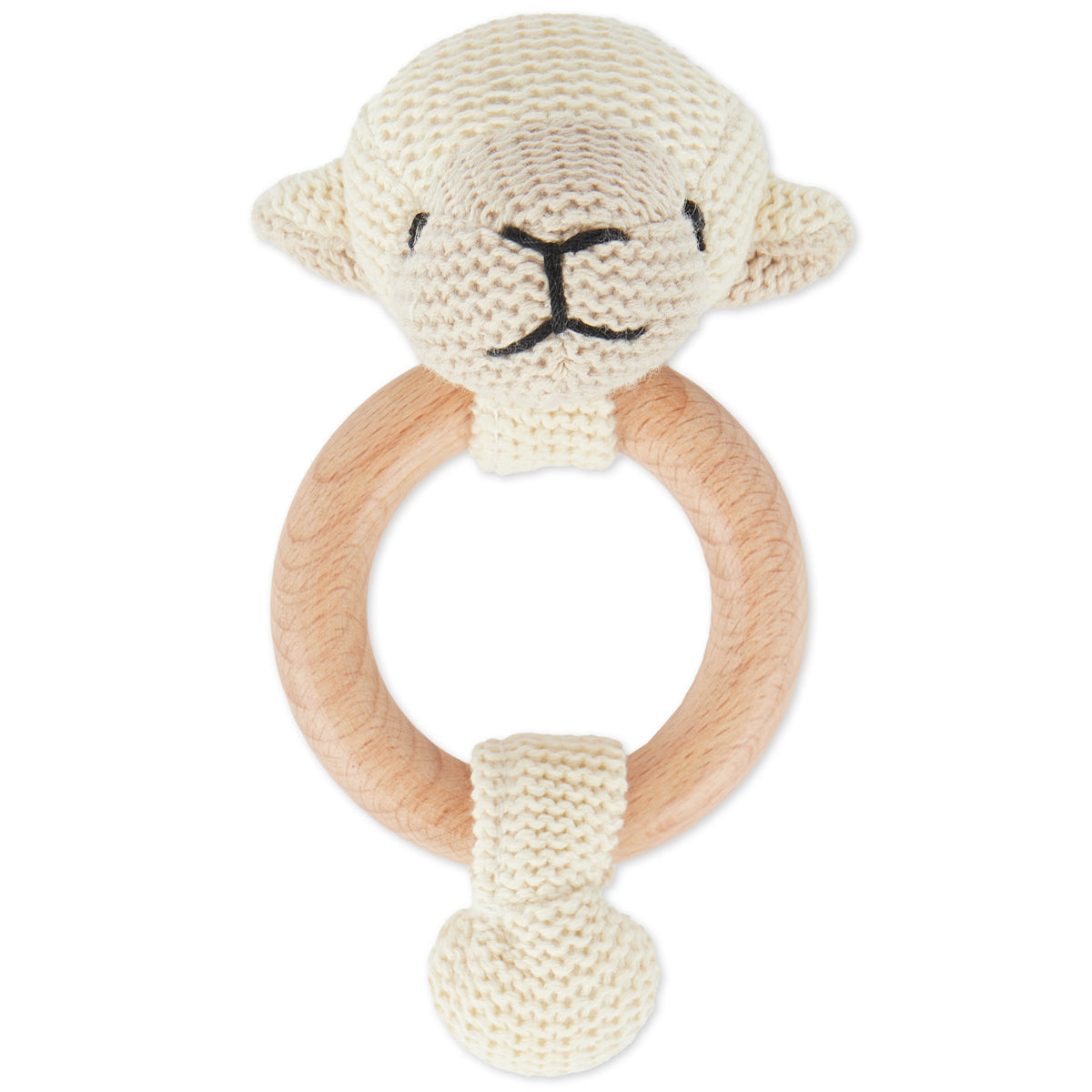
- Elephant Teether with Rattle and Bear Teether with Rattle (teether with rattle)
- Dumbbell Rattles 2-Piece Set Forest Animals or Dumbbell Rattles 2-Piece Set Star Dust (baby rattles as a set)
- Play Figure Deer Ella with Rattle (play figure with rattle)
- Rattle Bunny Fine and Rattle Bear Mika (classic rattle)
If you like to keep browsing: in Rattles and Teething Rings you'll find matching combinations, and for on the go, Stroller Toys is often exactly the right corner.
FAQ: Short & Helpful (Without Long Lectures)
From what age can my baby play with a rattle?
Short answer: As soon as your baby starts to grasp more purposefully, a rattle gets really exciting. This develops gradually. According to BZgA Child Health, when grasping begins, things in different shapes and materials become particularly interesting (kindergesundheit-info.de). Explained in detail here: “From What Age Does a Rattle Make Sense for Babies?”.
What do you do with a baby rattle?
Short answer: You offer the baby rattle – and you follow your baby's interest. Sometimes it gets shaken, sometimes just chewed, sometimes it gets “put away” (usually toward the floor). That's part of discovering. If you're looking for play ideas: our baby rattle guide is made for that.
Which rattle is better: fabric or wood?
Short answer: Fabric is soft and often quieter, while wood sits grippy and sturdy in the hand. What matters is what your baby can hold well and what you're happy to clean in everyday life. If you want to compare in more depth (including plastic): “Baby Rattle Made of Wood or Plastic? Advantages Compared”.
How can I recognise a safe rattle for babies?
Short answer: It should have no loose parts and be checked regularly to make sure it's undamaged. According to BZgA Child Health, it makes sense to repeatedly check toys for damage such as loose parts or torn seams (kindergesundheit-info.de). And: take age recommendations and warnings seriously – they're not printed on there for fun.
How loud may a rattle be?
Short answer: It should sound pleasant and not shrill or “noisy”. BZgA Child Health advises against buying noisy toys because children's ears are sensitive (kindergesundheit-info.de). If you're unsure: rather choose the gentler sound – that's rarely a mistake.
What are baby rattle socks – and what are they good for?
Short answer: Baby rattle socks make noises when kicking and thus encourage discovery. That's nice when the feet can currently “do more” than the hands. If you'd like to see whether it suits you: Rattle Socks for Babies – and in more detail in the guide “Rattle Socks & Rattle Eggs”.
What are rattle eggs – and what is a single rattle egg?
Short answer: Rattle eggs are small shaker instruments; a rattle egg is the singular form. They're often more something for making music together, once grasping is more secure. To start with, a classic baby rattle is usually easier to hold. You can browse here: Rattle Eggs & Rattle Instruments.
What is an Oball rattle – and when is it practical?
Short answer: An Oball rattle is a grasping ball with many openings that is easy to hold on to. That can be practical when grasping is still unsteady and “smooth” shapes quickly slip away again. In our rattle collection you'll find similar ideas in the form of open teethers and velour balls with rattles – so the direction is there, even without brand fixation.
About This Page
This text was written and updated by the BIECO editorial team (a family business from Hamburg). We combine 66 years of toy experience with reliable sources, e.g. BZgA Child Health on safe toys (kindergesundheit-info.de) and EU requirements on toy safety (ec.europa.eu). Goal: You should quickly find a rattle that fits into your everyday life.
If you're choosing a rattle now, do the 30-second check. Feel once, look once, pull gently once: is everything secure, are there cracks, does anything seem loose? Then you're already most of the way there. And if you're still looking for an alternative that often goes well with it: in Rattles and Teething Rings you'll find lovely additions – and for gifts, Gift Ideas is the relaxed shortcut.
By Ulli & Flo · Owners & parents More about us ↓

About this page
Ulli & Flo
Owners of bieco · Hamburg · parents ourselves
With rattles, we always keep two things in mind: they need to be easy to grip, and they shouldn't get "offended" in everyday life when they fall on the floor for the twelfth time. And yes: a gentle sound is often worth its weight in gold, especially when peace and quiet finally arrive.