Baby Rattle Socks: How to Use Rattle Eggs Safely and Playfully
At a glance
- Baby rattle socks make kicking audible – short and regular is all it takes.
- Rattle eggs are little shakers for grasping, passing from hand to hand and first rhythms.
- It works best with mini-rituals: 30–120 seconds, then a break.
- Safety first: firm seams, no detachable small parts, check regularly.
- Cleaning & care: only as the material and care label allow.

Baby rattle socks support a sense of music best when you use them briefly and together. A little kicking, a little listening, a little eye contact – and your everyday concert is ready. In this guide you'll find simple play ideas, a safety check (without the panic), care tips and a small DIY tutorial in case you enjoy crafting, but please, without the craft drama.

Ulli & Flo
Owners of bieco · Hamburg · parents themselves
We've found that rattle socks and a little “stop-and-go” game can get you through some fussy minutes surprisingly well. And even if it's only brief – brief counts. Feel free to browse our Rattles collection.
What are rattle socks and rattle eggs – and what are they good for?
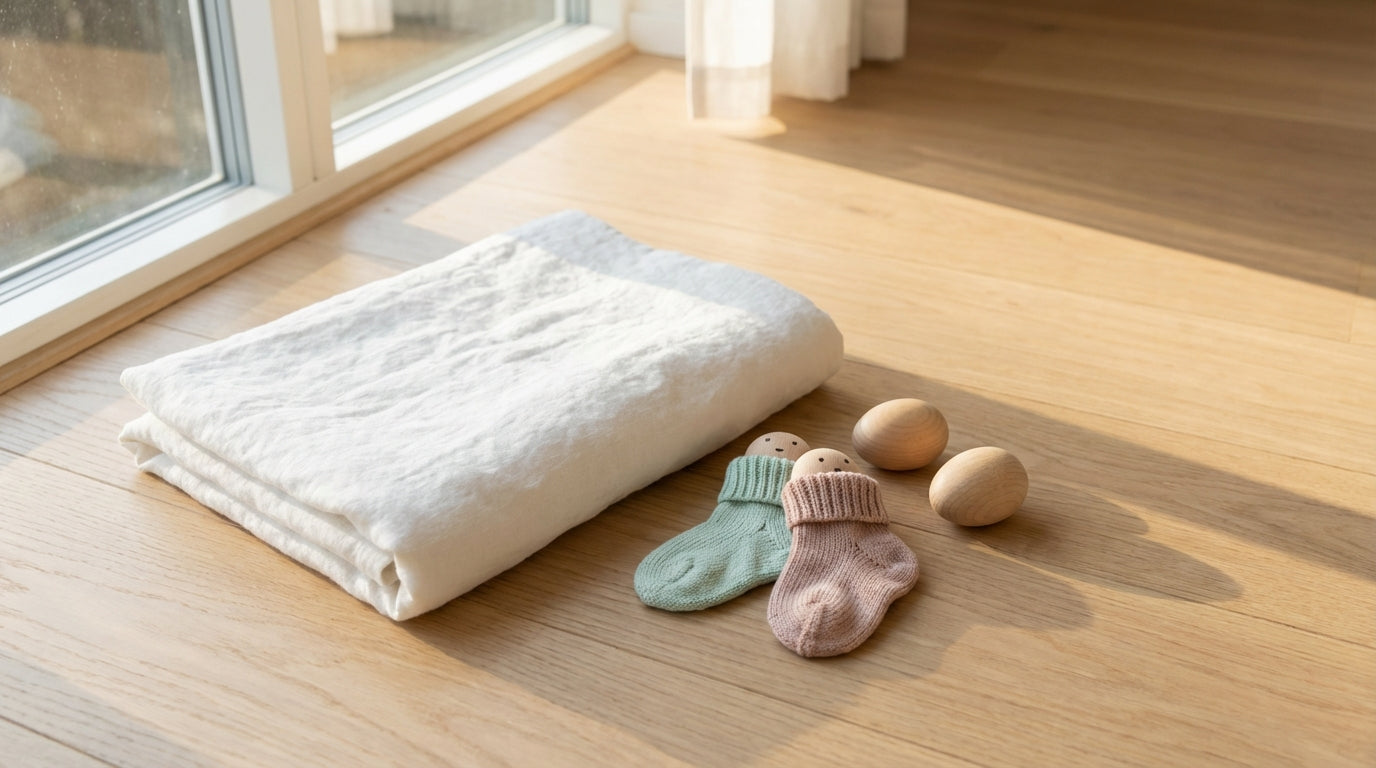
Rattle socks are baby socks with built-in rattles that make movement audible. This helps babies connect cause and effect: foot moves – it makes a sound. And yes, even we adults sometimes find that surprisingly fascinating.
Rattle eggs are handy shakers that make rhythmic sounds when shaken. Thanks to their shape, they're often easy to grip and pass from one hand to the other – practical coordination practice, without anyone having to say “training”.
Musical encouragement for babies means discovering sounds, pauses and rhythm together. According to UNICEF, music in everyday life can support development through interaction and shared attention. (Source)
When do rattle socks make sense for a baby?
Rattle socks get interesting as soon as your baby starts to use their legs on purpose. This isn't the same for every baby – some kick early like little outboard motors, others prefer to watch calmly first. You can often tell when your baby looks at their feet, pulls them up, touches them or kicks deliberately more often.

For sensitive babies: start quietly and keep it very short. Begin with 30–60 seconds, then take a break. If your baby looks away, fusses or gets frantic, that's not a “mistake” – that's communication.
If you'd like to understand the signals and stages better, a little orientation helps. Right this way: When does a rattle make sense for babies? Development & tips.
How to use rattle socks in everyday life (no circus act required)
A recurring mini-ritual usually works better than “lots all at once”. You don't need a show – you just need repetition and breaks. Here are a few ideas that can truly fit in between diaper changes and laundry mountains:

- Diaper-change rhyme: Speak or hum briefly while dressing (“left, right, tiny toes tight”). Then accompany 2–3 gentle kicking movements.
- Stop-and-go: Move the legs very slowly: “Stop … and now!” This makes rhythm tangible.
- Eye-contact beat: Every time it rattles, look at your baby and say calmly “There.” (Often that's all it takes.)
- Foot explorer: Your baby lies on their back, you briefly touch their feet and let go. Many babies respond with kicking or curious looks.
Practical tip: If you're already running on empty: make it quieter rather than longer. 60 nice seconds beat 10 minutes of “come on, have fun already”.
Rattle socks are especially handy when grasping doesn't work reliably yet. The sound is “right on your child” – your baby can be active without you constantly having to hand something over.
Using rattle eggs the right way: grasp, shake, switch
Rattle eggs work well when your baby wants to deliberately hold and explore things. This keeps it relaxed and still effective:
- You demonstrate: Shake once, then pause. Pauses are often the most exciting part for babies.
- Place it in an open hand: Don't press it in. Simply offer it and wait.
- Switch right/left: After a few seconds, gently pass it into the other hand.
- Call-and-response game: You shake – pause – your baby moves – you react. This back and forth is the actual “piece of music”.
Making music together works mainly through interaction, not through hitting the right notes. According to Head Start, singing and simple instruments such as shakers can support interaction and movement. (Source)
If you'd like more play ideas around “the rattle as an instrument”, here's more to explore. The rattle as your child's first musical instrument.
Which sounds are pleasant – and when is it too much?
Pleasant sounds are usually soft and clear, with pauses in between. You rarely recognize “too much” by a decibel value, but by your baby: turning away, fussing, frantic kicking or suddenly “shutting down” are fairly clear signs.
One sound, one rhythm, short repetition – that's often enough. Head Start describes how rhythm and predictability can engage babies well, especially when singing. (Source)
Safety: What to look for with rattle socks & rattle eggs
The most important thing is simple: nothing may come loose or be swallowable. Especially with things that rattle and are sewn or glued, a quick “parent check” is worth it: pull, twist, press – does it really hold?
Safety note: Toys for children under 3 years must not contain detachable small parts; this is tested, among other methods, with a test cylinder according to DIN EN 71-1, as the Bavarian consumer portal (Verbraucherportal Bayern) explains. (Source)
DIN EN 71-1 is a standard with tests for mechanical and physical safety. DIN Media describes requirements that are particularly relevant for children under 36 months. (Source)
In everyday life, that means: check regularly and consistently sort out anything damaged. If seams come undone, something rattles “differently” or parts feel loose: out it goes. That's not overprotective, it's simply responsible.
Cleaning & care: How to keep rattle socks & rattle eggs hygienic
Washing and cleaning rules always depend on the specific material and the label. With rattle socks, what often matters is whether the rattle is firmly sewn in and whether the product is machine washable according to its care instructions.
- Rattle socks: Check the care label, ideally wash in a laundry bag, then let dry thoroughly.
- Rattle eggs: Clean the surface with a mild cloth if the manufacturer allows it; no harsh cleaners.
- In general: If something absorbs moisture or rattles on the inside like a little stalactite cave: better not to keep using it.
A good sign is when you find no cracks, open seams or loose parts after cleaning. A quick visual and pull test takes 10 seconds and saves you a lot of worry later.
DIY: Making rattle socks, rattle eggs & rattle ideas yourself (simple & safe)
DIY works best when you keep it really simple and nothing small is flying around loose. Important to say upfront: homemade items are not automatically tested like store-bought toys – so use them only under supervision and dispose of them as soon as anything gives way.
DIY 1: “Rattle socks” without sewing (only as a supervised game)
The quickest DIY version is more of a game: “sound at the foot” for a few minutes. You'll need: a pair of baby socks and a ready-made, safe rattle egg (no small parts, no craft beads).
- Put the sock on: Just as usual.
- Hold the rattle egg against the outside of the ankle: Don't attach it, just hold it.
- Accompany 2–3 kicking movements: Then pause, eye contact.
This isn't meant for walking around, but for short shared play moments. The advantage: no craft stress, no risk from improvised fastenings.
DIY 2: Rattle egg as a “sound tin” (only if it closes securely)
If you craft, then only with a container that cannot be opened. Use only a tin/box that truly stays firmly closed and has no sharp edges – and use it only briefly and under supervision.
- Filling: Rather larger, harmless filling pieces than tiny beads (they end up everywhere – including mouths).
- Test: Shake, press, drop (from a low height onto a carpet) – does everything stay closed?
If you have even a moment of doubt, better leave it. Babies are remarkably good at turning “actually secure” into “apparently not so secure after all”.
Practical tip: For DIY you don't need a whole craft afternoon. Set a timer for 5 minutes – if it isn't done by then, it becomes a “tomorrow project”.
Avoiding mistakes: What often goes wrong with rattle socks & rattle eggs
The most common pitfalls are play sessions that are too long, too much volume and too few breaks. Babies aren't fans of constant noise – even if they sometimes look like they want an encore.
- Too much at once: Better one game, repeated.
- Too loud: A quiet sound plus your voice often works better than “action”.
- Switching too quickly: Babies need time to understand what's happening.
- Overlooking the toy: Check briefly before each use (seams, tears, loose parts).
And if nothing works today: that's not a setback, that's a perfectly normal day. Sometimes the best encouragement is: a break, cuddles, trying again later.
Why we at Bieco are so picky about sound toys
We're a family business from Hamburg and have been making baby and play products for 66 years. That's not a reason to show off, but rather a reason to take things calmly and thoroughly – especially with anything that ends up in small hands.
Safety transparency means to us: taking materials, workmanship and testing seriously. We take a close look at products to see whether seams are clean, whether anything could come loose and whether usage instructions are clear – because parents already have enough on their minds in everyday life.
FAQ
How long should my baby play with rattle socks?
Usually 2–5 minutes is enough if you offer it spread throughout the day. Babies process stimuli intensely, so short, recurring moments are often ideal. If your baby looks away, fusses or becomes restless, that's a clear sign for a break.
When do rattle socks make sense for a baby?
They make sense as soon as your baby uses kicking on purpose and reacts curiously to sounds. That can be early or later – both are normal. Start short (30–60 seconds) and observe: interested looks and calm listening are good signs.
Which is better: baby rattle socks or rattle eggs?
Rattle socks suit the kicking phase, rattle eggs suit the grasping phase. Rattle socks make movement audible without your baby needing to hold on securely yet. Rattle eggs are ideal when your baby likes to have things in their hands and you want to playfully encourage passing between hands.
Are rattle eggs safe for babies?
Rattle eggs are safe when they're age-appropriate and no parts can come off. Look for sturdy workmanship and make sure nothing can be swallowed. According to the Bavarian consumer portal (Verbraucherportal Bayern), toys for children under 3 years must not contain detachable small parts. (Source)
My baby gets startled by sounds – what helps quickly?
Make the sound quieter, shorter and predictable: shake once, then pause. Speak calmly alongside (“one … done”) and stick to a simple pattern. If your baby isn't in the mood today, that's okay – tomorrow there's often more curiosity again.
How do I best clean rattle socks and rattle eggs?
Follow the care label or the manufacturer's instructions and check the workmanship afterwards. Wash rattle socks ideally in a laundry bag and let them dry thoroughly. Rattle eggs should usually only be wiped with a damp cloth, if that's intended. If there are cracks, open seams or a loose-sounding rattle: better sort it out.
If you use baby rattle socks and rattle eggs in small doses, they become real everyday helpers. If you'd like to look around further: in the Rattles section you'll find various options, and for the specific cases go straight to Rattle socks for babies or Rattle eggs & rattle instruments.