Wooden Baby Rattle: Benefits, Care & Buying Checklist for Parents
At a glance
- A wooden baby rattle stands out for its pleasant feel and good durability.
- More important than the material: clean workmanship, no small parts, and the right size.
- Choose by age: 0–3, 3–6 and 6+ months each have different needs.
- Cleaning differs: wipe wood with a damp cloth, plastic is usually washable.
- Check for toy safety information (e.g. EN 71) and clear care instructions.

A wooden baby rattle is a great choice when it is safely made and fits into your daily life. Many people love wood because it feels warm in the hand and doesn't scream "bright and loud." Others need something they can quickly wipe clean on the go. Here you'll find a practical comparison, a simple age guide (0–3, 3–6, 6+ months), care tips for each material, and a buying checklist that works even on very little sleep.

Ulli & Flo
Owners of bieco · Hamburg · parents themselves
We quickly learned with rattles: it's not "wood or plastic" that decides, but whether your baby can grip it well and whether it stays clean in everyday life. With the checklist above, things get a little easier. Feel free to browse our Rattle collection.
What really matters in a baby rattle?
What matters most are safety, ease of gripping and a harmless surface. Whether it's a wooden rattle or a plastic one: babies put toys in their mouths, drop them, and test the world with astonishing determination. That's why it's worth a quick look at workmanship, size and manufacturer information before you sink your teeth into the material question (pun sadly unavoidable).

A baby rattle is a grasping toy that makes noise when moved. The benefit is simple: your baby realizes "when I move, something happens" – and practices grasping, holding and coordination along the way.
DIN EN 71 is a European series of standards for toy safety. Among other things, it describes tests for mechanical/physical requirements and for certain substances; according to DIN e. V., DIN EN 71-3 deals with the migration of certain elements (DIN e. V.).
Safety note: If you notice cracks, chipped areas, splinters or loose parts, please throw the toy away – whether it's wood or plastic.
Wooden baby rattle: benefits (and where it can be a bit fussy)
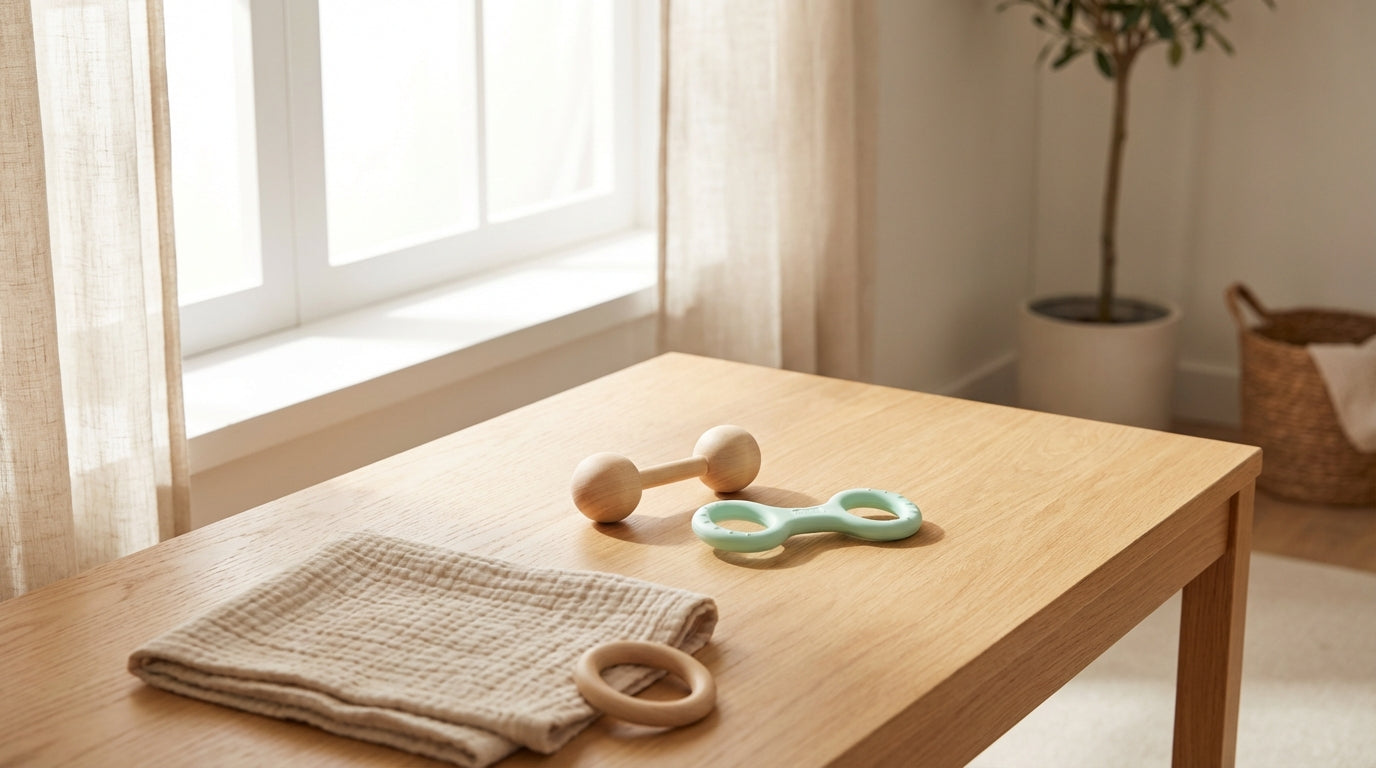
A wooden rattle often feels calm, easy to grip and long-lasting. Many parents and grandparents like the "honest" feel: wood is warm, sits nicely in the hand and looks timeless. On top of that, a well-made wooden baby rattle often survives everyday life surprisingly bravely – even when it regularly leaps from the sofa onto tiles.

- Feel: Wood can be very pleasant to grip when it is smoothly sanded.
- Weight & balance: Often a bit heavier – this can help with deliberate grasping, but may be too much for very small babies.
- Durability: Robust when dropped (your ears will still notice, though).
- Look: Simple, understated, "always fits" – also as a gift.
Wood is not automatically easier to care for, but rather calls for more mindful care. Untreated wood doesn't like constant moisture, and lacquered surfaces should stay intact. According to the Verbraucherzentrale (German consumer advice center), it's worth choosing untreated solid wood for wooden toys and, for paints and varnishes, making sure they meet the toy standard (Verbraucherzentrale).
Practical tip: If the wooden rattle likes to go "clack": put a cloth diaper down as a landing pad. It saves nerves – usually yours.
Plastic baby rattle: benefits (and what to look out for)
Plastic is often light, washable and available in many shapes. Especially in the first months, low weight can be worth its weight in gold: your baby can hold on longer, and you have to offer "Shall I hold it for you for a moment?" less often. And yes: on the go, "wipe once, done" is sometimes half the battle.
- Lightweight: Often easier to grasp and hold.
- Cleaning: Often easy to wash (follow the manufacturer's instructions).
- Shapes: Many grip shapes, textures and transparent elements possible.
What matters is which plastic is used and how it is processed. As a guide for plastic toys, the Verbraucherzentrale points to PE, PP or ABS, since these do not require added plasticizers (Verbraucherzentrale).
When it comes to plasticizers, a calm but watchful eye is worthwhile. The BfR (German Federal Institute for Risk Assessment) explains that phthalates were once used on a large scale as plasticizers and are now banned or strictly regulated in many products; children can be more exposed through mouthing (BfR).
Which baby rattle from when? An age guide (0–3, 3–6, 6+ months)
The best rattle is the one your baby can hold well. Age is only a rough compass – every baby has their own pace. Still, a simple breakdown helps you avoid offering "too much at once" by accident.

0–3 months: light, gentle, not overloaded
In the first weeks, light models with a gentle sound are usually the most comfortable. Many babies still grasp rather by chance, and listening and looking take center stage. A very heavy wooden rattle can be frustrating because it slips out of the hand more easily. Simple grip shapes or soft rattle sounds are practical.
3–6 months: practicing grasping, mouthing, dropping again
Now a shape that is easy to grip, with a safe surface, is what counts. In this phase, babies grasp a lot on purpose – and "test" very deliberately (with their mouths). Look for a comfortable size, no sharp edges, and make sure nothing inside rattles that could come loose. A wooden baby rattle can be wonderful here if weight and shape are right.
6+ months: more movement, more strength, more "I can do it!"
From about six months, rattles can often do a bit "more." Many babies move more actively, switch toys, and even drum on the table. Robust workmanship becomes even more important now. Some babies then also enjoy teethers or small instruments – as long as they are sturdy, easy to hold and easy to clean.
If you'd like to browse: in the Rattle overview you'll find different shapes and materials. For wood fans, the Wooden Baby Rattle collection is a good place to start.
Cleaning & care by material (wood, plastic, fabric)
Yes to cleaning – but please match it to the material and the manufacturer's instructions. You don't need to keep baby toys "sterile," but they should be clean and intact. And: anything cleaned too aggressively can damage surfaces – which helps no one.
Cleaning a wooden rattle
It's best to just wipe wood with a damp cloth and dry it quickly. A slightly damp cloth is often enough, with a mild cleaning agent if needed according to the manufacturer's instructions. Please don't soak wood for long or put it in the dishwasher unless this is explicitly permitted – otherwise it can swell or the surface can suffer.
Cleaning a plastic rattle
Plastic can often be wiped down or briefly rinsed off easily. Afterwards, dry thoroughly, especially in crevices. If a rattle can "trap" water (e.g. through openings), make sure nothing stays inside. When in doubt: the manufacturer's instructions beat kitchen myths.
Fabric versions (e.g. rattle socks)
Fabric is practical because it is often washable and stays soft. With rattle socks, it's worth checking the care label: wash temperature, dryer yes/no, and whether Velcro or appliqués should be protected. For many families, rattle socks for babies are the most relaxed solution on the go, because they (usually) stay on your child.
Practical tip: A small box in the hallway for "toys that came along today" helps: collect first, then clean calmly in the evening. No rush.
Buying checklist: How to find a good wooden baby rattle (or alternative)
You can recognize a good rattle by its workmanship, information and suitability for everyday life. Here is the checklist I'd love to stick on the fridge (if there weren't already 17 works of art hanging there).
- Workmanship: No splinters, no sharp edges, no cracks.
- Small parts: Nothing may come loose (caps, beads, screw parts).
- Size & shape: Easy to grip, not too heavy, not too "fiddly".
- Surface: Intact, smooth, no chipping paint.
- Transparency: Clear manufacturer information on testing/standards and care.
- Sound: Pleasant for all of you – yes, that's a real criterion.
Standards are not decoration, but a helpful indication of testing. For context: in the EU, the Toy Safety Directive 2009/48/EC sets out essential safety requirements; according to the German Federal Ministry for the Environment, technical requirements have applied since 20 July 2011 and chemical requirements since 20 July 2013 (BMUV).
Wood vs. plastic: the direct comparison (short & practical)
In everyday life, the material that fits your routines wins. Here it is summed up "kitchen-table style" – including the cold coffee next to it.
| Aspect | Wood | Plastic |
|---|---|---|
| Feel | Warm, easy to grip, often "calm" | Very variable: smooth to highly textured |
| Weight | Often a bit heavier | Usually lighter |
| Cleaning | Wipe with a damp cloth, don't soak | Often washable (follow manufacturer's instructions) |
| Sound | Can be louder when dropped | Often a little quieter |
| Look | Timeless, simple | Colorful, transparent, many shapes |
A North German word on quality & transparency (from Hamburg, for 66 years)
We like it when materials, testing and care are clearly stated. We are a family business from Hamburg and have been doing this for 66 years – you learn a thing or two: parents don't need big promises, but honest information. What we see again and again in practice (and in customer feedback): most problems don't come from the material, but from damaged surfaces, parts that are too small, or missing care instructions.
If you'd like to look at different shapes, the overview is often the best place to start. In the Rattle collection you'll find different variants; and if your heart belongs to wood, take a look at Wooden Baby Rattle.
FAQ
Which baby rattle from when – and is wood suitable for newborns?
The right age depends less on the material than on weight and ease of gripping. For 0–3 months, light, simple shapes are usually the most comfortable. Wood can work if the rattle isn't too heavy and is cleanly made. From 3–6 months, babies grasp more deliberately and mouth more, so a robust, intact surface counts especially.
How can I recognize a safe wooden rattle?
A safe wooden rattle is smooth, sturdy and has no detachable parts. Look for clean edges, no splinters, no cracks, and make sure nothing wobbles. Transparent manufacturer information on testing/standards and care is helpful. If paint or varnish has been applied, it should be suitable for toys.
How do I clean a wooden baby rattle properly?
Clean it with a damp cloth and then dry it well. Please don't soak wood, and don't put it in the dishwasher or sterilizer without explicit approval. If the surface is damaged (chipping, cracks), replacing it is the more relaxed and safer solution – even if it's annoying.
Is plastic a toy automatically "worse" because of plasticizers?
No, what matters are the material details and legal requirements. As a guide for plastic toys, the Verbraucherzentrale points to PE, PP or ABS (Verbraucherzentrale). The BfR explains that phthalates are now banned or strictly regulated in many products (BfR).
Are a teether and a rattle the same thing?
No: a teether is mainly meant for holding on to, while a rattle also makes noise. Many products combine both, which is handy: your baby can grasp and gets instant acoustic feedback. With combination toys, pay special attention that nothing inside rattles that could come loose, and that the shape fits well in small hands.
What is better on the go: wooden rattle, plastic or rattle socks?
On the go, what usually wins is whatever stays put and is quickly cleaned. Plastic is often easy to wipe clean, wood feels high-quality but needs a little more care. For many families, rattle socks are the "I'm not bending down so often today" option, because they (usually) stay on the baby. You can find them here: rattle socks for babies.
Conclusion: A wooden baby rattle is great when it is well made and suited to everyday life. If you now feel like comparing different shapes: in the Rattle overview you'll find wood, other materials and practical variants for on the go.