XXL Puzzle Play Mat: Sizes & Shapes – How to Make It Really Fit Your Room
At a glance
- An XXL puzzle mat works if it can stay put as a permanent play area.
- Easy maths: tiles per side × 32 cm = edge length (for 32 cm tiles).
- A square is the all-rounder, a rectangle saves walking space, an L-shape works modularly.
- Look for specific standards and test information (e.g. EN 71) and air out new mats.
- Not sure? Start modular and expand later instead of getting frustrated.

You'll find the right XXL puzzle mat by first measuring your free floor space and then deciding: leave it down permanently or tidy it away every day. If it's allowed to stay, it can happily be generous. If your living room needs to be a living room again in the evening, “modular and quick to make smaller” is worth its weight in gold. Below you'll find calculation examples, shape ideas (including for corners) and a few everyday tricks that have already saved plenty of parents' backs.

Ulli & Flo
Owners of bieco · Hamburg · parents themselves
We once laid out an overly optimistic “XXL” – and then had to dismantle it again every single evening. Since then, we measure first and click together afterwards. Feel free to browse our puzzle mat collection.
What does “XXL puzzle mat” actually mean?
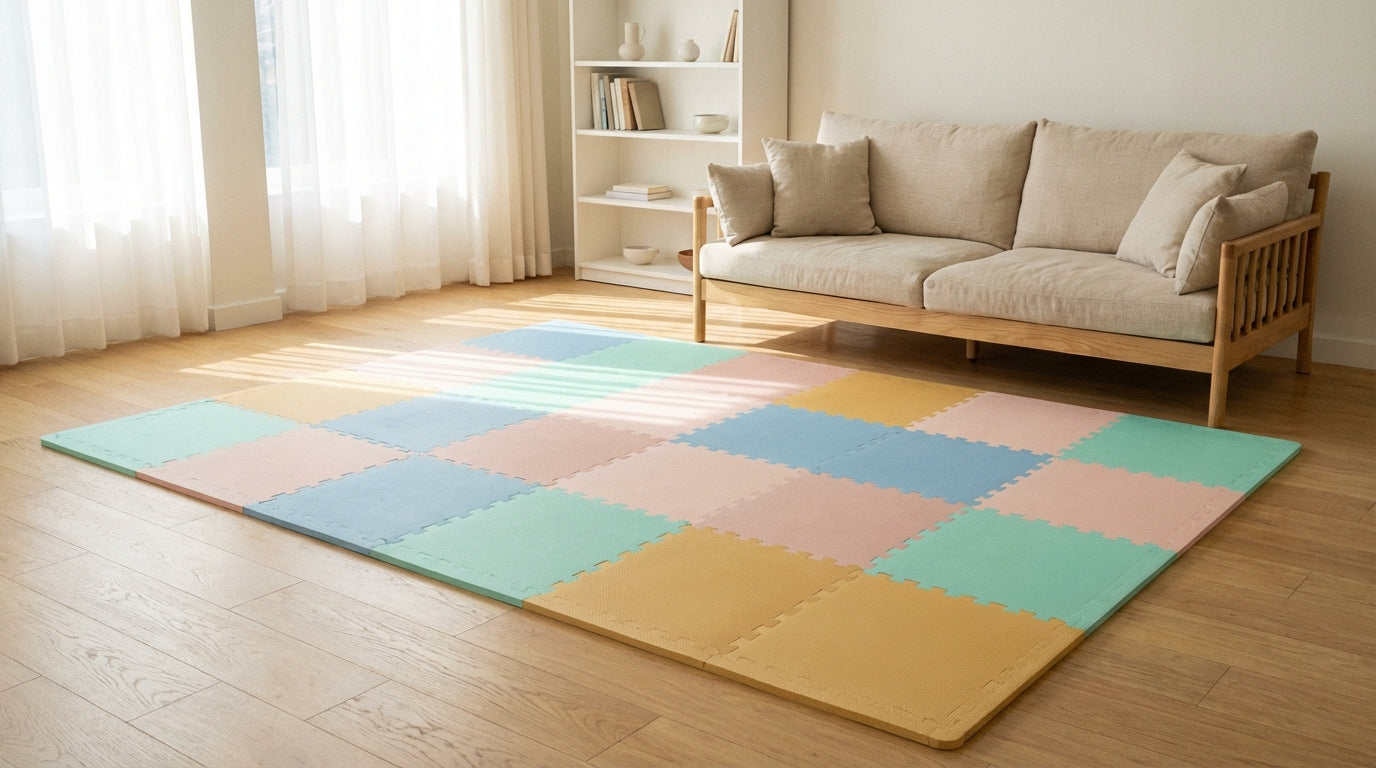
“XXL” isn't a fixed size for puzzle mats – it usually just means: lots of surface area. That's why two numbers matter: the size of a single puzzle tile and how many tiles you lay out.
A puzzle mat is a play surface made of interlocking tiles that you click together into one larger area. That sounds simple – but it's exactly why it adapts so well to rooms and everyday life.
At BIECO you'll find, for example, mats with individual tiles measuring 32 × 32 cm, plus details on thickness and standards. The product page for the “Numbers Black & White Puzzle Mat” lists, among other things, a tile size of 32 × 32 × 0.9 cm and compliance with EN-71-1-2-3-9. (Source: BIECO product details)
How to measure properly: free space, walkways, furniture
Don't measure the room – measure the space that is actually free between the furniture. Otherwise you'll end up buying a dream size that becomes a tripping hazard in everyday life.

- Measure the free space: width × length where the mat is going to lie (e.g. between the sofa and the shelf).
- Save your walkways: Keep paths to the door, kitchen or sofa clear – you don't want to compete with a Lego brick there at night.
- Plan a buffer: Allow 10–20 cm of distance from doors, chair legs, radiators or cupboard doors.
- Calculate with the tile size: With 32 cm tiles you can scale up very quickly (see table).
Practical tip: Mark the planned mat edge with masking tape. Live with it for a day – then you'll really know.
Handy maths: 32 cm tiles – examples & size table
With 32 cm tiles you can estimate the mat edge in your head. All you need is “number of tiles per side × 32 cm” – done.

32 cm tiles: quick calculation examples
- 3 tiles side by side: 3 × 32 cm = 96 cm
- 4 tiles side by side: 4 × 32 cm = 128 cm
- 5 tiles side by side: 5 × 32 cm = 160 cm
- 6 tiles side by side: 6 × 32 cm = 192 cm
Important: These are edge lengths without border pieces or edging strips – if your set includes them, the total area may differ slightly.
Size table: number of tiles → approx. area (for 32 × 32 cm)
| Layout | Dimensions (approx.) | Area (approx.) |
|---|---|---|
| 3 × 3 tiles | 96 × 96 cm | 0.92 m² |
| 4 × 4 tiles | 128 × 128 cm | 1.64 m² |
| 5 × 5 tiles | 160 × 160 cm | 2.56 m² |
| 6 × 6 tiles | 192 × 192 cm | 3.69 m² |
| 4 × 6 tiles | 128 × 192 cm | 2.46 m² |
| 5 × 6 tiles | 160 × 192 cm | 3.07 m² |
Which shape fits? Square, rectangle, L-shape (modular)
The shape decides whether the mat “works with the room” or is constantly in the way. With the same tiles you can often lay several shapes – here are the tried-and-tested classics:

Square: the all-rounder
A square is ideal as a play island if you play in the middle of the room. It looks “tidier” than a long strip and is easy to arrange around a play gym, a box of building blocks or a little reading nook.
Rectangle: great for narrow areas
A rectangle fits perfectly next to a sofa, a bed or along a wall. It's often the best solution when walkways are sacred and you still want a decent play area.
L-shape: when furniture is in the way (and it always is)
An L-shape is handy when you want to lay the mat around sofa corners or tables. You build it by “angling” two rectangles together – this works especially well when the mat is modular and you can rearrange it flexibly.
A play puzzle mat is a puzzle mat that also offers play stimulation, such as pictures, numbers or letters. That's nice in everyday life, because the mat isn't just a “surface” but also keeps little ones busy.
Decide in 30 seconds: leave it down or go modular?
The best decision is the one that fits your daily routine. So here's a little decision tree you can run through over your morning coffee:
- Can the mat stay down permanently? Then plan more generously (more area, preferably a square) and choose a look that won't get on your nerves after three days.
- Do you need the space back in the evening? Then go modular: a base area that can quickly be made smaller, and easily expanded when you have visitors or the weather is bad.
- Do you have a “problem room” (narrow, lots of doors)? Then choose a rectangle or L-shape – and plan a buffer around the doors.
Practical tip: Lay the mat so that you, as an adult, can comfortably sit on it too. Your back and your patience will thank you.
Typical room scenarios (with little “that's how it was for us” moments)
The best puzzle mat is the one that fits your everyday life – not a glossy photo. Here are three typical rooms, as they really look in real families (crumb reality included).
Living room: “It can stay, but please make it cosy”
In the living room, square or slightly rectangular areas often work best. What has worked for us: not directly in front of the sofa edge, but slightly to the side – that way you trip less often when you're walking through with a laundry basket and a child under your arm.
If you'd like to look at shapes and designs in peace, the puzzle mat overview is a good place to start.
Children's room: “More space, less discussion”
In the children's room it can often be bigger, because the mat becomes part of the play area. An edge along the wall is practical: that leaves the middle free, and you get a clear “play zone” that doesn't have to be renegotiated every day.
If you like pictures and themes (animals, numbers, letters), you could take a look at the Animal Motif Train Puzzle Mat (18 pieces) – purely as a guide to size and layout, because the set details are listed right there.
Kitchen/dining area: “Just briefly, but please make it soft”
In the kitchen, a small, quickly assembled set-up is usually worth more than a huge XXL. It's often about “set down for a moment, play for a moment” – and then wiping over it once. And yes: crumbs have a talent for gathering under everything.
For cleaning and everyday care, our article Cleaning & Caring for Puzzle Mats: Tips for Hygiene & Durability will help.
Material & safety: what to look out for with foam puzzle mats
With foam puzzle mats, smell, workmanship and clear test information are what count. Many mats are made of EVA foam (ethylene-vinyl acetate): lightweight, cushioning and usually pleasant in everyday use – but you want to be able to verify that the mat has been tested.
Safety note: Loose edge pieces or removable motifs should be used by small children only under supervision – especially when everything likes to end up in their mouth.
According to the European Chemicals Agency (ECHA), there are restrictions and limit values for certain substances in toys, including formamide. (Source: ECHA – Substances restricted in toys)
In the EN 71 context, EN 71-15 is listed, among others, as the standard for formamide. (Source: DIN Media: EN 71-15)
At BIECO, you'll find specific information on standards and tests on the product pages. For example, the “Numbers Black & White Puzzle Mat” lists EN-71-1-2-3-9 and “independently tested”. (Source: BIECO product details)
Build XXL instead of buying XXL: how the mat grows with you
Starting modular and expanding later is often the most nerve-saving solution. Especially if you don't yet know whether your child will love the mat or would rather play next to it (yes, that happens – kids are very consistent about it).
- Start: Lay a base area where you can comfortably sit and play together.
- Let it grow: When crawling or walking begins, or visiting children come over, you simply click together a bigger one.
- Move it around: A rectangle in the living room today, a square in the children's room tomorrow – depending on the day's plan.
If you use mats with pictures, “bigger” often becomes more exciting for play as well. Our guide Puzzle Mats as Learning Toys: Discovering Numbers, Letters & Animals fits nicely here.
FAQ
What size makes sense for an XXL puzzle mat?
XXL makes sense if the mat can stay down as a permanent play area. Measure the free space and allow 10–20 cm of distance from furniture. With 32 cm tiles, 5 tiles side by side give an edge length of about 160 cm – which often already feels really generous in everyday life.
Square, rectangle or L-shape: which is the most practical?
A square is the play island, a rectangle saves space, an L-shape solves corners. If you play in the middle of the room, a square usually looks calmer. Next to a sofa or wall, a rectangle is often more practical for everyday use. An L-shape is great when furniture “chops up” the space and you have to build around it.
Can puzzle mats be washed, or only wiped?
In everyday life, puzzle mats are usually wiped down with a damp cloth rather than “washed”. Exactly how depends on the material and the manufacturer's instructions. If you use the mat regularly in the kitchen or dining area, a quick wiping routine is more realistic than big washing sessions. For specific care tips, our article on cleaning will help.
Are puzzle mats suitable for underfloor heating?
Whether it works depends on the mat, the floor and the manufacturer's instructions. A mat can dampen warmth because it insulates – that's physically normal. If you have underfloor heating, check the manufacturer's notes and observe whether heat builds up underneath or the surface becomes uncomfortably warm.
How can I tell a safe foam puzzle mat?
Look for specific standards and test information, and clear product details. According to ECHA, there are restrictions and limit values for certain substances in toys, including formamide. (Source: ECHA) It also helps to air the mat out, check for cleanly finished edges, and make sure there are no noticeable odours after a while.
Can I leave a puzzle mat down permanently in the living room?
Yes, if its size and shape respect your walkways. Test the area with masking tape or lay the mat out on a trial basis. If doors scrape, chairs wobble or the vacuum cleaner keeps catching, it's too big or badly placed. In that case, plan something narrower or more modular.
In closing (and entirely without drama)
An XXL puzzle mat is right when it makes your life easier. We're a family business from Hamburg and have been doing this for 66 years – and honestly: everyday life beats theory. If you'd now like to compare sizes and shapes, take a look at the puzzle mat collection, and for the full picture, read Puzzle Mats for Babies & Children: Guide, Pros & Cons.