Puzzle Mat Letters: Play Ideas for ABC, Numbers & Animals
At a glance
- Puzzle mat letters work best as a short game – no quizzing.
- Start with just a few inserts: less chaos, more little wins.
- Look for the CE mark, age recommendations and warnings on the product.
- Cleaning & airing out are everyday topics: clean first, then relax.
- With play ideas by age, the mat becomes a real play island.

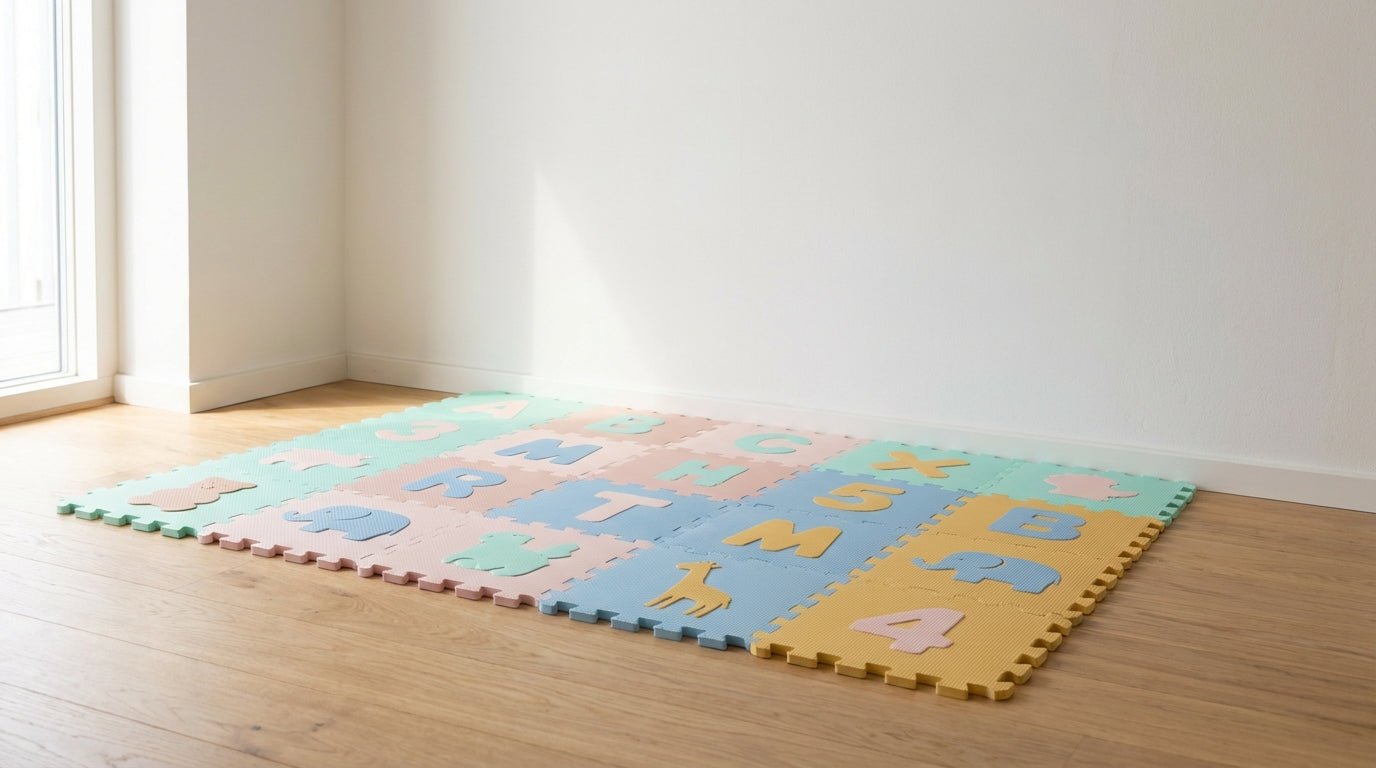
Puzzle mat letters are most helpful when you use them to snap pieces in, sort and be silly together. That's exactly how children love to learn symbols like the ABC, numbers or animals: touch them, turn them, recognize them – and shout a big “Aaaah!” now and then, simply because it's fun. In this guide you'll find everyday play ideas by age, a small safety and material checklist, tips against piece chaos, and advice on cleaning, storage and saving space.

Ulli & Flo
Owners of bieco · Hamburg · parents themselves
We like to use puzzle mat letters in mini portions: two minutes of snapping pieces in, one good laugh, done. And if today only “animal out, animal in” works – then that was exactly right. Feel free to browse our puzzle mat collection.
Why puzzle mats work so well as learning toys
Children learn through hands-on repetition – not through explanations. When your child pushes a letter out, turns it and puts it back in, a lot happens along the way: grasping, comparing, spatial thinking and a little frustration tolerance (yes, that's learning too). And you don't have to “teach” – you're more of a playmate, snack manager or referee, depending on the day.
A puzzle mat is especially practical because it's a play surface and a toy in one. It's warm on the floor, dampens noise a little and gives play a clear frame: “This is our island.” That helps many children stay with an activity – and many parents catch their breath.
Being silly is allowed – it makes things memorable and easy. If the “K” turns into a “Krrrr” crocodile sound or the cow says “Meow”, that's not a mistake. That's childhood in its purest form.
What is a puzzle mat – and what is the “learning” part?
A puzzle mat is an interlocking floor mat made of individual tiles, often with inserts. You can connect the tiles into a larger surface or lay them out smaller – depending on whether you're having a crawling party or a living room obstacle course.
A learning toy is play material that supports skills through trial and error – without performance pressure. For toddlers, “learning” usually means: repeating, matching, naming, imitating. And that works quite well with letters, numbers and animals, because every piece has a clear task: “Where do you fit?”
Practical tip: At first, leave only 4–6 inserts in play and put the rest away. Less searching, more “I can do it!”
Play ideas by age: keeping puzzle mat letters relaxed
The “right” age matters less than what your child enjoys right now. Some children love snapping pieces in early, others only later – and some find inserts exciting only because they can run off with them. Here's a rough guide that often fits real life:
0–12 months: feel, look, roll (without inserts)
For babies, the mat is mainly a safe, soft surface – that's it. At this age it's all about tummy time, rolling, first wriggling forward and “What's that crinkling?” If your mat has inserts, you can simply leave them out for this phase and use the surface as a play island.
1–2 years: snap in, pull out, snap in again
At this stage, “in and out” is a full-time job – and that's a good thing. Let your child put in individual shapes or animals without having to “name them correctly”. You can offer words along the way: “That's the horse.” If it comes out as “Neigh-neigh”: also fine.
3+ years: names, sequences, little tasks
Now letters and numbers get more exciting, because children recognize symbols on purpose. Many are keen on the first letter of their name, on “I can count to 10” or on little search games. What matters: keep it short and make success possible, and the mood will be better than in any “practice round”.
ABC on the mat: playing with letters instead of quizzing
Letters work best through names, sounds and silly words. The goal isn't for your child to recite the alphabet. The goal is for letters to become familiar. Three games that work in everyday life:

- “My letter”: Look for the first letter of your child's first name. “F as in Flo” – and then Flo gets to proudly carry the letter around.
- “Letter detective”: You show a letter, your child finds the same one on the mat. If they get stuck: you “accidentally” look for the wrong one. Children love correcting grown-ups.
- “Silly words”: Line up 2–4 letters. The word doesn't have to make sense. As long as there's laughing and laying, you're set.
If inserts are small, supervision is a must for children in the “mouth-testing phase”. That's not a drama, just a realistic look at everyday life: some things are for snapping in, not for tasting.
If you're looking for a suitable play surface, you'll find several options in our puzzle mat overview. We're a family business from Hamburg and have been doing this for 66 years – we know toys have to be able to live with you, or they get tossed out.
Numbers on the puzzle mat: learning to count without “Now we're practicing”
Numbers become tangible when they come together with quantities and movement. That way “2” isn't just a shape, but “two things”. A few games that need little preparation:

- “1–2–3 collecting”: Set out 1–5 larger, safe objects (e.g. building blocks). Your child adds the matching number and counts the items.
- “Number parking lot”: Every car gets a spot. “Car 4 is parked on 4.” If it's on 7: well, you've parked a car. That's a success too.
- “Hop & count”: Lay out 3–6 tiles as a little path. Count at every square. Movement helps many children remember.
Even putting the digits in place is a math precursor: recognizing, turning, fitting. That's down-to-earth learning – and usually much less stressful than “Say the 6, please”.
Animals & shapes: vocabulary, sounds, sorting – all in one
Animal motifs are an easy way in, because language comes along automatically. You can name them, make sounds or tell mini stories: “The rooster is looking for his home.” (And yes, grown-ups may cluck along. There are worse hobbies.)
- “Animal families”: Sort by habitat: farm, forest, water – depending on what you have.
- “Feeling game”: Your child closes their eyes, feels an insert and guesses. If it's wrong: laugh, try again. No test, just play.
- “Who's missing?”: You put in 3 animals, your child looks away for a moment, you take one out. “Which animal ran away?”
Along the way, you're training fine motor skills and hand-eye coordination. Those are the invisible foundations that later help with drawing, cutting or getting dressed – without you having to make a science of it.
Safety & materials: a checklist for a calm mind
Safety note: Removable inserts can be a choking hazard for very young children. Use them only under supervision, or leave the inserts out for now.
CE marking, age recommendations and warnings are part of toys in the EU. According to the European Commission, toys must meet EU safety requirements and be labeled accordingly (CE) – see the toy safety information on the European Commission's website.
The Toy Safety Directive 2009/48/EC is the central EU rule for toy safety. You can find the legal text on the EU law portal: Directive 2009/48/EC on EUR-Lex.
If a mat smells strongly, this often helps: air it out, wipe it down, then use it. Smell isn't a measurement, but in family life it's a useful hint: if it stays unpleasant, I wouldn't put it in the nursery. Also: check regularly whether edges are fraying or small pieces are coming loose – if so, better to sort it out.
Transparency isn't an extra for us, it's normal: naming materials and notices clearly. We've been at it for 66 years and, as a Hamburg family business, we're more of a “tell it like it is” team – especially on topics like material, care and safety.
Cleaning & care: when porridge, cookies and felt-tip pens join in
A puzzle mat stays nice for longer if you give it a quick clean regularly. In everyday life, small routines are often enough: sweep off crumbs, wipe with a damp cloth, let it dry well. What matters is less “perfectly hygienic” and more “not sticky and not musty” – so you'll enjoy using it.
After wiping, let the mat dry completely before it lies flat again. That way you avoid trapping moisture. If you use the mat on carpet, it's worth taking a look underneath now and then – just so there are no “surprises”.
If you need concrete step-by-step tips, our article Cleaning & caring for puzzle mats: tips for hygiene & longevity will help. It's all about the classics of family life.
Storage & saving space: so the inserts don't wander off
Pieces don't disappear “just like that” – they go on adventures. And you get to decide how long that trip lasts. A few tricks that have proven themselves:
- A fixed parking spot: A tin, a fabric bag or a small box next to the mat – done. What matters: always the same place.
- Rotation instead of the full set: Letters today, animals tomorrow. That keeps things exciting and manageable.
- Mini routine: Before bedtime, 60 seconds of “all pieces go home”. No more. You'd like some time off too.
Practical tip: Take a photo of the “finished” mat. Children like tidying up by picture – and you have to explain less.
Buying checklist: what many parents only think of after buying
A good mat fits your everyday life – not the perfect Instagram living room. If you're about to choose, these questions help:
- How many pieces do you really want to manage? More inserts = more searching. (Some like it. Many don't.)
- Where will the mat mostly be? Permanently in the nursery or flexibly in the living room? That determines how big it should be.
- How old is your child – and what do they do with small parts? If a lot still ends up in the mouth, inserts are more of a “later” topic.
- How important is everyday cleaning to you? If the mat is used daily, it also has to be practical to keep clean.
For questions about sizes and shapes, our guide Puzzle mats in XXL & different shapes: which size fits? is a good addition. It saves you the “Darn, too small” feeling in the end.
FAQ on puzzle mat letters
From what age do puzzle mat letters make sense?
They make sense as soon as your child enjoys snapping pieces in, sorting and recognizing things. More important than a fixed age: does your child put small inserts in their mouth? Then use the inserts only under supervision, or leave them out for now and use the mat as a play surface.
Are the inserts a choking hazard?
Removable parts can be a risk for very young children. Whether something is a choking hazard depends on the size, your child's age and their behavior. If your child still explores a lot “orally”, it's better to play without inserts or only with direct supervision – that keeps things more relaxed.
What's the best way to clean a puzzle mat?
Usually it's enough to remove crumbs and wipe with a damp cloth. Then let the mat dry well before it lies flat again or is stacked. If you wipe regularly instead of doing a “big clean”, the mat stays practical for everyday use – even when porridge, cookies and juice join in.
What should I do if the mat smells like “chemicals”?
First air it out, wipe it down, and only use it once the smell is pleasant. Smell isn't a measurement, but it's a practical everyday check. Ideally air it out by an open window and give the mat time. If the smell stays stubborn and bothers you, I wouldn't use it in the children's area.
How do I practice letters without it feeling like school?
Stick to short games around names, sounds and searching. Look for the first letter of the name, lay silly words or play “detective”. Two minutes is plenty. If your child drops out, that's not failure – that was simply their entire attention span for today.
How can I tell whether a puzzle mat is correctly labeled as a toy?
Look for the CE mark, age recommendations and warnings. In the EU, these markings are part of the toy safety requirements. According to the European Commission, the CE mark on toys is a key element of conformity – see Toy Safety (European Commission).
If you want to rearrange your play corner: in the puzzle mat overview you'll find different options for different needs. We've been at it for 66 years – and we like solutions that work in real family life, not just on paper.