Toys for 5-Year-Olds: Ideas, Buying Tips & Gifts That Last
At a glance
- Toys for 5-year-olds work best when they challenge your child without causing frustration.
- The best bets: role play, building, creative activities, movement and short games.
- Safety check: labeling, warnings, workmanship and suitable part sizes.
- Gifts are easier to get right when they are playable right away and can grow later.
- Rotation and mini-challenges keep toys exciting for longer.

Toys for 5-year-olds work best when they are playable right away and can still “grow along” with your child. Five-year-olds are often little idea machines: they tell stories, make plans, negotiate rules – and still splash into a puddle as if it had just been invented. In this guide you will find practical, everyday orientation: which types of toys often work well, how to recognize quality, how to avoid overwhelming or under-challenging your child, and which gift ideas fit without hours of head-scratching.

Ulli & Flo
Owners of bieco · Hamburg · parents themselves
At five, play often becomes really “their own”: suddenly there are plans being made, rules being negotiated and worlds being built. We hope you find something here that fits your everyday life – without the headache. Feel free to browse our collection Toys for Ages 5+.
If you want to jump ahead: this table of contents takes you straight there.
- What kids can do (and want) at 5
- 6 categories that almost always fit
- 7 questions for choosing
- Safety & quality
- Gift tips
- Ideas by type: calm, active, creative, tinkerer
- How to keep things exciting day to day
- Mini checklist to take along
Toys for 5-Year-Olds: What Kids Can Really Do (and Want) Now
At five, play often becomes more purposeful: planning, testing, improving. Many children can stay with one activity for longer, understand rules better and are proud when something works: a tower, a picture, a “real” role play with assigned parts. At the same time, they are still practicing frustration, waiting, losing and “starting over” quite intensively.
Age-appropriate means: it fits your child’s development, not just the number. Age recommendations are a good guideline, but children aren’t clockwork. One child loves tricky building ideas at 5, while another needs more free play without many rules.
“Open-ended play material” is a toy without a fixed goal that allows many ideas. It helps children develop their own play ideas and stick with them longer, because they are free to reinvent things again and again.
Practical tip: If you’re unsure, pick something that works in stages (easy start, harder later). That way it simply grows with your child.
Toys for Ages 5+: These 6 Categories Almost Always Hit the Mark
A mix of head, hands, heart and movement works best. Rather than “the one perfect piece”, it’s often play worlds that can be combined and keep hopping out of the shelf again and again.
- Role play & dress-up: Doctor, shop, construction site, family, fire brigade – acting out everyday life and processing it along the way.
- Construction and building toys: Connecting, building, tinkering – happily with instructions, but not only.
- Creative activities: Painting, crafting, modeling clay, stamping – the main thing is that it gets to be “their own”.
- Board games (simple): Short rounds, clear rules, little waiting time – that keeps moods steady.
- Movement & outdoors: Throwing, balancing, jumping – and indoors when it’s pouring.
- Quiet play: Puzzles, magnetic and layout materials – great for winding down after daycare or school.
If you’d like to see everything in one place: you’ll find play ideas sorted by type of play in our overview. Here’s the hub: Toys for Ages 5+.
Choosing Toys for 5-Year-Olds: 7 Questions That Help Right Away
With a few questions, you’ll find something that actually gets used more quickly. And you’ll spare yourself the famous “Oh, how loooovely…” followed by disappearing into the drawer.
- What is it meant for? Playing alone, together, outdoors, on the go, quietly?
- How long is the attention span? 10 minutes or 45 – both are normal, just different.
- How frustration-tolerant is your child? If tears come quickly, choose fewer “sources of error” (too many rules, too many tiny parts).
- Does your child like rules? Some love games, others hate “you have to” – then open-ended material is the better choice.
- How much space do you have? Big sets are great until they start living in the hallway.
- How much help does it need? A toy that constantly needs adults is… ambitious for a Tuesday evening.
- How sturdy does it need to be? If siblings join in: stability over frills.
Toys for Kids Aged 5+: Safety & Quality – What to Look For
You can recognize safe toys by their labeling, workmanship and warnings. In the EU, toys must meet requirements that are made more specific through the Toy Safety Directive and safety standards; the EN 71 series of standards describes tests and requirements for toy safety. According to DIN, DIN EN 71 helps reduce risks and make requirements more concrete, e.g. for mechanical/physical properties or chemical safety: DIN: Clear requirements for safe toys.
Chemical safety matters because children sometimes put things in their mouths. According to the German Federal Institute for Risk Assessment (BfR), phthalate plasticizers, PAHs and allergenic fragrances in toys, among other things, have been assessed for health risks: BfR: Health assessment of toys.
Safety note: With small parts, strings or throwing/shooting mechanisms, pay special attention to warnings – and if there are cracks or breaks: take a break rather than “it’ll be fine”.
A warning is a short risk notice from the manufacturer about use. It tells you, for example, whether small parts, age limits or special use (indoors/outdoors) matter.
EN 71 is a European series of standards for toy safety. It describes tests and requirements to reduce typical risks such as breakage, sharp edges or certain released substances.
A quick quality check works even without a lab or magnifying glass. Take a brief look (and feel): Are the edges clean, the seams firm, the parts sturdy? Are there loose screws, splintering spots, protruding wires? And, quite unromantically: if something smells strongly or feels sticky, you’re allowed to be skeptical.
Toys for 5-Year-Olds as a Gift: How to Strike the Right Note
A good gift is playable right away and makes even more possible later. Grandparents and friends in particular like to give “something special”. Understandable. The child usually wants to: unwrap, get started, succeed.
- Get started right away: a clear idea, little setup, not 1,000 tiny parts.
- Expand later: through their own ideas, combinations, new challenges.
- Fits into everyday life: not too loud, not too big, not too complicated.
Practical tip: Write a mini play idea on the card (“Today we’re building a bridge for stuffed animals”). It helps with getting started – especially with shy children.
If you hardly know the child, the “three-question shortcut” helps. If possible, quickly ask the parents: Rather building or drawing? Rather indoors or outdoors? Rather alone or with others? These are often the deciding factors – without you having to quiz the child.
Toys for 5-Year-Olds: Ideas by Type (Calm, Active, Creative, Tinkerer)
The right toy often depends more on temperament than on age. Treat this as a buffet, not a drawer – children also like to switch their “type” every hour.
For calm observers (and anyone who loves to get lost in play)
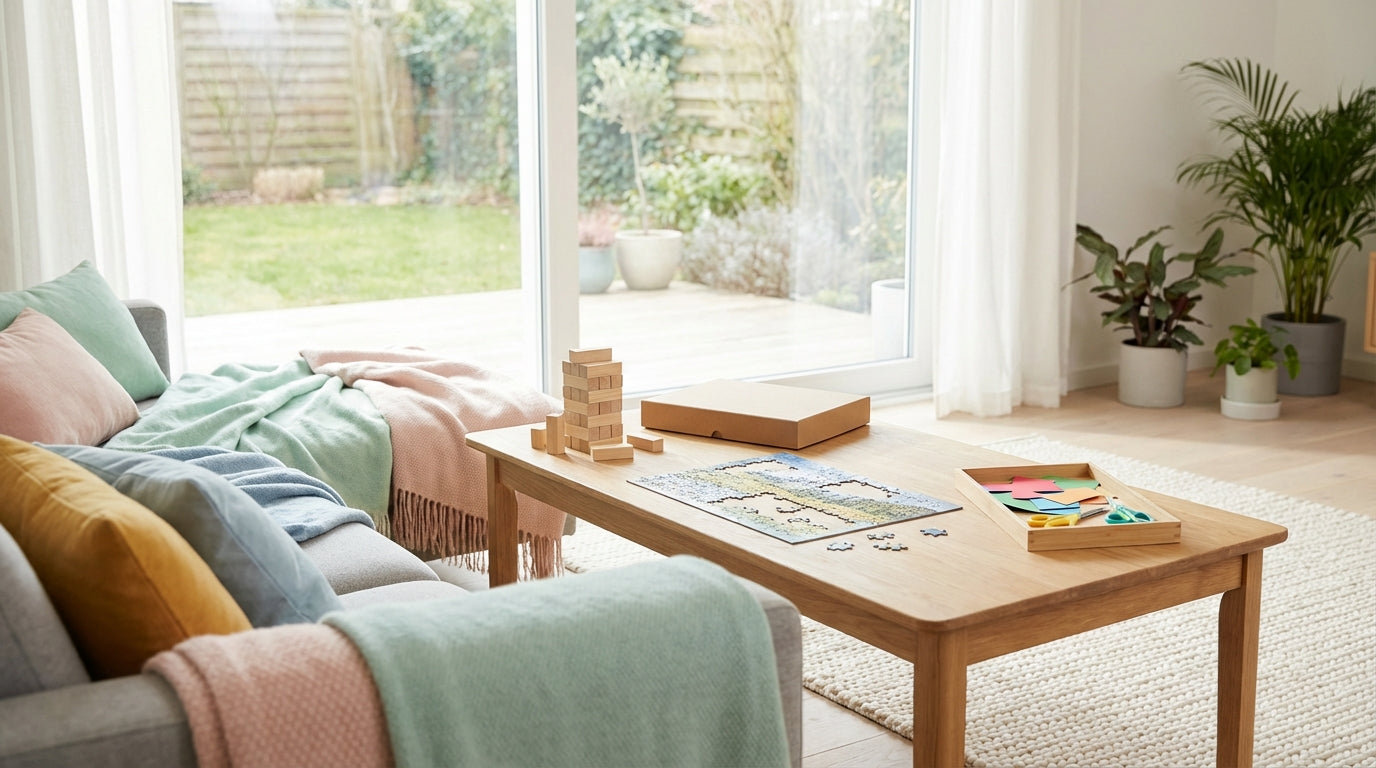
Calm children like toys that reward concentration and don’t rush them. Puzzles, magnetic and layout games, sorting and matching games or simple brain teasers fit well. Materials you can leave out in between without everything falling apart are practical – that saves many an afternoon.
- Idea for at home: Make your own “hidden object game”: put 10 small items on a tray, look at them for 30 seconds, then cover them up and name them.
- Idea as a gift: a quiet game plus a small storage box – sounds unspectacular, but it’s parent luxury.
For movement rockets (who stir up a breeze even in the living room)
Active children need toys that allow movement without causing trouble right away. Balls, throwing games, target throwing, balancing and jumping ideas are classics – indoors preferably “soft” and with a clear zone. Outdoors it can of course be more: obstacle courses, races, tag games, everything that delights heart and legs.
- Idea for indoors: Tape lines on the floor as a “balance path”, with challenges: backwards, with a book on your head, with a stuffed animal.
- Idea for outdoors: Target throwing with chalk circles (or sticks in the sand) and counting points – small rules, big motivation.
For creative minds (who prefer making to copying)
Creative children love materials that allow mistakes and spark new ideas. Craft and painting supplies, stamps, modeling clay, simple cutting and gluing projects (with age-appropriate scissors) work well when the result doesn’t have to be “perfect”. It’s lovely when the child gets to decide: colors, shapes, theme.
- Idea for everyday life: “Postcard workshop”: a card to Grandma/Grandpa every week – it’s creative and, quite incidentally, a ritual.
- Idea for rainy days: Collage from flyers: cut out, glue, build a “wish shop” or “dream house”.
If you want to bundle creative topics, you’ll find more ideas here. Take a look at the in-depth article: Creative Toys for Ages 5+: Ideas for Imaginative Play.
For tinkerers & builders (who like to work “like the real thing”)
Tinkering children want to solve problems and see that something works. Construction material, connecting systems, simple marble runs (depending on the child), workbench role play or building challenges (“Build a bridge that can hold a book”) are often a big hit. It helps when there are several ways to solve something – then the child keeps going instead of getting hung up on right or wrong.
- Idea for at home: A “building task of the day” on a slip of paper: a tower taller than the sofa cushion, a garage for three cars, a bridge over a book.
- Idea with little material: Recycled building: boxes, toilet paper rolls, tape – and suddenly the afternoon is saved.
If your child likes to build and puzzle things out, this overview helps you go deeper. This way: Construction Toys for Ages 5+: Building, Tinkering, Learning.
For role-play fans (who invent entire worlds)
Role play helps children process everyday life and practice language. Dress-up, accessories for shop/doctor/kitchen/workshop, figure worlds or simple “stages” (a blanket over two chairs – presto, theater) often work for a long time. Toys that don’t dictate everything but leave room are lovely: vet today, space station tomorrow.
- Idea to start: Write three roles on slips of paper (customer, shopkeeper, cashier) and switch after 5 minutes.
- Idea for siblings: A “director card”: whoever isn’t having a turn gets to announce the next scene.
Toys for 5-Year-Olds in Family Life: How to Keep Them Exciting for Longer
Toys don’t get boring – they just need a new setting now and then. Five-year-olds love repetition, but with variation. You don’t have to be a full-time entertainer for that. Small tricks are enough.
- Rotation: One part visible, the rest “on vacation” in the cupboard.
- Mini-challenges: “Build a garage”, “draw a treasure map”, “invent three rules”.
- Link it to daily life: “Play shop” after grocery shopping, sort nature finds after a walk.
- Start together, then hand over: Play along for 5 minutes – then “I’m just making coffee, you take over.”
“Play rotation” means: only part of the toys are available, the rest take a break. This makes tidying up easier and makes familiar things feel new again.
Mini Checklist: Does This Toy for Ages 5+ Suit Us?
If you nod along to three points, you’re usually on a good path.
- It’s immediately understandable: Your child can start without a long explanation.
- It has room to grow: new challenges/variations are possible.
- It fits your everyday life: space, noise level and tidying up are manageable.
- It feels solid: no sharp edges, no loose parts, no wobbly seams.
- Warnings are clear: you know what to watch out for.
- It’s fun together too: at least now and then, with no guarantee of squabbles.
Why We at Bieco Are So Picky About Toys
We are a family business from Hamburg – and we prefer to look twice. We’ve been doing this for 66 years and we know: in real family life, toys are carried, thrown, loved, forgotten and found again. That’s why workmanship, understandable instructions and an honest look at materials and testing are not an optional extra for us, but part of everyday life.
For us, transparency means: clear information rather than big promises. Ulli & Flo write as parents for parents – with an eye on what works at the kitchen table and what tends to stay living in the box.
FAQ
Which toys for 5-year-olds are educationally valuable?
Educationally valuable toys are those that suit your child and invite them to keep going. Building and construction material, creative sets and simple games with rules are often strong choices. What matters is not the label, but whether your child can experiment, plan, talk, move or develop their own ideas while playing.
How do I recognize good quality in toys for kids aged 5+?
Good quality shows in workmanship, clear information and sturdy parts. Check edges, seams, stability and whether the warnings are understandable. According to DIN, the EN 71 series of standards describes important safety aspects such as mechanical properties and flammability: DIN.
What do I give if I hardly know the child (toys for 5-year-olds)?
The safest choices are all-rounders that work without much explanation. Creative basics, short board games or sturdy construction material are often a hit. If you can, ask briefly: more building, drawing or running? That saves missteps and makes sure the gift actually gets used.
Are toys for 5-year-olds with lots of parts automatically better?
No, lots of parts are only good if they suit the child and your everyday life. Some children love detailed sets, others are annoyed by sorting after ten minutes. For many families, “fewer, but sturdy” is more relaxed – and the toy stays playable for longer instead of disappearing into bags.
What should I pay attention to regarding chemical safety?
Look for reliable labeling, warnings and a trustworthy seller. According to the BfR, phthalate plasticizers and PAHs in toys, among other things, have been assessed for health risks: BfR. If something smells strongly or feels sticky, be critical and, when in doubt, return it.
How do I keep toys for 5-year-olds interesting for longer?
With rotation and mini-challenges, familiar toys become exciting again. Put out only part of the toys, give small tasks (“Build a bridge”, “invent rules”) and start together briefly. Five-year-olds often need just a nudge – then play runs on its own (sometimes suspiciously long).
If you’re now in the mood to browse: our overview has fitting ideas sorted by type of play. Feel free to have a look here: Toys for Ages 5+ – and take only what really suits you. The rest can stay living on the internet.