Creative Toys for Ages 5+: Ideas, DIY & Gift Ideas
At a glance
- Creative toys for ages 5+ work best when children are free to invent.
- A small “idea box” of everyday materials is often enough for lots of games.
- Indoors: role play, building, crafting, stories – outdoors: missions and natural building sites.
- Fewer toys on display, more play: rotate them instead of letting the shelf descend into constant chaos.
- Safety: choose materials carefully and handle small parts, scissors and glue with care.

Creative toys for ages 5+ are at their best when they leave plenty of ways to play. That means your child gets to invent, reinterpret and combine – and you don't have to “entertain” them all the time. In this guide you'll find a simple checklist, concrete play ideas for indoors and outdoors, a small DIY project (no craft degree required) and a few gift ideas that actually get used. And if things get a little wilder along the way: that's not a mistake, it's usually a good sign.

Ulli & Flo
Owners of bieco · Hamburg · parents themselves
At 5, a single opening line is often all it takes in our house – and the imagination is off and running. The creativity box is our trick to make that work even on perfectly ordinary days. Feel free to browse our Toys for Ages 5+ collection.
Creative toys for ages 5+: what does that actually mean?
Creative toys are toys that allow more than one solution. Today it's a spaceship, tomorrow a vet's practice, the day after a “secret office” under the table.
Free play means children decide the theme, the rules and the pace themselves. According to the United Nations, play is enshrined as a children's right in Article 31 of the UN Convention on the Rights of the Child – so it's officially “important”. According to the United Nations, this underlines how important play is for children.
We're a family business from Hamburg – and for 66 years we've been close to everyday play. Ulli & Flo write here as parents for parents: when the idea comes from the child, play often runs by itself. When only the toy has the idea, it's more like tea break after five minutes.
How can I recognize creative toys for ages 5+? (Mini checklist)
Good toys for ages 5+ can be reinterpreted, expanded and combined. You don't need a lecture on pedagogy – these points are enough in real life:

Checklist: how to recognize creative toys
- There are several ways to play (not just “press, done”).
- Your child can invent or change their own rules.
- It goes well with other things: scarves, cardboard boxes, figures, building blocks.
- It works alone and together – without constant arguments about “who gets a turn”.
- It's sturdy enough for everyday life (and the occasional storm cloud of anger).
A good test is the “three ideas question”: what else could it be? If you (or your child) can quickly come up with three roles – car, boat, cake – then the chances are good that it will stay exciting for longer.
Practical tip: Put out only 6–10 toys where they can be seen. The rest goes into a box and rotates every 1–2 weeks.
Creative toys for 5-year-olds indoors: 7 ideas that really work
Indoors, creative play works best with clear “starter signals”. One sentence is often enough – after that, you can get back to laundry, emails or the legendary “I'd like to drink my coffee while it's still warm”.

- Restaurant at home: Draw a menu, take orders, use paper money for change.
- Animal clinic: “Treat” stuffed animals, bandages made from gauze or old cloths, appointment slips.
- Detective agency: Search for clues, a notepad, “evidence bags” made of paper, a flashlight.
- Stage/theater: Hand puppets, make tickets, a curtain from a blanket.
- City building: Building blocks + cardboard boxes + tape, plus small figures as residents.
- Mini museum: Your child displays 5 items and writes signs (“Please do not touch!” – very popular).
- Story dice: Draw three slips of paper: place, character, problem – and off you go.
A small prop basket is often enough for ten stories. Scarves, clips, empty (clean) packaging, a notepad, pens and a few figures are handy. If you'd like to browse: in our age category Toys for Ages 5+ you'll find things that combine well.
Creative toys for 5-year-olds outdoors: nature missions & active play
Outdoors, creativity often becomes louder, faster and lighter all on its own. Nature supplies materials, rules and surprises for free – a very likable business model.
- Stick-and-stone building site: “Build a bridge” or “a home for a beetle” (look only, don't disturb).
- Treasure hunt: Find 5 things: something round, something soft, something shiny …
- Chalk missions: Draw roads, parking spaces, hopscotch squares and a gas station.
- Role play outdoors: “Ice cream parlor”, “fire department”, “harbor” – with scarves as uniforms.
- Mini photo assignment: Your child photographs (or draws) “3 interesting patterns”: bark, stone, leaf.
Outdoors, less is more – but a bag is worth its weight in gold. A small cloth bag for finds, chalk and a scarf make for half an adventure already.
Construction toys for ages 5+: build, tinker, tear down again (it's part of it)
Construction toys for ages 5+ are perfect if your child likes to plan and improve. The result isn't set in advance – and that's exactly what makes it creative.
A “building mission” is often better than “just build something”. Try it like this:
- “Build a bridge that can hold three cars.”
- “Build a house with a secret door.”
- “Build a tower that's taller than your forearm.”
- “Build a city – and decide who lives where.”
Mixing materials turns building into real inventing. Building blocks plus cardboard, tape, scarves and empty boxes – and suddenly it's architecture instead of “a tower that falls over”.
If you'd like to dive deeper, we have a dedicated article on this. This way: Construction Toys for Ages 5+: Building, Tinkering, Learning.
Safety note: Always store small parts out of reach of younger siblings. Ideally in a box with a lid – and not “just for a moment” on the table.
DIY: The “creativity box” for 5-year-olds (ready in 20 minutes)
A creativity box is a grab-and-go box of craft and play materials for spontaneous inventing. The benefit is simple: less searching, more starting.
What you need
It's best to use things that aren't “too precious”. Then your child is more likely to dive in.
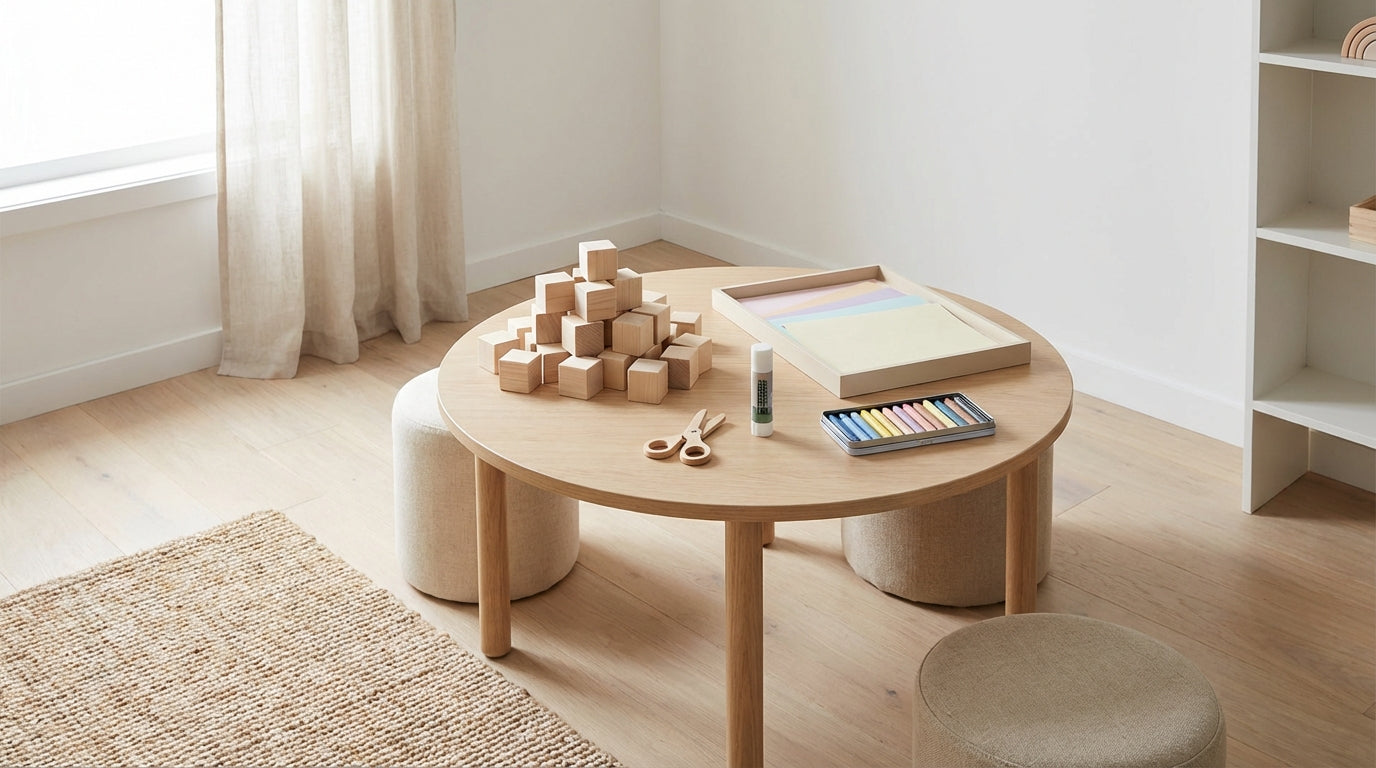
- A sturdy box or basket
- Paper: A4, kraft paper, old envelopes
- Tape (e.g. masking tape) and possibly a glue stick
- Children's scissors
- Pens (colored pencils, felt-tip pens)
- A few “treasures”: clips, leftover yarn, stickers, old cards
- Optional: googly eyes, pipe cleaners, empty cardboard tubes
How to put the box together (step by step)
- Sort into 3 categories: cutting, gluing, decorating. (You don't need more than that at the start.)
- Make it visible: Put paper and pens on top so getting started is easy.
- Add 3 starter cards: “Build a monster”, “Invent a vehicle”, “Make a sign for your room”.
- Set a rule (keep it short): “Crafting only at the table” or “a mat underneath” – one rule is enough.
- Mini tidy-up ritual: 2-minute timer, everything back in the box. The end.
Practical tip: Keep an old tablecloth or a large sheet of kraft paper ready as a crafting mat. It saves arguments about glue residue.
Crafting & drawing without frustration: how to keep it creative (and not just “clean”)
Creativity doesn't come from perfect results, but from trying things out. At 5, it works best when getting started is easy and you're not already calling out “careful!” beforehand.
- Stamp workshop: Corks or potato stamps, with kraft paper as the gallery.
- Collage box: Magazines, leftover wrapping paper, stickers, tape.
- Cardboard tube parade: Animals, robots, spyglasses, “mailbox monsters”.
- Drawing prompts: “Draw an animal that doesn't exist” or “a city under water”.
If your child says “done” after two minutes, that's often perfectly fine. Some children work in sprints – and come back later. That's not a defeat, that's efficiency.
Safety note: Use only age-appropriate scissors and glue, and store small craft items (e.g. beads) safely. If you're unsure, the age recommendation on the packaging will help.
Gift ideas: creative toys for ages 5+ that aren't “done” after two days
Good gift ideas are open-ended, combinable and suit the child. For grandparents, godparents and friends, this is the best shortcut: choose something that allows many kinds of play rather than something with only one sequence.
- For role-play fans: Figures, hand puppets, dress-up pieces, a small “prop set”.
- For little builders: Building blocks, construction sets, vehicles/figures to complement the building world.
- For creative hands: Drawing and craft materials, stamps, stickers, child-friendly scissors.
- For outdoor kids: Chalk, a small collecting bag, things for movement and missions.
If you'd like to look at bieco specifically, use the age category as your guide. In Toys for Ages 5+ you'll find a good overview for browsing and combining.
Safety & transparency: what to look out for with toys and materials
Safe toys are, above all, suited to the age and the way they're used. In everyday life, it's often the little things that matter: swallowable small parts, long strings, sharp edges or craft materials that aren't meant for children.
At bieco we talk about this openly, because it simply belongs. We look at materials, workmanship and compliance with relevant safety requirements – and we also say this: no toy replaces supervision when it comes to scissors, glue or small parts.
Play isn't a “nice to have”, it's a building block of children's everyday life. According to UNICEF, play helps children understand their surroundings and develop social and emotional skills.
Play environment: turning “I have nothing to do” back into “I'm busy”
A good play environment is clear, within reach and quick to get started with. That's the difference between “getting lost in creativity” and “I can't find anything, so I'm grumbling”.

- Less visible = more played with: 6–10 things within reach are often enough.
- Play zones: one corner for building, one for drawing, one for role play (even a small one).
- Open storage: Baskets/boxes with simple categories (“Building”, “Drawing”, “Dress-up”).
Tidiness is not a moral value, just a helpful tool. If it doesn't work today, it'll work tomorrow. Or the day after. We're not in a catalog here.
Quick overview: activity, materials, duration – so you don't have to think long
This table is your cheat sheet for “What shall we do now?” Pick a row, done.
| Activity | Materials | Duration | Alone/together | Indoors/outdoors |
|---|---|---|---|---|
| Restaurant | Paper, pens, empty packaging | 20–45 min. | both | indoors |
| Building mission “Bridge” | Building blocks, cardboard, tape | 15–30 min. | both | indoors |
| Collage | Magazines, glue, scissors | 15–40 min. | alone | indoors |
| Treasure hunt | List (drawn/written), bag | 20–60 min. | together | outdoors |
| Chalk mission | Sidewalk chalk | 10–30 min. | both | outdoors |
| Story dice | 3 slips of paper (place/character/problem) | 10–20 min. | both | indoors |
FAQ
What are creative toys for ages 5+?
Creative toys for ages 5+ allow many play ideas and solutions. Children can build, invent, combine or play roles with them, without there being just one “right” outcome. Things that can be reinterpreted are especially good – they keep play interesting for longer.
Which toys encourage creativity at age 5+?
Creativity is encouraged most by toys that are open-ended and can be combined. These include building and construction materials, figures for role play, dress-up, drawing and craft supplies, and simple everyday materials like cardboard boxes and scarves. What matters: your child gets to invent the rules themselves.
How many toys make sense for a 5-year-old?
A small, versatile selection is often perfectly enough. A mix of building toys, creative materials, figures and something for role play is practical. If you put some away and bring them back out later, they often feel “new” to children – without constantly having to add more.
What should I watch out for with craft materials and safety?
Pay attention to age recommendations and make sure the materials are suitable for children. Typical stumbling blocks are swallowable small parts, long strings, and scissors and glue that aren't child-friendly. If younger siblings live in the household, a box with a lid and a fixed crafting spot will help.
How do I motivate my child to tidy up after crafting?
Keep it short and predictable: 2-minute timer, everything into the box. When tidying up is a small ritual (always the same, always short), there's less discussion. A clear “creativity box” that everything is allowed to go into also helps – instead of ten separate drawers.
If you're looking for even more inspiration, take a look at the big overview. In the guide The Best Toys for Ages 5+: A Guide for Parents you'll find more ideas – and in Toys for Ages 5+ you can click through at your leisure.
Keep reading
Bottom line: creative toys for ages 5+ are less “stuff” and more possibility. If you have a small foundation of building, role-play and creative materials, the best ideas often come all by themselves. Feel free to drop by Toys for Ages 5+ if you'd like to round out your play box sensibly.