Puzzle Play Mat for Babies & Kids: Guide, Safety & Buying Check
At a glance
- Puzzle play mat: a quick way to create a warm, soft play island on the floor.
- For babies: take the age recommendation seriously and only use it on an even surface.
- For kids: it often turns into a building set, so plan for crumbs, gaps and “wandering pieces”.
- When buying, look at material information, smell, cleaning, non-slip properties and edge pieces.
- For foam play materials, EU rules apply, e.g. on formamide emissions.

A puzzle play mat is worth it if you want to lay out a soft, warm play area quickly and flexibly. Especially on tiles, laminate or in a kids’ room where the floor is more stage than decoration, it often makes everyday life more relaxed. In this guide you get a practical assessment: what a puzzle play mat is good for, where it can be annoying, how to keep it clean and how to recognize a solid model. And because we know family life (Ulli & Flo here) and, as a Hamburg family business, have been working with toys for 66 years: we stay honest, without scaremongering.

Ulli & Flo
Owners of bieco · Hamburg · parents themselves
We’ve learned that a puzzle play mat is at its best when it makes your everyday life easier, not more complicated. With airing out, a short cleaning routine and a firm eye on the edges, you usually get along very relaxed. Feel free to browse our puzzle play mat collection.
Puzzle play mat: what is it, actually?
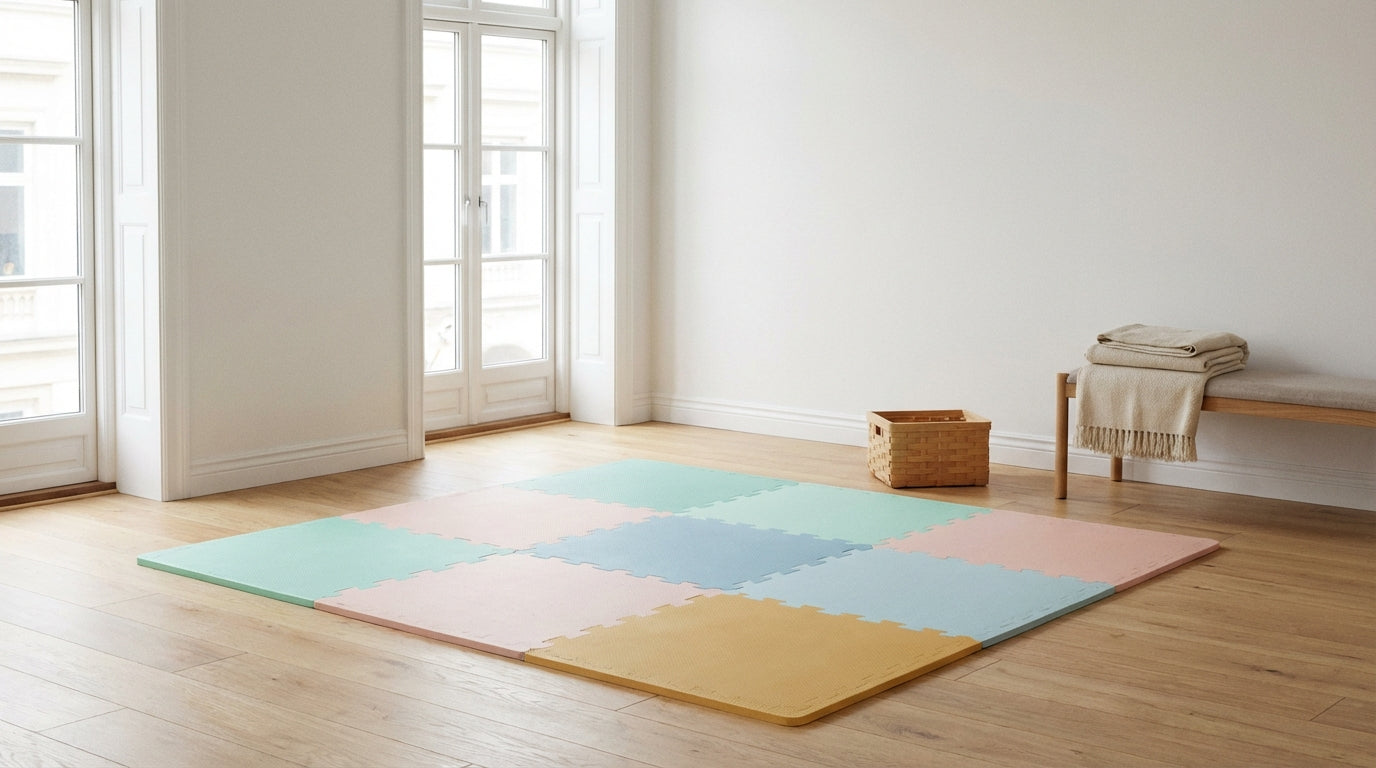
A puzzle play mat consists of individual tiles that you snap together. This lets you adapt the surface: small next to the sofa or large as a play zone in the kids’ room.

Definition (quotable): A puzzle play mat is a modular play surface made of interlocking tiles, used as a cushioning and warming floor covering.
Many puzzle play mats are made of EVA foam (ethylene-vinyl acetate). EVA is light, springy and can usually be wiped clean with a damp cloth, which is handy when life happens between apple slices and play dough crumbs.
Good to know: A puzzle play mat is a play surface, but not a crash mat for heights or a safety solution for furniture edges.
If you’d like to look at some examples: in Bieco’s puzzle play mat collection you’ll find different variants (e.g. numbers, letters, animal designs). The individual product pages state the material, care instructions and age recommendations, which is exactly the kind of transparency you’re still grateful for as a parent at half past ten at night.
Puzzle play mat for babies: what is it suited for, and what not?
As a baby play mat, it is mainly useful as a soft island on a hard, cold floor. For tummy time, first rolling over, sitting and floor play it can feel really pleasant, for your baby and for your knees.
- Well suited: Supervised floor play, short tummy time, grasping/playing, as a base under a play gym or a small ball pit.
- Rather not suited: as “crash protection” next to the sofa/bed, as a permanent carpet replacement in damp rooms or anywhere it regularly gets wet.
Practical tip: At first, don’t lay the mat right up against the wall. Leaving 2–3 cm of space will save you vacuum cleaner curses later.
For babies, the “mouthing phase” matters in particular. When your child is testing everything that isn’t screwed down, loose edges or single tiles quickly become more exciting than any toy.
Safety note: Only use the puzzle play mat for babies under supervision and regularly check that edges/pieces are firmly in place.
Puzzle play mat for kids: what changes as the little ones grow?
With kids, the puzzle play mat often turns into a building set, and that is both: wonderful and exhausting. They build dens, roads, cubes, “ice cream stands” and sometimes a trap for your toes.
Definition (quotable): A play mat for children is a floor surface that dampens play noise, warms the ground and marks out a clear play area in the room.
In the kids’ room, a puzzle play mat often helps with organizing the space. “This is where we build” is sometimes easier for kids (and adults) than “please play everywhere at once, but don’t leave anything lying around”.
If you’re interested in play ideas with numbers, letters or animal designs: Puzzle play mats as learning toys: discovering numbers, letters & animals goes into more depth, without the school-lesson feeling.
Advantages of a puzzle play mat: what speaks in its favor
The biggest advantage is a quick, flexible feel-good surface on hard floors. And that is often the best kind of “solution” in family life: uncomplicated and good enough.

- Cushioning: Small bumps and “hops” are softened (without any crash-protection promise).
- Warmth/insulation: More pleasant than directly on tiles or laminate.
- Flexible: You can adjust the area and shape, extend it or take it apart.
- Easy to care for: Many models can be wiped clean with a damp cloth (please follow the manufacturer’s instructions).
- A bit quieter: Play noise is dampened, which your neighbors and your nerves will thank you for.
A real plus is transparency about material and test information. If a provider clearly states what the mat is made of, how it is cleaned and what age it is meant for, that is worth more than any pretty photo.
Disadvantages of a puzzle play mat: honestly, this can be annoying
The typical disadvantages are rarely dramatic, but in everyday life they can be a nuisance. If you know about them beforehand, you’ll be more relaxed afterwards (or at least less surprised).

- Gaps collect crumbs: A classic. And yes, sand too. Always sand.
- Pieces wander: Kids carry tiles around the house as a tray, a helmet or a “snow shovel”.
- Edges come loose: Depending on use and surface, the interlocking can loosen.
- Smell at the beginning: New foam products can smell at first, and airing them out often helps.
- Pressure marks: Heavy furniture can leave dents.
- Slipping: On very smooth floors it can get slippery (depending on the underside).
If you need a “stays put forever” solution, a puzzle play mat isn’t always the first choice. It is more flexible and suited to phases, and that is exactly where its charm lies.
From what age a puzzle play mat, and why does it often say 12 months?
Many puzzle play mats are recommended by the manufacturer from 12 months, and that is a sensible safety anchor. This recommendation is often linked to typical risks: children pull at edges, put pieces in their mouths or use the mat as a building set.
An age recommendation is not a nuisance but a risk brake. It helps you judge when a product is likely to work better in everyday life, without you constantly having to say “No, don’t bite that”.
If you want to start earlier, it only works with extra care. Then use the mat only under supervision, on an even surface, and check regularly whether anything is sticking up or can be pulled loose.
What to look for in a puzzle play mat: a buying checklist for everyday life
A good puzzle play mat fits your everyday life, not just your Instagram shelf. Here is the checklist that has proven itself in real living rooms (crumb reality included).
1) Material & surface
Choose a mat with clear material information and a smooth, easy-to-wipe surface. EVA foam is often used; what matters is that the manufacturer names the material transparently and provides care instructions for it.
2) Thickness & cushioning
The thickness should suit your floor: tiles usually need more comfort. “Thicker” is not automatically “better”, but too thin brings little joy on cold floors.
3) Non-slip properties (on your floor!)
Test the mat on your own surface: laminate, tiles and carpet behave differently. If it wanders, sometimes a different spot is enough, or a solution that is more of a rug.
4) Interlocking & edge pieces
Firm interlocking and matching edge pieces make the mat more suitable for everyday use. Edge pieces reduce open “teeth” at the border and can help keep fewer edges from sticking up.
5) Cleaning & drying
Plan for a mat that you can clean quickly without giving it a full bath. Wiping with a damp cloth is more realistic in family life than “deluxe hand washing”.
6) Smell & airing out
It’s best to unpack new mats first and let them air out well. That’s not rocket science, just a practical habit: air first, kids’ room second.
7) Standards/testing & traceable information
Concrete test information is more helpful than a general “tested”. For toys, the CE marking is relevant in the EU; in addition, manufacturers sometimes cite tests according to EN 71 (e.g. mechanical/physical properties, flammability, migration of certain elements). Concrete details are easier for parents to put into context.
This guide helps with planning size and area: XXL puzzle play mats & different shapes: which size fits?
Are puzzle play mats free of harmful substances? What you can realistically check
More useful than “free of harmful substances” is the question: which rules apply and what is tested? Especially with foam play materials, it’s worth looking at specific requirements.
Formamide is regulated in the EU for foam play materials. Under EU law (Commission Directive (EU) 2015/2115), an emission limit of 20 µg/m³ (after a maximum of 28 days) applies to foam play materials for children under 36 months; at a content of ≤ 200 mg/kg, no emission test is necessary (EUR-Lex).
Another good point of orientation is the body of rules around REACH. According to the European Chemicals Agency (ECHA), there are restrictions for certain substances in articles, including rules that can be relevant for toys (ECHA).
- Look for transparency: material, age recommendation, care instructions, traceable test/safety information.
- Airing out is a simple standard: unpack, air out, and only then use it permanently.
- Condition beats theory: If something crumbles, smells strongly or comes loose, sorting it out is the more relaxed decision.
We like clear information because it really helps parents. That is exactly why we pay attention to material and care information as well as safety transparency in our own product details, with northern German understatement and no smoke screens.
How to clean a puzzle play mat without ruining the material
The best cleaning is the one you actually do: short, regular, no drama. Many mats can be cleaned with a damp cloth and mild soap; the specific instructions are given by the manufacturer.
- Remove crumbs: Vacuum or shake out (yes, including under the sofa).
- Wipe damp: Lukewarm water + mild soap is often completely enough.
- Don’t soak: Unless the manufacturer recommends it, no full-bath action.
- Dry well: Let it dry completely first, then put it back together.
Practical tip: Only one corner dirty? Take out 2–4 tiles, wipe them individually, done. It saves time and nerves.
For more hygiene and care tricks, a dedicated step-by-step guide helps. You’ll find it here: Cleaning & caring for a puzzle play mat: tips for hygiene & durability.
What does a puzzle play mat promote? (And what not.)
A puzzle play mat mainly promotes free floor play, because the surface becomes pleasant. The mat doesn’t “make” development happen, but it lowers the hurdle to sit down, turn, build and experiment.
- Movement: Turning, creeping, crawling, standing up all happen more easily on a pleasant surface.
- Senses: Edges, patterns and transitions are explored with hands and feet.
- Play ideas: Designs offer conversation starters (“Where is the 3?”), without pressure.
What it can’t do: “early learning at the push of a button”. In the end, that is still done by the people in the room, and sometimes a calm sentence and a bit of time are enough.
FAQ
What is a puzzle play mat?
A puzzle play mat is a snap-together play surface made of individual tiles. You assemble it like a puzzle and get a soft, warming play area. Because it is modular, you can adapt the size and shape to your room and take it apart again when needed.
From what age does a puzzle play mat make sense?
Many manufacturers recommend puzzle play mats from 12 months, and that is a good guideline. The background is typical everyday risks: the mouthing phase, hands pulling at edges and the possibility of pieces coming loose. If you use it earlier, then only under supervision and with very regular condition checks.
What should I look for in a puzzle play mat for babies and kids?
Look for clear material information, an age recommendation, firm interlocking and easy cleaning. In everyday life, non-slip properties on your floor, a suitable thickness for tiles/laminate and whether edge pieces are included also matter. The more transparent the information on care and test notes, the better you can judge whether it suits you.
Are puzzle play mats free of harmful substances?
Instead of just looking at the word, rules, limit values and traceable test notes help. In the EU, formamide is regulated in foam play materials; Commission Directive (EU) 2015/2115 specifies, among other things, an emission limit for it (EUR-Lex). It’s also worth looking at REACH-relevant restrictions as summarized by the ECHA (ECHA).
How can I clean a puzzle play mat?
It usually works best to vacuum and then wipe with a damp cloth. Use lukewarm water and mild soap, and let the tiles dry well before you snap them back together. Avoid soaking unless the manufacturer recommends it, so the layers and edges aren’t stressed unnecessarily.
What should I do if the puzzle play mat slips or corners come loose?
If it slips or corners stick up, first do a quick surface check and move it. Try a different spot, check whether the floor is very smooth, and inspect the interlocking for wear. If pieces regularly come loose or crumble, that is a clear sign: better to replace it than to argue about it every day.
In closing: take a deep breath, then choose what fits
A puzzle play mat is a practical everyday helper when material, care and age recommendation suit you. If you now want to see which designs and sizes are available, you’ll find a selection here: puzzle play mat. And if you’re torn between size, shape and cleaning: the linked guides will help you step by step, with no technical jargon.