Montessori Toys for 1-Year-Olds: Playing Meaningfully & Choosing Safely
At a Glance
- Montessori toys for 1-year-olds are ideal when they let your child practice real hand movements.
- Starter set: 1 shape-sorting or posting toy, 1 stacking toy, 1 pull-along or push toy.
- A small prepared environment makes independent play much easier.
- Safety first: large parts, clean edges, clear labeling, easy to clean.
- Fewer choices on the shelf often bring more calm (for everyone involved).

Montessori toys for 1-year-olds make sense when your child can get active with them on their own. Posting, sorting, stacking, opening and closing, pulling, carrying – these “real” hand movements often win one-year-olds over completely. And yes: at one year old, many children are little “I do it myself” people (just without the service hotline). Here you’ll find a practical guide to choosing toys, DIY ideas for at home, a safety check, and a few tricks so play works without you being the entertainer all day long.

Ulli & Flo
Owners of bieco · Hamburg · parents themselves
We remember it well: at one year old, “look at this” quickly turns into “me do it!” With just a few clear play ideas, things at home feel noticeably more relaxed. Feel free to browse our collection Toys for Ages 1+.
Montessori doesn’t mean “fancy” or “expensive”, it means “thoughtful and uncluttered”. Many good ideas are simple – and some even work with safe everyday items you already have at home.
What Does Montessori Toy Mean (and What Doesn’t It)?
Montessori toys support independent doing instead of entertaining the child. They are usually designed in a reduced way so your child can find their focus: “What happens when I do this?”
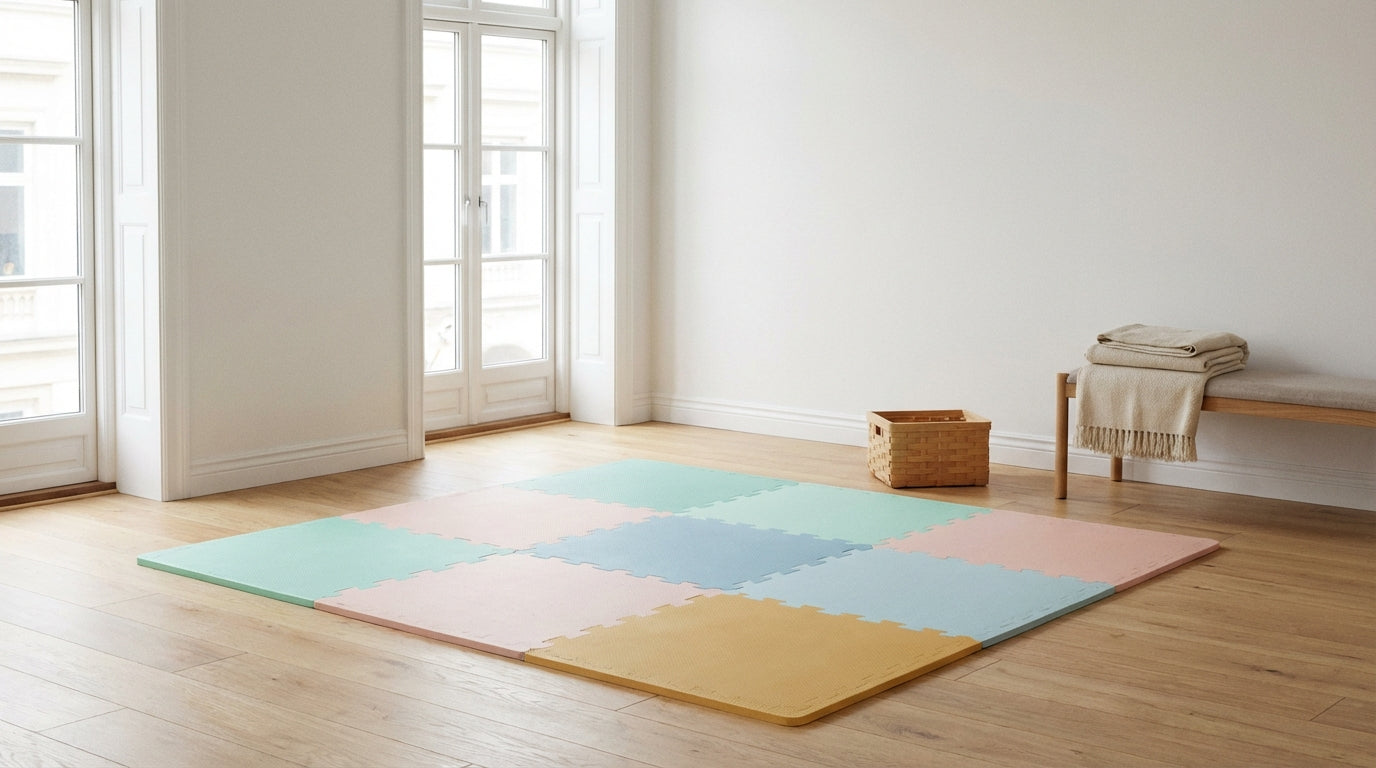
A prepared environment is a child-friendly area with reachable, orderly materials. The benefit is very down to earth: your child can choose, begin and (with your help) put things back. According to the Montessori Landesverband Bayern, the environment is designed so that children can learn as independently as possible: Prepared environment (source, in German).
Not so Montessori: toys that mostly flash, play tunes and “put on a show”. Pressing buttons isn’t forbidden – but when all that’s left is pressing buttons, there’s often little of your child’s own doing left. (And yes: we’ve all thought “oh, that’s so cute” – and then it jingled for three days straight.)
Which Montessori Toys Really Suit a 1-Year-Old?
At 1 year old, materials work best when they can start out simple and grow more refined. At this age, many children are somewhere between “with the whole hand” and “now I’m going to fiddle with this very precisely” – and toys should be able to handle exactly that.

- Posting and sorting toys: Posting shapes, rings onto a peg, simple sorting boxes. This is hand-eye coordination in its purest form – plus patience training for both sides.
- Stacking toys: Stacking cups, large building blocks, first towers. It’s not about “higher, faster”, but about repetition and moments of success.
- Opening and closing: Flaps, large twist lids, simple sliders. This practices hand strength, coordination and the pride of “I can do it myself”.
- Pushing, pulling, rolling: Simple vehicles or pull-along toys – great when your child is on the move a lot.
- Everyday role play: Soft dolls, simple “care” items, small kitchen or household elements. Not for the perfect scene, but for imitating.
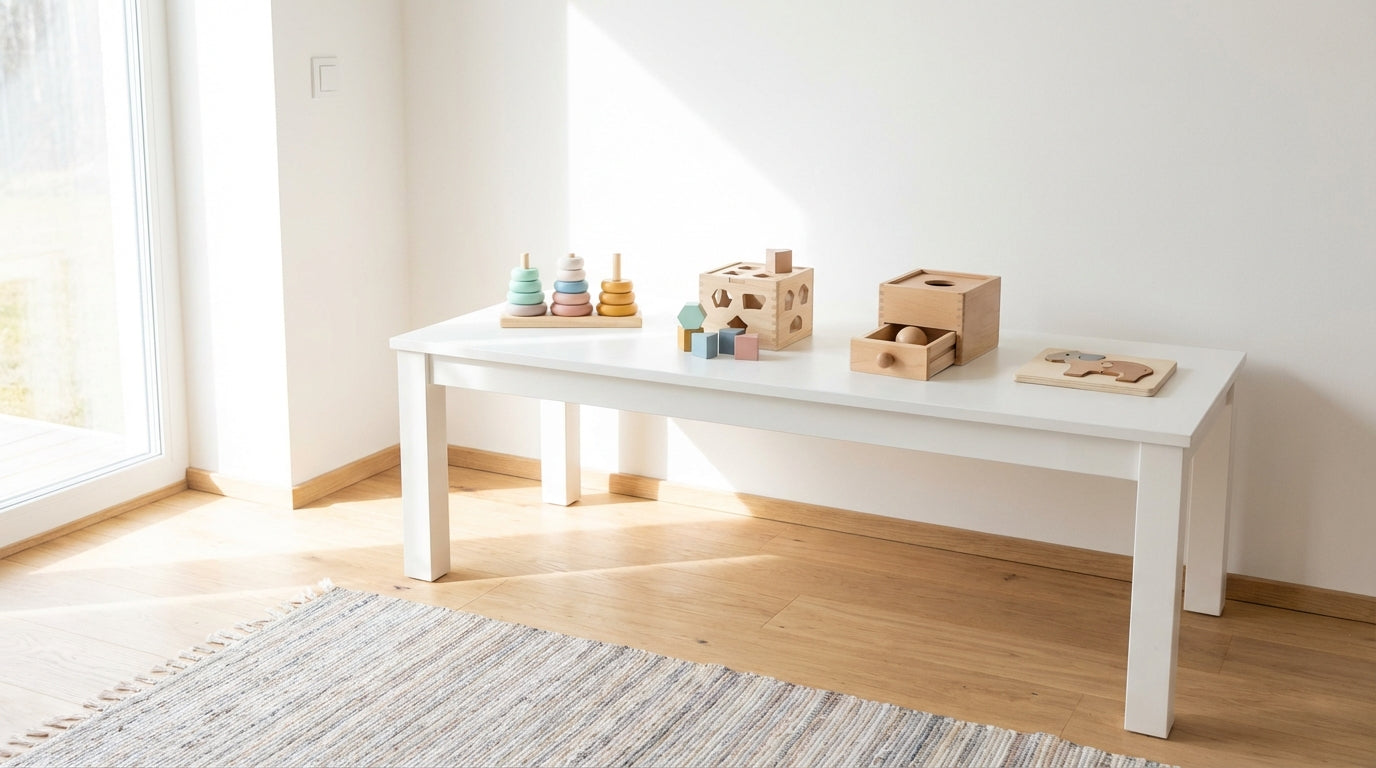
Practical tip: It’s better to put 4–6 things out in plain sight rather than 25. Fewer choices make it easier for one-year-olds to get started.
If you’re wondering which Montessori toys for 1-year-olds make a good start: pick three categories. One posting/sorting toy, one stacking piece, one pull-along or push toy – and you have a small basic assortment that often lasts longer than you’d think.
If you’d like to browse: in the Toys for Ages 1+ hub you’ll find age-appropriate ideas gathered in one place. And for everything that keeps hands and fingers busy, Motor Skills Toys for 1-Year-Olds is a good follow-up read.
Montessori at Home: A Prepared Environment Without a Makeover
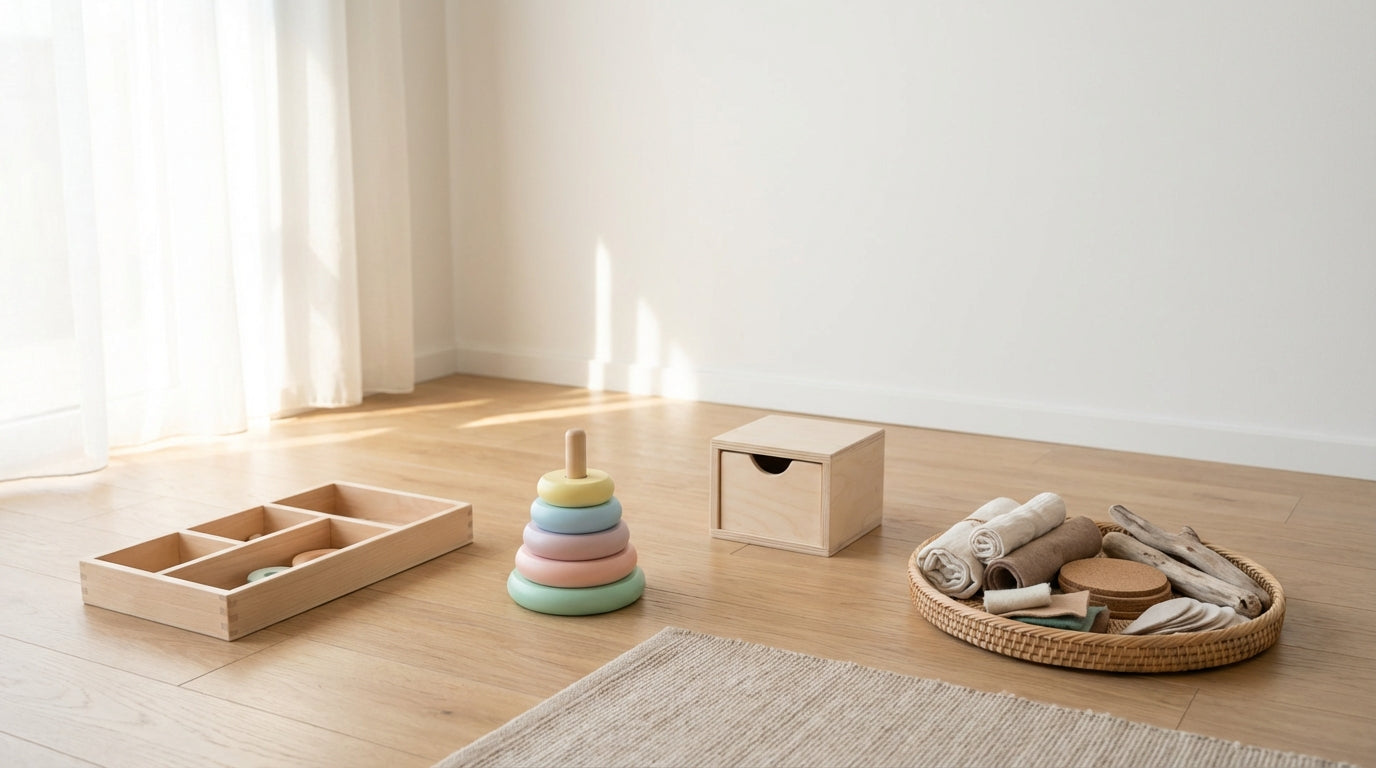
You don’t need a perfect nursery – a low, clear spot is completely enough. What matters is that your child can reach things, see what’s there, and (with your help) put it back.

- A quiet spot: A corner of the living room is fine. Just not right next to the TV or on the hallway “racetrack”.
- Low storage: A low shelf, a bench or two sturdy crates. Visible almost always beats “vanished into the box”.
- One theme per spot: One basket for the posting toy, one basket for stacking. No rummage box with 17 tiny pieces.
- Rotation instead of oversupply: Put out only a portion and swap items when you notice: “This is being ignored right now.”
- Mini-simple tidying up: Baskets, bowls, clear places. One-year-olds can help – not neatly, but proudly.
Rotation means: you swap materials every now and then so they feel “new” again. It’s not a strict plan, more a friendly trick against toy blindness (and against the feeling that you constantly have to buy something new).
DIY: Montessori-Inspired Play with Everyday Materials
Many Montessori ideas for 1-year-olds work with safe everyday items – and often hit exactly the right note. Children love things that are “real”: opening, filling, carrying, sorting. And you don’t have to pass a crafting exam first.
1) “Pour & Hit the Target” (from about 12 months)
A large container plus large filler pieces makes for focused play. Take a bowl or crate and use, for example, large pompoms or fabric scraps as filling. Your child pours in, out, in, out – and you might even manage to drink half a cup of coffee while it’s still warm.
2) “Lid On – Lid Off”
Opening and closing practices hand strength and coordination along the way. Offer 2–3 empty, clean containers with lids that are easy to open (no glass containers, no sharp edges). For many children this is “the work” of the day – in the best sense.
3) “Sorting by Big/Small”
Sorting is thinking with your hands – without anyone having to explain it. Two bowls, two easily distinguishable objects (e.g. large and small rings). For one-year-olds, simply “putting in” is completely enough; rules and categories will come later all by themselves.
Safety note: For pouring and sorting games, use only parts that can’t be swallowed, and stay close by. Age warnings such as “Not suitable for children under 36 months” are required in the EU for certain risks, according to EUR-Lex in the Official Journal of the EU: Regulation (EU) 2025/2509.
How Can I Tell Good, Safe Toys for 1-Year-Olds?
Good toys for one-year-olds are sturdy, large enough, cleanly made and clearly labeled. At this age, a lot is still explored with the mouth – that’s normal and part of it.

- Size & graspability: Choose large pieces that fit well in the hand. No detachable mini elements.
- Workmanship: Smooth edges, no splinters, no sharp corners, nothing wobbling “suspiciously”.
- Material: Unfussy, sturdy, made for everyday life. What matters is less the “what” and more the “how well made”.
- Cleaning: Wipeable or washable – that saves your nerves, especially during cold season.
- Labeling & manufacturer information: CE marking and manufacturer details should be present and easy to read.
CE marking is mandatory in the EU, but it is not an independent seal of approval. According to the Verbraucherportal Bayern (Bavarian consumer portal), CE marking is required for toys and manufacturer details must be provided: Legal requirements & CE marking (source, in German).
Labeling & Traceability: Short Explanation, but Important
Traceability means: a product can be linked to a manufacturer and a batch. For you as a parent, this is practical, because clear manufacturer details and labeling help you find information quickly – especially when you want to look something up.
With toys, look for clearly legible manufacturer details and traceable labeling. This isn’t “paperwork”, it’s a little safety compass for everyday life. If you can’t find something, or it seems deliberately vague, you’re welcome to be skeptical.
How Do You Play Montessori-Inspired Without Constant Entertaining?
You prepare, show it once calmly – and then take a step back. Not because you have to be “strict”, but because otherwise your child never gets the chance to try things out themselves.
- Demonstrate slowly, once: Without many words. One hand movement, done.
- Leave a pause: Your child tries. Even if they do it “differently” than you.
- Help only as much as needed: Steady it briefly, then hand it back. This is often the best frustration brake.
- Repetition is learning: One-year-olds repeat because their brain is a construction site right now – in a positive sense.
Practical tip: 10–15 minutes of focused sorting is a lot at this age. You’re allowed to celebrate that inwardly.
Why We’re So Picky About Materials & Safety (and Happily Admit It)
We are a family business from Hamburg and have been making toys for 66 years. That doesn’t mean we know everything better – but we’ve learned that clear information, solid workmanship and honest materials simply matter in everyday life.
For us, transparency is not an extra but an attitude: better understandable than polished. Parents shouldn’t have to guess whether something is “probably fine”. If you have questions about a product, clear details and traceable labeling are worth their weight in gold – especially for the very youngest.
Typical Montessori Play Ideas for 1-Year-Olds (That Will Work Again Tomorrow)
The best play ideas are the ones you can repeat without much fuss. Here are a few classics that work well in many families:

- “Into the box – out of the box”: A basket, large cloths or balls. In, out, carry, put down.
- “Build the tower – knock it down”: Stacking cups or large blocks. First build, then knock down with delight.
- “Two colors are enough”: Sorting by two colors or two shapes. More comes later.
- “Pushing with a goal”: A cart or push toy plus a “parking spot” (carpet edge or a line of tape).
- “Caring”: Tucking in a doll, brushing, feeding (with a play spoon). Lots of imitating, little drama.
For fitting categories, the Toys for Ages 1+ hub offers good orientation. If you’re specifically looking for ways to keep little hands busy, Motor Skills Toys for 1-Year-Olds is helpful as well.
FAQ
Which Montessori toys for 1-year-olds are a good start?
A posting or sorting toy plus something for stacking is ideal for many 1-year-olds. Look for large parts, simple tasks and sturdy workmanship. If your child likes to walk, a pull-along or push toy rounds out the set nicely. A few fitting things are often more relaxing than a shelf full of “sensory fireworks”.
How many Montessori toys does a 1-year-old need?
Often 6–10 well-chosen items are enough if they are displayed where your child can see them. One-year-olds like to play in loops: repeat, vary, again. With rotation – that is, swapping items now and then – it stays exciting without you constantly needing something new. Fewer choices make decisions easier.
Are Montessori toys for 1-year-olds always made of wood?
No, Montessori is not a wood requirement, but an idea for independent doing. Wood is popular because it is sturdy and pleasant to handle. But fabric or other robust materials can also work if they are safely made and don’t “play for the child”. What matters is that your child is the one acting.
How can I tell if a toy is safe for 1-year-olds?
Look for large, solid parts as well as clear labeling and manufacturer details. CE marking is required for toys in the EU; manufacturer details must also be provided, as the Verbraucherportal Bayern explains: Legal requirements & CE marking (in German). For one-year-olds, clean edges and sturdy workmanship are especially important.
How long does a 1-year-old play with concentration?
Anything from a few minutes to about 20 minutes can be completely normal. Concentration comes in waves and depends heavily on tiredness, hunger and how the day is going. Helpful are materials that are quick to get started with, and a bit of calm around your child. Repetition is a good sign here, not a standstill.
What is a prepared environment at home, in practical terms?
It’s a small, orderly area that your child can reach on their own. A low shelf, a few baskets, clear places – done. According to the Montessori Landesverband Bayern, the environment is designed so that children can learn as independently as possible: Prepared environment (in German).
Bottom line: Montessori toys for 1-year-olds should make small successes possible – and give you a little breathing room. If you now feel like browsing more age-appropriate ideas, take a look at Toys for Ages 1+ or read The Best Toys for 1-Year-Olds: Recommendations & Tips for Parents. And then: breathe deeply. At one year old, every day is a little adventure.