Motor Skills Toys for 1-Year-Olds: Ideas, Safety & Everyday Tips
At a Glance
- Motor skills toys for 1-year-olds work best when they involve grasping, stacking, pulling and rolling.
- Motor skills toys for 1-year-olds above all need to be safe, large and sturdy.
- Motor skills toys for 1-year-olds fit into daily life through short, frequent play moments.
- Motor skills toys for 1-year-olds: from 18 months, threading and sorting get more exciting.
- Motor skills toys for 1-year-olds: from age 2, screwing and role play join the mix.

Motor skills toys for 1-year-olds make the most sense when they let your child repeat simple movements again and again. Grasping, letting go, putting in, pulling, rolling – without you having to stand next to them and “explain” anything. In this guide you’ll find a clear selection of toy types, safety points without the panic, and small everyday tricks so that it doesn’t feel like yet another item on your to-do list.

Ulli & Flo
Owners of bieco · Hamburg · parents themselves
We know how it goes: first you spend weeks practicing “putting in”, then suddenly it gets boring and everything gets emptied out. These simple ideas are made for exactly that – short, doable and easy to fit into everyday life. Feel free to browse our collection Toys for Ages 1+.
If you only have 30 seconds: grab a shape puzzle, something to stack, a ball and a pull-along toy. That already covers a surprising amount – and your living room stays reasonably walkable.
Table of Contents
- Motor skills toys for 1-year-olds: what really fits?
- 7 proven types: from shape puzzles to balls
- Safety: what to look for without the stress
- Materials: wood, fabric, silicone – what works in daily life?
- Which types support motor skills from age 2?
- How to really use motor skills toys (no craft hour required)
- FAQ
Motor Skills Toys for 1-Year-Olds: What Really Fits?
At 12–18 months, toys that give an instant “response” work best. Something drops in, rolls out, clacks, spins – and your child wants to do it again. This repetition isn’t “treading water”, it’s exactly the practice that makes hands and body more confident.
Motor skills toys are toys that practice movement sequences through repetition. The benefit is very practical: hands become more skilled, movements become steadier, and your child realizes “I can do this by myself”.
Fine motor skills are small, precise hand movements like the pincer grasp, turning and putting in. They help later with eating, drawing, buttoning and all the little tasks that constantly come up in family life.
Gross motor skills are big movements like crawling, walking, climbing and balancing. This often needs less “special toys” than safe opportunities – but a ball or a pull-along toy can work wonders.
Motor Skills Toys for 1-Year-Olds: 7 Types That Have Proven Their Worth
The best selection is small but versatile – that way it actually gets played with. Here are seven categories that have proven themselves in everyday life (and not just in pretty photos).
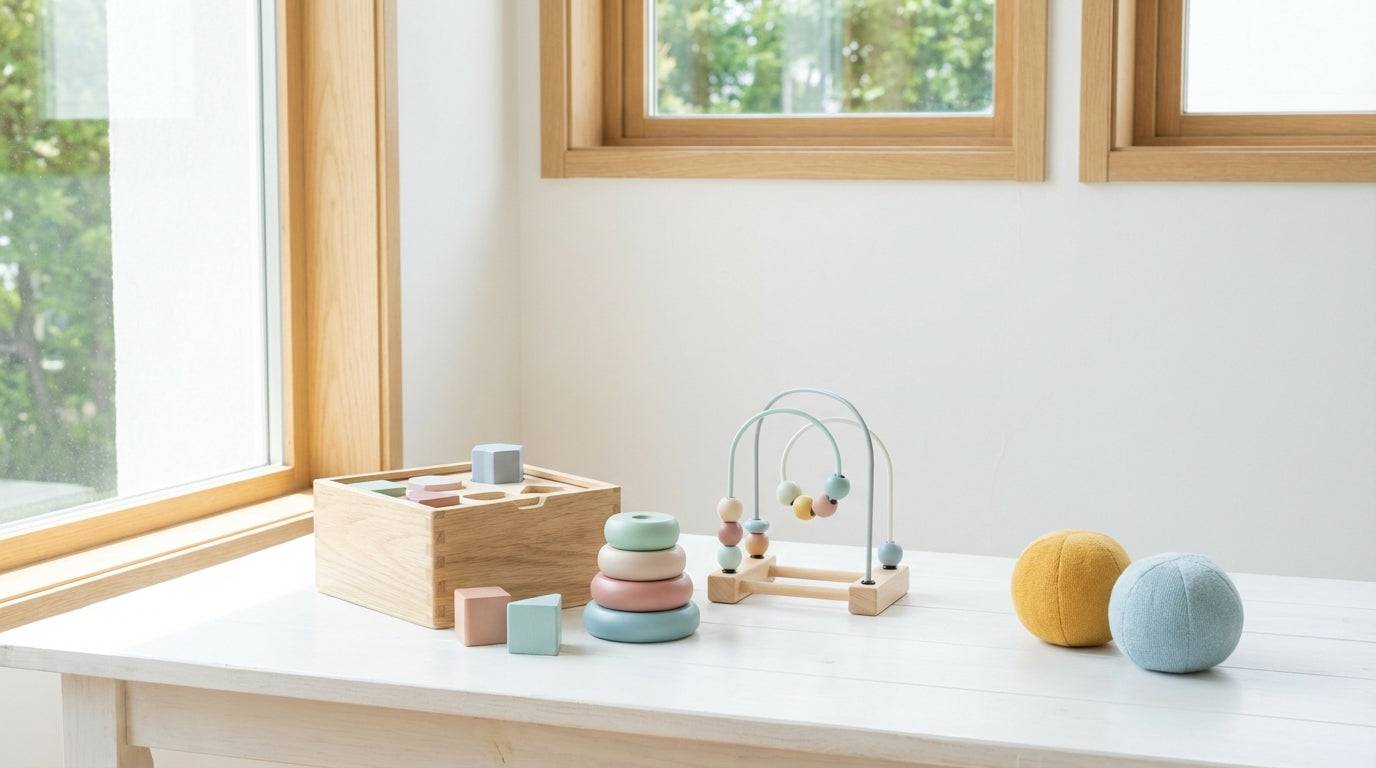
1) Shape Puzzles and Sorting Toys (Shapes, Colors, Openings)
Shape puzzles train grasping, aligning and letting go – fine motor skills without any drama. To start, a few shapes that sit nicely in the hand are enough. With too many pieces, it quickly turns into a “shaker box with bonus frustration”.
Anything that’s easy to clean and has no nasty crevices is practical. Because yes: motor skills toys for 1-year-olds are often also “drool toys”.
If you’d like to see what we have for this age group: in Toys for Ages 1+ you’ll find a good, clear selection.
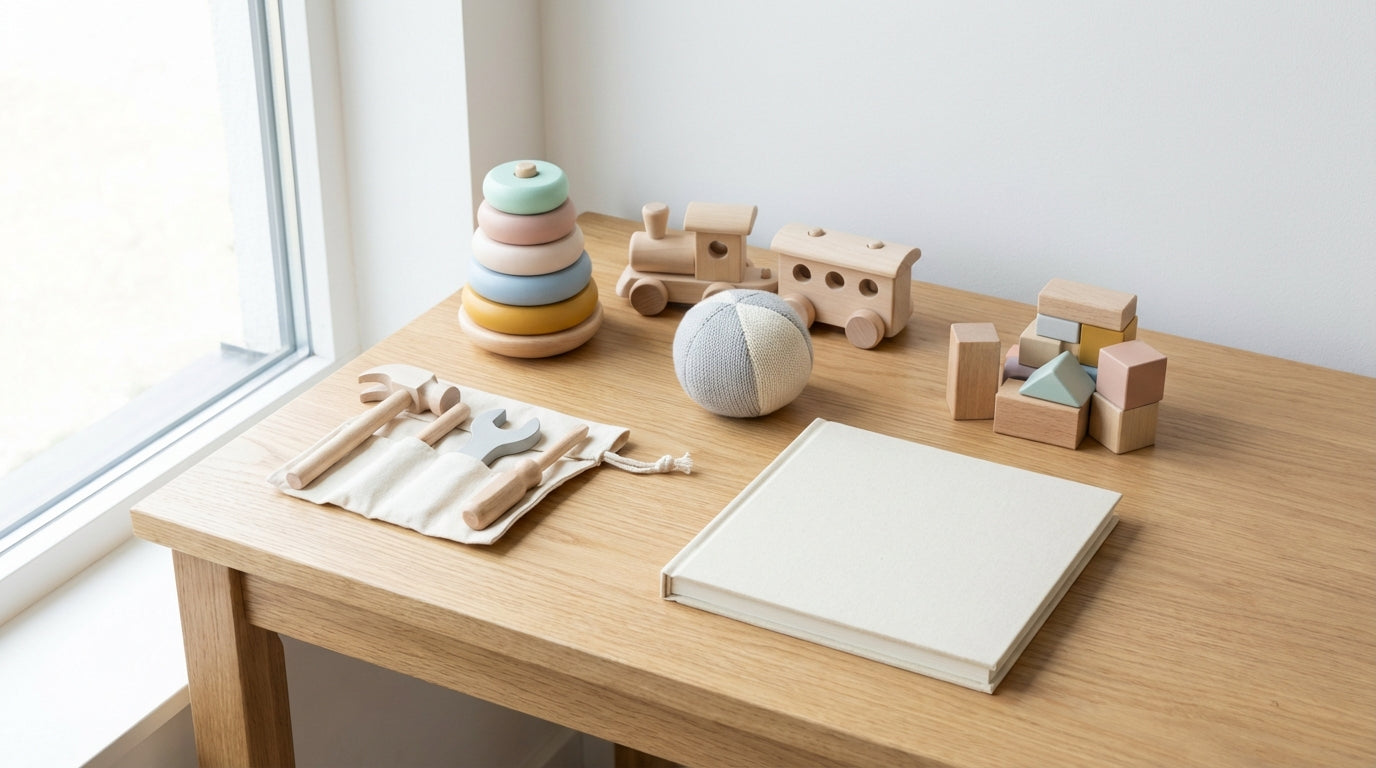
2) Stacking & Building (Cups, Blocks, Rings)
Stacking practices hand-eye coordination and frustration tolerance in small, manageable portions. First everything topples over, then suddenly it works – and you get to act as if you expected it all along.
Look for large pieces that don’t splinter and are easy to grip. Anything that falls apart in a huff on first contact with the floor is more decoration than toy.
3) Pull-Along and Push Toys
Pulling and pushing combine learning to walk with balance and coordination. Especially when the first steps are still wobbly, a “walking buddy” often motivates more than any “Come to me!”.
Practical tip: Don’t leave pull-along or push toys out permanently. Swapping them every few days makes them feel “new” – without you having to buy anything.
If you’re looking for a suitable category, take a look at Pull-Along Animals.
4) Activity Cubes & Activity Toys (Turning, Sliding, Flipping)
An activity cube is a little practice ground for hands: slide, turn, flip, repeat. For 1-year-olds, a few clear elements are often better than “everything at once”. Stability beats show effect – always.
If this interests you: in Activity Cubes you’ll find suitable options.
5) Threading & Lacing Toys (Usually from 18 Months)
Threading toys promote two-handed coordination: one hand holds, the other works. Many children only find this exciting from around 18 months – before that, the string is often more of a “mouth-testing device” than a play idea.
Choose large pieces and a short string to keep things manageable. The goal is a sense of achievement, not a “test of patience for everyone present”.
6) Balls, Rolling, Tumbling (Indoors & Outdoors)
Ball games are gross motor skills to go: roll, throw, chase, again. A soft ball for indoors and a sturdy one for outdoors is plenty. And yes: crawling after it under the sofa counts as exercise.
If you’d like to browse: in Balls you’ll find simple, child-friendly options.
7) Climbing and Balance Opportunities (Gentle & Safe)
For gross motor skills, safe climbing and balance experiences are often more valuable than complicated toys. That can be a cushion obstacle course (with supervision) or a sturdy, low stool – as long as it’s tip-proof and non-slip.
Safety note: Small parts are especially critical for children under 3 years. The “small parts cylinder test” is clearly explained by the Verbraucherportal Bayern (Bavarian consumer portal, in German).
How Can I Tell if Motor Skills Toys Are Safe (Without Panic)?
Safe here mainly means: sturdy, labeled with an appropriate age and free of detachable small parts. At this age, the “mouth check” is part of daily life – it’s not a bad habit, it’s development. You don’t have to be strict, just consistent.
- Take the age recommendation seriously: “3+” often has a reason (small parts, cords, complex mechanics).
- Read the warnings: The EU Toy Safety Directive regulates labeling and warnings; you’ll find an understandable overview from the IHK (SIHK Hagen) on Toy Directive 2009/48/EC.
- Standards as guidance: The EN 71 series describes safety requirements; DIN e. V. provides information on EN 71-3 (chemical requirements), including a note on revisions.
- Everyday check: Does it splinter, are seams coming loose, is something wobbly? Then it’s out – no discussion.
Also helpful: the DGUV has safety tips on small parts and everyday situations. According to the DGUV (German Social Accident Insurance), it’s worth keeping a watchful eye on swallowable parts – especially with the youngest children.
Which Materials Make Sense (Wood, Fabric, Silicone) – and What Does “Tested” Mean?
The best material is the one that suits your daily life: durable, easy to grip, easy to clean. Wood often feels warm and sits firmly in the hand, fabric is soft and quiet, and silicone can be handy during teething. What matters is less “wood vs. plastic” and more the workmanship, edges, seams and the size of the parts.
“Tested” means: there are defined requirements and test procedures – not “indestructible”. The EN 71 series covers different areas, for example mechanical/physical properties and chemical requirements – that helps as a guide, but doesn’t replace a sensible look at each individual toy.
And because we’re often asked: we’re a family business from Hamburg and have been doing this for 66 years. For us (and for Ulli & Flo as parents) that means: clear, everyday-friendly functions, solid materials and honest safety transparency rather than gimmicks that just get in the way after two days.
If you’re curious who’s actually writing and building here: on About Us you’ll find a quick look behind the scenes.
Which Types of Toys Support Motor Skills in Children from Age 2?
From age 2, motor skills toys often get “finer”: more turning, screwing, sorting and role-play hand movements. Many children can then grasp more precisely, stay with an activity longer and want to do things “like the grown-ups” (with a very serious expression, of course).
- Screwing and turning toys: large nuts/screws, turning knobs, simple workbench elements – good for controlling force.
- Threading and bead toys (large pieces): train coordination and patience in small bites.
- Puzzles with knobs: targeted placing, hand-eye coordination, a sense of achievement.
- Sorting by shape/color/size: makes hands steadier and more precise – without any “learning program”.
- Role play with hand movements: feeding, dressing, stirring, pouring – that’s fine motor skills in real life.
Remember: gross motor skills keep developing alongside – running, climbing, balancing. Fine and gross aren’t either-or, more like tea and a cookie: they go better together.
Daily Life Instead of Craft Hour: How to Really Use Motor Skills Toys
Motor skills are best supported when toys are within reach – not when they live in the cupboard. A small basket in the living room, one toy in the kitchen, one in the hallway: that’s often enough.
- One toy, one spot: shape puzzle at the table, ball in the hallway, stacking cups in the bathroom (yes, that works).
- Short rounds are perfectly fine: three minutes count if they happen often.
- Show once, then wait: children need the “I do it myself!” moment – even if it takes longer.
- Rotation instead of overload: better 4–6 pieces in rotation than 30 at once.
Practical tip: If your child only dumps things out: add a second bowl. Pouring from one to the other is motor practice – and doesn’t feel like “practicing tidying up”.
In practice it also helps: better one toy that’s used briefly every day than ten “special” things. Motor skills toys for 1-year-olds thrive on repetition – and repetition thrives on things being within easy reach.
Mini Checklist: Motor Skills Toys for 1-Year-Olds in 5 Pieces
If you’re getting lost in the details: with this little list you’re already very well set up. It’s not a must, more of a “relax, you’re not studying toys at university”.

- 1x shape puzzle/sorting toy
- 1x stacking or building set
- 1x pull-along or push toy
- 1x ball (soft)
- Optional from 18 months: simple threading toy
For browsing without a category marathon: in Toys for Ages 1+ you’ll find age-appropriate ideas that work in everyday life.
FAQ
How many motor skills toys does a 1-year-old really need?
Usually 3–5 types of toys are enough, as long as they’re easy to reach. A shape puzzle, something to stack, a pull-along or push toy and a ball already cover a lot. Children learn through repetition and short play moments. A full shelf looks impressive, but often gets used less.
How can I tell if motor skills toys for 1-year-olds are safe?
Look for sturdy construction, an appropriate age recommendation and no detachable small parts. For children under 3 years, swallowable parts are especially risky; the test cylinder is explained in an easy-to-understand way by the Verbraucherportal Bayern (in German). If something breaks easily or seams come apart: better to leave it be.
Is an activity cube always a good idea for 1-year-olds?
Often yes, if it stands firmly and the elements aren’t too small or too complex. For 1-year-olds, a few clear functions are usually better than an overloaded play board. Sliders, flaps and turning parts that work without help get used most often – and that’s exactly the point.
What should I do if my child only dumps things out, throws them or puts everything in their mouth?
That’s normal at this age and can still be motor training. Dumping out and pouring from one container to another practice grasping and wrist movement, and the “mouth check” is part of it for many children. Offer soft, easy-to-grip pieces and stay consistent about safety (no small parts). Short rounds are enough.
Which types of toys support motor skills best in children from age 2?
From age 2, screwing, threading, sorting and puzzle toys are often especially suitable. Role play like feeding or dressing adds to this, because many small hand movements get practiced along the way. Gross motor skills stay important: ball games, climbing and balancing should remain part of daily life – a little every day is great.
If you now feel like keeping it simple: take a look at our collection Toys for Ages 1+ – you’ll find fitting ideas there that don’t just look good in the photo.