Pink Ball Pit: Color Trends & Safe Combos for Kids' Rooms
At a glance
- A pink ball pit looks loveliest when it's the only “loud” accent in the room.
- 2–3 base colors plus 1 accent are plenty (your brain will thank you).
- Modern pink ball pit: go for dusty rose, powder pink, rosé or mauve instead of bright pink.
- Planning ball pit colors: tone-on-tone is calming, a pastel mix is cheerful.
- Safety: pay attention to the age recommendation, warning notices, supervision and clean balls.

A pink ball pit looks modern when you pair it with 2–3 calm room colors. Then it doesn't look like “toys left lying around” but like a deliberate choice – even if the laundry is still waving at you from the next room. In this guide you'll find everyday-friendly color ideas (pink & cream, sage, natural tones), simple combination rules and a practical safety checklist for babies and toddlers.

Ulli & Flo
Owners of bieco · Hamburg · parents themselves
We've learned that pink isn't “too sweet” when you treat it as an accent. With a few calm base colors, a room becomes truly cozy – and stays that way. Feel free to browse our Ball Pit collection.
Why a ball pit changes the look of a room so much
A ball pit is visually almost like a piece of furniture – just softer. It takes up floor space, draws the eye and “moves” in color because the balls never lie the same way twice. That's why your color choice has a big say in whether a room feels calm or more like a fairground on Monday morning.

A color concept is a small agreement: which 2–3 colors stay in the room. It's not an art project but a relief in everyday life: when you know which colors are “allowed”, you make fewer wrong purchases – and tidy up faster, because there's less visual clutter.
An accent is a single, deliberately placed color that guides the eye. In a children's room, that can be a pink ball pit while the walls and textiles stay neutral.
Pink ball pit: which shades of pink look modern (and not kitschy)
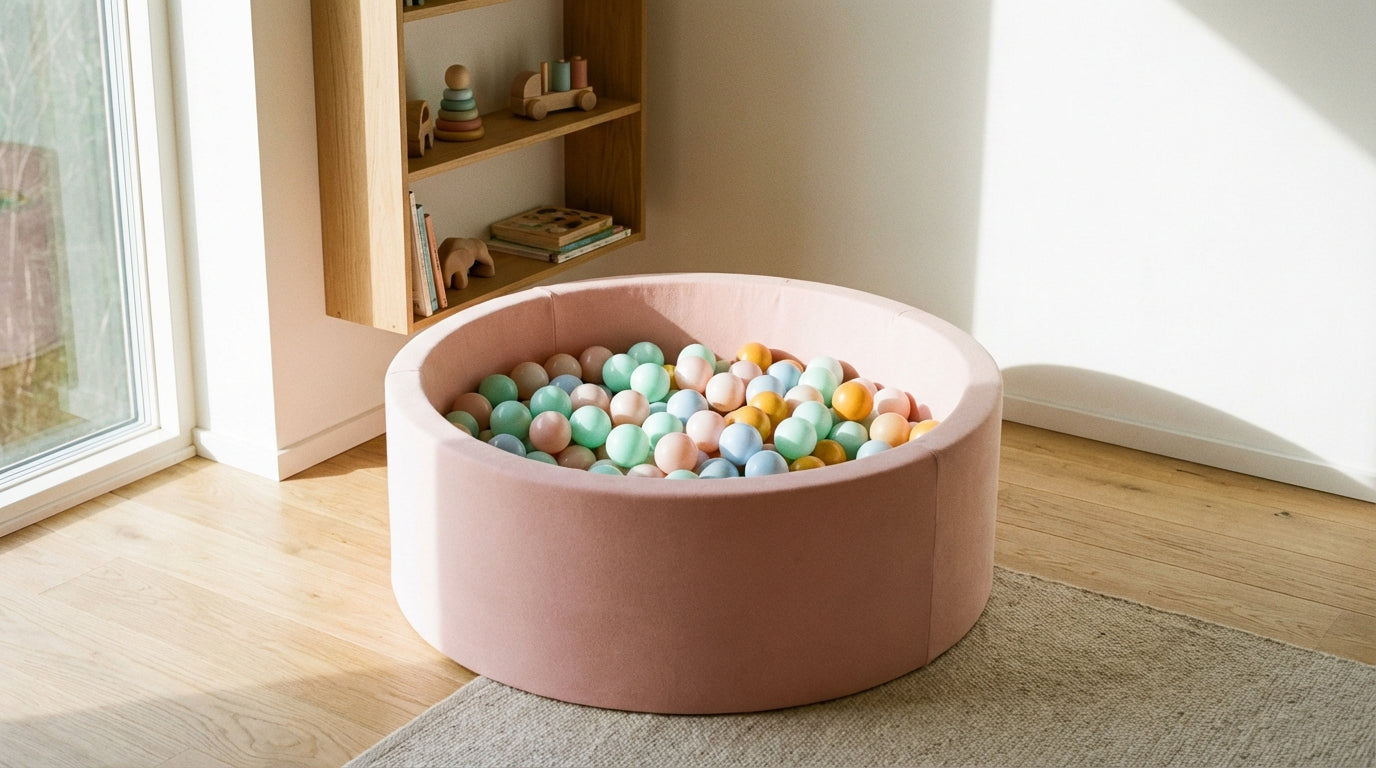
Pink looks modern when it's warm-toned or slightly “dusty”. Dusty rose, powder pink, rosé or mauve are often the relaxed candidates – friendly, but not sugary. Bright pink can be wonderful, but it becomes “a lot” more quickly in everyday life (and yes: you can tell even in the half-light at 5:30 a.m.).

- Dusty rose + cream: soft, timeless, pairs well with wood and natural textiles.
- Powder pink + greige: looks more grown-up, but still warm.
- Rosé + sage: modern and natural, without turning “sweet”.
- Mauve + sand: a little deeper, great with light walls.
Practical tip: If you're unsure, bring pink in only through the balls or the ball pit – not additionally through the wall, rug and curtains.
A pink ball pit looks calmest next to wood, beige, cream and off-white. Natural materials “ground” the color and make the look homely. We've seen exactly these combinations again and again for many years – we're a family business from Hamburg, and for 66 years we've been (happily) stumbling through the reality of children's rooms.
Clicking through colors once can save you from wrong purchases later. In the Ball Pit overview you'll quickly get a feel for which shades look calm together.
The 5 most everyday-friendly color schemes around a pink ball pit
The best color scheme is the one you can calm down again in two quick steps. Children's rooms are workshops for growing up – not photo studios. These five directions tend to work especially well in practice:
1) Tone-on-tone (the pink family)
Tone-on-tone means one color in several shades – and it instantly looks tidier. Example: ball pit in pink + balls in rosé/cream/beige. Neutral walls, calm textiles. The result: soft, modern, not overloaded.
2) Natural & warm (beige, sand, wood)
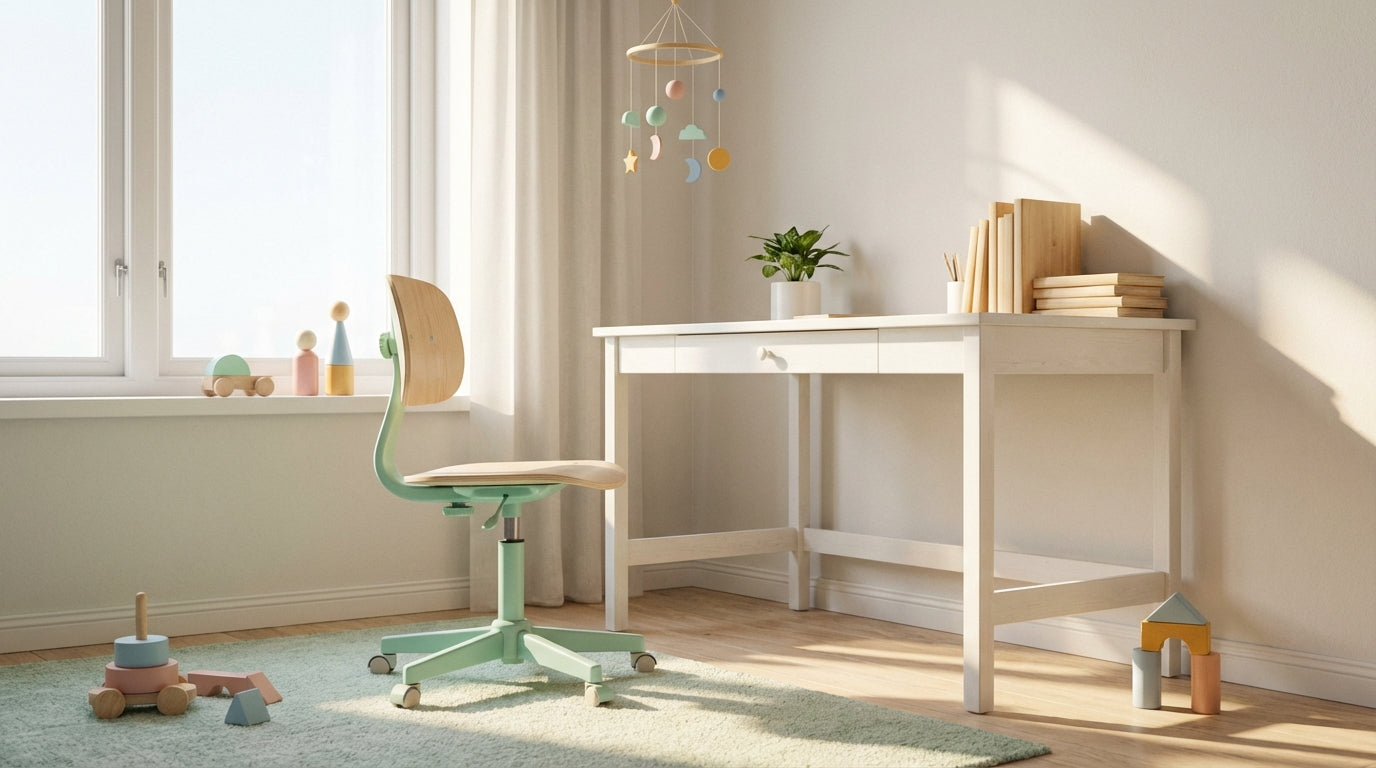
Natural tones are the relaxed, north-German base for a children's room. Here a pink ball pit becomes a gentle eye-catcher. Light wooden shelves, baskets and off-white textiles go well with it – and you don't have to constantly decorate “against” the color.
3) Pink + sage (calm, but not boring)
Sage brings freshness without getting loud. If the wall is already sage green, choose a muted pink (dusty rose or powder). If the wall is neutral, the pink can be a bit more present.
4) Scandi contrast (pink + graphite as a mini accent)
A dark mini accent makes pastel look more grown-up right away – but please use it sparingly. A frame, a lamp, a cabinet handle is plenty. Otherwise it quickly becomes stern, and a children's room shouldn't feel like a conference room.
5) Rainbow pastel (cheerful, but not shrill)
Rainbow pastel works when the base surfaces stay neutral. Then the balls can be colorful without the room “tipping over”. It looks lovely when you mix the ball colors deliberately: a light base plus a few accent colors.
For targeted mixes, it helps to choose balls separately by color. In Balls for Ball Pits you can match your ball pit colors to your room more easily – instead of thinking later: “This one pink has… a lot of opinions.”
How to combine colors: the 60-30-10 rule (no design degree needed)
The 60-30-10 rule brings calm, even when toys are lying around. Quite simply:

- 60% base color (walls/rug: white, cream, greige)
- 30% secondary color (textiles/furniture: beige, sage, light gray)
- 10% accent (this is where it can be stronger: pink ball pit or ball mix)
When the pink ball pit is your accent, the rest automatically stays more relaxed. And when a new favorite theme moves in later (fire engines, dinosaurs, unicorns – we know the script), you only swap the accent, not the whole room.
Practical tip: Put 10–15 balls on a shelf or in a bowl. It ties the look together visually – and you'll find them again faster.
Which materials & labels matter for ball pits?
With babies and toddlers, looks are nice – clear labeling is more important. Pay attention to labels and warning notices on toys. According to the German Federal Ministry for the Environment (BMUKN), the EU Toy Safety Directive (2009/48/EC) sets safety requirements, including chemical requirements and labeling. (Source)
Chemical safety means that materials should release or off-gas as few substances as possible. According to the German Federal Institute for Risk Assessment (BfR), the institute assesses health risks from chemical substances in toys and publishes information and assessments on the subject. (Source)
Swallowable small parts are especially critical for children under 3. According to the Bavarian consumer information portal, toys for children under 3 must not contain detachable small parts; testing is done using a test cylinder (“small parts cylinder test”). (Source)
Safety note: Loose balls should never be left unsupervised in a baby's bed or playpen – and in the play area, the rule is: always play under supervision.
Safety checklist for the ball pit (short, practical, everyday-friendly)
A safe ball pit comes from supervision, the right location and regular checks. Here's a small checklist you'll actually use:
- Age & notices: Follow the age recommendation and read the warning notices through once (yes, even if it's boring).
- Location: Place the ball pit on a non-slip, level surface and not directly next to hard edges or radiators.
- Underlay: If the ball pit sits on a smooth floor, a rug or play mat underneath helps keep it from wandering.
- Supervision: Especially with little ones, always stay close by – balls are light, but children are sometimes faster than our thoughts.
- Ball check: Regularly look for damaged balls (cracks, sharp edges) and sort them out.
- “Ball counting light”: You don't need to take inventory every evening, but a quick glance to see whether an unusual number are missing makes sense.
- New items & airing out: If something smells new, let it air out for a while and ventilate the room well.
Safety note: If a ball is visibly damaged, it has to go – “it'll be fine” is rarely a good plan in a children's room.
Care & cleaning: how to keep balls and ball pit hygienic (without a big project)
Hygiene in the ball pit works best with small routines instead of a cleaning marathon. Because let's be honest: sooner or later the ball pit collects cookie crumbs, dust and that one stuffed animal who “wanted to go for a swim too”.
- Crumbs out: Shaking it out briefly once a week or “combing through” by hand is often enough.
- Cleaning the balls: If you wipe the balls, use a soft cloth and mild detergent; then let them dry well before everything goes back into the ball pit.
- Ventilate regularly: This helps the indoor air – especially when there are lots of textiles in the room.
Indoor air is a silent roommate – and it likes being aired out. The German Environment Agency (Umweltbundesamt) explains that building products, wallpapers and paints can release plasticizers and other semi-volatile organic compounds into indoor air. (Source)
Ball pit tent or open? What makes colors (and tidiness) easier
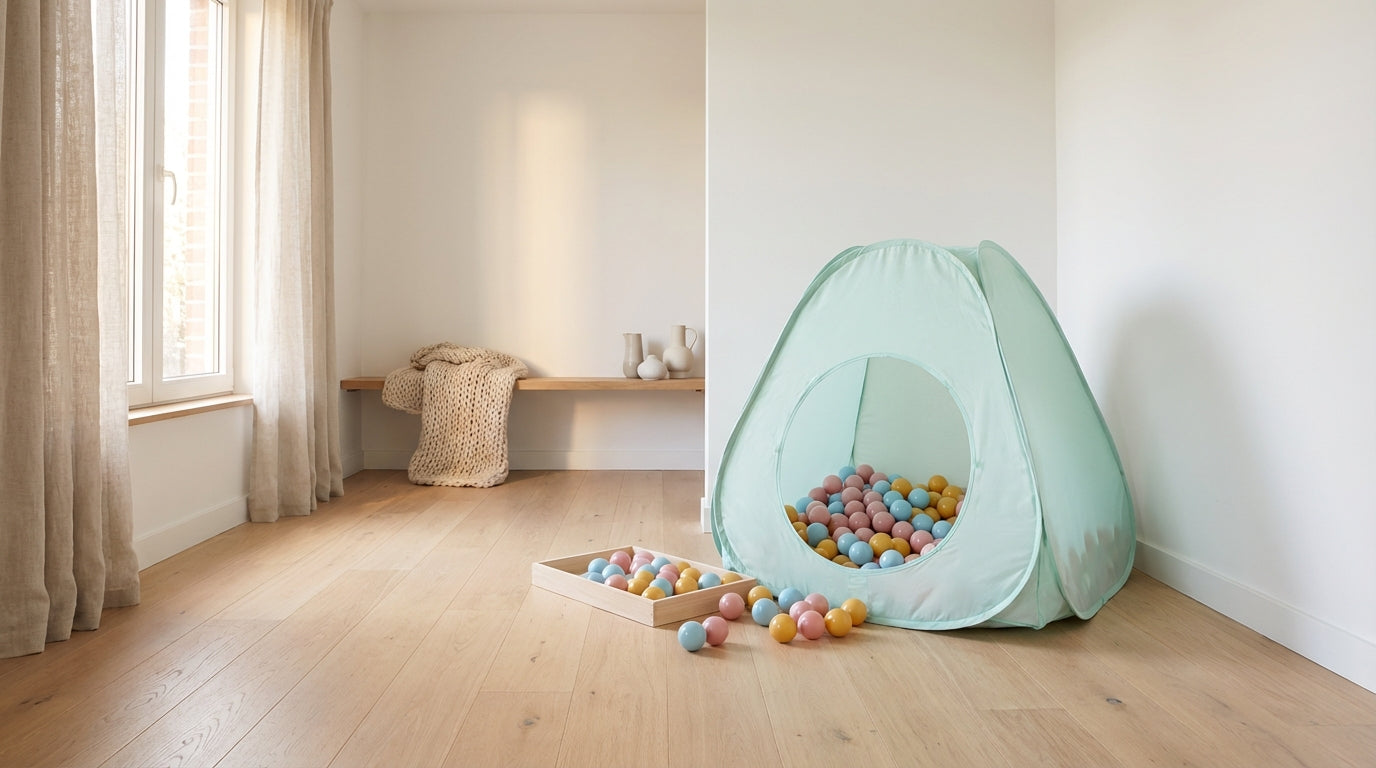
A ball pit tent holds colors and balls together visually – which instantly looks calmer. A practical side effect: fewer balls roll across the home, and you step on a ball less often at night (which is about as elegant as stepping on LEGO, only rounder).
Open is great when you want to toss things in and out quickly. Then it helps to give the ball pit a fixed spot and keep its surroundings deliberately calm – otherwise it quickly looks like “one more thing” in the room.
If you're looking for ideas on how to use the tent in everyday life, a quick look at our guide is worthwhile. Here: Ball Pit Tent: Creative Play Ideas and Benefits for Kids.
How a pink ball pit fits into small rooms (without making them feel crowded)
In small rooms, “light, calm, fixed spot” is half the battle. A pink ball pit looks smaller when there are light surfaces around it: a light rug, a light wall, few patterns. And: a clear corner is better than constantly rearranging – it saves nerves and looks tidier.
- Corner instead of center: In a corner it looks like a play station, not an obstacle course.
- Storage close by: A basket or box nearby makes tidying up “quickly” more realistic.
- Few patterns: If the balls are colorful, keep the rug and curtains calm.
The number of balls affects the look more than you'd think. If you're planning how many balls make sense, our article Balls for Ball Pits: Which and How Many Balls Are Ideal? will help – so you don't swing between “too empty” and “balls in the hallway”.
FAQ
Which colors go best with a pink ball pit?
The easiest matches are cream, beige, greige and light wood tones. They make a pink ball pit look modern and calm. If you want more freshness, choose sage or a very light gray as a secondary color. Bright colors work best only as a small accent, otherwise things quickly get restless.
Does a pink ball pit quickly look “too sweet”?
Not if pink stays the accent and the rest is neutral. A muted pink (dusty rose/powder/rosé) looks far less “candy-like” than bright pink. Wood, linen and cotton also take the sweetness out – and it still looks cohesive after a long time.
Which ball pit colors are the easiest to care for?
Light natural tones and pastels often look “clean” for longer in everyday life. Cream, beige or very light pastel shades visually forgive dust more readily than very dark or extremely bright colors. A mix of a calm base plus a few accent balls is practical – lively, but not delicate.
Is a ball pit suitable for babies?
What matters is the age recommendation, supervision and a safe design. Look for clear warning notices and make sure nothing is damaged or detachable. According to the BMUKN, comprehensive safety requirements for toys apply in the EU, including labeling and chemical requirements. (Source)
How do I stop a pink ball pit from making the room feel restless?
Limit the palette to a maximum of three colors in the direct line of sight. If the pink ball pit is the eye-catcher, choose balls in pink/cream/beige and keep the rug and curtains calm. If the balls are colorful, the ball pit itself should be more neutral. Closed storage helps more than any theory.
How do I plan the number of balls without miscalculating?
It's better to plan roughly up front than to buy more later or end up with too many. The amount you need depends on the size of the ball pit and the “fill height” you want. You'll find a practical guide here: Balls for Ball Pits: Which and How Many Balls Are Ideal?.
In closing: it can be pretty – but please keep it practical
A pink ball pit is loveliest when it calms your room instead of overloading it. Keep the base neutral, use pink deliberately as an accent, and take a moment to go through the safety checklist. If you'd like to compare colors now, take a look at the world of Ball Pits and add matching Balls for Ball Pits if needed – and everything comes full circle, quite literally.