Ball Pit Balls: Which Size & How Many Do You Need?
At a glance
- Ball pit balls: 7 cm is usually the most comfortable all-round size.
- The number you need depends mostly on how deep you want the fill to be.
- A simple volume calculation gives you a good estimate in no time.
- Cleaning is easy: mild dish soap, then let them dry thoroughly.
- Look for the CE mark and clear manufacturer information, and check the balls regularly for cracks.

For a ball pit, 7 cm balls usually work best – and the right amount is the one that lets your child sink in comfortably. That might sound like a matter of gut feeling at first, but it's actually quite easy to plan once you know the ball size and the fill depth you want. In this guide I'll show you a simple calculation (with examples for common sizes), plus practical tips on material, cleaning, storage and safety. No drama – more like chatting at the kitchen table: measure quickly, calculate once, done. We're Ulli & Flo from the bieco team (a family business from Hamburg, going strong for 66 years), and we know the questions from parents' inboxes, from product development and from the perfectly normal “Why are there balls everywhere?” moments of everyday life.

Ulli & Flo
Owners of bieco · Hamburg · parents themselves
We've learned that the right number of balls turns “quite nice” into a real sea of balls. With the little calculation here, you'll be smarter in five minutes than we were back then. Feel free to browse our Ball pit collection.
Which ball size makes sense?
A 7 cm diameter is the best compromise between grabbing, throwing and burrowing for many families. The balls are big enough not to roll around the house like confetti, and small enough for little hands to hold easily. If you already have balls at home: pick one up, squeeze it, feel it – that often tells you more than any product description.

A ball pit ball is a lightweight, hollow plastic ball that gives way under pressure and springs back into shape. That “bounces back” quality is exactly what makes the difference between a cozy sea of balls and a hard marble party. For play, it's important that the surface is smooth and the seam looks cleanly finished.
6 cm or 7 cm is less a matter of faith than an everyday test. 6 cm feels “finer” and can sit more densely in smaller pits, while 7 cm is often a bit calmer to handle. If your child can grip the ball securely (without clenching it) and it doesn't poke when they lie on it, you're on the safe side.
Practical tip: Ask yourself: “Should this be more about burrowing or about really diving in?” For diving in, you don't need smaller balls – you mainly need more balls.
Material & safety: What you should really look for
More important than the material name is the combination of smell, workmanship and labeling. In everyday life, that means: if something smells strongly chemical or feels sticky, let it air out first – or send it back. And yes, I know: you'd love to rip it open and start playing right away. But your nose can sometimes be the best stress-saver.

The CE mark is mandatory for toys in the EU, but it is a manufacturer's declaration. According to the Bavarian consumer portal, the CE mark is not subject to independent prior inspection; the manufacturer is responsible (Verbraucherportal Bayern). That's why it's worth also checking for complete manufacturer information, warnings and neat-looking workmanship.
EU toy rules are based on the Toy Safety Directive 2009/48/EC and its implementation. According to the German Federal Environment Ministry (BMUKN), technical safety requirements have applied since 20 July 2011 and chemical regulations since 20 July 2013 (BMUKN: Safe toys). It's not exactly bedtime reading – but it's good to know there are clear guardrails.
“EN 71” is a series of standards that describes important toy tests. TÜV SÜD explains that the series covers, among other things, mechanical/physical requirements and chemical aspects (TÜV SÜD). A mention of it is helpful, but it doesn't replace a quick hands-on check: Seam smooth? Ball gives way? No sharp edges?
Safety note: Never leave babies and toddlers unattended in the ball pit, and check the balls regularly for cracks or sharp edges.
How many balls do you need? (Rule of thumb + clear calculation)
The number of balls depends mainly on the pit's floor area and the fill depth. The “height of the rim” matters less than the height to which you actually want to fill. For many families, a fill depth of 20–30 cm is a good start – and then you top up until your child is happily sitting in a sea of balls.

Fill depth is the height of the layer of balls in the pit, not the height of the pit wall. That sounds trivial, but it saves money and nerves: a pit with 30 cm walls doesn't automatically need to be filled 30 cm high, otherwise your living room will be “full” faster than the ball pit.
The simple volume formula (rectangular)
Volume (liters) = length (cm) × width (cm) × fill depth (cm) ÷ 1000. Example: 110 × 40 × 25 cm = 110,000 cm³ = 110 liters. That's just “space,” not “number of balls” – but it gives you a clear sense of whether you're filling a paddling pool or a cereal bowl.
The simple volume formula (round)
Volume (liters) = π × radius² (cm²) × fill depth (cm) ÷ 1000. Example: 90 cm diameter → radius 45 cm. With a fill depth of 25 cm: π × 45² × 25 ≈ 159,000 cm³ ≈ 159 liters.
And how do you turn that into a number of balls?
For the number of balls you need a rule of thumb, because balls leave air gaps between them. That air, by the way, is why “volume” is never 1:1 “balls.” As a practical guide, it works well to plan with a starting amount and then top up in steps of 100 until you reach the depth you want.
Practical tip: If you're torn between two amounts, go for the bigger one. Too many balls can be stored – too few you'll notice every time someone plops in.
Calculation table: Common sizes & typical starting amounts
The table is an everyday guide, because shape, ball size and fill goal all vary. If you want to “dive in,” go for the higher number; for calm play and sorting, the lower one is often enough. (And yes: kids are excellent “quality inspectors” – they'll tell you right away whether it's enough.)
| Pit size | Fill goal | Typical starting amount | For “really plenty” |
|---|---|---|---|
| 90 × 30 cm (round) | approx. 20–25 cm fill depth | approx. 200–300 balls | approx. 400–600 balls |
| 110 × 40 cm (oval/rectangular) | approx. 20–25 cm fill depth | approx. 300–400 balls | approx. 500–700 balls |
| 120 × 40 cm (oval/rectangular) | approx. 25–30 cm fill depth | approx. 400–500 balls | approx. 600–800 balls |
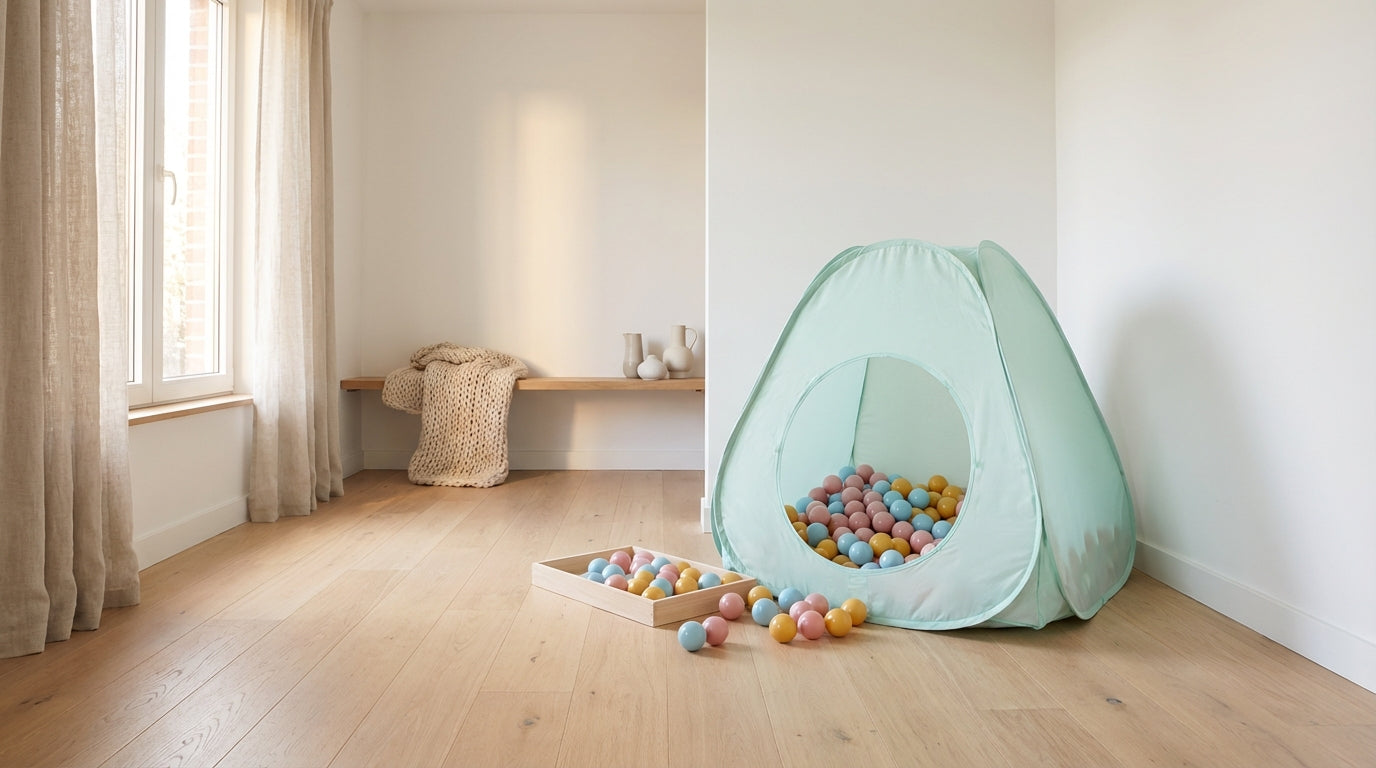
| Pop-up/tent (small area) | Cover the floor + burrow | approx. 100–200 balls | approx. 250–400 balls |
Age & safety: From when and how can you play with peace of mind?
Things stay relaxed when you think about age recommendation, supervision and play style together. Little ones explore with their mouths, bigger ones with a running start. Both are normal – and both need a bit of structure: suitable products, clear rules and a quick look at the condition of the balls.
For babies, “grabbing, feeling, sorting” usually makes more sense than wild jumping. If you notice your child likes to put balls in their mouth, pay extra attention to clean, intact balls and a space free of small parts. And remember: a ball pit is a toy, not a place where you can “just quickly” do the laundry while your child plays unattended.
When several children play, plan for extra balls, because bodies displace volume. In practice, that means: plan roughly 100–200 more balls for each additional child, otherwise your sea of balls quickly turns into a thin layer of “floor with decoration.”
Cleaning & disinfecting: How to keep the balls fresh
The easiest way to clean balls is with warm water and mild dish soap. Rinse them well afterwards and let them dry completely so no musty smell settles in. This is the method most likely to actually happen in family life – so it's the best one.
For a more thorough round, it helps to wash in batches instead of all at once. A laundry bag or a large laundry basket makes handling easier. What matters is less “high tech” and more drying: spread the balls out on towels and turn them from time to time until everything is truly dry.
If someone has been ill, “cleaning more often” makes more sense than “cleaning more aggressively.” It's better to use mild cleaning water more often than to experiment with harsh products that could damage the material and surface. And if a ball is damaged: out it goes – it won't get any better.
Storage: Where do all those balls go?
Good storage is half the battle, so the ball pit doesn't turn into a permanent obstacle course. You don't need anything fancy: a large box, a laundry bag or a basket with a lid is often enough. The main thing: quick in, quick out, without playing Tetris every time.

- A laundry bag/mesh bag is practical because air can get in and it doesn't get musty.
- A box with a lid is great if you want to keep out cats, dust or the “I'll just rearrange this” effect.
- A small bucket in the playroom for the “thrown-out” balls saves your nerves in the evening.
Mixing colors: Pretty, yes – but practical too
A mix of 2–4 colors looks calmer and is still exciting for play. And it comes with a bonus: you can turn it into little games without any extra materials. “All the blue balls into the basket” has been our evening routine more than once – it sounds like a game, but it's really tidying up.
Colors are decoration; the quantity is the real fun factor. If you only optimize one thing, make it the fill amount. That's what's most likely to give you the moment when your child “disappears” giggling and you think for a second: “Okay, that was worth it.”
Where to start: What can you find at bieco?
If you first want to compare shapes and sizes, the hub is the most relaxed place to start. You'll find different options there and get a feel for what suits your space. Ball pit
For topping up or adding to your set, the overview of individual ball sets is the quickest way. Especially handy if, after the first fill, you think: “Okay, that was nice – but there's room for more.” Ball pit balls
If you're shopping especially for the littlest ones, the baby guide is full of everyday details. It covers supervision, play ideas and what parents pay attention to in practice. Ball pit for babies: From when, benefits & the best tips
And for rainy days with energy to burn, tent ideas make a pretty rewarding read. Especially if you're short on space or want to set up and take down quickly. Ball pit tent: Creative play ideas and benefits for kids
FAQ
Which ball size is best for a ball pit?
A 7 cm diameter is usually ideal, because the balls are easy to grip and pleasant to burrow in. 6 cm can work too, but feels a bit more “fiddly.” The deciding factor is the hand test: the ball squeezes easily, the seam is smooth, and your child can grip it securely and enjoys throwing it.
How many balls do I need for a 90 × 30 cm ball pit?
For 90 × 30 cm, many families start with about 200–300 balls. For more sinking in and “diving,” 400–600 balls often feel more right. If two children play at the same time, the larger amount is worth it, because otherwise the floor is quickly noticeable.
How many balls do I need for a 110 × 40 cm ball pit?
For 110 × 40 cm, about 300–400 balls make a good start. If you want a greater fill depth or several children are playing, 500–700 balls are often closer to that “real sea of balls” feeling. The most relaxed approach is topping up in steps of 100.
How can I tell if ball pit balls are safe?
Look for the CE mark, complete manufacturer information and clean workmanship without sharp edges. CE is mandatory, but it is a manufacturer's declaration; according to the Bavarian consumer portal there is no independent prior inspection (vis.bayern.de). So also: check the smell, feel the seam, and sort out damaged balls.
From what age is a ball pit suitable?
That depends on the product and the child; what matters is supervision and appropriate use. For babies, calm play (grabbing, feeling, sorting) is often a better fit than jumping. Follow the manufacturer's age recommendation and stay close by – a ball pit is wonderful, but not a place for unsupervised play.
What does “EN 71” mean for toys like ball pit balls?
“EN 71” is a series of standards that describes key safety tests for toys. According to TÜV SÜD, it covers, among other things, mechanical/physical requirements and chemical aspects (tuvsud.com). A mention of it is good, but it doesn't replace checking the labeling, smell and workmanship.
Bottom line: 7 cm is a strong standard – and the quantity decides the fun. Start with a solid amount, top up if needed, and keep the balls fresh with simple cleaning. If you'd like to see what suits your space, you'll find a good overview at Ball pit and Ball pit balls – and your living room will briefly turn into a play oasis. Briefly. Definitely.