Ball Pit Tent: Play Ideas, Safety & Everyday Tips for Home
At a Glance
- Ball pit tent: In 10 minutes, a little adventure land is up and running in your living room.
- 7 play ideas that work without constant entertaining (and are still fun).
- A quick safety check: location, small parts, cords, sturdy construction.
- Cleaning & care: How to keep balls and tent fresh and everyday-ready.
- At the end: a checklist for setup & rules, so things run smoothly at home.

A ball pit tent is the quickest way to combine indoor movement with a cozy den feeling. Set up the tent, add the balls, and your child is happy – and you don’t have to turn the living room into a gym first. In this guide you’ll find play ideas, safety checks, cleaning and tidying tricks, plus a little help in choosing a tent shape. All of it made to work on real family days: with a laundry basket, half a cup of coffee, and the good intention of not tripping over every single ball today.

Ulli & Flo
Owners of bieco · Hamburg · parents themselves
At our place, the ball pit tent has two main jobs: getting the kids into play and giving parents a moment to catch their breath. With a basket next to it and a mini tidy-up rule, things stay surprisingly peaceful. Feel free to browse our Ball Pit collection.
What Is a Ball Pit Tent – and What Does It Really Offer?
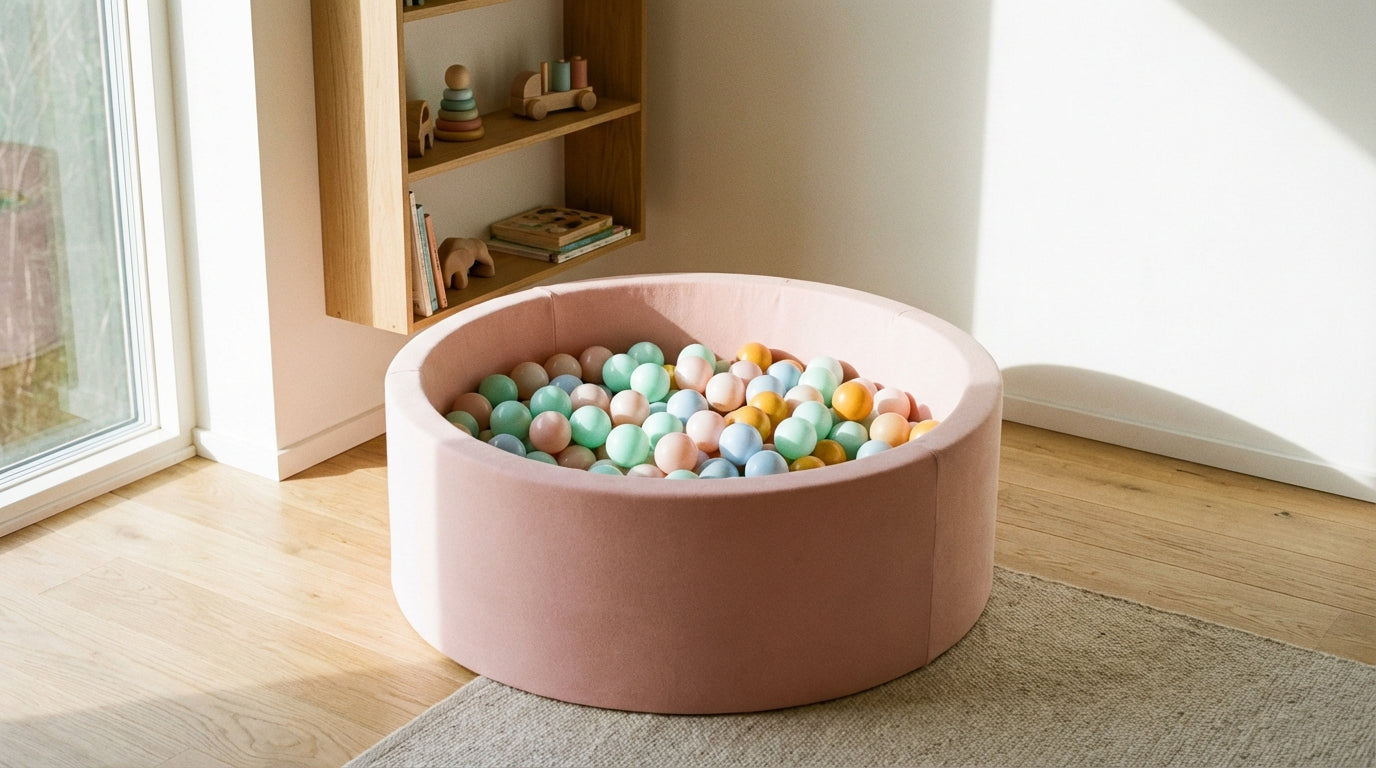
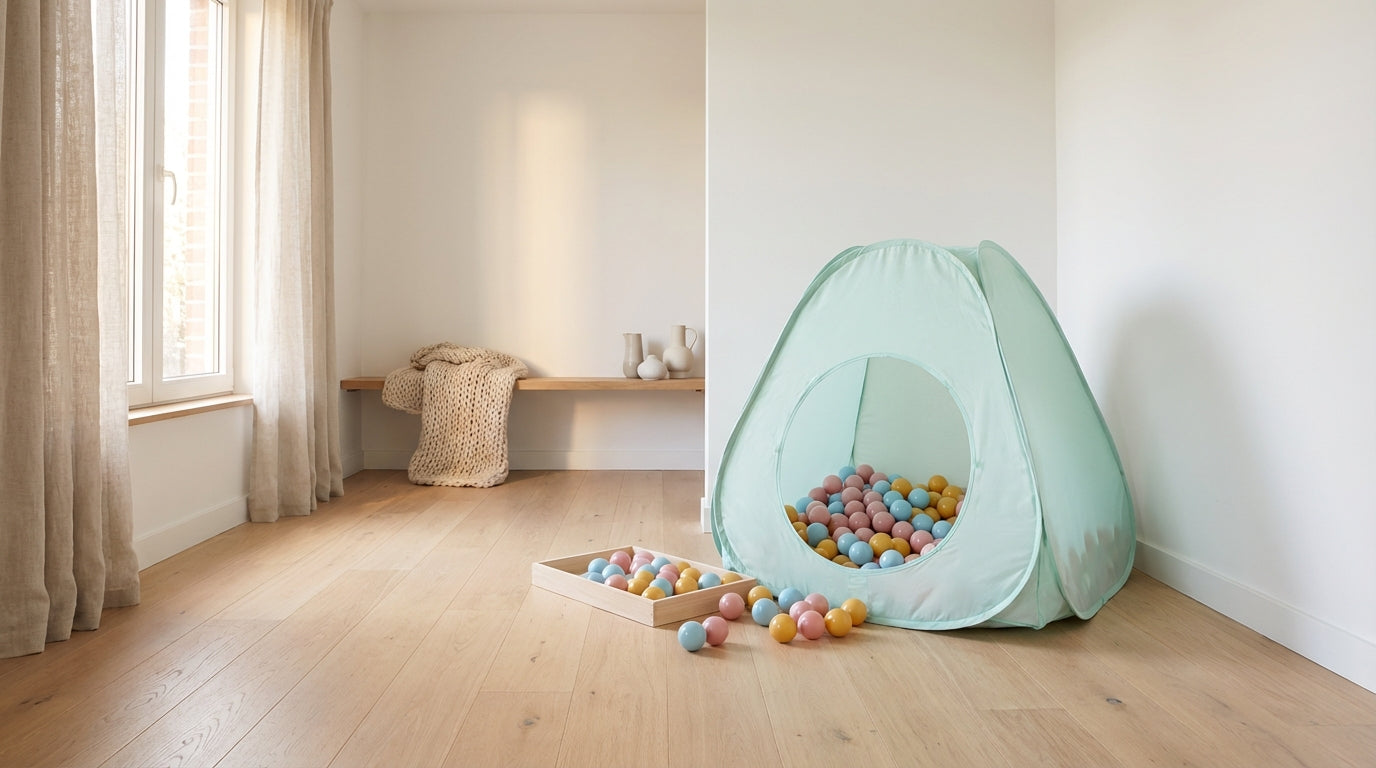
A ball pit tent is a play tent that clearly defines the ball area. That means fewer balls end up all over the room, and kids more quickly get the feeling: “This is my own little place.”

Free play means: Your child decides on the idea, the pace and the flow. For you, in the best case, that means: you set the frame, your child does the rest (and you get to take a short breather).
In everyday life, the tent is often more of a “retreat” than an action zone. Some children burrow like a mole, others sit inside and sort colors as if they were running a mini warehouse. Both are fine – as long as it fits your day.
Why a Ball Pit Tent Works So Well in Family Life
A play tent with a ball pit brings in movement without your furniture having to suffer. Rolling, crawling, throwing, sorting – all in a small space, but with enough “play feeling” that it doesn’t look like occupational therapy.
The tent provides structure: going in, coming out, taking turns, taking a break. Especially with siblings or visitors, that’s worth its weight in gold, because the play area is visible and rules are easier to enforce.
And yes: It’s also a tidiness hack. Not perfect, but better than a “ball pit without edges”, where you still find three balls in your shoe in the evening.
When Does a Ball Pit Tent Make Sense?
What matters is less the age than steady sitting and purposeful grasping. Many families start when children can sit steadily and grasp things on purpose – that’s when burrowing, throwing and sorting is really fun.
With little ones, the rule is: fewer balls, more overview, more closeness. It’s best to stay within sight and reach, and to keep the setup simple: tent, balls, soft base – done.
If you want to place this more precisely by developmental stage, the overview will help. In the article Ball Pit for Babies: When to Start, Benefits & the Best Tips we walk through it in an everyday-friendly way.
Which Tent Shape Fits: Pop-up, Tipi or Play House?
The best shape is the one you can set up and take down without swearing. Here are the typical differences – no magic involved.

- Pop-up tent: Quick to set up and quick to put away again. Handy when you want the living room to be an “adult room” again in the evening.
- Tipi: Often looks pretty and feels like a little reading nook. With very wild ball games, though, the open shape can mean more “ball ejection”.
- Play house (with walls/windows): Gives a lot of spacious feeling and clear boundaries. Usually needs a bit more floor space and tends to stay up “permanently”.
Practical tip: Quickly measure the space you really have free – plus “door open, child out”. That saves you from moving furniture in your pajamas later.
7 Creative Play Ideas for the Ball Pit Tent (Without Much Effort)
The best games are the ones you can explain in one sentence. Here are ideas that work without craft stress – and that you can make easier or trickier depending on age.

1) Ball Mail: Delivering Instead of Throwing Around
“Playing delivery service” turns throwing into a target game. Put a bowl or basket next to the tent and “order” colors: “Please deliver 5 yellow balls!” For older kids: against the clock (“until I count to 10”). For little ones: “Bring me a red one” is enough.
2) Color Safari: Search, Find, Celebrate
Color games are simple and work even with little space. You name a color, and your child collects matching balls in a corner. Variation: lay out a “rainbow row” or sort by light/dark (if you feel like it, not because you “have to”).
3) “Treasure in the Ball Sea” (with Large, Safe Objects)
Hiding things is a turbo boost for attention. Hide a large object that is easy to grasp under the balls. Then it’s searching, digging, finding – and hiding again.
Safety note: For hiding, only use items that cannot be swallowed. According to the Bavarian consumer portal (Verbraucherportal Bayern): toys for children under 3 years must not contain detachable small parts; anything that fits into the test cylinder (Ø 31.7 mm) counts as a “small part” (DIN EN 71-1). Source
4) Ball Bowling (Great for Indoors)
Bowling adds structure without turning into a “sports program”. Set up soft pins or cups and let the balls roll instead of fly. It’s quieter, more controlled – and with smaller children often less frustrating.
5) “Quiet Balls” for Tired Afternoons
Sometimes the goal isn’t action, but winding down. Agree: balls are only rolled and quietly re-sorted. Add a task: “Build a nest out of blue balls.” It works surprisingly often – even when the day is already hanging a bit crooked.
6) Mini Obstacle Course: In, Out, Turn, Clap
A short course turns the tent into a movement station. Example: “Crawl in, turn around once, clap, crawl out.” For older kids: “backwards in” or “with a ball on your head” (only if safe and without tripping).
7) Tidy-Up Game: “Ball Fire Brigade”
Tidying up works better when it stays a game. Basket next to the tent, and then “emergency call”: “All balls must go into the rescue vehicle!” Or by color: “First red, then yellow.” That saves arguments – not always, but often enough.
Practical tip: Put a non-slip mat or blanket under the tent. It dampens noise and means fewer balls to rescue from under the sofa later.
Safety in the Ball Pit Tent: What You Should Really Look Out For
Playing safely means: location, use and construction all fit together. A few quick checks save you stress later – and make the whole thing more relaxed.
- Location: Level surface, away from stairs, radiators and sharp edges.
- Supervision: Especially with little children: stay within sight and reach, particularly when play gets rowdy.
- Avoid small parts: For children under 3, detachable small parts are a no-go; assessment is carried out according to DIN EN 71-1, among others. According to LAVES (Lower Saxony state office for consumer protection), swallowability is tested, among other things, with a test cylinder. Source
- Strings & cords: Make sure nothing dangles awkwardly or can get tangled (keep an eye on tie-backs at the entrance).
- Notices & standards: In the EU, the Toy Safety Directive applies; harmonized standards such as DIN EN 71 support the safety assessment. According to DIN, applying harmonized standards plays an important role in the presumption of conformity. Source
The CE mark is mandatory, but your quick check remains worth its weight in gold. Take one look over seams, zippers, poles/pop-up rings and possible openings before the wild hustle and bustle begins.
How Many Balls Does a Ball Pit Tent Need?
The right number of balls depends on tent size and play goal. For “burrowing like in a sea of balls” you need more; for target games and sorting, fewer are enough – and fewer often means easier tidying up.
If you want to plan by size, a quantity overview helps more than gut feeling. The article Balls for Ball Pits: Which Ones and How Many Are Ideal? is handy for this, because you can calculate by tent/pit size there.
Ball pit balls are lightweight plastic balls made for grasping and throwing. Look for clean workmanship without sharp edges and for the age recommendation. If you want to mix colors or buy more later: in the Balls for Ball Pits collection you’ll find suitable options.
Cleaning & Care: Keeping the Tent and Balls Everyday-Ready
“Small and regular” works best, rather than “rare and huge”. That way it doesn’t become a weekend chore that you ignore for three weeks.
- Tent: Clean according to the manufacturer’s instructions. Many tents can be wiped with a damp cloth; for fabric parts, follow the care label.
- Balls: Wash in the bathtub with a mild cleaner, rinse well and let them dry completely before they go back into the tent.
- Smell: Let new products air out first, especially when they come fresh out of the packaging.
Safety note: Only put the balls back in once they are completely dry. Moisture in the tent is an unnecessary guest that nobody invited.
Tidiness Without Drama: Keeping Balls and Nerves Together
With two mini rules, the ball pit tent becomes much more everyday-friendly. Rule 1: “Balls stay in the play area” (tent or mat). Rule 2: “Before dinner, X balls get rescued” (start small – 10 or 20 are enough).

A big basket is the best invention since Velcro. Put a laundry basket next to the tent: kids throw the balls in, and you carry it away later. No bending marathon, no “Where is that ball again…”.
Practical tip: Turn collecting into a game with an end: “When the basket is half full, we’re done.” A clear line means less discussion.
How We Choose: What Matters to Us in Tents & Balls
We first look at the things that really save trouble in everyday life. Ulli & Flo write here as parents – and at Bieco we are a family business from Hamburg. We’ve been doing this for 66 years, and that is exactly why, when it comes to toys, we’re more Team “honestly sturdy” than Team “just looks good”.
- Material & smell: We make sure that new products are allowed to air out first and feel pleasant to the touch.
- Workmanship: Seams, edges, zippers and pop-up elements must look clean and feel stable.
- Everyday test: Can it be set up, taken down and stowed away quickly? If not, it often goes unused in real families.
- Cleaning: Wipe-clean or easy-care isn’t a luxury, it’s real life.
- Notices & transparency: We don’t read age recommendations and safety notices “at some point”, but beforehand.
Checklist: Setup & Rules in 2 Minutes
With this short list, the ball pit tent is set up more safely and with less stress.
- Set up the tent on a level surface, keeping distance from edges/radiators.
- Put a non-slip base underneath (blanket/mat).
- Start with only a few balls, then increase as needed.
- Secure tie-backs/cords so that nothing dangles.
- Rule: Balls stay in the tent/on the mat.
- Rule: Set a minimum for tidying up (e.g. 20 balls before dinner).
- Quick check: Seams, zipper, pop-up ring/poles okay?
FAQ About the Ball Pit Tent
Is a ball pit tent suitable for babies?
Yes, if your baby can sit steadily and you stay close by. Start with just a few balls so your baby doesn’t “sink in”, and use a soft base. Extra toys in the tent only if they are large enough and cannot be swallowed. Short play sessions are better than “too much at once”.
What is the best way to clean a ball pit tent and the balls?
The easiest way is: a quick clean regularly rather than a radical one rarely. Wipe the tent down according to the manufacturer’s instructions or – if permitted – clean the fabric part. You can wash the balls in the bathtub with a mild cleaner, rinse them well and let them dry completely before they go back into the tent.
How do I stop balls from ending up all over the home?
With a mat as a “play boundary” and a fixed collection spot, it gets much better. Put a blanket/mat under the tent and agree: balls stay on it. A basket next to it turns collecting into a throwing game. It will never be completely ball-free – but there will be far fewer “click-clack” sounds under the sofa.
Which safety rules matter for a ball pit tent?
What matters are supervision, a safe location and no swallowable small parts. According to the Bavarian consumer portal (Verbraucherportal Bayern), toys for children under 3 years must not contain detachable small parts; anything that fits into the test cylinder counts as a small part (DIN EN 71-1). In addition: keep an eye on cords/tie-backs and give the construction a quick check.
How many balls does a ball pit tent really need?
Enough that burrowing is fun – but that you still feel like tidying up. For target and sorting games, fewer are enough; for a “sea of balls” you need more. If you want to calculate by tent size, use a quantity overview and rather plan a little extra. Buying more later is usually easier than being annoyed every day.
What is the difference between a ball pit and a ball pit tent?
A ball pit is the play area with balls; a ball pit tent is the boundary around it. The tent provides structure and a den feeling, so the balls tend to stay together. Many children play for longer because it feels like their own little room – and not like “just a pile of balls”.
In Closing: A Little Den, a Little Movement, Lots of Everyday Life
A ball pit tent is at its best when it takes work off your plate instead of adding to it. With a clear play boundary, a few rules and a basket for tidying up, things stay relaxed. If you’d like to look around at what variants and accessories are available, the Ball Pit hub gives a good overview – and if you need something quick, a pop-up model like the Pop-up Play Tent and Ball Pit (Dots) with 50 Balls is often the simplest solution.