Ball Pit for Babies: When It Makes Sense & Safe Tips
At a Glance
- A baby ball pit works best once your child can sit steadily.
- Ball size, number of balls and supervision decide between fun and safety.
- Cleaning: a quick wipe, wash the balls lukewarm, then dry them completely.
- CE marking is mandatory, but it is not an independent test seal – take a critical look.
- Start in an everyday-friendly way: begin with few balls, then top up.

A ball pit for babies usually makes sense once your child can sit steadily and hold their head up well. Then "whoa, I'm tipping over" turns into a really lovely game of rummaging and grabbing. Here you'll get practical guidance: when it fits, which ball size and quantity work well day to day, how to clean up (without sacrificing half a Saturday) and how to better judge material and safety information.

Ulli & Flo
Owners of bieco · Hamburg · parents themselves
We've learned that a ball pit is at its best when you start small and don't go "full throttle with 500 balls" right away. With a few simple checks, it quickly becomes a really cozy ritual. Feel free to browse our Baellebad collection.
When Is It Suitable?
A ball pit is a good fit when your baby doesn't constantly tip over while sitting. It's less about a fixed number of months and more a question of motor skills: stable head, hands free to support themselves, and your child can briefly "sort themselves out" while sitting. If that works, a ball pit is often a lot of fun.

If your baby can't sit yet, that's no big deal. Then simply play a "mini ball pit" on a blanket: lay out a few balls, let them roll, let your little one crawl after them. It's just as valuable – only with fewer balls under the sofa.
Practical tip: Start with just enough balls to cover the floor – and only top up after a few days. This often works wonders.
Types: What Suits You?
The best type is the one that stands securely and fits into your everyday life. Whether a soft pool, pop-up tent or play corner: what matters is stability, clean workmanship and that you can easily get to your child (lifting in, lifting out, a quick wipe).

- Soft ball pit pool: cozy and often stable, great for the living room.
- Ball pit tent / pop-up: quickly put away; look for a firm stand and sturdy seams.
- DIY solution: only works if edges are truly child-safe and nothing splinters or is sharp.
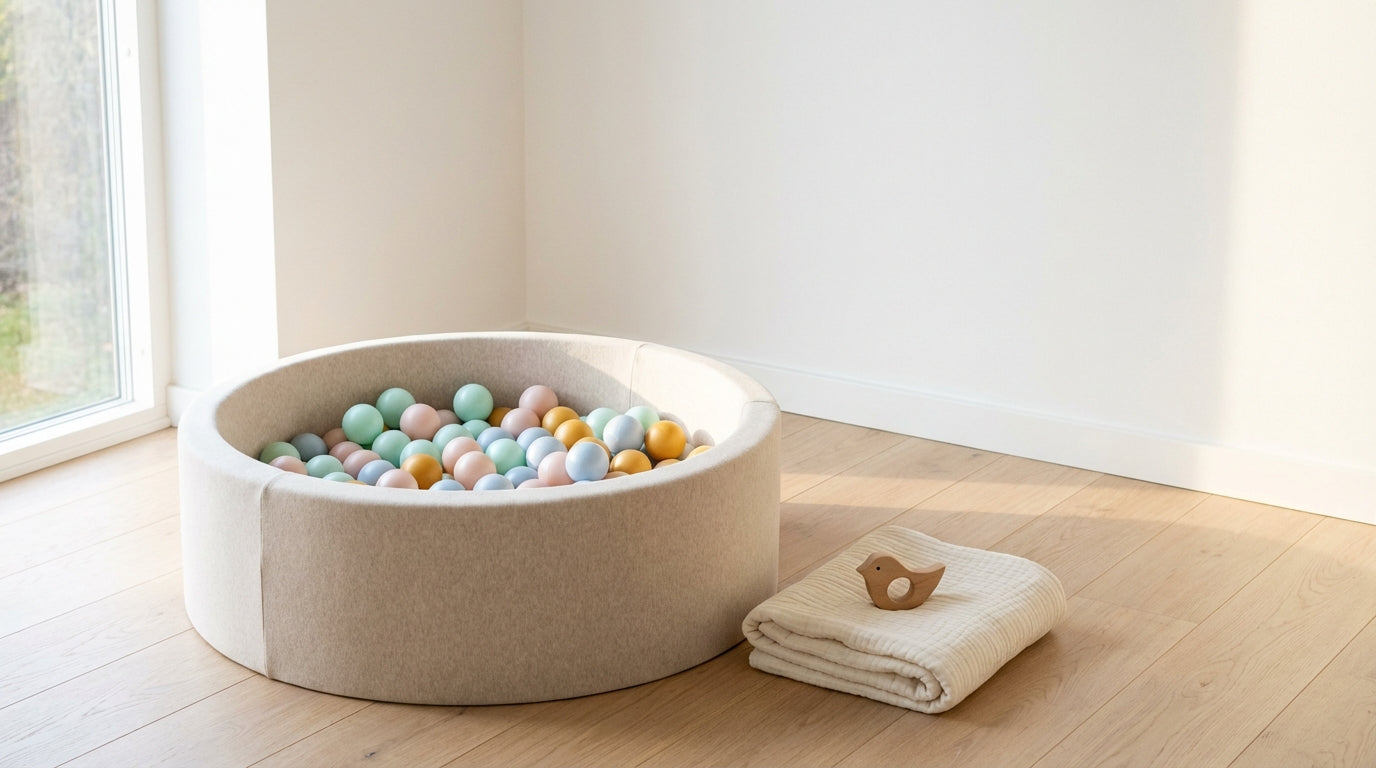
A ball pit is a play area filled with many light balls for rummaging. The benefit is simple: children grab, throw, search and move around in it with very little "setup time".
If you'd like an overview: in the ball pit collection you'll find various types, and under balls for ball pits suitable balls to add.
Ball Size & Quantity: What Works in Everyday Life?
Ball size and quantity determine whether your child can grab well and doesn't "sink in". Little ones need balls that are easy to grasp with one hand and a fill level at which they still feel stable.
- To start: Rather fewer balls, so your baby sits securely and you can quickly see how it feels.
- For more rummaging fun: Top up gradually until your child feels pleasant "resistance" when moving.
- Everyday check: If your child keeps tipping backwards or seems frustrated, "too full" is often the reason – not "not enough courage".
If you're looking for concrete guidance, a simple rule of thumb helps: cover the floor first, then increase. For exact quantities depending on pool size, a dedicated overview is most practical – you'll find it here: Balls for ball pits: Which and how many balls are ideal?.
Safety: The Important Checks Without Panic
The most important rule remains: never leave babies unsupervised in a ball pit. Not because you're "overcautious" – but because babies are fast just when you think they're slow.

- Stability: The ball pit must not slide; on smooth floors a non-slip mat helps.
- Wall height: Such that your child can't tip over it awkwardly – while you can still reach in easily.
- Ball condition: Don't use torn, sticky or badly deformed balls.
- No foreign objects: No cords, no small parts, no hard toys among the balls.
- Quick check: Run your hands once over the seams, zipper and base – done.
Safety note: A ball pit is not a place to sleep. If your baby gets tired: take them out and lay them down safely.
CE marking is part of toys in the EU, but it is not an independent test seal. This is exactly what the consumer advice center points out: CE is a manufacturer's marking, and it's also worth looking at workmanship, smell and, if applicable, independent test marks such as GS, according to the Verbraucherzentrale (Verbraucherzentrale).
Material & Harmful Substances: What You Can Go By
"Free of harmful substances" is a big phrase – more useful is: traceable information and a critical eye. Safety requirements apply to toys in the EU, including rules on chemical properties, under the EU Toy Safety Directive 2009/48/EC (EUR-Lex).
- Smell: If something smells strongly chemical or pungent, "send it back" is a perfectly legitimate decision.
- Reputable sellers: Especially online, buy from providers who give clear information and are reachable; the Verbraucherzentrale generally warns about frequent defects in some marketplace offers (Verbraucherzentrale).
- Standards as guidance: Requirements from the EN 71 series, among others, are relevant for toys; DIN explains, for example, EN 71-3 on the migration of certain elements (DIN).
A helpful reference point is the BfR, which assesses substances in toys, among other things. The German Federal Institute for Risk Assessment also works on topics such as plasticizers or PAHs and advises on the further development of requirements, according to the BfR (BfR).
We're a family business from Hamburg and have been doing this for 66 years – it makes you pleasantly level-headed. If information is missing, something smells odd or the workmanship doesn't convince you: take your gut feeling seriously, don't debate it, send it back.
Cleaning: Keeping It Hygienic Without Moving Out
The most important thing when cleaning is: clean gently and let it dry completely. That way it stays fresh, and you don't have to play "What's that smell?" after three days.
Cleaning the Pool/Tent Quickly
For the pool, shaking out/vacuuming and wiping with a damp cloth is usually enough. Here's how to do it fast:
- Balls out: Into a laundry basket, large bag or (classic) the bathtub.
- Crumbs gone: Shake out or vacuum briefly (an upholstery nozzle is worth its weight in gold).
- Wipe: Lukewarm water + mild soap, then wipe again with clear water if needed.
- Dry: Only refill once everything is truly dry.
Practical tip: Keep it small: 2 minutes of vacuuming + 2 minutes of wiping when you're doing the floor anyway. It doesn't need to be more.
Cleaning the Balls (Without Drama)
It's best to clean ball pit balls lukewarm and dry them thoroughly. Because many balls are hollow, drying is the part that makes the difference.
- Sort: Cracks, sticky spots or heavy deformation = throw out.
- Wash: Lukewarm water + mild soap, preferably in a large laundry bag or pillowcase.
- Rinse: Rinse off soap residue thoroughly, otherwise the balls get slimy.
- Dry: Spread out on towels, turn them in between; only put them back once everything is dry.
If you want to use a washing machine, only do so if the manufacturer expressly allows it. Otherwise you'll end up with "ball pancakes" rather than balls.
Play Ideas: Quickly Explained, Quiet Enough for the Afternoon
The best ball pit games are the ones you can explain in ten seconds. Here are a few ideas that work without a craft box:

- "Where is the ball?" Half-bury a ball, your child finds it – and feels like a pro.
- Pour & fill: A large bowl or bucket, balls in/out (nothing small, please).
- Gentle ball rain: Let a few balls roll over legs or back – many children love it.
- Finding colors (later): "Show me the yellow one" – without pressure, more as a silly game.
If you use a tent, a few extra ideas will help you with "romping around indoors without rearranging everything". Take a look here: Ball pit tent: Creative play ideas and benefits for children.
FAQ
From what age is a ball pit suitable for a baby?
A ball pit makes the most sense once your baby can sit securely. This is individual and not just a number of months. Start with few balls so your child doesn't sink in, and always stay nearby. If your baby can't sit yet, play with individual balls on the blanket first.
How many balls do I need for a baby ball pit?
Start with enough balls to cover the floor, then top up. The exact number depends heavily on the size of the pool. A practical approach: first test whether your child sits steadily and enjoys it, then add more balls step by step. You'll find guidance on quantities in the comparison article.
Which ball size makes sense for babies?
For babies, balls that are easy to grasp with one hand make sense. What matters is that your child can hold and release them securely without them constantly "slipping away". If you notice that grasping is difficult or your baby gets frustrated, try a different size or start with fewer balls.
How often should you clean a ball pit?
A quick check and wipe at regular intervals is usually enough in everyday life. At the latest when there are crumbs inside, something is sticky or it smells musty, it's time. You don't have to wash the balls daily, but clean them occasionally and above all dry them well. And broken balls go straight out.
How can I tell whether balls and pool are "okay"?
Look at workmanship, smell and traceable information – not just at one marking. CE is mandatory but not an independent test seal; that's how the Verbraucherzentrale classifies it. If something smells strongly chemical, information is missing or seams/material look cheap, sending it back is often the most relaxed solution.
Finally, in true northern German style: a ball pit doesn't have to be perfect, just safe and practical for everyday life. If you'd like to browse, you'll find suitable types in the ball pit collection – and under balls for ball pits you can easily add more when needed.