Soft Activity Cubes: What Age Are They Suitable For?
At a glance
- A soft activity cube is a good fit when the age rating and warnings match your child.
- For babies, look for: soft, easy to grip, firmly stitched, no small parts.
- Once your child sits and crawls, crinkle panels, flaps and little “hiding spots” get really exciting.
- “Not suitable for children under 36 months” is a clear no – even for fabric toys.
- With a checklist, care tips and play ideas, you can quickly find the right everyday use for your family.

A soft activity cube is suitable for the right age when it matches the age labelling and your child can safely grip it, explore it and put it in their mouth. Sounds simple – and at its core, it is. But in real life you stumble over three things: warning labels, workmanship (will it all hold up?) and your child’s stage of development (can they already grasp, turn, sit?). Here you’ll find clear guidance by phase, a buying checklist by age, care tips and little play ideas that work even when the pasta water is boiling over in the background.

Ulli & Flo
Owners of bieco · Hamburg · parents themselves
We’ve learned that with fabric toys, looks rarely decide anything – the labelling and whether everything is truly firmly stitched do. With the checklist here, you’ll be on the safe side in no time. Feel free to browse our collection of motor skills cubes.
What age is the soft activity cube suitable for?
The age rating and warning labels are your first and most important guide. In the EU, toys must carry warnings depending on the risk – for example “Warning: Not suitable for children under 36 months” when swallowable small parts pose a risk. According to the German Federal Office of Consumer Protection and Food Safety (BVL), the CE marking and any required warnings are part of the mandatory labelling of toys. BVL: Labelling elements on toys
If it says “Not suitable for children under 36 months”, the cube is off limits for babies and toddlers. This isn’t a case of “but mine is very advanced” – it’s a safety label. And yes: even with soft fabric, a single detail (a small part, a ribbon, an attachment) can make all the difference.
If there’s no under-3 warning, you should still take a moment to think and touch. The CE mark shows that the manufacturer declares conformity with the applicable requirements – but your everyday check remains worth its weight in gold: seams, loops, smell, washability and whether the cube realistically stays “baby-proof” in your home (keyword: older siblings and small parts lying around).
What is a soft activity cube (and what isn’t it)?
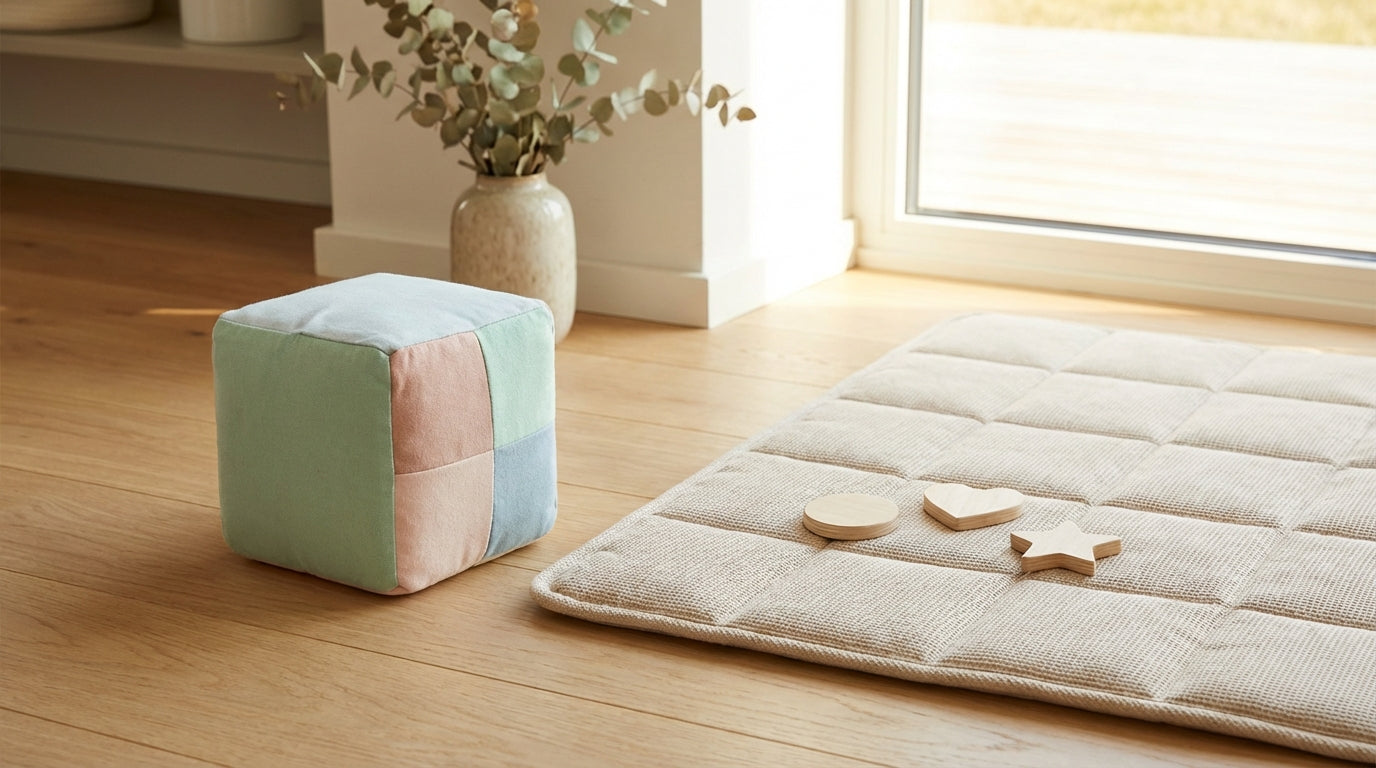
A soft activity cube is a soft fabric cube with grasping and sensory elements. In practice, that means different fabrics, crinkle panels, small tabs, sometimes rattle or squeaker elements – all designed so babies can discover things with their hands and mouths.

A soft activity cube is not a classic wooden motor skills cube. Wooden motor skills cubes are often “play stations” with fixed elements (lacing, gears, shape inserts) and often become interesting later. If you’d like to browse: Motor skills cubes
A term worth remembering: age labelling on toys is a guide to safety and use. It combines developmental ability (what children can typically do) with safety requirements and warnings when risks exist for certain age groups.
Age guidance by developmental phase (without calendar pressure)
The best age question is: What can my child do right now – grasp, turn, sit, crawl? Children don’t develop in lockstep. That’s why guidance based on abilities is often more helpful than a rigid number of months.

Phase 1: Grasping & holding on (early babyhood)
In this phase, what counts is: light, soft, easy to grip, and everything holds rock-solid. Many babies grasp purposefully, squeeze, pull – and the toy reliably ends up in their mouth. That’s exactly why firm seams and non-detachable elements are so important.
Safety note: Before every play session, quickly check seams, loops and sewn-on elements. If something is loose or fraying: take a break, repair it or sort it out.
How to recognize a suitable cube:
- No swallowable small parts or detachable decorative elements. According to LAVES, “swallowability” is assessed, among other things, with a test cylinder to identify risky small parts. LAVES: Swallowability explained
- Short, sturdy loops instead of long ribbons. Short isn’t unromantic, short is practical.
- Soft, without hard edges or parts that “snap back”. Babies like to hit themselves in the face while playing.
- Care is manageable: washable or easy to wipe clean. Drool happens. Always.
Phase 2: Turning, feeling, cause and effect (when “crinkle!” is the highlight)
Now different surfaces and sounds get really exciting. Crinkle foil, rattles, squeakers, little flaps – this is often the phase when a soft activity cube becomes a favorite, because “I do something – and something happens.”
Practical tip: Rest the cube half on a small cushion so it rolls away easily. This makes “reaching after it” exciting without causing frustration.
Good cube elements for this phase:
- Crinkle panels (instant feedback)
- Mirror foil (short, securely attached)
- Grip tabs (sturdy and not too long)
- “Hiding spot” details like small pockets or flaps
Phase 3: Sitting, throwing, crawling after it (the cube flies – by accident…)
When your child sits or becomes mobile, the cube becomes an object in the room. It gets turned, pushed, crawled after – and at some point thrown, too. The upside: it’s soft. The downside: poor seams now show themselves reliably.
What you should look out for:
- Sturdily stitched edges and corners. Corners are the “chew zone” for many children.
- No detachable decorative parts. Anything cute still has to hold.
- Care instructions are clear and realistic. If something gets hard or comes loose after washing, that’s a warning sign.
How to read the age rating correctly (and why it matters)
The age rating is a guide to safety and development, not a marketing gimmick. If a toy can be dangerous for children under 36 months, it must be labelled accordingly – typically with “Not suitable for children under 36 months” plus a reason, e.g. because of swallowable small parts. The BVL describes it the same way. BVL: Warnings & mandatory labelling
“3+” often means: too risky for younger children – not “too demanding”. A cube can be completely simple and still not be meant for the youngest because of a single detail.
DIN EN 71 is the series of standards for toy safety in Europe. It describes requirements and tests, for example on mechanical risks (such as small parts) – and also contains special requirements for toys for children under 36 months. For background, DIN explains the relationship between the Toy Safety Directive and the standards. DIN: Background on toy safety (EN 71)
Buying checklist by age: What should the cube be able to do?
The younger the child, the less “fuss” and the more clean workmanship. Here is an everyday-friendly guide you can quickly run through when gifting or buying.

| Phase | What to look for | Better to avoid |
|---|---|---|
| Grasping & holding on | Soft, light, large surfaces, firm seams, short tabs | Long ribbons, hard parts, detachable decorations |
| Turning & cause and effect | Crinkle, different fabrics, flaps, small “hiding spots” | Too many tiny details that could come loose |
| Sitting & becoming mobile | Robust edges, washable, withstands pulling and throwing | Delicate appliqués, loose rings, “just pretty” |
If you’re unsure, take the cube in both hands and “tease” it for a moment. Pull a little, twist, squish – just as a child would. If you already think “hmm” while doing it, it won’t get better in everyday life.
Care & cleaning: How to keep the cube ready for everyday use
Care isn’t a luxury but part of safety: clean, dry, intact. Especially with fabric toys, “it’ll be fine” is rarely the best strategy – but you don’t need to open a lab, either.
- Read the care label and take it seriously. Temperature, wash cycle, drying – this isn’t decoration.
- Check briefly before washing. If a seam already looks tired, washing can be the last straw.
- After washing: feel, pull, look. If something gets hard, comes loose or warps badly, that’s a stop signal.
- Let it dry thoroughly. Fabric toys should be completely dry before they go back into little hands.
Practical tip: If it’s washable, put the cube in a laundry bag. This protects seams and small elements – and you’ll find it again in the drum chaos.
Common mistakes (so you don’t have to make them)
Most mishaps don’t happen when buying, but in everyday life afterwards. Here are the classics – collected kindly, because we’ve all seen them.
- Confusing “looks soft” with “is safe”. Even fabric can have small parts, ribbons or unfavorable attachments.
- Giving a cube “for later” right now. If the labelling rules out younger children, it stays in the cupboard. Period.
- Too many toys at once. One cube, one blanket, one quiet moment – that’s often all you need.
- Not checking after washing. That’s exactly when a quick check of seams and elements is worthwhile.
Play ideas per phase: Mini exercises without the circus act
A soft activity cube is best when it’s simply “there” and allowed to be discovered. You don’t have to “train” anything – but you can offer small prompts that feel like part of everyday life.
- Grasping & holding on: Place the cube beside your baby’s hand so they can “find” it. Wait a moment. Don’t help before it’s necessary.
- Turning & cause and effect: Let one side crinkle, then be quiet. Babies love pauses – that’s where the thinking happens.
- Sitting & becoming mobile: Let the cube roll a short distance away. Close enough that success comes quickly. Nobody needs frustration.
- On the go: A soft cube on the blanket instead of hard plastic – less noise, fewer tears, more peace.
And how does this fit with BIECO? (Short, honest, Hanseatic)
We’re a family business from Hamburg – and we think about toys from the perspective of real family life. Ulli & Flo write as parents for parents, and we know: the most beautiful toy is useless if it doesn’t last or can’t be cleaned.

For 66 years, we have looked closely at toys: materials, workmanship, clear information. For us, safety transparency means: we’d rather explain clearly what a toy can do (and what it can’t) than sugarcoat anything.
If you’re thinking more about wood than fabric, our overview will help. From what age do motor skills cubes make sense? Montessori & development and Motor skills cubes: manufacturers, safety & dimensions at a glance
FAQ
What age is the soft activity cube suitable for?
It is suitable when the age labelling fits and there is no under-3 warning. For babies, soft, easy-to-grip cubes without detachable parts make sense. Firm seams, short loops and clear warnings are what matter – that’s more important than a “gut feeling” about age level.
How can I tell whether a soft activity cube is safe for babies?
It is safe when nothing is detachable and the warnings don’t rule out babies. Look for firm seams, short tabs and make sure there are no small parts. According to the BVL, required warnings must appear on the toy – that’s your first, quick check in the store. BVL
Why do some cubes say “Not suitable for children under 3 years”?
Because a specific danger can exist for children under 36 months, often due to small parts. In that case, the toy is not suitable for babies and toddlers – even if it feels soft. The warning is a safety label, not an assessment of how “advanced” your child is.
Is a soft activity cube better than a wooden motor skills cube for babies?
For many babies, fabric is more practical because it’s soft, light and portable. A wooden motor skills cube is often a fixed play station and frequently becomes exciting later. What always matters are the age approval, the workmanship and what your child can currently do motor-wise.
How often should I check or wash a soft activity cube?
Check it briefly before playtime and wash as needed according to the care label. Look at seams, loops and sewn-on elements. After washing, touch it and give it a tug: if something gets hard, comes loose or frays, that’s a clear stop signal.
What should I give as a gift if I’m unsure about the age?
Go by the labelling and choose “simple and robust” over “super fancy”. A soft, easy-to-grip cube without detachable details often works better than a model with lots of tiny elements. And: a gift with a clear age rating instantly takes the stress off parents’ minds.
If you’re now curious about the next developmental stage, you’ll find suitable ideas in the overview. Motor skills cubes