Motor Skills Cube for Babies: When Does It Make Sense? Age, Features & Safety
At a glance
- A motor skills cube for babies often suits children from 10–12 months, once sitting is steady.
- Motor skills cube: from what age? Look for signals: going over on their own, grasping, repeating.
- One simple side (slider/turning) is often better than “everything at once”.
- For a wooden motor skills cube for babies: stable, smooth, firmly attached, no small parts.
- Mini cheat sheet: 10–12M turning/sliding, 12–18M shape sorting, 18–24M more complex.

A motor skills cube usually makes sense for babies from around 10–12 months, because many children can sit steadily by then, grasp more purposefully and stay with one thing for longer. Before that, it's often more of a “look at this” item that moves the adults more than the child. And honestly: we already have enough of that in everyday life.

Ulli & Flo
Owners of bieco · Hamburg · parents themselves
We've learned that a motor skills cube is worth its weight in gold when it “calls” the child on its own, not us adults. And if it doesn't fit today, it may fit next week. Feel free to browse our motor skills cube collection.
Here you'll find a calm age guide, plus a Montessori perspective, a table of features and a safety checklist to tick off. We're a family business from Hamburg, we've been doing this for 66 years, and Ulli & Flo write here as parents for parents: practical, no drama, with both feet on the rug.
Motor skills cube: from what age? A practical age guide
Most motor skills cubes suit children best between about 10 and 24 months, depending on size, weight, features and your child's temperament. The age recommendation on the packaging isn't just decoration: it's often linked to testing requirements, complexity and small-part risks.

- 0–6 months: Usually too heavy and too “far away”. Soft activity toys, teethers or rattles are often more relaxed choices.
- 6–9 months: If sitting already works well, individual elements are exciting, but often only briefly. Many babies first test: “Can I knock this over?”
- 10–12 months: Often the sweet spot: sitting is steadier, hands get more precise, and cause and effect is really fun.
- 12–18 months: Shape sorting and sorting games often only “click” now, as patience and hand-eye coordination grow.
- 18–24+ months: Many children keep using the cube, but if it's too “babyish”, it gets boring. Then the tasks can get trickier.
Definition: A motor skills cube is an activity toy with several play sides that combines grasping, turning, sliding and shape sorting in one compact cube.
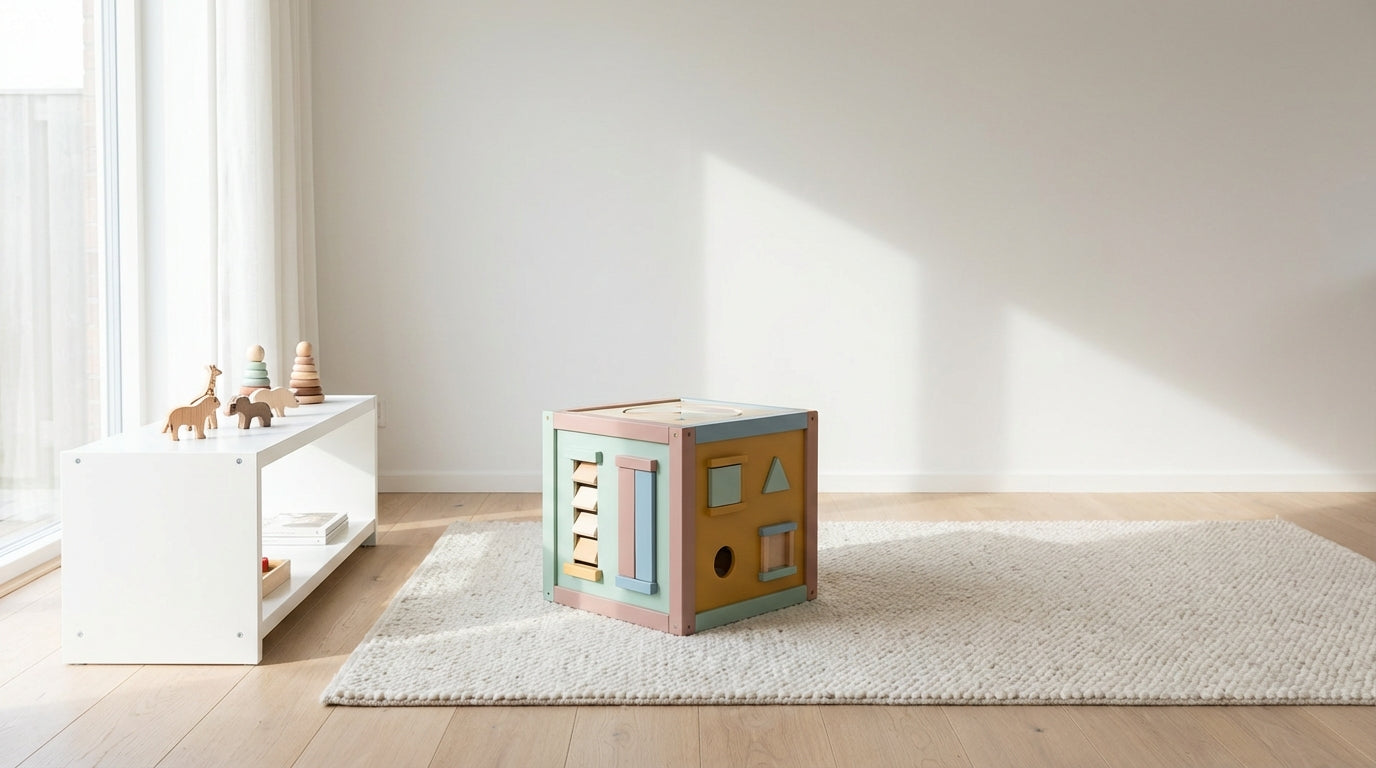
Practical tip: Place the cube in a quiet corner (e.g. against the wall next to the rug). Less commotion = more concentration.
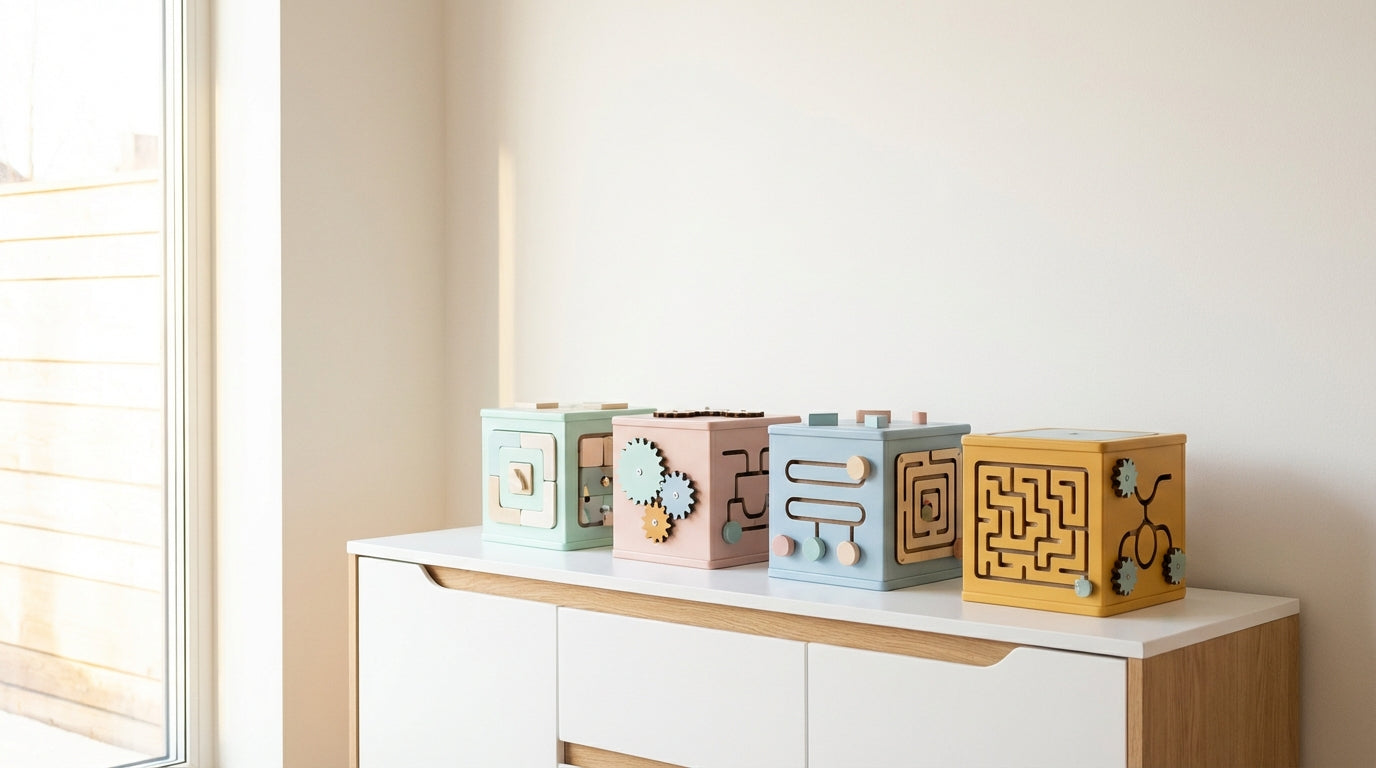
If you simply want to compare which sizes and play sides are out there, our motor skills cube overview shows several variants, without you having to dig through 30 tabs.
Which features from which age? A table for quick comparison
The younger the child, the simpler the play ideas should be, so that moments of success don't come down to luck. The table is deliberately rough: children don't read tables, they do their own thing.

| Age (approx.) | What often works well | How you can tell |
|---|---|---|
| 10–12 months | Turning and sliding elements, flaps, large beads/sliders | Child sits steadily, grasps purposefully, likes to repeat |
| 12–18 months | Shape sorting, simple “doors”, gears (smooth-running) | More patience, tries out “fits/doesn't fit” |
| 18–24 months | Multi-step mechanisms, more complex shape sorters, small “tasks” | Child seeks challenges, stays with it longer |
If you're looking for an activity cube for 12 months and up, sliders/turning plus a simple shape-sorting game is often the most relaxed combination: not too easy, not too frustrating.
How can you tell if the motor skills cube suits your baby right now?
A motor skills cube is a good fit when your child goes over and tries it out on their own, without you constantly having to “show” them. That's the best indicator, and it saves your nerves along the way, which is nice for a change.

- Sitting steadily: Hands are free, and the upper body doesn't keep tipping over.
- Joy in repetition: Turn, slide, flip, and again. And again.
- The “I'll put this in there” phase: Spoon in the drawer, cup in cup … you know the drill.
- Short islands of concentration: Staying with it for a few minutes is already a good sign.
If your baby gets frustrated quickly or only throws things, that doesn't mean “they can't”. It often simply means “not right now”. Then it's better to wait or offer something softer or simpler first. Our article Soft activity cubes: What age are they suitable for? fits well here.
Is a motor skills cube worthwhile, and what does it really “support” in everyday life?
A motor skills cube is worthwhile if it allows free practice instead of overwhelming your child with stimuli. In real life that often means: hands become more skillful, concentration grows, and your child realizes: “Aha. I can do this myself.”
- Fine motor skills: Grasping, turning, purposeful inserting, moving the wrist.
- Hand-eye coordination: Moving things to where they're meant to go (and not just anywhere).
- Cause and effect: “When I do this, that happens.” Little science, big eyes.
- Perseverance: Repeating, varying, trying again.
Definition: Fine motor skills are small, precise hand and finger movements that children later need for eating, getting dressed and drawing.
And no: a motor skills cube is not a turbo button for development, but rather a good place to practice. It works best when it's age-appropriate and doesn't try to do too much at once.
Motor skills cubes & Montessori: do they go together?
A motor skills cube can be close to Montessori, but doesn't have to be, because “Montessori” isn't a fixed product category but an attitude: clear, usable independently, not overloaded.
At its core, Montessori-oriented means: the child acts independently, gets clear feedback (fits/doesn't fit) and can repeat in peace. If the principle interests you: according to the Association Montessori Internationale (AMI), the Montessori approach centers on independent learning with suitable materials. Association Montessori Internationale (AMI)
- Less is more: a few clear play ideas instead of 20 mini-features.
- Self-explanatory: The child can try things out without constant help.
- Self-correction: The material gives feedback (the shape fits or it doesn't).
- Real materials: Wood/metal/fabric feel “real” and can take a lot.
Practical tip: For more calm: turn the cube so that only 1–2 sides are “open”. Fewer choices often work wonders.
If you want to dive deeper into dimensions, construction types and testing topics, our overview Motor skills cubes: Manufacturers, safety & dimensions at a glance will help.
Safety with (wooden) motor skills cubes: what parents should really look for
Safety starts with workmanship, stability and appropriate age recommendations, not with pretty colors. A wooden motor skills cube for babies should be smooth, have no sharp edges and not end up “in pieces” when it tips over.
Safety note: For children under 3 years, swallowable small parts are a key risk. Check regularly whether any parts are coming loose or screws are loosening.
Here is a short safety checklist to run through before the cube moves into the nursery:
Practical tip: Do the “pull test”: pull firmly (with normal hand strength) on beads, sliders and flaps. If you can almost get them off, a toddler will manage it eventually.
- Stability: Does the cube wobble when your child leans on it or works on the loop at the top?
- Surface: Feel all the way around: smooth, no splinters, no rough spots.
- Firm parts: Nothing should wobble, rattle or turn suspiciously where it shouldn't.
- Size of parts: No detachable mini parts that could disappear into a mouth.
- Clear labeling: Age recommendation, warnings and manufacturer details easy to read.
To put the rules in Europe into context: According to EUR-Lex, the EU Toy Safety Directive 2009/48/EC sets out essential safety requirements, including on mechanical/physical risks and choking hazards. EUR-Lex: Directive 2009/48/EC
The standards behind it matter too: According to DIN Media, DIN EN 71-1 describes requirements and test methods for the mechanical and physical properties of toys, including specific requirements for children under 36 months. DIN Media: DIN EN 71-1
If you're wondering how to spot a “trustworthy” product: We look for (and would advise you to look for) clean workmanship, clear warnings and transparent material information. We've been doing this for 66 years, and smokescreens are something you can do without. Parents already have enough on their plate.
Decision checklist: Does this motor skills cube fit your everyday life?
The best motor skills cube is the one that gets used, without stress in the living room. This mini checklist helps you sort out a gut feeling in 30 seconds.

- Age & ability: Does your child sit steadily and use both hands freely?
- Complexity: Are there 2–4 clear play ideas instead of “a fairground on six sides”?
- Stability: Does the cube stay steady, even when playing on top?
- Space: Do you have a fixed spot (rug/corner) so it doesn't keep wandering around?
- Everyday life: Can your child start on their own, or do they always need you as the “start button”?
If you're thinking about size (more stability, more play sides, but also more space), feel free to read on here: Large motor skills cube & XXL activity center: When is the size worth it?.
FAQ
At what age does a motor skills cube make sense for babies?
Usually from around 10–12 months, once sitting is steady, because your baby can then grasp, turn and slide more purposefully. Before that, soft activity cubes or simple grasping toys are often more suitable. What matters less is the age in months than this question: does your child go over and try it on their own?
Motor skills cube from 1 year: What should it be able to do?
From 12 months, sliders/turning plus a simple shape-sorting game are often ideal, because your child can then cope better with “fits/doesn't fit” and tries repeatedly. Look for smooth-running elements and clear play ideas. Too many features at once make a child restless rather than clever.
Activity cube from 12 months: Is wood okay?
Wood is okay if the workmanship and stability are right, because the cube has to withstand a lot. What matters are smooth edges, firmly attached parts and no detachable small parts. The EU Toy Safety Directive 2009/48/EC (EUR-Lex) and test requirements such as EN 71-1 (DIN Media) provide guidance.
Are motor skills cubes worthwhile or rather “too much”?
Motor skills cubes are worthwhile if they allow free, independent practice without overstimulating. Clear play ideas that can be practiced repeatedly are good. It becomes “too much” when effects compete for attention everywhere and your child hardly knows where to start.
Is a motor skills cube Montessori?
Not automatically. It becomes close to Montessori through simplicity and independence, not through a label. Make sure the child can start without constant help and the toy gives clear feedback (fits/doesn't fit). A few meaningful elements are often closer to the idea than “everything at once”.
What if my child only knocks the motor skills cube over?
That's often a sign: still a bit too difficult for now, or “too much cube”, and not easy to play with. Place it against a wall, offer just one side and stay nearby for a moment without explaining much. If it doesn't get better after a few days: take a break. That's not a step backward.
To finish, nice and relaxed: If you now feel like having a look around, our motor skills cube overview offers various sizes and play ideas, so you can calmly compare what suits your family.