Activity Cube Comparison: Best Models, Size & Safety
At a glance
- A good activity cube suits your child's age, your space and your child's play style.
- Check stability, smooth edges and firmly attached parts before the first play session.
- XXL is worth it if you often play on the floor and have enough room for it.
- Wood is practical for everyday life if it can be wiped down with a damp cloth and dries well.
- CE marking, an age recommendation and warnings should always be included.

The best activity cube is the one that is safe, stands firmly and actually gets played with regularly at your home. In this guide you'll get relaxed but thorough orientation: which sizes suit which home, how to recognize good craftsmanship, how to define a “test winner” in everyday family life – and which standards and labels can help you feel more secure. Ulli & Flo write here as parents (and Bieco is a family business from Hamburg that has been part of the toy world for 66 years) – so with real living rooms, real piles of laundry and real “Where did it go this time…?” moments in mind.

Ulli & Flo
Owners of bieco · Hamburg · parents themselves
We've learned that an activity cube doesn't have to be perfect – but it does have to stand firmly and be easy to keep clean in everyday life. Then it's far more likely to be loved than just “put away somewhere”. Feel free to browse our collection Activity Cubes.
Table of contents
- Short answer: Which activity cube is the best?
- Criteria that really matter in everyday life
- Big or small? How to find the right size
- Materials guide: wood vs. other materials
- What does it support – and what can you expect?
- Safety & standards: CE, EN 71, warnings
- Home test: Will this be your test winner?
- Care & durability
- FAQ
Which activity cube is the best? (Short answer for those in a hurry)
The best activity cube is age-appropriate, tip-proof and free of loose small parts. In practical terms, that means: a clear age recommendation, solid craftsmanship, rounded edges, easy-to-grasp elements and a surface you can clean with a damp cloth. For large models, there's more to consider: enough space and a stand that doesn't slide across the living room with every burst of enthusiasm.
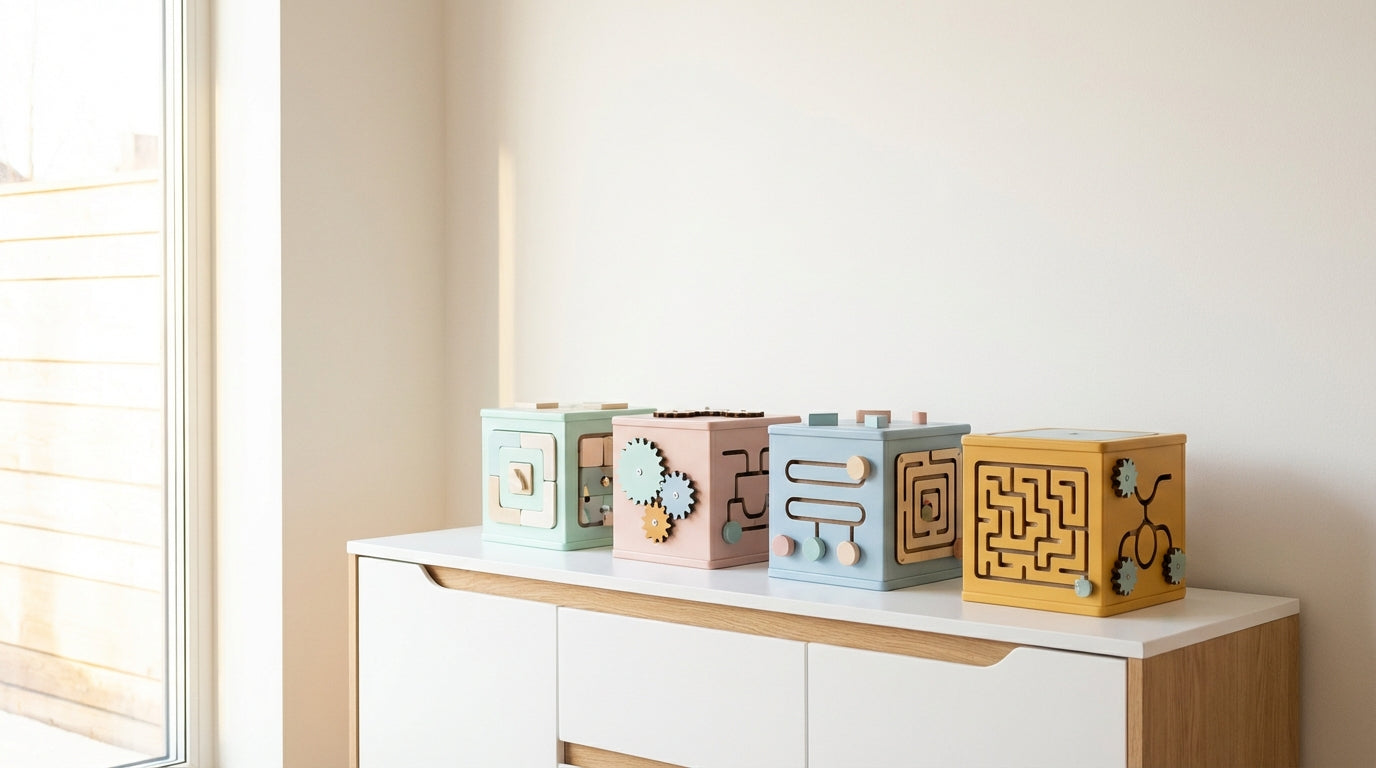
An activity cube is a multi-sided activity toy with a variety of play tasks. Typical features include a bead maze (motor skills loop), a shape sorter or posting game, sliding elements, gears or flaps – in other words, things little hands love to repeat until they get it right.
A “test winner” in everyday family life is a toy that can be used safely and is often chosen voluntarily. The winner isn't the one with the loudest promises, but the one that doesn't end up “accidentally” living behind the sofa after two weeks.
How we compared: criteria that really matter in everyday life
If you only check three things: age recommendation, craftsmanship, stability. The rest is a bonus – nice, but not essential.
- Age & developmental stage: The manufacturer's recommendation is a good starting point, but it doesn't replace your own look at your child (some are already “doers” at 12 months, others are more “observers”).
- Stability: Does the cube wobble when pressed, pulled or turned? Then things get frustrating quickly – for your child and your back.
- Craftsmanship: Smooth surfaces, no sharp edges, no splintery spots, no wobbly wire loops.
- Play value: Better 4–6 good activities than 12 mini gimmicks that get annoying or lost after two days.
- Cleaning: Surfaces should be wipeable with a damp cloth; with wood, thorough drying afterwards is important.
- Space & noise: XXL is great – but not if you end up squeezing past it in the hallway like a moving box.
Practical tip: Picture the cube in its spot and quickly measure it. “It'll fit” is usually a lie in a nursery.
Big or small? How to find the right size
Size often matters more than the brand – because it shapes your everyday life. A compact cube is more likely to be used “just for a moment”, while an XXL model invites longer floor-play sessions.
Compact: great for small spaces & quick play moments
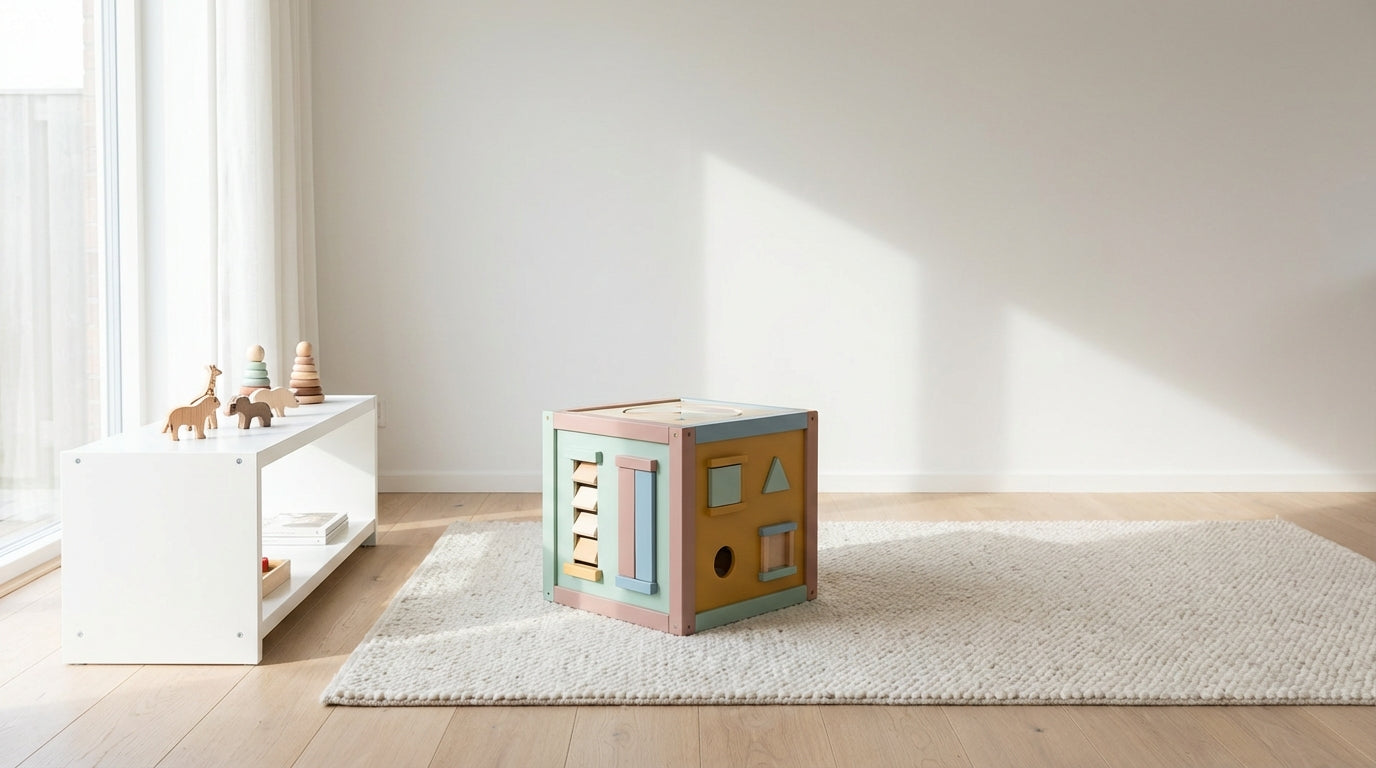
Compact activity cubes are ideal if you have little floor space. One example is the Bieco Activity Cube “Scandi Chic” (dimensions and age as stated on the product page). View the “Scandi Chic” activity cube
- A good fit if: you have short play sessions (drinking a warm coffee is a hobby too, after all).
- Pay special attention to: a non-slip surface or rug, so nothing wanders off.
XXL: great for floor play, siblings & “we'll stay at it longer”
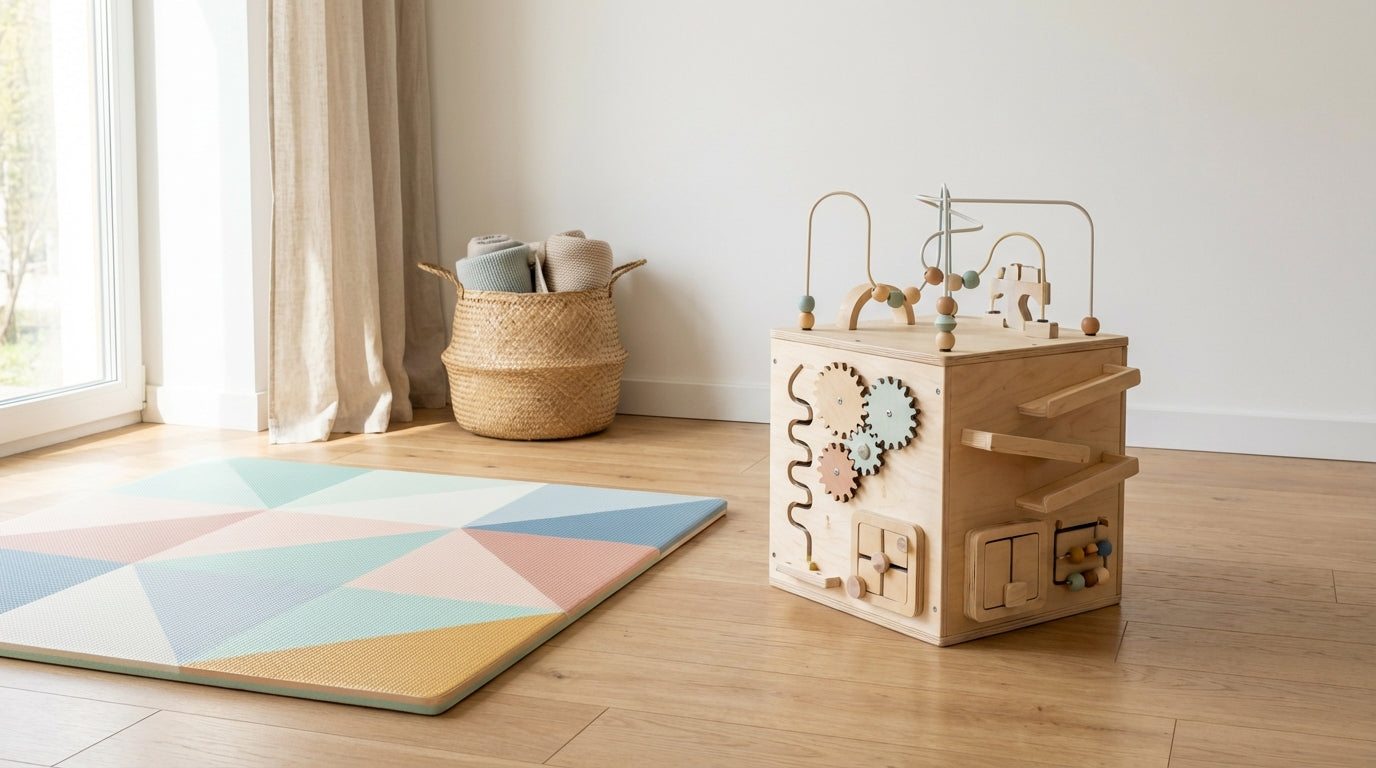
An XXL activity cube is worth it if you regularly play together on the floor. One example is the Bieco XXL Activity Cube “Woodland Animals” (dimensions/age/material as stated on the product page). Bieco XXL Activity Cube Woodland Animals
- A good fit if: siblings join in or visiting children are around.
- Pay special attention to: enough room to move around it, so nobody “accidentally” falls against it.
Comparison table: compact vs. XXL (decide quickly)
If you're unsure: decide on the size first, then the details. Examples and details are each as stated on the product pages:
| Type | Example | Dimensions | Age | Good for |
|---|---|---|---|---|
| Compact | Bieco “Scandi Chic” | as stated on product page | as stated on product page | small rooms, short play sessions |
| XXL | Bieco “Woodland Animals XXL” | as stated on product page | as stated on product page | floor play, more exploring, siblings |
Materials guide: wood vs. other materials (without the culture war)
Wood is often sturdy and feels pleasant in the hand, but it needs a little care. Many families like wood because it feels solid, looks calmer and doesn't scream “broken” at the first little scratch.
- Wood: feels warm and is usually stable; what matters are smooth edges, clean paint or glaze and a surface that can be wiped with a damp cloth.
- Metal/wire elements (e.g. bead maze): should be firmly anchored and have no sharp transitions.
- Plastic elements: can be quieter or lighter; the same applies here: nothing should wobble or have sharp edges.
FSC is a certification system for wood from responsibly managed forests. If a product is labeled FSC, it means the wood comes from supply chains controlled according to FSC standards (details depend on the specific FSC label).
An example of “calm & solid”: For the Bieco Activity Cube “Deer Ella XXL”, the product page mentions FSC wood as well as testing information, among other things. Activity Cube Deer Ella XXL
What does it support – and what can you expect?
An activity cube mainly supports practice, repetition and hand-eye coordination. That sounds less glamorous than “early childhood genius”, but it's exactly what counts in everyday life: small moments of success that your child controls themselves.
- Fine motor skills: turning, sliding, posting, grasping – all small hand movements with great practice value.
- Hand-eye coordination: “I see the hole – I hit the hole” (and yes, sometimes that takes a while).
- Problem solving: trying things out, turning them around, trying again. That's basically mini training for patience.
- Language moments: you can name things in passing (“wheel”, “door open/closed”, “in/out”) – no extra program needed.
Practical tip: Comment sparingly. A “Oh, you're turning the wheel” is enough – when children are tinkering, they often need less commentary and more time.
What to look for in terms of safety & standards (no panic, please)
A reputable activity cube has CE marking, age recommendations and clear warnings. In the EU, the Toy Safety Directive 2009/48/EC sets out essential safety requirements; among other things, it covers requirements for warnings and age-related suitability (according to the EU legal text). Source: EUR-Lex (2009/48/EC)
EN 71 is a series of standards describing test methods and requirements for toy safety. According to the DIN/ANSI Webstore, DIN EN 71-1 covers mechanical and physical properties (standard description). Source: DIN/ANSI Webstore
CE means: the manufacturer declares compliance with EU requirements. CE is not an independent “seal of approval”, but a marking with which the manufacturer declares conformity with the applicable EU regulations (details are set out in the relevant EU regulation).
Safety note: Check the activity cube regularly: is everything firmly attached, with no cracks and no loose parts – especially on flaps, sliders and wire loops.
Mini checklist: what to look at before the first play session
With five quick checks, you can spot 90% of typical problems right away.
- Stability: Place the cube on the floor and press firmly on one side – does it wobble a lot?
- Edges: Run your hand over the corners and edges – is anything sharp?
- Parts: Give the moving elements a shake – is everything firmly attached?
- Warnings: Read the age recommendation and notices (yes, I know… but once is enough).
- Surface: Does the cube slide? Then use a rug or anti-slip mat.
Transparency helps more than glossy copy. As a Hamburg family business that has worked with baby and toy products for 66 years, we see again and again: parents sleep better when materials and testing information are clearly stated.
You can find more official information directly from the EU. The European Commission explains CE marking and its purpose in an overview (according to the EU info page). Source: European Commission – CE marking
How to test at home whether an activity cube will be “your test winner”
The best comparison is: 10 minutes of observing instead of 2 hours of brooding. Once the cube is at home, make it easy on yourself:
- Start simple: offer just one side at first (e.g. the sliding elements), not “everything at once”.
- Watch body language: does your child reach for it repeatedly – or are they done after 30 seconds?
- Frustration check: if something is too hard, help briefly – but don't take over. Otherwise it becomes your activity cube.
- Rotation: after 2–3 minutes, turn the cube to the next side – it often feels like a “new toy”.
- Make it a ritual: 5 minutes every day after breakfast – and the routine is done.
Care & durability: so it doesn't look like it's been through a winter
An activity cube lasts longer if you clean it gently and store it dry. For many wooden models, wiping with a damp cloth and then letting it dry thoroughly is enough; if the manufacturer provides care instructions, follow them.
- Cleaning: damp cloth, mild soap if needed; then wipe dry.
- No full baths: please don't soak wood – it likes that about as much as parents like Lego bricks at night.
- Screws/connections: check them briefly now and then, especially if the toy does a lot of “work” (pulling, pressing, turning).
- Storage: dry, and not right next to the radiator – extreme heat can strain materials.
Further reading: more depth on age, size and safety
If you want to compare even more closely, these deep dives will help. Just in case you're in “I really want to know now” mode.
- Activity cube overview (compact to XXL)
- Large activity cube & XXL activity center: when is the size worth it?
- From what age do activity cubes make sense? Montessori & development
- Activity cubes: manufacturers, safety & dimensions at a glance
FAQ
Which activity cube is the best?
The best activity cube is the one that is safe and actually gets used. Look for a suitable age recommendation, smooth edges, firmly attached parts and a stable stand. In everyday life, the winner is usually a model that doesn't overwhelm but offers a few clear play ideas your child enjoys repeating.
Which is the best activity cube for 1-year-olds?
For many children, an activity cube from 12 months works well if it stands firmly and is easy to grasp. What matters are large, simple elements (sliding, turning, posting) and a clear age recommendation from the manufacturer. If your child gets frustrated quickly, fewer functions are often better than “everything included”.
Activity cube big or small – which is better?
Big suits floor play and longer sessions, small suits limited space. An XXL cube offers more surface and invites siblings or visitors to join in, but it needs a permanent spot. A compact cube is quicker to put away and gets used spontaneously more often.
How can I tell if an activity cube is safe?
A safe activity cube has CE marking, warnings and looks solidly made. Under the EU Toy Safety Directive 2009/48/EC, warnings and age-related suitability are regulated, among other things. A hands-on check at home helps too: does anything wobble, are there sharp edges, do parts come loose when shaken?
How do I clean a wooden activity cube properly?
Usually, wiping with a damp cloth and then letting it dry thoroughly is enough. Use a damp cloth and mild soap if needed, but please don't soak it. If the manufacturer gives specific care instructions, follow them – that protects the surface and the wood and saves you trouble later.
Is an activity cube a good gift for a 1st birthday?
Yes, as long as the age recommendation fits and the toy isn't overloaded. Models with easy-to-grasp elements and a calm play concept that isn't “played out” after two days are practical. And for gift-givers: check the size beforehand – otherwise the gift ends up at Grandma's.
If you want to make a quick choice now: start with the right size, then check craftsmanship, care and warnings. In the activity cube overview you can easily view models side by side. And if you're torn between “wow” and “practical for everyday life”: go for practical – it'll get played with for longer.