Large Activity Cube: Is an XXL Activity Center Really Worth It?
At a glance
- A large activity cube is worth it if it gets a permanent spot in your home.
- XXL is often a good fit from 12 months, when children love to play standing up.
- Plan for floor space plus a little “maneuvering zone” so every side is within reach.
- Look for clear material and care information as well as tested toy safety.
- As a gift, XXL works best if you quickly ask about space beforehand.

A large activity cube is worth it if it can truly stay put in your home. Then it becomes a daily playmate instead of a “we’ll put it away later” project. In this guide you’ll find a clear decision aid: space requirements, age, everyday practicality, safety – and how XXL holds up in real family life. No wagging finger, just an honest look at what actually works between breakfast, the laundry basket and “Mommyyy, look!”

Ulli & Flo
Owners of Bieco · Hamburg · parents themselves
We’ve learned that XXL isn’t about “more is better” but about “does it fit your daily life?” If the cube is allowed to stay, it quickly becomes a favorite daily spot. Feel free to browse our activity cubes collection.
Large activity cube: What does “large” actually mean?
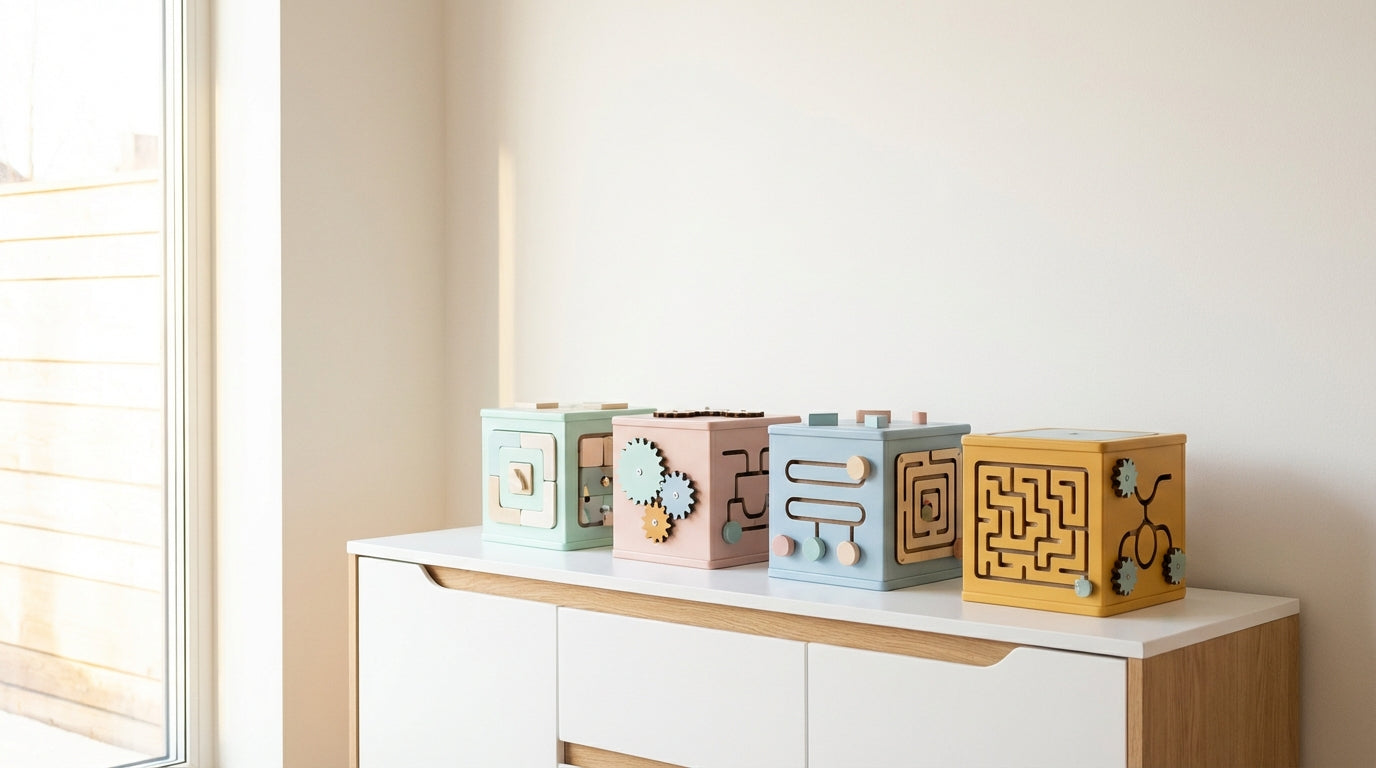
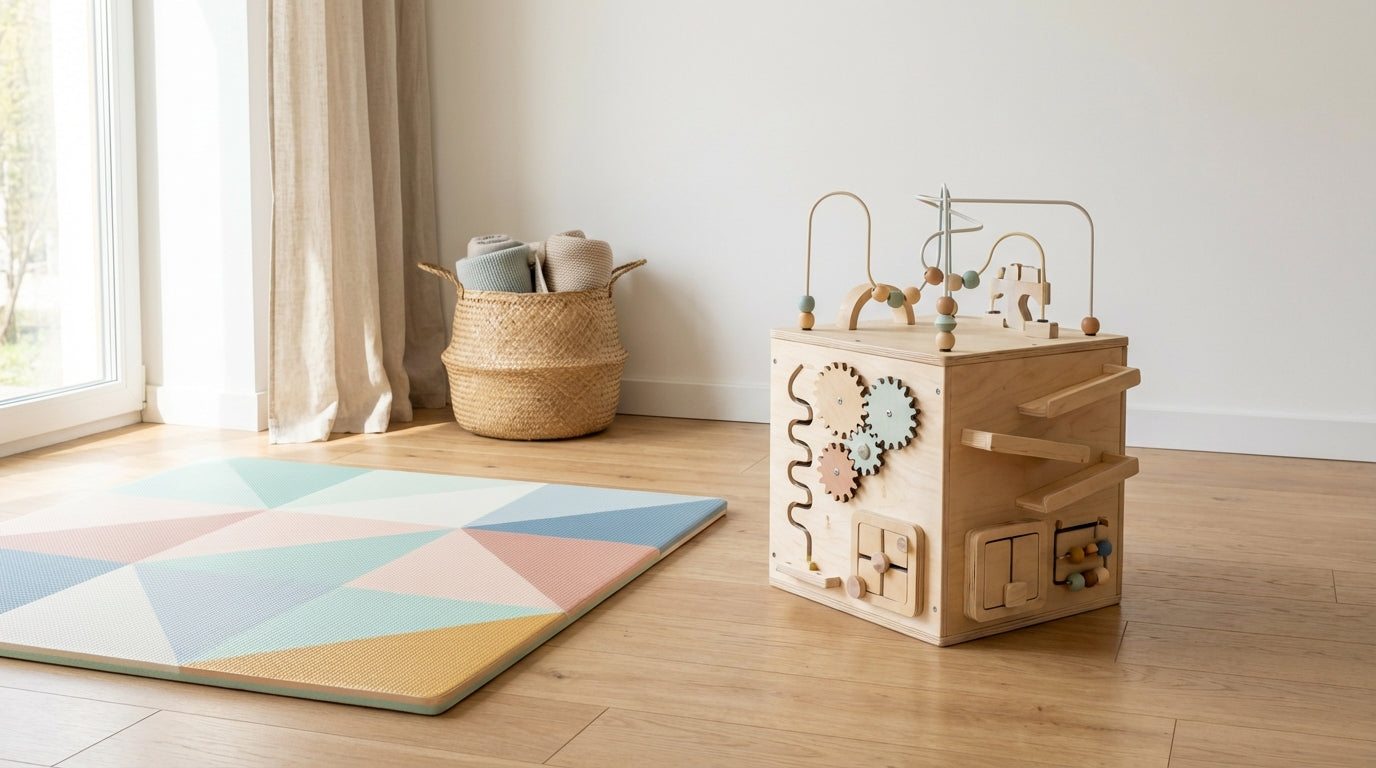
“Large” mainly means more height – and with that, more play while standing. At Bieco, for example, there are sizes such as 20 x 20 x 40 cm (e.g. the Scandi Chic Activity Center) and XXL versions at 30 x 30 x 60 cm. That’s not just “a bit more cube”, it changes how children play: they walk around it more often, pull themselves up and use several sides one after another.

An activity center is a toy that combines several motor skills games in one body. For parents, that simply means fewer individual pieces that end up living under the sofa.
In everyday life, an XXL cube is more like a small piece of furniture than a take-along toy. That’s great if it has a permanent spot – and a bit annoying if it has to move out every evening.
Large activity cube: Which age suits XXL best?
XXL often suits children from 12 months, once they stand steadily and pull themselves up. For the Bieco XXL cubes, “from 12 months” is given as the recommended age (e.g. Woodland Animals XXL FSC®, Berry XXL FSC®, Ella the Deer XXL FSC®). That makes the direction clear: more for early walkers and “I-climb-everything” kids than for tiny babies.
Practical tip: For the first few days, place one side of the cube against the wall. This stops it from “wandering” and gives unsteady little standers more calm.
For very young children, “large” can quickly be too much at once. Not because they aren’t allowed, but because many elements at the same time can occasionally feel overwhelming. In that case, a more compact activity center is often the more relaxed choice, especially if your child mostly plays on the floor.
A simple decision aid is how your child likes to play. Floor-play kids often enjoy smaller cubes or individual motor skills toys, while standing-play kids tend to benefit from the height and stability of an XXL activity center.
XXL activity cube: The 6 questions to ask yourself first
XXL is worth it if you can honestly answer “yes” at least four times.

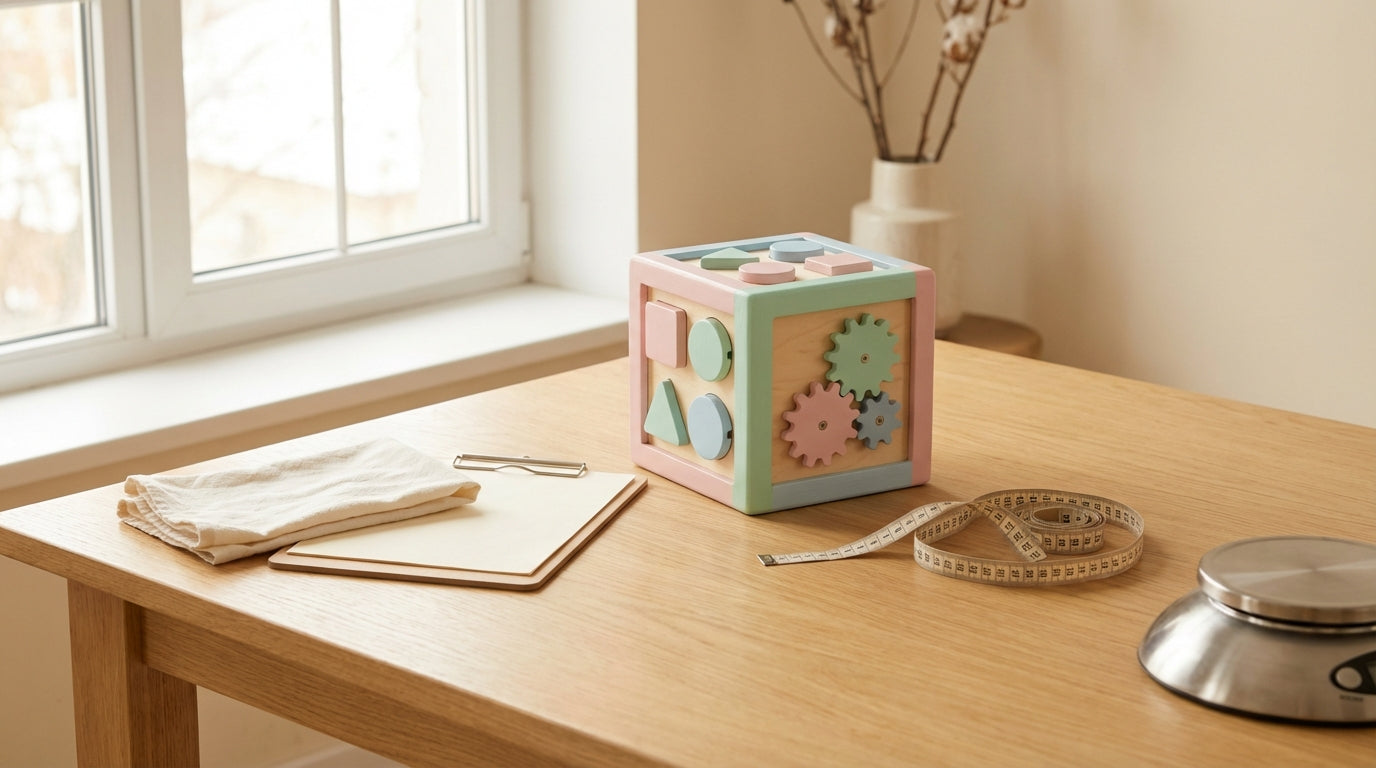
- Do you have space? A 30 x 30 x 60 cm cube needs floor space and some “breathing room” around it so all sides are reachable.
- Can the cube stay where it is? If your living room has to turn “grown-up” again every evening, XXL can get annoying.
- Does your child like to play standing up? Then the height is worth its weight in gold – less bending down, more “I can do it myself”.
- Are there siblings or frequent visitors? More surface often means fewer “You’re in my way!” moments.
- Do you want one central play spot instead of many individual pieces? Then a large activity center is often the tidier solution.
- Is stability important to you? Bigger and heavier often stands more steadily – especially with energetic spinning and pushing.
XXL vs. large vs. small: What really changes in daily life?
The biggest difference is often: how often does your child actually play with it? A small cube disappears onto a shelf more quickly. An XXL cube stays visible – and so it gets used “on the side” more often. Parenting is also visibility management: what’s in sight gets played with.
Space requirements
Besides floor space, plan for a small “maneuvering zone”. Children want to reach several sides, sometimes crouch in front of it, sometimes run around it. If the cube sits right between the sofa and the coffee table, it quickly turns into an obstacle course – for child and toes alike.
Stability
More size can mean a steadier stand, but it doesn’t make anything automatically “indestructible”. A large activity cube often tips less easily, but still: place it on level ground and check regularly that everything is securely in place.
Tidying up
Small wins if you need free floor space quickly every evening. In apartments without a separate children’s room, “easy to put away” is sometimes the most important criterion of all – even before design and features.
What to look for in a large activity cube (safety & materials)
Clear safety information is what matters – not just pretty pastel colors. On Bieco product pages, the safety information mentions, among other things, “tested according to EN 71” as well as “use only under adult supervision” (depending on the product). If you find details like these, that’s already better than a shrug.

EN 71 is a European series of standards describing requirements for toy safety. For you, that practically means: there are defined tests, not just “it’ll probably be fine”.
EN 71-3 describes tests for the migration of certain elements from toy materials. According to DIN Media, DIN EN 71-3 sets out requirements and test methods for this migration (DIN Media: DIN EN 71-3).
Safety note: With large cubes, regularly check that wire elements are firmly in place and nothing wobbles. Always follow the manufacturer’s supervision instructions.
Material details aren’t just “nice to know” – they also help with cleaning. On the product pages of the Bieco XXL cubes, for example, wood (partly FSC®) and iron (wire) are listed – plus care instructions such as “clean with a damp cloth and mild soap” and “do not immerse in water” (depending on the model).
FSC® is a certification system for wood from responsibly managed forests. It can give you guidance if origin matters to you – but it doesn’t replace a close look at craftsmanship and safety information.
The EU Toy Safety Directive 2009/48/EC sets out essential safety requirements for toys in the EU. If you like to read the original: EUR-Lex: Directive 2009/48/EC.
Mini checklist: Does an XXL activity center fit your home?
With this short list, you’ll quickly see whether XXL will make life easier or get on your nerves.

- Permanent spot: Is there a corner where the cube is allowed to stay?
- Free space: Can your child comfortably reach at least 2–3 sides?
- Surface: Does the cube stand level and not slide around all the time?
- Daily routine: Do you often rearrange everything in the evening – or rarely?
- Use: Does your child like to play standing up and moving around the toy?
Which XXL versions does Bieco offer – and who are they right for?
At Bieco, XXL cubes are designed as permanent play centers for your play corner. Examples include the Woodland Animals XXL FSC® activity cube (30 x 30 x 60 cm, from 12 months) and the Berry XXL FSC® activity cube (30 x 30 x 60 cm, from 12 months). The Ella the Deer XXL FSC® activity cube is also listed at 30 x 30 x 60 cm and “from 12 months”. In the respective safety information you’ll also find notes on supervision and standard testing (e.g. EN 71).
If you’re looking for “big, but living-room friendly”, the mid-size is often a good compromise. The Scandi Chic Activity Center, for example, is listed at 20 x 20 x 40 cm (from 12 months; EN 71 is mentioned on the product page). It’s noticeably taller than mini models, but takes up less room than XXL.
If you’d like to browse first: the overview helps with comparing sizes. In the activity cube collection you can see different formats side by side – which often makes the decision easier than ten browser tabs full of measurements.
Transparency from Hamburg: Why we’re so picky about cubes
We’d rather state clearly what a cube can do – and what it can’t. Bieco is a family business from Hamburg, and we’ve been doing this for 66 years. Ulli & Flo write here as parents for parents: with an eye on material details, care, age recommendations and clear safety information. Not because we enjoy the small print – but because in everyday life it simply gives peace of mind.
When is a “large activity cube” the best gift idea?
A large activity cube is a wonderful gift if it suits the family’s home. For a 1st birthday (if the “from 12 months” age recommendation fits), XXL is often a real eye-catcher – but only if it doesn’t immediately become a tripping hazard. The most loving question before buying is sometimes the least romantic one: “Do you have a play corner?”
For grandparents, XXL can make particular sense if the child spends a lot of time with you. Then the cube lives at Grandma’s or Grandpa’s and becomes a ritual: arrive, shoes off, one spin around the cube. And honestly: that’s a pretty relaxed solution for everyone.
Practical tip: If you’re giving it as a gift, ask about the floor. A small piece of felt or a play rug dampens noise and protects parquet – and you’ll come across as suspiciously organized.
FAQ
How much space does an XXL activity cube need?
Count on floor space plus some room to move around it. An XXL cube with a 30 x 30 cm footprint doesn’t just need “30 x 30”, it needs space so children can reach several sides. If the cube is wedged between furniture, it gets used less often – and more often turns into a toe trap.
From what age does a large activity cube make sense?
Usually when your child likes to play standing up and is steady on their feet. Many large activity centers are recommended from 12 months (at Bieco, this is stated for several models). If your child pulls themselves up on everything and loves “working with their hands”, XXL often fits better than a mini cube.
How do I properly clean a wooden activity cube?
Usually a damp cloth with mild soap is enough. Many manufacturers state that wooden toys should not be immersed in water and should then be left to air dry (at Bieco, this is stated on some product pages). What matters: read the care instructions for your specific model, especially if wire or metal parts are included.
Is a large activity cube automatically safer because it’s heavier?
More weight can mean a steadier stand, but it doesn’t replace supervision. A large cube often tips less easily, but you should still place it on level ground and regularly check that all elements are secure. If the manufacturer says “only under supervision”, that applies even when the cube looks like a small sideboard.
What does “tested according to EN 71” mean for toys?
It means the toy is tested against defined safety requirements. EN 71 is a series of standards for toy safety in Europe. There are parts for individual aspects, e.g. EN 71-3 on the migration of certain elements; according to DIN Media, it describes requirements and test methods (DIN Media).
XXL activity center as a gift: How do I ask without being awkward?
Just ask briefly about space and daily life – for a gift, that’s actually extra thoughtful. One sentence is enough: “Do you have a play corner where a big cube like this could stand?” That way you avoid the classic “Lovely gift, but where do we put it?” And you show that you’re not just giving something beautiful, but something well thought out.
All in all, a large activity cube is worth its weight in gold if it makes your daily life easier. If you’d like to compare, you’ll find different sizes in the activity cube overview, and in our guide Activity Cubes: Manufacturers, Safety & Dimensions at a Glance you can read up on dimensions and safety information.