Kids' Desk Chair: How to Find the Right Study Chair
At a glance
- A kids' desk chair fits when feet are planted, knees are free and the backrest gives support.
- Adjust the seat height first, then the seat depth, and the contact with the table last.
- A footrest is often the quick fix when legs are dangling.
- Wheels are handy, but only with the right flooring and a tidy “roll zone”.
- Re-adjust every 3–4 months – kids don't grow on schedule.

The right desk chair for kids is one where the feet stand firmly, the knees aren't squeezed and the backrest supports your child when they lean back. If you get these three things right, you're already most of the way there – no ergonomics degree required. In this guide you'll find a simple 5-minute check, a small reference chart (height → seat height), an adjustment checklist and clear answers about wheels, armrests and footrests.

Ulli & Flo
Owners of bieco · Hamburg · parents ourselves
At home, it feels like we adjust the chair more often than the alarm clock. With the three basics (feet, back of the knees, shoulders), things get noticeably more relaxed pretty quickly, though. Feel free to browse our kids' chair collection.
Kids' desk chair: the 3 criteria that really matter
When feet, knees and back are right, sitting automatically becomes calmer. Everything else (design, “pro mechanics”, 17 levers) is nice but secondary – especially in real family life.

- Foot contact: Feet stand flat on the floor or on a stable footrest. According to BG BAU, full-surface foot contact is a key feature of ergonomic sitting (BG BAU).
- Space behind the knees: There's some room between the edge of the seat and the back of the knees – as a rule of thumb at least two finger widths. BG BAU also gives this recommendation (BG BAU).
- A backrest that actually gets used: A backrest only helps if your child can lean back without being “pushed out” toward the front.
Definition (quotable): A kids' desk chair is a piece of seating furniture that can be adjusted to a child's height and the table height, so children can sit at the table stably and without pressure points.
Which types of chairs are there – and who are they right for?
The best type of chair is the one that fits your child's everyday life. Drawing, homework, gaming, crafting – these are different “sitting situations”, and kids are… let's say: creative about them.
| Chair type | Pros | Cons | Best for |
|---|---|---|---|
| Classic kids' chair (no wheels) | Stable, calm, often easy to clean | Fewer adjustment options | Short sitting times, drawing/crafting, small desks |
| Kids' desk chair (adjustable seat height) | Grows better with your child, more flexible at the desk | Depending on the model: seat depth not adjustable | Homework, reading, regular use |
| Office chair for kids (more adjustments, often wheels) | More customization possible, often a more flexible backrest | Can be “too rolly”, needs space and tidiness | Longer desk time, older kids |
| Sit-stand stool / standing chair | Adds movement, makes changing posture easier | Not always stable enough for writing | As a supplement, short study phases, active kids |
Quite practically: For 10–30 minutes a day, a sturdy kids' chair is often enough, as long as the height and foot contact are right. If sitting time regularly gets longer, a kids' desk chair with more adjustment options is worth it.
Orientation: height → seat height (as a starting point)
A chart doesn't replace trying the chair out, but it prevents major missteps. School furniture comes in size classes according to DIN EN 1729-1; you'll find an easy-to-understand overview at insGraf (insGraf).

| Body height (approx.) | Typical seat height (approx.) | How you can tell |
|---|---|---|
| 110–120 cm | approx. 30–34 cm | Feet must stand securely; a footrest often helps |
| 120–140 cm | approx. 34–38 cm | Knees at roughly a right angle, room behind the knees at the front |
| 140–160 cm | approx. 38–43 cm | Table height becomes more important: shoulders should stay relaxed |
| 160–180 cm | approx. 43–48 cm | Many “adult chairs” fit as long as the seat depth isn't too long |
Practical tip: It's better to set the chair a touch too low and use a footrest than to set it “too high” and accept dangling legs.
Check in 5 minutes: does the study chair really fit?
The best test is simply looking at feet, the backs of the knees and shoulders. You don't need a measuring tape – just a moment of calm. (I know. But we'll try.)
- Feet: Are they flat on the floor? If not, a footrest is usually missing or the seat height is too high.
- Back of the knees: Is there at least two finger widths of space to the edge of the seat? According to BG BAU, this distance is a helpful guideline (BG BAU).
- Pelvis & back: Can your child sit back against the backrest without sliding forward? If not, the seat depth is often too big or the backrest is unsuitable.
- Contact with the table: Forearms can rest on the table, shoulders stay relaxed. If shoulders go up: the chair is too low or the table too high.
- Movement: Can your child change position without the chair wobbling or “rolling away”?
Definition (quotable): Dynamic sitting means changing posture regularly instead of staying rigidly in one position for a long time.
Setting up chair + table correctly: a mini checklist for the children's room
Adjust the chair first, then the table – otherwise you'll chase each other in circles. If the table isn't height-adjustable (it often isn't), you'll work with the chair + footrest.

- Step 1: Set the seat height so that feet stand flat (or on a footrest).
- Step 2: Choose the seat depth so that the backs of the knees stay free (two fingers of space as a guideline).
- Step 3: Use the backrest so that leaning back is possible – without a “swayback show” or hunching forward.
- Step 4: Check contact with the table: forearms resting, shoulders relaxed.
- Step 5: Light from the side, so your child isn't writing in their own shadow (that's more a sanity issue than an ergonomics one).
Wheels, armrests, footrest: when does what make sense?
The more mobile the chair, the more important tidiness and the right flooring become. Wheels aren't “evil” – they just need clear ground rules.
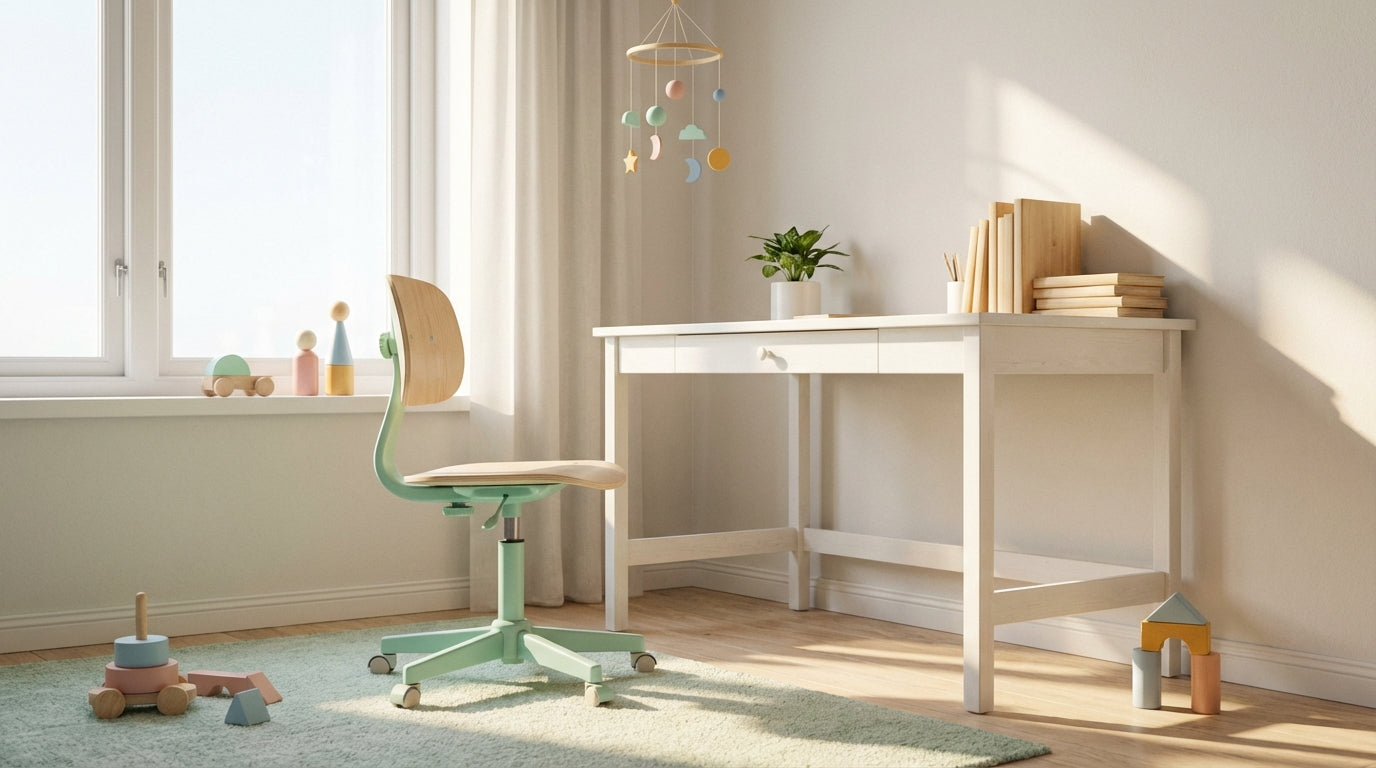
- Wheels: Useful if your child often pushes the chair in and out and doesn't tip while doing so. Look for wheels that suit your flooring (carpet vs. hard floor) and make sure the chair doesn't turn into a race car.
- Armrests: They can offer relief if forearms would otherwise hang “in mid-air”. But they get in the way if they don't fit under the table or if your child constantly sits crooked to get “around” them.
- Footrest/foot support: Often the game changer with standard table heights. If feet can't stand stably, things get fidgety – that's not a character flaw, that's physics.
Safety note: With swivel chairs on wheels: clear away tripping hazards (school bags, cables, toys) and make sure the base is stable before the “wheel games” begin.
Material & care: what really counts in everyday life
An easy-care cover saves your nerves – and sometimes family peace. Kids eat, drink, glue, paint. And yes: sometimes all at the same time.
- Wipeable surfaces: Handy for small mishaps (juice, play dough, the beginnings of felt-tip marks).
- Fabric covers: Often feel pleasant, but show stains more quickly. If removable/washable: jackpot.
- Sturdy edges & workmanship: In a children's room, a chair isn't just “used”, it also gets tested as a pirate ship every now and then.
What we keep seeing as parents (and from Hamburg)
A well-adjusted spot beats the most expensive chair set up wrong. Ulli & Flo here – we're parents ourselves and have learned that kids rarely sit “like in the textbook”. That's why it helps to set up the basics so that the chair is forgiving when your child thinks sideways (and sits sideways).
And yes, a little trust is allowed: We're a family business from Hamburg and have been doing this for 66 years. That doesn't mean everything is perfect – but it does mean we've learned to look honestly at materials, workmanship and safety rather than sugarcoat things.
FAQ: Common questions about the kids' desk chair
Which kids' desk chair is the right one?
The chair is right when feet stand stably and the backs of the knees stay free. Your child should be able to sit back against the backrest, and at the front there should be at least two fingers of space behind the knees – BG BAU names this guideline (BG BAU). An adjustable seat height is the minimum.
When do wheels on a kids' desk chair make sense?
Wheels make sense when the chair stands securely and the flooring suits them. For very fidgety or younger children, a chair that stays put can be more relaxing at first. If you do go with wheels: keep the area around the chair clear, with no school bags or cables in the way – otherwise it quickly gets slippery and chaotic.
When do armrests on an office chair for kids make sense?
Armrests help when forearms would otherwise hang “in mid-air” all the time. But they need to fit under the table, otherwise your child will automatically sit crooked or too far away. If you're unsure: start without them – and add them later if space and use allow.
Does my child need a footrest on their study chair?
Yes, if their feet otherwise can't stand flat. Stable foot contact often makes sitting calmer, because the body doesn't constantly have to look for a “counterweight”. Especially with standard (non-height-adjustable) desks, a footrest is often the simplest and cheapest improvement.
How can I tell if the desk chair is too high or too low for my child?
Too high: feet dangle; too low: shoulders go up or the table seems “too far up”. When it fits, shoulders stay relaxed and there's room behind the knees. If your child keeps sliding around or tucks one leg under their bottom, that's often a sign that the height or foot contact isn't right.
Is a standing chair for kids useful or more of a gimmick?
It's useful as a supplement, if it truly brings movement into study phases. For some kids that's great, for others it's the starting signal for fidgeting deluxe. Important: for writing and fine tasks, more stability is often needed. As a guideline for ergonomic sitting, BG BAU names regular changes of posture (BG BAU).
To wrap up: adjust it once, then it (mostly) runs smoothly
If you only do one thing today: plant the feet and keep the backs of the knees free. That often brings more calm to the desk right away. If you'd like to look at different seating solutions, you'll find an overview of desk chairs for kids with us, and the classic kids' chair as an alternative. And now: top up your coffee. You've earned it.