Kids' Chair Guide: High Chairs, Rocking Chairs & Sizes Made Easy
At a glance
- Kids' chair: first decide where it will be used, then think about size, material and cleaning.
- For meals at the table, stability, a harness and a footrest are often what matter most.
- EN 14988 is the key safety standard for high chairs in Europe.
- A small comparison table helps you quickly find the right chair type.
- 5-point checklist: so the chair truly makes everyday life easier.

The quickest way to find the right kids' chair is to decide first where it will be used. Eating at the family table, drawing in the nursery, doing homework at the desk or “we're at Grandma's” – depending on the situation, seat height, stability and even how easily you can get tomato sauce off all change. In this guide you'll get a clear overview of kids' chair types, a quick comparison table, a 5-point checklist and a few everyday tips that have worked well for us at home (and for many parents who have asked us).

Ulli & Flo
Owners of bieco · Hamburg · parents ourselves
With kids' chairs, what we regretted most was thinking about seat height and cleaning too late. This overview saves you exactly that extra detour. Feel free to browse our kids' chair collection.
Types of kids' chairs at a glance: what's out there – and what is each for?
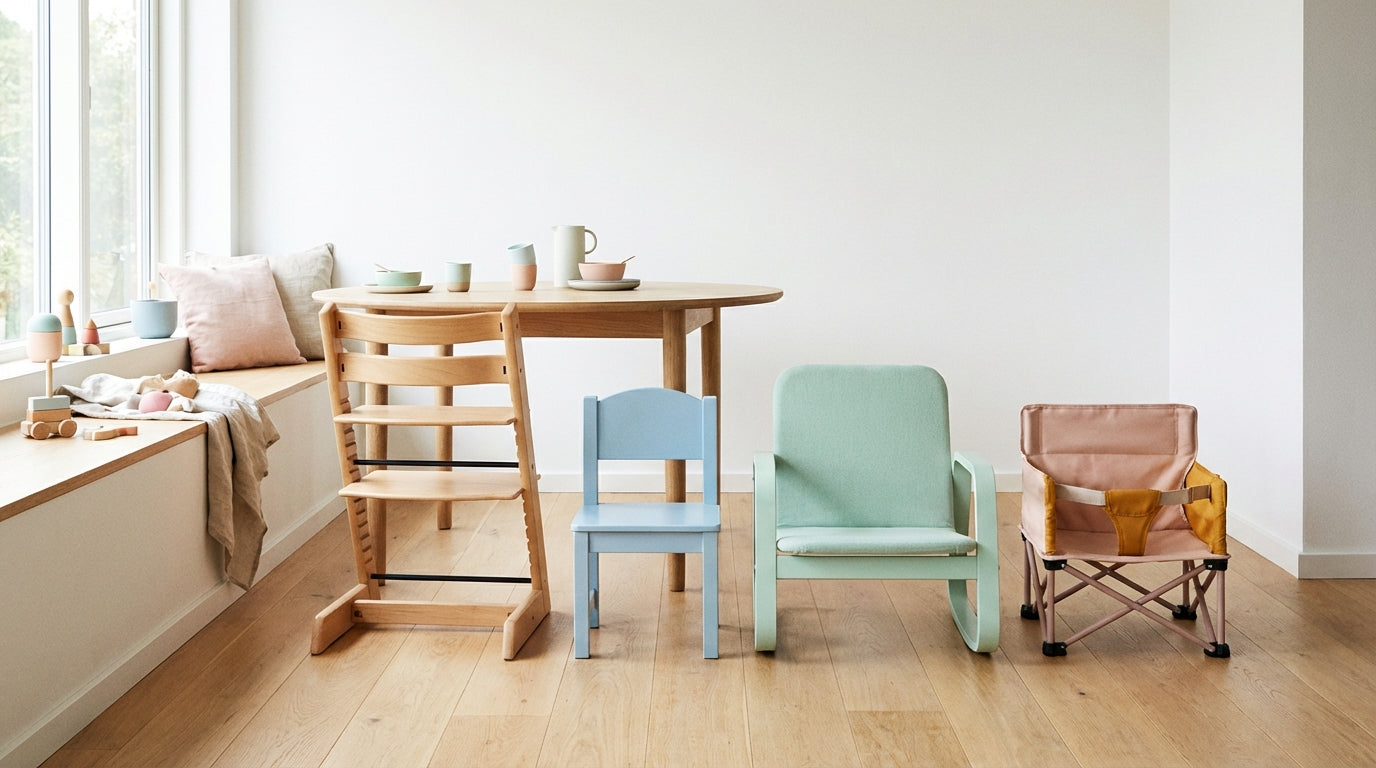
The best kids' chair is the one that makes your daily routine easier. Sort them pragmatically by “What do we really need it for?” – then choosing furniture won't turn into a weekend project.
- High chair: for eating at the family table, often from the time your baby can sit; depending on the model, with a baby insert.
- Low kids' chair: for the nursery, matching a kids' table – for drawing, playing, modeling clay.
- Kids' chair with table: a set for your child's very own spot (handy when space at the dining table is tight).
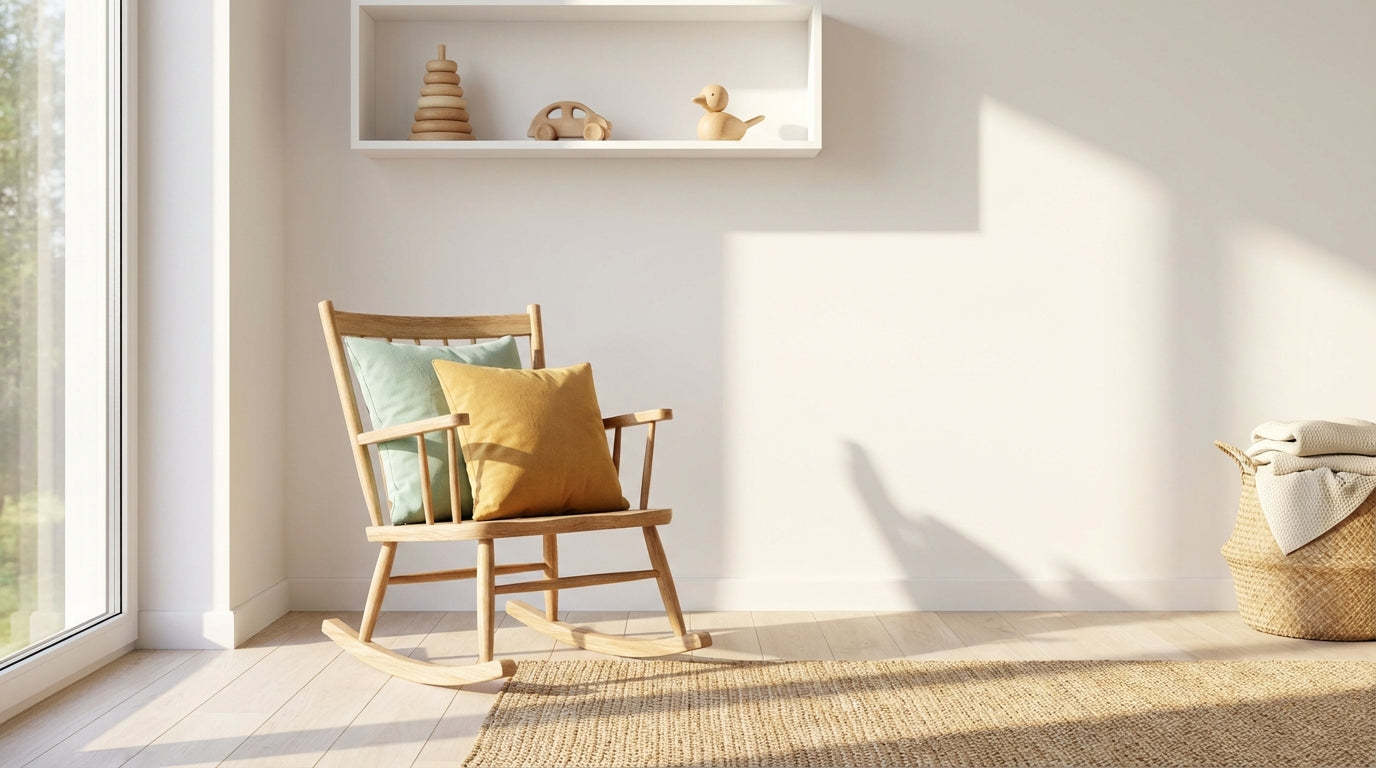
- Rocking chair for kids: a quiet spot for reading aloud, cuddling and winding down.
- Travel kids' chair: compact for visits, vacations and restaurants.
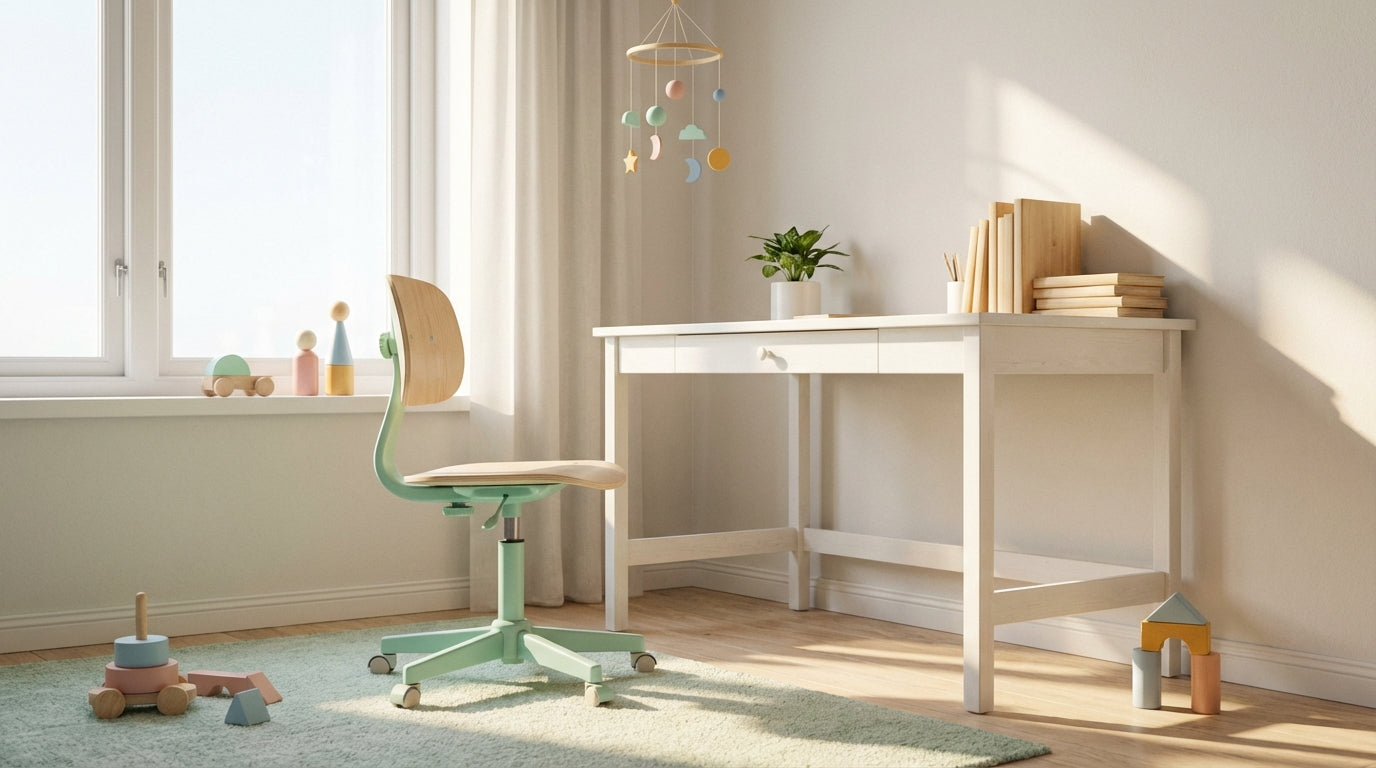
- Desk chair for kids: for when crafting or writing takes longer (daycare/school age).
Definition: A high chair is a raised seat for eating at the family table. It brings children up to table height and therefore needs particularly good stability and a safe construction.
Definition: A travel kids' chair is a portable seat for meals on the go. It is designed to pack down small – which is why secure attachment and a stable stand wherever you use it are especially important.
Comparison table: chair type, stage, pros/cons and what to look for
A table lets you see quickly which kids' chair suits your family. Treat it as a cheat sheet – nobody needs to memorize it.

| Chair type | Typical stage | Pros | Cons | What to look for |
|---|---|---|---|---|
| High chair | Meals at the table | Child sits at table height, clear eating spot | takes up space, cleaning can be annoying | Stability, restraint system, footrest, easy to clean |
| Low kids' chair | Playing/crafting | light, child-friendly, quickly set up | often too low at the dining table | wide base, smooth edges, seat height that matches the kids' table |
| Kids' chair with table | Nursery/small household | own spot for your child, projects can stay out | needs extra floor space | sturdy table, easy to wipe, no wobbly joints |
| Rocking chair | Quiet time/reading | cozy, a place to retreat | not ideal for eating, needs room | Tip-over protection/base, distance from wall/shelf |
| Travel kids' chair | On the go | flexible, often light and compact | doesn't fit every chair/table | secure fastening, simple setup, material that's easy to clean |
| Desk chair | Preschool/school | better for sitting longer | wrong size = slouched sitting | Adjustability, stability, suitable seat height |
Chair for kids: how to find the right size (without measuring-tape panic)
A chair fits your child when their knees and feet stay relaxed. In practical terms: when your child sits upright, their feet should have support (floor or footrest) and their knees should be comfortably bent. That's more comfortable – and less wobbly at mealtimes.

For older children, school size categories can serve as a guide. There, sizing is often based on body height or lower-leg length (known from size classes for school furniture). You'll find a well-explained overview here: Chair and table sizes in school (VS).
Practical tip: Let your child “test sit” and watch their legs: dangling, kneeling or constantly sliding around = the height often isn't right.
Kids' chair for toddlers: from when does it make sense – and what really matters?
With a toddler's chair, ability matters more than age. “From 1 year” is often the stage when children sit more securely, climb and have very clear opinions (respect). What matters is: does your child sit steadily? Can they get in and out on their own? And how strong is the urge to climb?
- Toddler (roughly 1–3 years): low seat height, wide base, easy to clean, no sharp edges.
- At the dining table: often a high chair or a grow-with-me chair with a footrest, so little feet don't dangle.
- Daycare/preschool: kids' chair at the table or a first desk chair – depending on how long they draw or craft.
Safety note: With raised chairs, always check stability and never leave children unattended – especially in the “climbing is my hobby” phase.
High chair: safety, EN 14988 and the three everyday points
A high chair must stand firmly and avoid pinch points. In Europe, the safety standard EN 14988 applies to high chairs; according to DIN Media, DIN EN 14988 sets out safety requirements covering, among other things, pinch points, restraint systems, stability and labeling. DIN EN 14988 (DIN Media)

In everyday life, cleaning, harness routing and a footrest are real nerve-savers. Cleaning sounds unromantic – but it's the difference between “a quick wipe” and “why has this been sticky since Tuesday?” A sensible footrest helps many children sit more calmly. And when it comes to harnesses: simpler is better, so you'll actually use them.
Practical tip: If you often eat out and about: a compact second chair (or a travel solution) saves arguments in restaurants and when visiting others.
If you're looking for solutions for on the go, a dedicated overview often helps more than pondering. Here you'll find practical ideas: Travel kids' chair: practical solutions for on the go.
Rocking chair for kids: cozy, but please with space and calm
A rocking chair for kids is more of a resting spot than a place to eat. For reading aloud, cuddling or “winding down,” a chair like this can be wonderful. For meals it's usually impractical – crumbs and rocking are a discipline of their own.
Look for a stable base, tip-over protection and enough room in front and behind. A rocking chair needs space – otherwise you'll rock into the wall or shelf faster than you can say “just one more time.”
If you'd like to dive deeper, here is the matching in-depth article. Rocking chair for kids: benefits, choosing & safety
And here's the overview if you'd like to browse. Rocking chair for kids
Wooden kids' chair & white kids' chair: material, finish, care
A wooden kids' chair is often long-lasting if the finish is suited to everyday use. Wood feels warm, is robust and shrugs off plenty of “I'll do it myself!” moments. Look for neatly sanded edges, sturdy joints and a finish that can be wiped with a damp cloth.
A white kids' chair is beautiful – and shows very honestly what children love. Felt-tip pen, tomato sauce, modeling clay: white isn't delicate, but it is merciless. If you love white (understandably), pay special attention to an easy-care paint finish/sealant and to how the manufacturer recommends cleaning it.
For material and chemical topics, standards can serve as a guide, but always on a product-by-product basis. For toy materials there is, for example, DIN EN 71-3; according to DIN Media, it sets requirements and test methods for the migration of certain elements from toy materials. DIN EN 71-3 (DIN Media) For furniture, different requirements apply depending on the product – which is why manufacturer information on materials, testing and care instructions is especially important.
Practical tip: For wood, a slightly damp cloth plus mild soap is usually enough. Abrasive cleaners may get things clean, but they can rub surfaces dull.
Travel kids' chair & kids' chair with table: when you need flexibility
A travel kids' chair is ideal if you often eat “somewhere else.” At Grandma's, in a holiday home or at a restaurant, a seat of their own can sometimes be the difference between a relaxed meal and “we'll eat later.” What matters is that the chair suits the typical seating (chair shape, table height) and can be fastened securely.
A kids' chair with table is a little everyday hack for the nursery. For drawing, modeling and puzzles, a set of their own is handy – because not every project has to block the dining table. And because you won't have to pick glitter out of the table edge every evening.
If you'd like to browse: here are the matching overviews. Travel kids' chair and Kids' chair with table. If you'd rather read first: Kids' chair with table: the best sets for nursery & playtime
Grow-with-me kids' chair (often searched as “Nomi”): what to look for?
“Nomi” is a brand name and is often used as a catch-all for grow-with-me kids' chairs. What's usually meant is an adjustable chair that “keeps up” with your child for longer. Differences often lie in the adjustment mechanism, footrest, stability and accessories.
Keep it practical: does it fit your table height, your space and your daily life? Check whether your child sits comfortably (feet supported), whether the chair stands firmly and whether you can adjust it without tool frustration. And take a look at which testing and material details the manufacturer actually provides.
Desk chair for kids: when drawing suddenly takes “an hour”
A desk chair for kids becomes important as soon as longer sitting is on the agenda. At the latest when craft projects or homework “just” take 45 minutes, a chair that sensibly supports seat height and back is worth it.
Focus on a sturdy construction and sensible adjustability. For seating furniture in living areas there are standards covering safety, strength and durability; according to DIN Media, DIN EN 12520 describes minimum requirements for safety, strength and durability of domestic seating. DIN EN 12520 (DIN Media) Which requirements are right in an individual case depends on the product category and the manufacturer's information.
If you'd like to compare, here you'll find the overview and the guide. Desk chair for kids and Desk chair for kids: comparison, tips & recommendations
5 points before buying: small checklist, big impact
Five questions quickly tell you whether a kids' chair suits your family. This is the list you'd have liked to have beforehand.

- Where it's used: Eating, playing, learning or on the go?
- Right height: Do the feet have support (floor or footrest) and are the knees comfortably bent?
- Stability: Does the chair stand steadily, with no wobbling and no tipping easily?
- Cleaning: Can you wipe it down quickly, without special cleaners?
- Transparency: Does the manufacturer clearly state materials, care instructions and testing/standards information?
How we at bieco look at kids' chairs (a quick, honest word)
We like products that say clearly what they can do – and what they can't. bieco is a family business from Hamburg, and we've been doing this for 66 years. Ulli & Flo write here as parents for parents: practical rather than polished. And when it comes to safety, we're fans of transparency: materials, care instructions and (where appropriate) standards/testing should be easy to understand, so you don't have to guess.
FAQ: short answers to the typical kids' chair questions
From what age can a child use a kids' chair?
A kids' chair makes sense as soon as your child can sit steadily and you need a proper seat for them. For meals at the family table that is often a high chair, and for the nursery more of a low chair. Age alone doesn't decide – sitting stability, independence and how securely the chair stands do.
What height should a kids' chair have?
The right height is reached when the feet have support and the knees are comfortably bent. At the dining table, a footrest often helps so legs don't dangle. If your child constantly kneels, slides around or “does gymnastics on the chair,” the seat height (or the table height) is often not right.
EN 14988: what does it mean for a high chair?
EN 14988 is a European safety standard for high chairs. According to DIN Media, DIN EN 14988 describes safety requirements covering, among other things, pinch points, restraint systems, stability and labeling. DIN EN 14988 (DIN Media) It doesn't replace a look at the specific product, but it's helpful as a guide.
High chair or low kids' chair – which is better?
For meals at the table, the high chair is usually more practical; for the nursery, the low chair. The high chair brings your child up to table height and creates a clear eating spot. A low kids' chair is great for drawing and playing – at the dining table, though, your child often sits too low and gets restless more quickly.
Wooden kids' chair: what should I look out for?
What matters are workmanship, stability and a surface you can clean easily. Look for smooth edges, sturdy joints and clear care instructions. Wood is often long-lasting, but not automatically “better” than other materials. What counts is how neatly and robustly the chair is built.
White kids' chair: how does it stay looking nice for long?
White stays beautiful longest if the surface is sealed and you remove stains quickly. A soft, slightly damp cloth is often enough. With felt-tip pen and tomato sauce, the sooner the better. And if a shadow remains – as we say in northern Germany: it happens. That's childhood, not a furniture drama.
Bottom line: a good kids' chair is a little piece of everyday calm. If you now have a clearer idea of which type suits your family, feel free to browse our overview of kids' chairs or – depending on your needs – travel kids' chairs and kids' chairs with table.