Rocking Chair for Kids: Choosing, Safety & Everyday Tips (Checklist)
At a glance
- A kids' rocking chair makes sense if it is sturdy and suits your child.
- What matters: a calm rocking motion, a non-slip stance and enough space around it.
- Check for: rounded edges, no pinch points, clear instructions and warnings.
- On smooth floors, a mat or rug helps – and protects the floor as a bonus.
- Standards & markings give guidance, but they don't replace your own eye.

A rocking chair for kids is a good idea when it is sturdy, age-appropriate and set up safely. Then it quickly turns from "just a piece of furniture" into a little retreat: for reading aloud, for winding down after daycare, or for those famous two minutes when nobody is calling "Mommmyyy!" Here you'll find a practical buying and safety checklist, plus everyday tips for laminate floors, siblings and the inevitable applesauce fingers.

Ulli & Flo
Owners of bieco · Hamburg · parents themselves
A rocking chair only worked for us once it had a fixed spot and the rules were clear. Since then it's more of a calm island than a race track. Feel free to browse our children's chair collection.
Why a kids' rocking chair is often such a hit
Gentle rocking is movement while sitting – many children love it. It isn't "action", more a quiet body feeling: I'm sitting, I'm moving, I'm with myself. Especially after a full day, it can be a little anchor – without you having to invent a whole new bedtime ritual.
A place of their own builds independence, because children have something that's "just theirs". It shows in small ways: sitting down on their own, getting up on their own, deciding whether a book or a cuddly toy comes along today. And yes, sometimes they also decide: "I'm going to rock all the way to the moon." So let's move straight on to the part that saves your nerves.
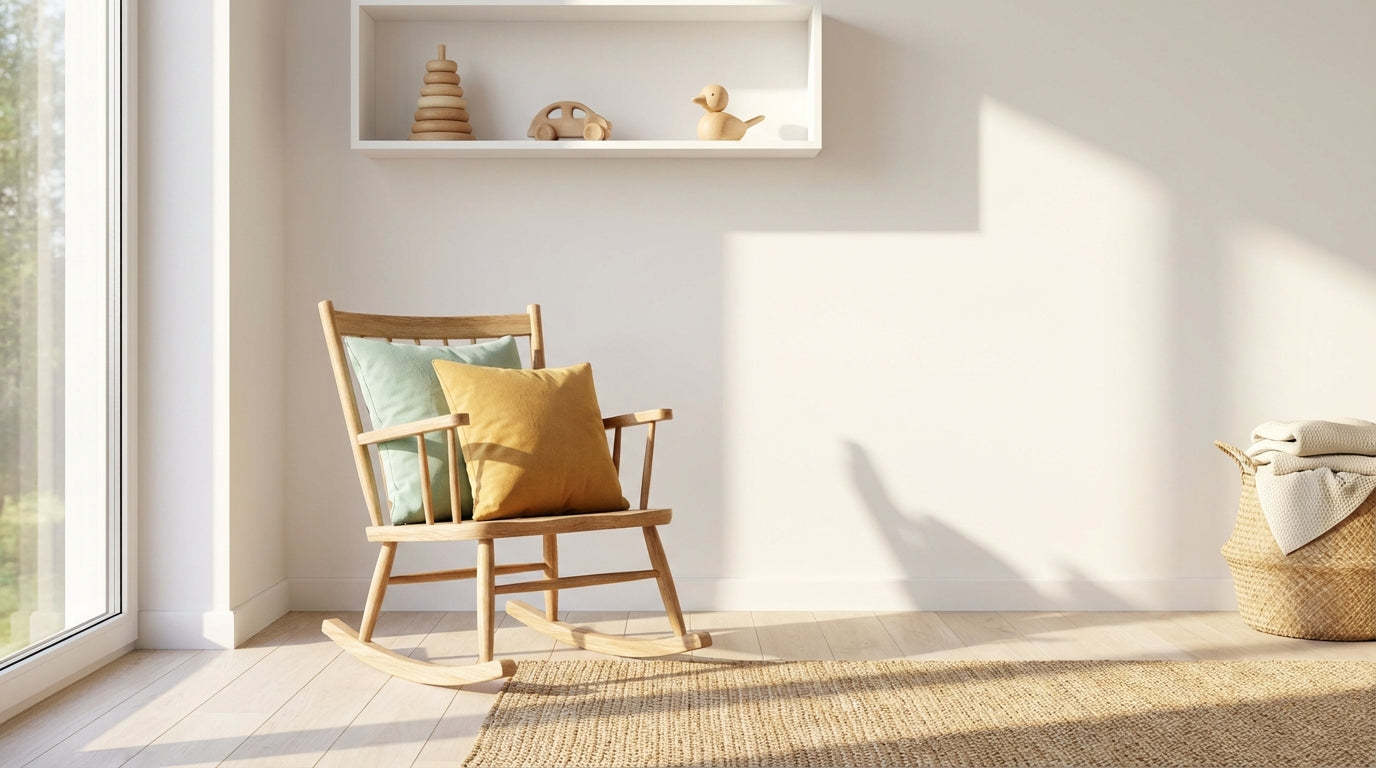
A rocking chair is most likely to become a favorite spot when it isn't in the walkway. Place it at the edge of the room – where nobody is constantly dashing past. In the middle of the living room, it quickly turns into a slalom pole.
Kids' rocking chair, bouncy chair or regular children's chair – what suits what?
A rocking chair has runners or a rocking base and needs more space. It moves while in use – that's the point, but it's also the difference from a fixed chair. For your home, that means more distance, more attention to tipping, and to spots where fingers could get caught between the floor and the runner.

A bouncy chair is a seat that gives way springily, usually with a limited range of motion. This can be handy if you want a calmer, "cushioned" movement. Whether a model is classified as a toy or as furniture depends on the product – which is why the manufacturer's notes (age, use, assembly) are so important.
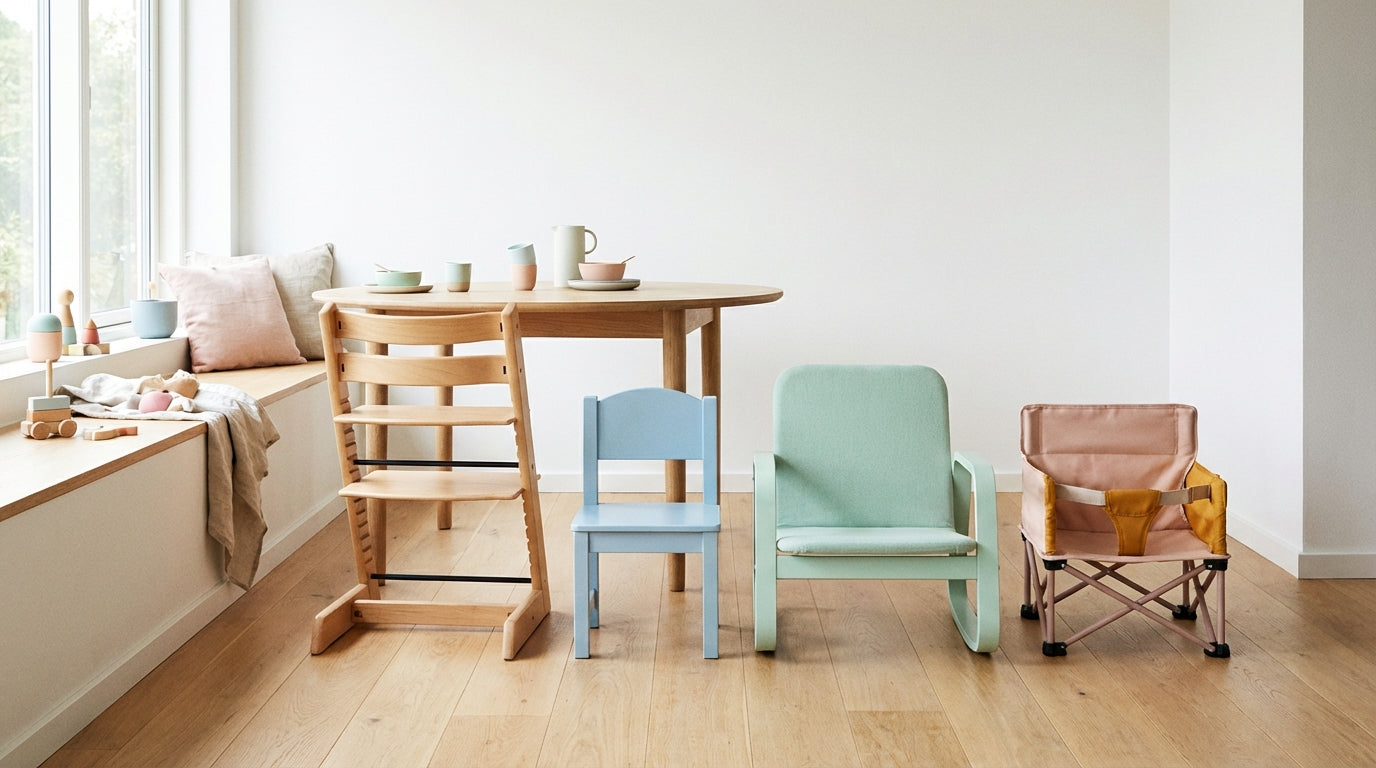
A regular children's chair is usually the better choice for table situations. For drawing, eating or crafting, a fixed seat is often more relaxed. The children's chair section is a good overview for that – there you'll find the more straightforward "I-stand-here-and-stay-here" models.
For longer sitting at a table, a suitable desk chair often makes more sense. Especially if your child already draws, does puzzles or will soon do homework, it's worth a look at the desk chair for kids.
What to look for when buying: the checklist for everyday life & safety
The most important point: The rocking chair must match your child's motor skills. If sitting is still wobbly, rocking quickly becomes a circus act. In that case, it's better to wait or to start with a stable seat that doesn't move.

- Stability: The chair shouldn't "tip away" sideways or twist while rocking.
- Movement: A calm, controlled rocking motion is better for everyday life than a "roller coaster".
- Seat height: Your child should be able to get in and out safely without having to climb up.
- Backrest: A backrest gives support – especially when rocking makes your child sleepy.
- Armrests: They can act like a little "frame" for smaller children and give a feeling of security.
- Edges & corners: Rounded simply means fewer ouchies in everyday life.
- Surface: Easy to clean isn't a luxury question, it's parent reality.
- Sliding behavior: Nothing should glide or "wander" uncontrollably on your floor.
- Workmanship: No splintery spots, no wobbly joints, no noticeable chemical smell.
- Notes & instructions: Clear age information, warnings and understandable assembly instructions save you trouble.
Practical tip: Let your child (under supervision) get in and out once before you get excited. If it's already tricky: keep looking.
Setting it up safely in 5 steps (the short list for the fridge)
Safety note: Place the rocking chair so that, while rocking, it can't reach furniture, edges or radiators.

With five simple steps, "wobbly" quickly becomes "ready for everyday life". It's not rocket science – more of a small safety check that spares you arguments and bruises later.
- Secure the surface: On laminate/tiles, put a non-slip mat or rug underneath.
- Create distance: Enough space at the front and back so nothing gets bumped.
- Keep the sides free: No boxes, building blocks or piles of toys next to the runners.
- Check pinch zones: Look at areas where fingers could get caught between runner and floor.
- A fixed "parking spot": A place at the edge (ideally with a wall nearby) makes things calmer.
Practical tip: Position the rocking chair so that one side is close to a wall. This often slows down wild rocking ideas without a word.
Standards & markings: What they really tell you (and what they don't)
The CE marking is not a quality seal, but it is an important mandatory marking. It shows that the manufacturer declares the product meets the relevant EU requirements; the CE marking is explained in connection with the EU Toy Safety Directive, among other things (according to IHK München).
DIN EN 71 is a series of standards on toy safety and describes tests. For mechanical and physical properties, DIN EN 71-1 is described, for example (see DIN Media), and for certain activity toys for domestic use, DIN EN 71-8 is explained (see DIN Media).
Standards help with orientation, but they don't replace your everyday check. A chair can be correctly marked and still be poorly placed in your home (smooth floor, too little space, sibling traffic). The reverse is also true: good assembly and a good location make a big difference.
"Activity toys" are toys that carry a child's weight and enable movement. Depending on the design, these include items meant for rocking, climbing or similar activities; DIN EN 71-8 describes requirements and test methods for them (according to DIN Media).
A "pinch point" is an area where fingers can get trapped. With runners and moving parts, distances change while rocking – so it's worth taking a look from a child's height (and yes: "riding along" once with your hand helps).
Materials & care: What really counts in family life
"Harmless" practically means: sturdy, well made and easy to keep clean. Whether wood, plastic or fabric – what matters is that nothing splinters, tears, peels off or comes loose. Children don't use things "carefully", they use them "with conviction".

Warnings and requirements are part of toy safety information in Europe. The Bavarian consumer portal explains, regarding EN 71, requirements and warnings in the toy sector, among other things (according to the Verbraucherportal Bayern).
- Wood: Look for smooth surfaces and clean edges – no splinters, no rough spots.
- Plastic: Check whether there are sharp burrs anywhere or parts that "crack" when you press lightly.
- Fabric/padding: Removable covers or surfaces that wipe clean easily are simply more relaxed in everyday life.
Care is easiest when you can do it in 60 seconds. A damp cloth, mild soap, done – anything that needs "special cleaner and three days of drying" is rarely loved in family life.
Which size fits? Simple rules of thumb without a tape-measure study
You can tell the size is right when getting in and out works safely. If your child tends to "plop in" when sitting down or has to climb up the chair to stand, it's often too tall or too big. If, on the other hand, they slump and can't find support, it's more likely too small.
More important than centimeters is how it's used: a quick wind-down or sitting for a long time? For short story times, a compact kids' rocking chair is often enough. If your child likes to sit longer, a backrest and armrests are usually more comfortable – and you have to say "sit properly" less often.
And let's be honest: Children grow, but apartments tend not to. Rather choose the model that fits well into your corner and gets used every day, instead of the one that would be great in theory but is in the way in practice.
Siblings, visitors & wild ideas: small rules, big effect
Most problems arise when several children want to "join in" at the same time. A mini rule set that everyone understands is often enough – including grandma, grandpa and visiting children.
- One child rocks: No pushing, no pulling, no "I'll just help".
- No climbing: The rocking chair is for sitting, not for gymnastics.
- Stop means stop: If someone feels unsure, we pause – no discussion.
If you need it short, the northern German way: "Rocking yes, pushing no." Often, that's all it takes.
Why we at Bieco are so particular about this topic
We are a family business from Hamburg and have been making children's things for 66 years. Ulli & Flo write here as parents for parents – and we know: at home, what counts isn't the perfect Pinterest corner, but that it works in everyday life.
For us, safety isn't a secret, but something you must be able to explain. That's why we look for comprehensible information, understandable notes and workmanship you can check with your own eyes. And if something is only meant to be used "under supervision", we say so – plainly.
FAQ
From what age does a kids' rocking chair make sense?
A rocking chair makes sense when your child can sit securely and get up in a controlled way. This depends less on the birthday than on motor skills. At the beginning, start with short moments and stay nearby until you see: the rocking stays calm and your child can stop safely.
Is a bouncy chair safer than a rocking chair for kids?
Not automatically – stability, assembly and placement are what matter. A bouncy chair may have a more limited motion, but there are tipping and pinching risks here too. Look for clear notes, check the stance on your floor and keep your distance from furniture edges. Safety is often more "space & rules" than "name".
How do I recognize a safe kids' rocking chair?
A safe kids' rocking chair is sturdy, cleanly made and clearly marked. For products that count as toys, the CE marking is a mandatory marking and important guidance (according to IHK München). In practice, these also count: no sharp edges, no loose parts, controlled movement.
Can I use a kids' rocking chair on laminate or tiles?
Yes, but use a non-slip mat or rug underneath. On smooth floors, a rocking chair can otherwise glide uncontrollably. This protects the floor as a bonus and makes rocking more predictable. Also make sure there is enough distance so that nothing gets bumped while rocking.
How do I prevent pinch points while rocking?
You best prevent pinch points with space, supervision and a quick check before starting. Look at the runners and moving areas from a child's height: where does the gap get small while rocking? Place the chair so that nobody "walks along" beside it, and explain briefly: fingers are best kept on the armrests.
If you're feeling good now, stick with the checklist – it saves nerves. As a next step, the overview in the children's chair category is a good fit, and if it's really meant to become a rocking spot, you'll find suitable models under rocking chair for kids.