Baby Winter Essentials: What Do You Really Need for Your Winter Baby?
At a glance
- Baby winter essentials: just a few basics are enough if you layer smartly.
- Sleeping: a sleeping bag and suitable clothing are better than a pile of blankets.
- On the go: pack wind protection, a blanket or footmuff, and an "emergency layer."
- In the car: buckle your baby in without a thick jacket, and only cover them afterwards (ADAC).
- Room climate: let your baby sleep in a rather cool room and avoid overheating (NHS).

Good baby winter essentials consist of layers, a safe sleep set and a warm plan for being out and about. You really don't need more than that at the start. Winter babies don't come into the world with extra demands – just with extra comments from the relatives. Here you'll find a small, everyday-friendly list plus clear tips for sleeping, going outside and travelling by car. And yes: with enough room to breathe.

Ulli & Flo
Owners of bieco · Hamburg · parents themselves
With our first winter baby, we also thought: "Better too much than too little." In the end, things were more relaxed with layers, a sleeping bag and a small checklist for going out. Feel free to browse our Baby Essentials collection.
Table of contents: find everything quickly.
- What do you really need?
- Clothing: a small list without overkill
- Sleeping in winter: warm, but not too warm
- On the go: stroller, carrier & packing list
- Car: infant car seat, harness check & covering up
- Room climate & skin in winter
- What you can often skip
- Mini plan for 14 days
- FAQ
Baby Winter Essentials: What Do You Really Need?
What you really need: warmth close to the body, a safe sleep environment and a good transport plan. Everything else is "nice to have," but not a must. If you cover just these three areas solidly, you'll be surprisingly relaxed:
- Clothing based on layering (bodysuits, rompers, cardigans/snowsuit depending on the weather)
- Sleeping without heat build-up (sleeping bag instead of a fortress of blankets)
- Warm but safe on the go (stroller/carrier + following the car rules)
Layering means: several thin layers instead of one thick one. That's practical because you can react quickly when the heating, the weather or your baby's mood changes.
A baby sleeping bag is a wearable blanket that doesn't slip. This helps many families stay calmer at night, because there's less need to pull the blanket back up.
Practical tip: Write on a note: "I'm allowed to buy more later." It takes the pressure off – and often saves money.
We are a family business from Hamburg and have been doing this for 66 years. Ulli & Flo write here as parents for parents – with the aim that tips work in real everyday life and not just on paper.
Baby Winter Essentials: The Small Clothing List (Without Overkill)
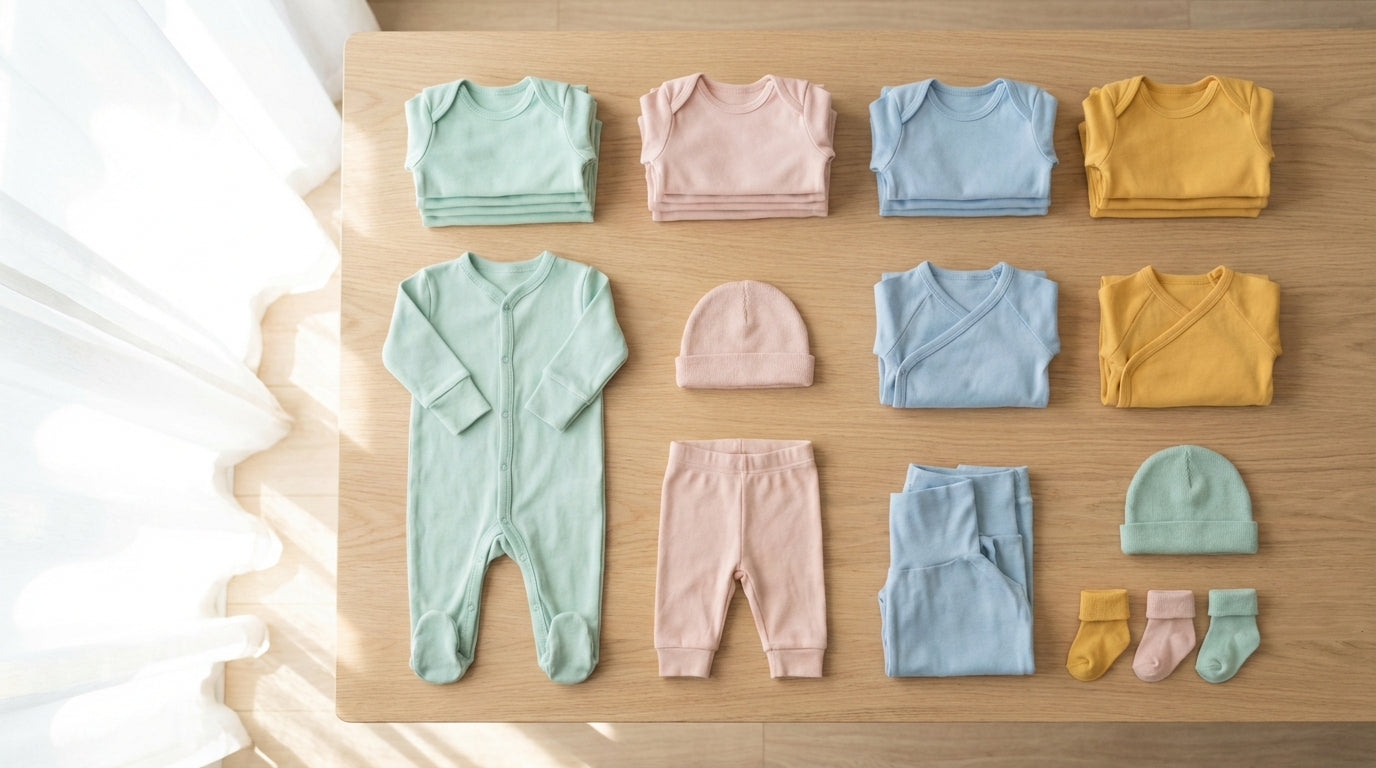
Plan to "wash more often" rather than "buy double" – babies grow fast. For the first weeks, a manageable basic set is enough, which you can adapt to your laundry rhythm:
- 6–8 bodysuits (long-sleeved is practical in winter; short-sleeved works as an under-layer)
- 5–7 rompers/sleepsuits (comfortable, worth their weight in gold at night)
- 2–3 wrap cardigans (wrap styles are often easier than fiddling things over the head)
- 2–3 pants/leggings (if you like bodysuit + pants)
- 2–4 pairs of socks (yes, they disappear anyway)
- 1–2 little hats (thin for indoors, warmer for outdoors)
- 1 warm snowsuit (for stroller/carrier – depending on region and temperature)
Practical tip: Many start with sizes 56/62 and only buy 1–2 items in size 50. That saves you from "worn twice, already too small."
Winter Dos and Don'ts (short and painless)
- Do: go for one more thin layer that you can take off.
- Do: choose clothing that opens easily (wrap styles, zippers).
- Don't: bundle your baby up "just in case" when you're indoors.
- Don't: use thick, padded jackets in the infant car seat (more on that shortly).
When it comes to fabric, what matters most: comfortable, easy to care for and not restrictive. Many families do well with cotton as a base and a warming layer on top – depending on how warm your home is and how your baby "ticks."
If you're looking for a general checklist, a big list helps you sort things out. You'll find it here: Baby Essentials: The Ultimate List & Checklist for Parents.
Winter Baby Essentials for Sleeping: Warm, but Not Too Warm
In winter, overheating is often the bigger issue in everyday life than "too cold." Heating on, baby dressed warmly, plus a blanket "just for a moment" – and suddenly it's too much.
A good guideline is a rather cool sleeping environment. According to the NHS, a room temperature of around 16 to 20 °C is considered suitable; lightweight bedding or a well-fitting sleeping bag is recommended. (NHS)
A sleeping bag instead of a blanket is the lower-stress solution for many. According to the NHS, baby sleeping bags can help reduce the risk of babies slipping under a blanket; what matters is a good fit at the shoulders and that no additional duvet is used. (NHS)
Safety note: Do not use loose, thick or heavily padded items around the head in the crib. This is unfavourable for safe sleep (see NHS recommendations).
How do I tell if my baby is "too warm" or "too cold"?
The neck is usually the best quick check: warm and dry is good. Cold hands and feet are common in babies and not automatically a sign that they are cold. If the neck is very hot or your baby is sweating, take off a layer.
If you want to sort out sleepwear in more detail, a dedicated guide can help. This way: Baby Essentials Clothing: What Does My Child Really Need?
Winter Baby Essentials for On the Go: Stroller, Carrier & Co.
Outdoors, what counts is wind protection plus adjustable warmth – not "as thick as possible." You want something you can adjust in 10 seconds if needed, without unpacking your baby completely.
Stroller packing list (short, but complete)
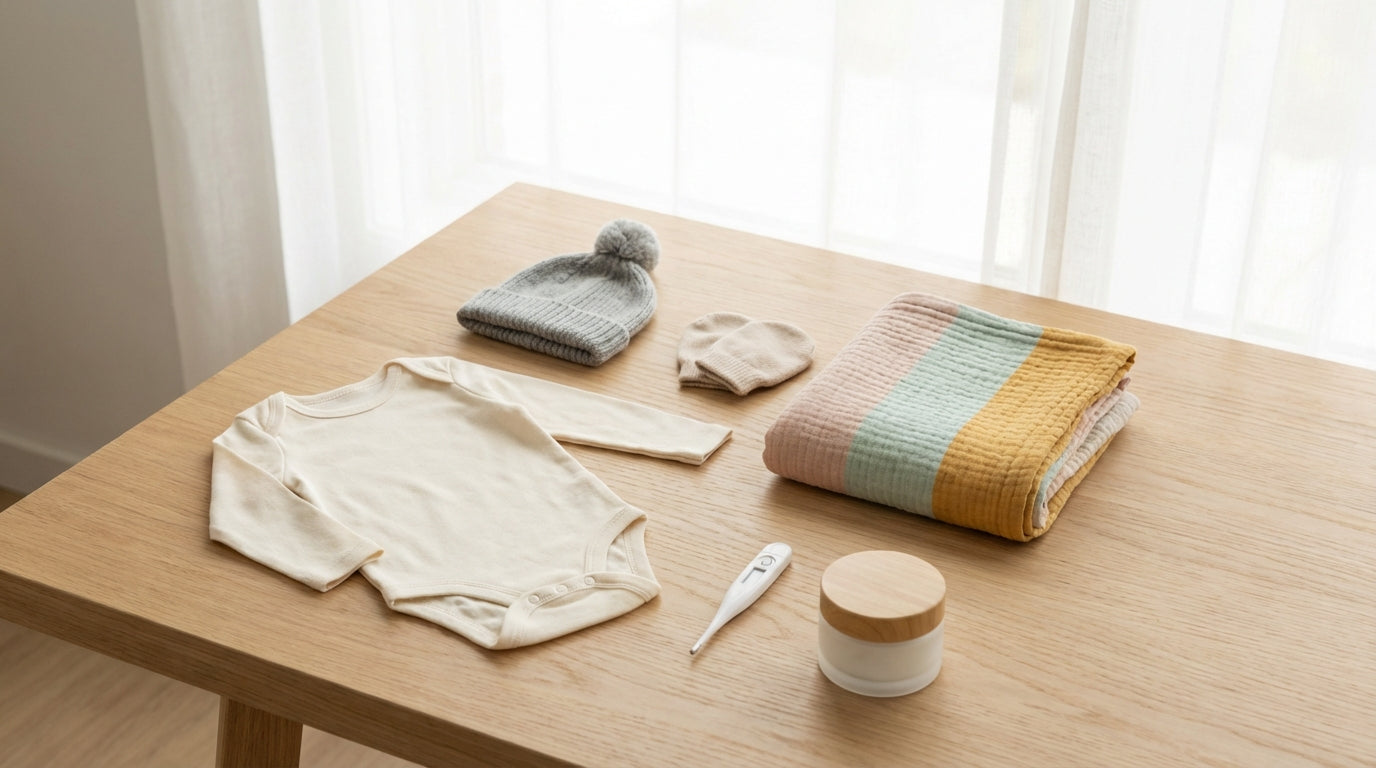
- Blanket or footmuff (to lay over or wrap up)
- Hat (ears covered, fits well)
- Wind and weather protection (very helpful in winter too)
- An extra layer (e.g. a cardigan or thin blanket for "it's warm inside")
In a carrier, your body is often the best heater. Under a babywearing jacket or carrier cover, your baby often needs thinner outer layers than in a stroller. Make sure the face stays free and you can adjust quickly.
Practical tip: If you're heading into warm shops: hat off first, then the blanket if needed. This prevents "suddenly soaking wet."
Baby Winter Essentials List for the Car: Infant Car Seat, Harness Check & Blanket Afterwards
In the car, the rule is: buckle in without a thick winter jacket and only cover up afterwards. The reason is simple: padded clothing can keep the harness from sitting snugly against the body.
The ADAC warns against thick jackets in infant car seats and child seats. According to the ADAC, the harness can end up too loose, offering less protection in an emergency. (ADAC)
How to do the "harness check" in 30 seconds
- Jacket off (thin bodysuit/romper, possibly a thin cardigan).
- Tighten the harness (it should sit snugly against the body without pressing).
- Test at the strap: you shouldn't be able to pinch a "bundle of material" at the shoulder strap.
- Only then cover up (blanket over the fastened harness, or the jacket placed over backwards).
To keep warm, the ADAC recommends: cover up after buckling in. As an everyday solution, the ADAC suggests buckling the child in without a thick jacket and then warming them with a blanket. (ADAC)
Safety note: No thick jackets, no additional padding or inserts "under the harness" unless they come with the infant car seat. If in doubt, check the seat's instruction manual.
Room Climate & Skin in Winter: Small Adjustments, Big Effect
Winter everyday life often means dry heating air and quick temperature changes. Sometimes you notice it less in your baby than in yourself – and then wonder why everyone is somehow "grumpier."
Room climate: what you can do with no effort
- Air out briefly and thoroughly (instead of leaving the window tilted all day).
- Don't overheat the sleeping area (the NHS gives 16–20 °C as a guideline). (NHS)
- Adjust clothing instead of "cranking up the radiator and hoping for the best."
For skin care, the rule is: as much as necessary, as little as possible. Some babies do great without much care, others react to dry air. If you use a cream, choose one your baby tolerates well, and simply observe whether things improve.
What You Can Often Skip in Your Winter Baby Essentials
Not everything that looks "wintery" is truly helpful in everyday life. A few typical candidates that many people buy – and then they sit there like unused exercise equipment:
- Too many thick outfits (better to have a few that can be combined)
- Mini-sized snowsuit (often impractical for newborns, unsuitable in the car)
- Piles of shoes (socks/booties are usually enough, walking comes later)
- Additional heat sources in the bed (unfavourable for safe sleep; better to follow NHS recommendations) (NHS)
"Cosy" is not automatically "practical." If you're unsure, stick to clear, public recommendations for safe baby sleep and keep your sleep environment simple and uncluttered.
How to Plan Calmly: Start Small, Buy More Later
The best winter baby essentials are the ones that fit your everyday life. Well-insulated home or old building? Lots of driving or lots of walking? That decides more than any perfect list.
Mini plan for the first 14 days
- Basic clothing for 5–7 days (depending on your laundry rhythm)
- Sleep set (sleeping bag + suitable sleepwear)
- On-the-go set (blanket/footmuff, hat, wind protection)
- Car rule (buckle in without a thick jacket, cover up afterwards)
If you're also keeping an eye on the budget: completely normal. To help you sort things out: What Do Baby Essentials Cost? Saving Tips & Financing.
FAQ
What really belongs in baby winter essentials?
Above all, you need layers, a sleep set and basics for being out and about. Start with bodysuits, rompers, 1–2 wrap cardigans, a hat and a sleeping bag. For outdoors, a blanket or footmuff plus wind protection is enough. You can buy the rest calmly later, once you've found your rhythm.
How many layers does a baby need in winter at 0°C?
Usually several thin layers plus wind protection make sense, because you stay flexible. Typical is: a base layer (bodysuit), a romper on top and, depending on the situation, a warming layer/snowsuit. In the stroller, a blanket or footmuff is often added. Check the neck/chest regularly instead of only looking at cold hands.
Which TOG is right for winter?
It depends mainly on the room temperature, not the calendar. The NHS recommends a sleeping environment of around 16–20 °C as a guideline and a well-fitting sleeping bag instead of additional blankets. (NHS) So always look at temperature and your baby's signals, not just a number.
How can I tell if my baby is overheating?
Typical signs are sweating, a very hot neck or sudden restlessness. If the neck feels clearly hot or damp, that's often a sign of "too warm." Then take off a layer and check the surroundings (heating, blanket, room temperature). Cold feet alone, on the other hand, are often normal.
Why no thick jacket in the infant car seat?
Because the harness can then sit too loosely and protect less well. The ADAC warns that thick winter jackets affect the harness routing unfavourably, which can reduce the protective effect. (ADAC) Better: buckle in without a jacket and cover up afterwards.
Do I need a sheepskin footmuff?
It's not a must – what matters is that you can regulate warmth well. Many families do just fine with a blanket or a regular footmuff, as long as wind protection and layers are right. If you use something warmer, make sure your baby doesn't overheat and that you can quickly "slim down" the layers in warm places.
Finally, nice and calm: a small list beats a wardrobe explosion. If you're looking for inspiration for basics, you'll find a clear selection in our Baby Essentials – and you simply take only what suits your winter routine.
Mini Checklist to Take Along (for Tired Minds)
- Clothing: bodysuits, rompers, 1–2 cardigans, hats
- Sleeping: sleeping bag + suitable sleepwear, no loose thick items
- On the go: wind protection, blanket/footmuff, extra layer
- Car: buckle in without a thick jacket, cover up afterwards (ADAC)