How Much Money Can You Get for Your Baby's First Essentials? (Guide)
At a glance
- How much money do you get for your baby's first essentials? Privately, roughly €300–2,000+; at the Jobcenter it varies by municipality.
- A mini start is often realistic: sleeping, changing, clothing, getting around.
- Jobcenter benefits for initial equipment are extra benefits, not part of the standard rate.
- Apply early, collect your documents, check the decision letter – it saves your nerves.
- Second-hand for big items, new for safety-related basics – a good mix.

How much money you get or need for your baby's first essentials usually falls somewhere between “lean and second-hand” and “comfortable and new” – and at the Jobcenter it depends on your municipality. So you don't spend three nights building spreadsheets (and then still forget the muslin cloths), here is a down-to-earth overview: typical budget ranges, the items that really cost money, and, very practically, how first-time equipment works at the Jobcenter (lump sum vs. benefit in kind, documents, timing, appeals). Ulli & Flo write this as parents – and as a Hamburg family business that has spent 66 years seeing what families actually end up using.

Ulli & Flo
Owners of bieco · Hamburg · parents themselves
We wish we had known back then that a mini start is perfectly fine. With a short list and a calm pace, it usually turns out cheaper than expected. Feel free to browse our baby essentials collection.
How much money do you need for your baby's first essentials? Realistic ranges
As a rough guide: mini start approx. €300–600, solid mix approx. €700–1,400, mostly new often €1,500–2,500+. These are not official figures, but typical budget corridors when you honestly factor in the big items (getting around, sleeping).

| Option | What it's based on | Rough range |
|---|---|---|
| Mini start | mostly second-hand/borrowed, focus on 4–6 weeks | approx. €300–600 |
| Solid start | Mix: essentials new, expensive items second-hand | approx. €700–1,400 |
| Comfort start | mostly new, “everything ready” | approx. €1,500–2,500+ |
Definition: Baby essentials are the basic equipment for the first weeks with a newborn – not a shopping trip for the whole first year. If you keep that in mind, it automatically gets cheaper (and your hallway stays walkable).
Practical tip: Plan for the first 4–6 weeks only. Everything after that can follow later – babies grow faster than you can say “shopping cart.”
Which items blow the budget? (Spoiler: rarely the bodysuits)
The biggest cost drivers are almost always transport (stroller/infant car seat) and sleeping (cot/mattress). Clothing and small items do add up, but the “ouch” moment usually comes with the big pieces.

- Transport: stroller, infant car seat/child seat, possibly a baby carrier.
- Sleeping: bedside crib/baby cot, mattress, sleeping bag, sheets.
- Changing & care: changing mat, diapers, washcloths, cream.
- Clothing: bodysuits, rompers, hat, socks – better fewer, but fitting.
- Household: muslin cloths, bottles/nursing supplies if needed, laundry.
If you want to save, save big: second-hand stroller, second-hand clothing, small items bought new where it counts. That is usually more effective than scrimping a little everywhere and ending up buying things twice.
Saving tips that really work (without feeling deprived)
You save the most with a clear mix: big items second-hand, safety-related basics new. That's not “stingy,” that's simply parenting reality – and honestly: quite sensibly northern German.
1) Second-hand for big items – but with a quick check
Strollers, bedside cribs and changing tables are often perfectly fine second-hand, as long as their condition is good and all parts are there. Ask about smoke-free/pet-free households, check the mechanics, screws and brakes, and have the seller show you how everything is assembled.
2) New for anything that touches the baby directly (or is safety-critical)
Many parents choose a new mattress and sleeping bag – for their own peace of mind and because they're used every day. For infant car seats the rule is: second-hand only with a clear history (accident-free, no cracks, all parts present) and the instruction manual.
Safety note: Only use infant car seats/child seats if they are accident-free and complete. When in doubt, leave it – safety is not up for debate.
3) Clothing: fewer, but smart
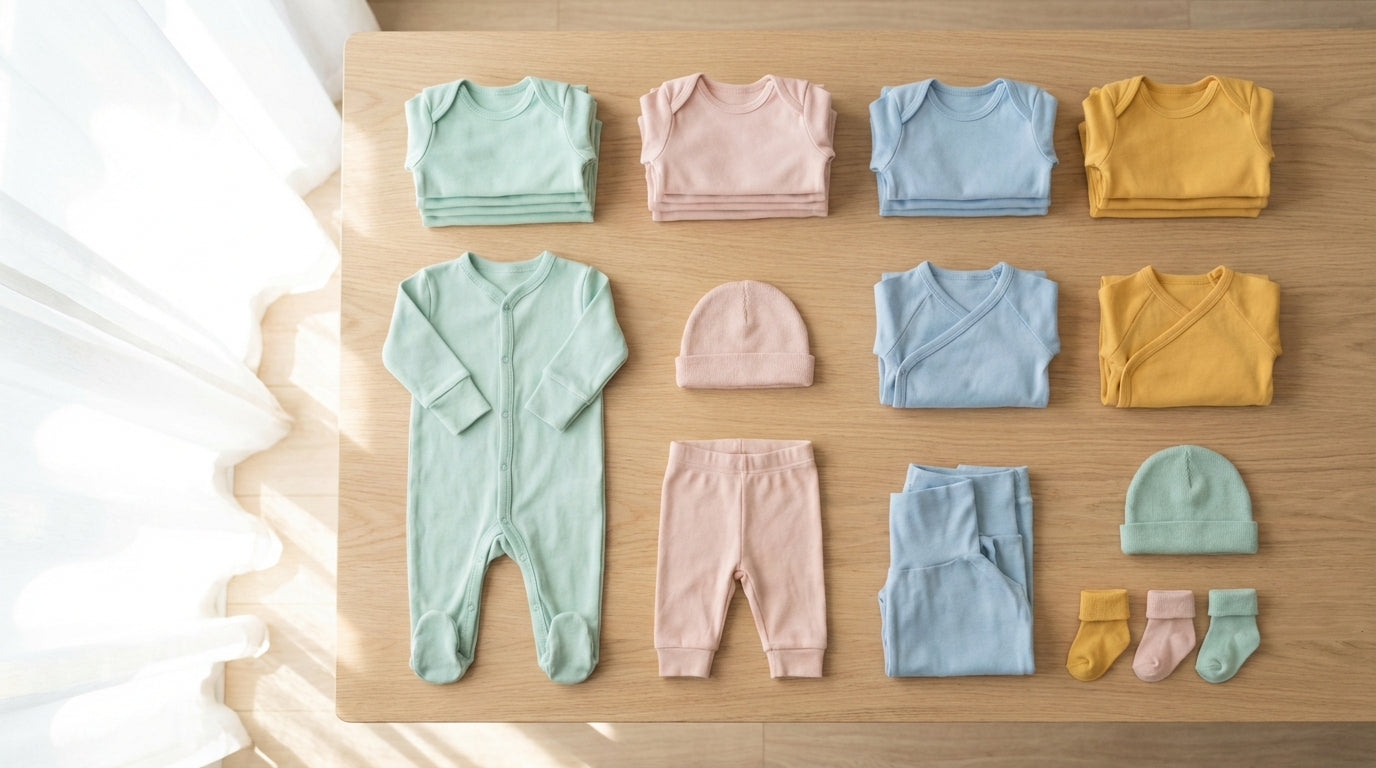
To start, 6–8 bodysuits and 6–8 rompers are often enough – the rest is down to your laundry rhythm. If you rarely do laundry or have a baby who spits up a lot: yes, feel free to get more. Second-hand in sizes 50/56 is often barely worn, because those sizes only say hello for a short while.
4) Borrow instead of buying
Anything that is only handy for one phase is often worth borrowing. Examples: baby bathtub, bouncer, certain nursing aids. That saves money and storage space – and later you don't have to post “free to a good home” in five groups.
5) A wish list instead of duplicate purchases
A small wish list keeps you from ending up with five cuddly toys and zero muslin cloths. Grandparents and friends are usually grateful for concrete ideas – and “something cute” becomes something that really makes your life easier.
If you're looking for a basic set as a guide, you'll find it bundled here: baby essentials. And if you like ticking off lists (we don't judge): Baby Essentials: The Ultimate List & Checklist for Parents.
How much money do you get from the Jobcenter for your baby's first essentials?
The Jobcenter can grant a one-time benefit for initial equipment for pregnancy and birth – the amount differs by municipality. The legal basis is § 24 paragraph 3 SGB II (initial equipment), which explicitly names pregnancy and birth, among other things. You can read it at the Federal Ministry of Justice: SGB II § 24 (gesetze-im-internet.de).
Important to understand: This initial equipment is an extra benefit and not part of the standard rate. This is also explained in the Federal Employment Agency's knowledge database on § 24 SGB II, which covers the deviations/extras: Federal Employment Agency – § 24 SGB II (WDB).
Definition: Jobcenter initial equipment is a one-time benefit for a first-time need (e.g. a birth) and not a monthly payment. That's helpful because it lets you cover purchases that would otherwise hit all at once.
Lump sum or benefit in kind: how the money (or the items) actually reaches you
Jobcenters can grant initial equipment as a cash lump sum, as a benefit in kind, or as a combination – depending on local practice. That's why the neighbor from the next district tells you something completely different from what ends up in your decision letter.
- Lump sum: You receive a fixed amount (or several partial amounts) and buy things yourself.
- Benefit in kind: You receive vouchers or specific items via a provider/cooperation partner.
- Combination: Part as money, part as vouchers/benefit in kind.
If you have a choice: a lump sum is often more flexible – but a benefit in kind can make sense if you can't pre-finance purchases right now. Feel free to ask in writing which form is common in your area.
Typical benefit contents: What is often recognized for baby essentials?
Typical items cover sleeping, changing, basic clothing and transport – luxury items are usually not included. Many municipalities define which items are recognized through lists or guidelines.
- Sleeping: baby cot/bedside crib, mattress, bedding/sleeping bag (depending on the list)
- Changing: changing mat or changing option, possibly a basic diaper supply
- Clothing: basic newborn clothing
- Transport: often a stroller, sometimes an infant car seat (varies by region)
- Care/household: a few basics, depending on the guideline
If you're unsure whether an item “belongs”: put it in the application anyway – the Jobcenter can still strike it. Not writing it down often means it won't be considered.
Applying at the Jobcenter: timing, documents, typical stumbling blocks
It's most relaxed if you submit the application a few weeks before your due date and send your needs list along right away. That leaves time for follow-up questions – and you don't have to chase prices on the phone while heavily pregnant.

Which documents are often required?
Proof of pregnancy (e.g. maternity record/medical certificate) and a needs list are often required. Depending on the Jobcenter, quotes/price evidence may also be needed, especially if no lump sum is used.
- Proof of pregnancy: depending on requirements (copy of the relevant page of the maternity record or a certificate)
- Needs list: short and clear (sleeping, changing, clothing, transport)
- Quotes/price overviews: screenshots, brochures or online offers (if individual proof is required)
Practical tip: Set up a folder (digital is enough): application, proof, confirmation of receipt, decision letter. Later you'll be glad you don't have to search.
When is it paid out?
That depends on processing time and the form of benefit – lump sums arrive after approval, benefits in kind often come as vouchers. If time is tight, ask for a quick decision and state your due date.
Appeal: What to do if something is rejected or approved too low?
If you disagree with the decision letter, you can file an appeal – what matters is the notice of legal remedies in the letter. The deadline is stated there (please really read it, don't guess), and a short, factual appeal is often better than a novel.
- Step 1: Read the decision and its reasoning carefully (which item, why was it rejected?)
- Step 2: Submit anything missing (e.g. a quote, a justification of “first-time need”)
- Step 3: File the appeal in writing and secure a confirmation of receipt
If all this bureaucratic German is too much: advice centers can help you word your needs properly. Especially in stressful times, that is worth its weight in gold.
Distinction: initial equipment vs. standard rate vs. additional needs (short and simple)
Initial equipment is one-time, the standard rate is monthly, and additional needs are a monthly supplement for special situations. It sounds dry, but it helps you avoid applying for the wrong thing.
- Standard rate: ongoing living costs (monthly)
- Additional needs: extra monthly need in certain cases (e.g. pregnancy can trigger an additional-needs supplement; the law and your situation determine the details)
- Initial equipment: one-time benefit for first-time purchases (e.g. basic baby equipment)
Rule of thumb: everyday diapers are more “ongoing,” the first place to sleep is “one-time.” And yes, the line sometimes feels unfair – but this is the best way to sort it.
Initial equipment for a home at the Jobcenter: When is it possible – and what counts?
A one-time benefit may also be available for furnishing a home if there is a first-time need. This is also named in § 24 paragraph 3 SGB II, likewise readable in the legal text: SGB II § 24 (gesetze-im-internet.de).
“First-time” means: no basic equipment exists yet – not: “the toaster is broken.” Typical cases might be a first own apartment or a fresh start after a separation; how exactly the Jobcenter examines this again varies locally.
- Typical contents: basic furniture (bed, table, chairs), household appliances (depending on the guideline), cooking facilities
- Documents: often rental agreement/move-in proof, needs list, possibly quotes
- Form: lump sum, benefit in kind or a combination
Here too: get the decision in writing and keep the decision letter. That's not distrustful – that's simply tidy.
Further help: Federal Foundation Mother and Child
If money is very tight, additional help may be possible through the Federal Foundation Mother and Child (Bundesstiftung Mutter und Kind) – applied for via pregnancy counseling centers. According to the BMFSFJ (Federal Ministry for Family Affairs), help can be granted for maternity clothing and the child's initial equipment, among other things; the amount depends on the individual case: BMFSFJ – Federal Foundation Mother and Child.

Important: There is no legal entitlement to foundation funds, and the application must be submitted before the birth. The BMFSFJ also states this in its information on the foundation (see the link in the sentence above).
FAQ
How much money do you get for your baby's first essentials?
Privately, the range is roughly €300–2,500+ – depending on how much is second-hand/borrowed and what you buy new. At the Jobcenter, a one-time initial equipment benefit for pregnancy and birth may be possible; the amount is set regionally and is not a fixed nationwide figure in the law.
How much money do I get from the Jobcenter for initial equipment?
That varies by municipality, because Jobcenters often work with lump sums or lists. The legal basis is § 24 para. 3 SGB II (initial equipment), which you can read at the Federal Ministry of Justice on gesetze-im-internet.de. Ask your Jobcenter in writing about the currently applicable lump sums.
What do I need to submit when applying for baby essentials at the Jobcenter?
You usually need proof of pregnancy and a needs list; depending on the Jobcenter, also quotes/price overviews. If individual proof is common in your area, screenshots or brochures help. It's important to submit everything in writing and secure a confirmation of receipt.
When should I apply for initial equipment at the Jobcenter?
Ideally a few weeks before your due date, so there is enough time for follow-up questions and approval. If you're running very late, state your due date in the application and ask for a prompt decision. The earlier you sort it out, the calmer everything else becomes.
What is the difference between initial equipment and additional needs?
Initial equipment is a one-time benefit for purchases, additional needs are a monthly supplement in certain situations. The standard rate is the monthly basic benefit. If you're unsure whether something is “one-time” or “ongoing”: a place to sleep is classically one-time, diapers are ongoing.
What should I do if the Jobcenter rejects something?
You can file an appeal – the deadline is stated in the notice of legal remedies in your decision letter. Read the reasoning, submit any missing proof and stay factual. Advice centers can help if you need support with wording or organizing your documents.
Finally, nice and relaxed: you don't have to buy everything at once – really, you don't. Build your baby essentials like a good fish sandwich: first the base, then the rest. If you'd like clear guidance while putting things together, take a look at our baby essentials or the checklist – it makes everything easy to see at a glance.