Baby Essentials Checklist: Tick-Off List for the First 0–8 Weeks
At a glance
- Baby essentials checklist: the basics in 6 categories, ready to tick off right away.
- Start with “0–2 weeks” – you can add the rest as you go.
- Safe sleep means: on the back, in a sleeping bag, with an empty cot.
- On the go, what counts is a suitable infant car seat (i-Size) and one main solution (carrier or pram).
- At the end you'll find a complete checklist to print or copy.

A good baby essentials checklist is short enough that you will actually use it. Here you get a tick-off checklist sorted by sleeping, changing, clothing, feeding, care and out and about – plus a “0–2 weeks” mini list so you don't drown in stuff. And yes, a little wink is allowed. Parenthood is not a crafting contest, after all.

Ulli & Flo
Owners of bieco · Hamburg · parents themselves
Back then, we would have loved a short tick-off list on the fridge – instead of 20 open tabs and a knot in our stomachs. Use it as a calm cheat sheet for the first few weeks. Feel free to browse our Baby Essentials collection.
How to use this baby essentials checklist (without stress)
Split your baby essentials into “must be there before the birth” and “can wait.” That takes the pressure off, saves money, and keeps the two of you from making each other nervous with 17 kinds of pacifiers in week 38.

- Step 1: First tick off the “0–2 weeks” basics.
- Step 2: Mark everything else with “buy / borrow / second-hand / gift.”
- Step 3: Plan a buffer: babies are tiny, but surprisingly productive (spit-up, diapers, laundry).
Definition: Baby essentials are the small basic kit that covers sleeping, changing, dressing, feeding and safe transport in the first weeks.
Practical tip: Write yourself a note: “If the baby arrived today…” Anything you wouldn't need for that can wait.
Baby essentials checklist for weeks 0–2: what you really need first
For the first few days, a handful of basics is enough – as long as they work reliably. The rest will still be there later (and so will your head).
- Sleeping: safe sleeping place + mattress + 2 fitted sheets + 1–2 sleeping bags
- Changing: changing mat + diapers (small pack) + washcloth/wet wipes + waste bags
- Clothing: 6–8 bodysuits + 4–6 sleepsuits + 2 little hats (seasonal) + 4–6 pairs of socks
- Feeding: burp cloths (several) + breastfeeding/bottle basics (depending on your plan)
- Care: mild wash product/oil + soft towels + nail scissors/file
- On the go: infant car seat (if you have a car) + carrier or pram + small changing organizer
If you remember just one thing: A safe sleeping place and a relaxed changing spot are half the battle.
Sleeping: safe, simple, everyday-friendly
For baby sleep, the rule is: on the back, in a sleeping bag, and the cot stays empty. That's not only practical, it also matches the recommendations of public authorities.

- Sleeping place: cot, bedside crib or Moses basket (sturdy, right dimensions)
- Mattress: a perfect fit, firm
- 2–3 fitted sheets
- 1–2 sleeping bags (keep the season in mind)
- Optional: baby monitor (if it puts your mind at ease)
Important: According to the Bavarian State Office for Health and Food Safety (LGL), placing your baby on their back is the most important measure for safe baby sleep; a sleeping bag and a smoke-free environment are also recommended (LGL: Safe Baby Sleep).
Safety note: No pillows, bumpers or thick blankets in the baby's cot – choose a sleeping bag and a clear, uncluttered cot instead.
North German pragmatism: “Pretty” is when you sleep well. “Safe” is when the baby sleeps safely. Both together are the jackpot.
Changing & care: within reach beats picture-perfect
A good changing spot saves your nerves – not the tenth special cream. What you mainly need: everything within reach, a safe surface and a routine that also works at 3:40 a.m.

- Changing mat (wipeable) + 1–2 soft pads/towels
- Diapers (small pack to start)
- Wet wipes or washcloth + warm water
- Diaper rash cream as needed
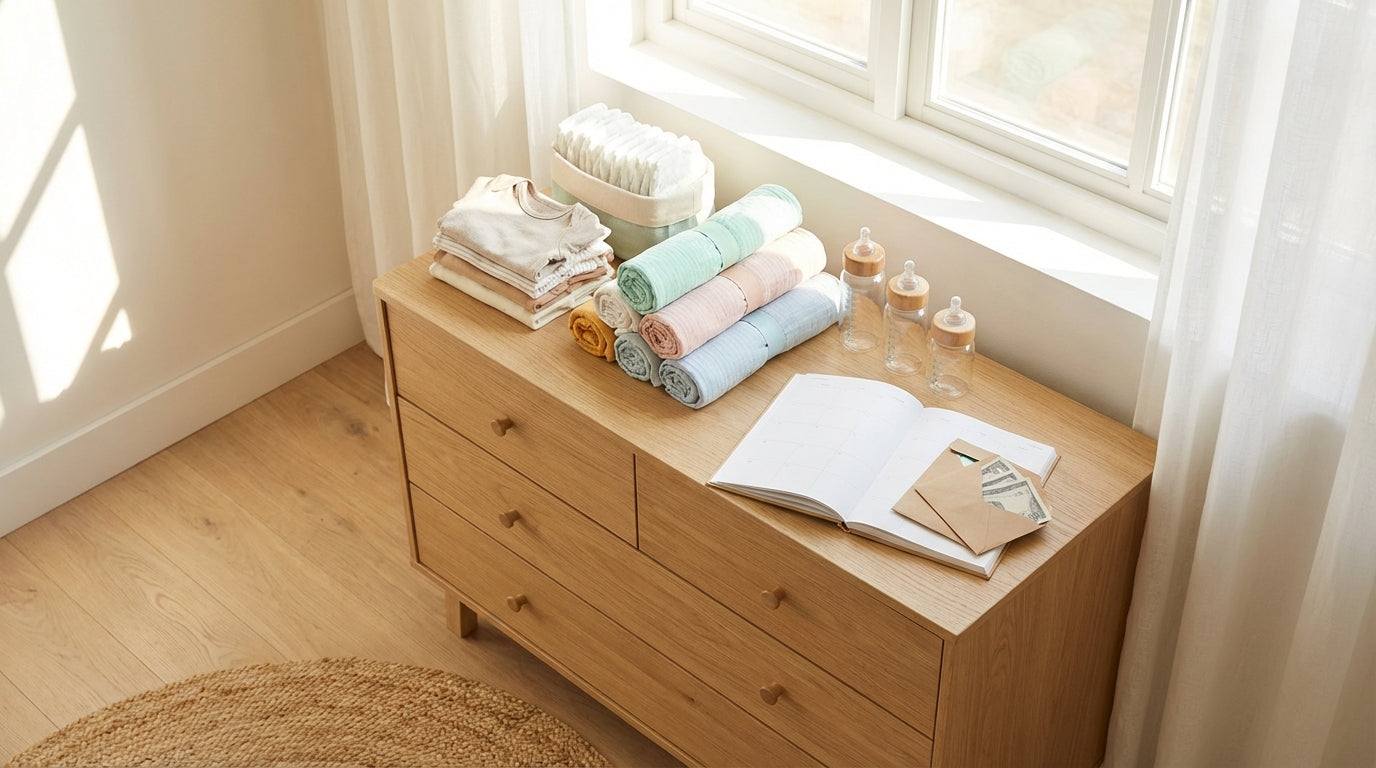
- Spare clothes at the changing spot (1 bodysuit, 1 sleepsuit)
- Care: mild wash gel/oil, baby brush, nail scissors/file
Definition: A changing station is a fixed spot where everything is laid out so that you can always keep one hand on the baby.
Practical tip: Keep 3–5 “emergency sets” ready: diaper + wipe + fresh bodysuit. Then you don't have to search at night – just act.
Quick material check: Soft, easily washable fabrics (e.g. cotton) are often the simplest in everyday life – as long as nothing scratches and you can wash them often.
Clothing: sizes, quantities, seasons (and why less is often more)
With baby clothes, it's not quantity that wins, but a smart rotation. Babies grow fast, spit up even faster – and the laundry seems to run constantly anyway.
Basic clothing (starter set)
It's better to plan for two sizes than to stack everything in one size. Many families start with 50/56 and have 62 ready – simply because babies start out in different sizes.
- 6–8 bodysuits (short or long sleeves depending on the season)
- 4–6 sleepsuits/pajamas
- 2–3 pants/leggings (if you don't only use sleepsuits)
- 2 jackets or cardigans
- 2 little hats (thin indoors, warmer outdoors)
- 4–6 pairs of socks
- 1–2 outfits “for visitors” (yes, grandparents will be happy too)
Seasonal helpers: what can make sense in addition
Seasonal items are handy – but only once you really have to go out. A baby in midsummer needs different things than a January baby, but a lot of it can be picked up at short notice.
- Winter: warm snowsuit or wrap blanket/footmuff (depending on your pram), possibly a warm hat
- Summer: light sun hat, thin blanket, airy clothing
If you want to dive deeper: In our guide Baby Essentials for Winter Babies: What Do You Really Need? you'll find a seasonal overview.
And if it's twins: You don't need double of “everything,” but some things, yes (e.g. sleeping bags, basics). You'll find an overview here: Baby Essentials for Twins.
Feeding: breast, bottle – and perfectly normal spit-up life
For feeding, at first you mainly need a working foundation – not a collection of gadgets. Whether breastfeeding, bottle or both: what matters is that you get through the day (and the night) calmly.
- Burp cloths (really, several)
- Breastfeeding: nursing pads, nursing bra/top if needed, a comfortable spot
- Bottle: a few bottles, matching teats, bottle brush
- Optional: thermos/small kettle within reach (depending on your daily routine)
Everyday reality: One burp cloth at the changing spot, one on the sofa and one by the bed isn't “overkill,” it's forward-thinking.
On the go & in the car: arriving safely (without the circus)
On the go, one main solution helps: carrier or pram – and you add to it later. A carrier is compact, a pram is a “storage surface on wheels” (sometimes exactly what you need).
Pram & carrier: what belongs on your list
Choose what suits your routes: stairs, city, countryside, car, bus. There is no single “right” solution – only the one you will actually use.
- Pram (or combi): look for clear safety information and suitable use
- Baby carrier: suited to you and the baby, adjusted correctly
- Changing bag/organizer: diapers, wipes, spare bodysuit, burp cloth, waste bags
- Weather: rain cover/sun protection depending on season and model
Standards explained briefly: The DIN EN 1888 series of standards describes safety requirements and test methods for prams/strollers (DIN Consumer Council on the pram standard).
Infant car seat: what you should really look for
The right infant car seat is approved, fits in your car and is installed correctly. Take your time with it – this is one item where “it'll do” is not the best advisor.
Important: According to the ADAC Foundation, only seats marked UN ECE Reg. 129 (i-Size) may be newly sold; i-Size also requires rear-facing transport until at least 15 months (ADAC Foundation: Child Restraints in the Car).
Safety note: Always install the infant car seat according to the instructions and buckle the baby in correctly – thick jackets under the harness can compromise the seat.
What can wait? An honest assessment (so your home doesn't burst)
What is truly necessary is what covers safety and basic care – everything else is comfort. Comfort isn't forbidden (quite the opposite), but it can arrive bit by bit, once you know what relieves you.
| Category | Useful now | Can wait |
|---|---|---|
| Sleeping | Sleeping place, mattress, sleeping bag | extra bedding sets, decoration, a big music box collection |
| Changing | Diapers, wipes/washcloths, changing mat | special organizers, extra systems (if you don't need them) |
| Clothing | Basics in 2 sizes | Shoes (newborns rarely walk), lots of outfits in one size |
| Feeding | Burp cloths, breastfeeding/bottle basics | Bottle warmer, sterilizer (depending on lifestyle) |
| On the go | Infant car seat (if you have a car), carrier or pram | Travel cot, stroller (comes later) |
In North German terms: If you ask yourself “Do I need this, or does it just calm my nerves?” – both are okay. As long as you can tell the difference.
A quick look behind the scenes: how we think about this list
This checklist is put together from everyday parenting and safety transparency. Ulli & Flo write here as parents for parents – and at bieco we have been a family business from Hamburg for 66 years: more “it'll be fine, but safe” than “one more gadget.”
- We sort by everyday life: what do you really need at 3 a.m.?
- We pay attention to clear information on materials, use and testing where relevant.
- We stay honest: not everything has to be in the house before the birth.
If you prefer to click through categories visually: In our Baby Essentials collection you'll find the typical areas gathered together – as orientation, not as a “you must have all of this” list.
Complete checklist to tick off (copy, print, done)
This baby essentials checklist is deliberately compact – so that it fits on one page. You can copy it as a note or print it: choose “Print” in your browser and, if needed, “Save as PDF.”

| Category | To-do / Item | Done |
|---|---|---|
| Sleeping | Sleeping place (cot/bedside crib/Moses basket) | [ ] |
| Sleeping | Mattress (perfect fit, firm) | [ ] |
| Sleeping | 2–3 fitted sheets | [ ] |
| Sleeping | 1–2 sleeping bags (season) | [ ] |
| Changing | Changing mat + 1–2 pads/towels | [ ] |
| Changing | Diapers (small starter pack) | [ ] |
| Changing | Washcloth/wet wipes + waste bags | [ ] |
| Changing | Diaper rash cream (as needed) | [ ] |
| Clothing | 6–8 bodysuits (season) | [ ] |
| Clothing | 4–6 sleepsuits/pajamas | [ ] |
| Clothing | 2 jackets/cardigans | [ ] |
| Clothing | 2 little hats + 4–6 pairs of socks | [ ] |
| Care | Mild wash product/oil | [ ] |
| Care | Soft towels | [ ] |
| Care | Nail scissors/file | [ ] |
| Feeding | Burp cloths (several) | [ ] |
| Feeding | Breastfeeding or bottle basics (depending on plan) | [ ] |
| On the go | Infant car seat (i-Size/UN ECE R129, if you have a car) | [ ] |
| On the go | Carrier or pram (main solution) | [ ] |
| On the go | Changing organizer for out and about | [ ] |
FAQ
What should be included in baby essentials?
Baby essentials include a sleeping place, changing basics, clothing, care items and a way to transport your baby. Specifically: cot + sleeping bag, diapers + changing mat, bodysuits/sleepsuits in two sizes, mild care products, burp cloths – and, depending on your routine, a pram/carrier and an infant car seat for the car.
Which baby essentials do you really need?
What you truly need is everything that covers safety and basic care. That mainly means: sleeping safely (sleeping place, sleeping bag), changing cleanly (diapers, wipes, mat), dressing warmly (basics), feeding (breastfeeding or bottle basics) and transporting safely on the go (infant car seat, carrier/pram).
What do you really need for a baby at the start?
At the start, you mainly need things that give you a routine. A fixed changing spot, a simple sleeping place and enough spare clothes make the first days easier. Anything that is merely “nice to have” can wait until you know your rhythm.
How many bodysuits and sleepsuits should you buy for baby essentials?
To start, 6–8 bodysuits and 4–6 sleepsuits are usually enough. That gets you through with a normal washing rhythm – and gives you a buffer for spit-up and diaper accidents. It's best to buy in two sizes, because babies start out so differently.
Do I need a pram, or is a carrier enough?
A carrier can be enough – a pram can take some of the load off. If you're often on foot, on buses/trains or dealing with stairs, a carrier is often worth its weight in gold. A pram is practical for longer distances and as a “parking spot” for bags. Many families combine both.
Which infant car seat is the right one for baby essentials?
The right infant car seat fits your car and is properly approved. According to the ADAC Foundation, only seats with UN ECE Reg. 129 (i-Size) may be newly sold; rear-facing transport is also required until at least 15 months. What matters is correct installation in the car and a good fit for your baby.
And finally, nice and relaxed: Once you've ticked off your checklist, you're allowed to give yourself a little cheer – that's already a lot. And if you'd like some orientation by category: in our Baby Essentials collection you'll find the typical areas at a glance.