Tipi Play Tent or Pop-Up Tent: What Suits Your Child?
At a glance
- A tipi play tent suits you if a permanent retreat is welcome to stay up.
- A pop-up play tent suits you if it needs to go up and come down quickly.
- Measure the floor space and walkways first – that decides between “loved” and “in the way”.
- Pay attention to the notes on setup, distance from heat sources and use under supervision.
- With a mat or blanket, a light and 3 favorite things, any tent instantly becomes cozy.

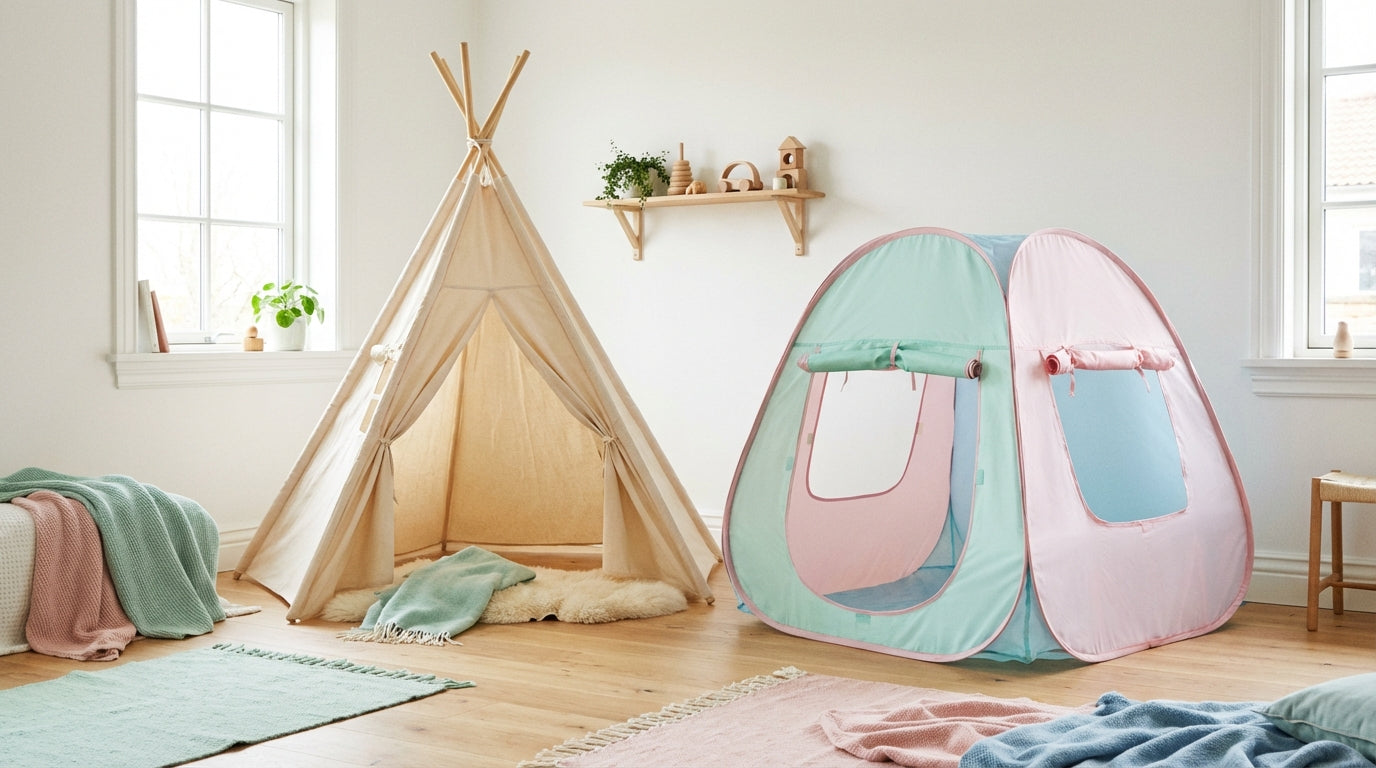
A tipi play tent is usually the right choice for a permanent favorite spot, a pop-up play tent for quick flexibility. Both give children a little “den” in everyday life – just at different speeds: a tipi is more like a piece of furniture, a pop-up more like a toy that comes and goes. Here you get a practical decision guide: space, age/temperament, care, indoor/outdoor and a short checklist. So you don't have to hold a fundamental debate with yourself somewhere between dinner and the laundry basket.

Ulli & Flo
Owners of bieco · Hamburg · parents themselves
We've learned: a tent is perfect when it makes your everyday life easier – not more complicated. And when things get chaotic: in the tent, at least the chaos is “inside”. Feel free to browse our play tent collection.
Tipi play tent or pop-up play tent: the decision in 30 seconds
What matters is space, play style and how often you rearrange. Ask yourself these three questions – and go with your gut feeling (which is often surprisingly accurate with parents):

- Should the tent mostly stay up? → Tipi play tent.
- Does it need to be gone in minutes (living room, visitors, vacuum cleaner)? → Pop-up play tent.
- Is your child more of a “nest builder” (calm) or a “whirlwind” (in and out)? → Nest builder: tipi; whirlwind: pop-up.
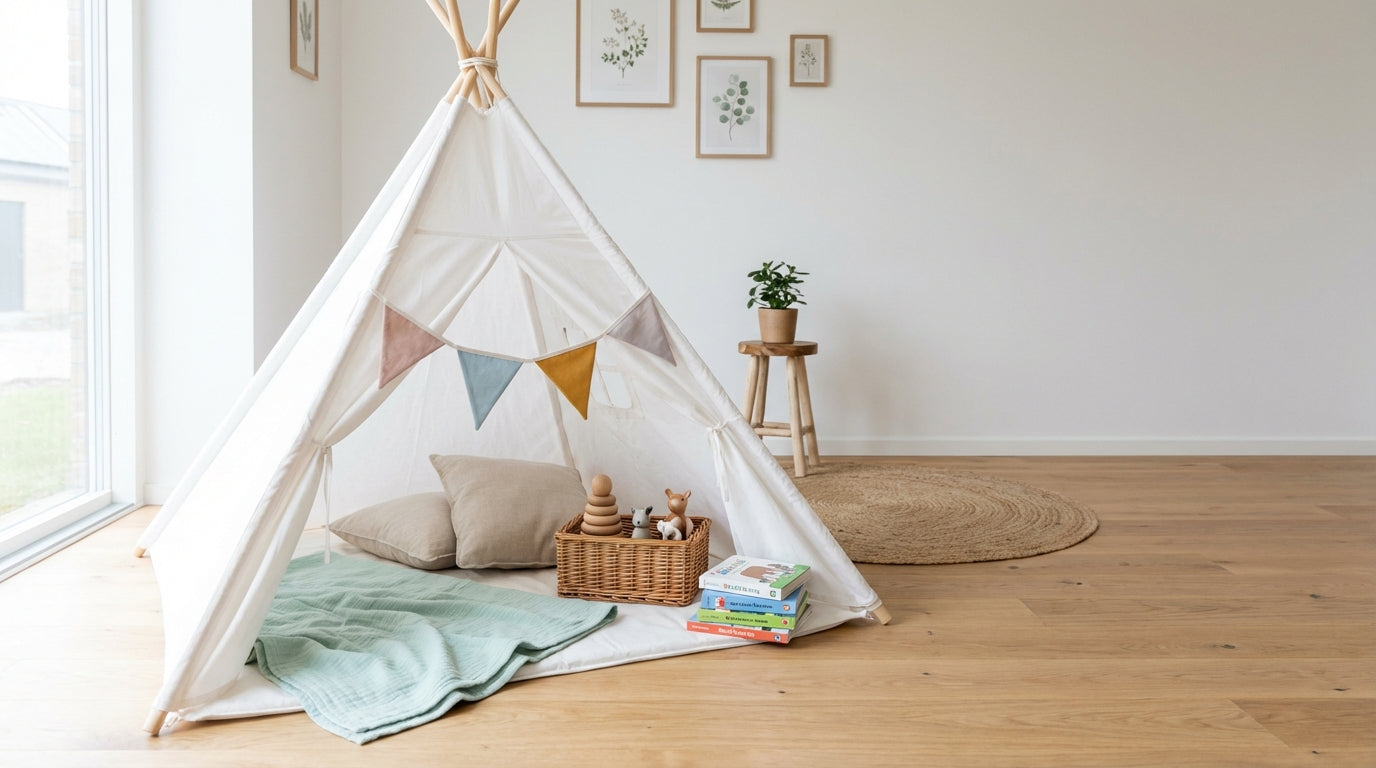
A tipi play tent is a play tent with poles that usually stays set up permanently. That's handy if you want a fixed retreat in the children's room.
A pop-up play tent is a foldable play tent that can be set up and stored away quickly. That's handy if space is tight or you rearrange often.
Tipi play tent: when it really fits into everyday life
A tipi play tent is especially good when your child needs a calm, “always there” place. Many children love that feeling of “in here is my world”: looking at a book, taking care of a stuffed animal, calming down for a moment. And honestly: sometimes it's nice for us adults too when the children's room has a corner that automatically invites calm.
- Quiet play: reading aloud, cuddling, role play (“I live here”).
- Rituals: tipi time first after daycare – this can make transitions easier.
- Look: tipis often feel like a little room within the room and are welcome to stay up.
Practical tip: Put a washable blanket and two pillows in the tipi – then it's instantly a reading nook, a cuddle spot and a “please do not disturb” zone.
A tipi play tent is most worthwhile if you can give it permanent floor space. If you have to clear everything away every evening, a “favorite spot” quickly turns into “ugh, it's in the way again” – and life is really too short for that.
Pop-up play tent: when it's the relaxed solution
A pop-up play tent fits when your everyday life is fast and you want to stay flexible. Especially in the living room or in smaller children's rooms, that's worth its weight in gold: set up, play, fold up, done. No tools, no big setup ceremony.
A pop-up play tent is ideal if “ready to play in 2 minutes” is a real argument for you. For the Dots pop-up play tent, Bieco describes exactly this principle: quick to set up and stored in a space-saving way; two mesh windows and a roll-up door are also mentioned there (information according to the Bieco product page).
- Active play: in and out, hide-and-seek, “spaceship today, shop tomorrow”.
- Saves space: after playtime it disappears into the corner again.
- Indoor & depending on the model also outdoor: for the Dots, “indoors and outdoors” is mentioned (information according to the Bieco product page).
Safety note: Pop-up tents can spring open quickly when unfolded – setting up and folding should be done by adults (note according to the Bieco product page).
A pop-up play tent is especially strong if you have to put it away often. And yes: it's also the tent for days when you simply need a moment of peace – and your child should still be happily occupied.
Tipi play tent vs. pop-up play tent: a fair comparison (with table)
Don't just compare the look, but real family life: space, care, pace. Here is the short version you could even hang on the fridge (if there weren't already 27 works of art stuck on it).

| Comparison point | Tipi play tent | Pop-up play tent |
|---|---|---|
| Setup | Usually a bit more setup, but it's happy to stay up | Very quick to open/close, ideal for spontaneous play ideas |
| Space in everyday life | Needs a permanent corner, feels like “furniture” | Can be stored away after playing |
| Play style | Calm retreat, role play, reading aloud | Lots of in and out, hide-and-seek, frequent changes of scene |
| Care | Depends on the material; regular airing out often helps | For the Dots: damp cloth + mild soap (according to Bieco) |
| “Living room factor” | Lovely if it's allowed to stay up | Practical when visitors come or the vacuuming needs doing |
The best choice is the one you don't curse anew every day. Sounds dry – but it's the truth from real life.
Which size fits in the children's room (and your nerves)?
The right size is the one that keeps walkways clear and is still cozy. Don't just measure “it kind of fits”, but also check: do doors and drawers still open? Can your child get in and out easily? And is the tent not standing exactly where you have to walk past about 40 times a day?

- Floor space: Plan a bit of room all around so nobody gets caught on the tent.
- Location: A corner is often better than the middle of the room (fewer bumps).
- Underlay: A soft, non-slip surface makes it cozier and dampens stomping.
A play mat instantly makes a play tent cozier and quieter. If you're looking for a permanent solution, take a look at the play mats overview – it's often the underrated “aha, now it's really cozy” lever.
Which suits which age (and temperament)?
It's not age alone that decides, but whether your child is looking for calm or action. Still, a few guidelines help you roughly know which direction to go.
- Little ones: Visibility helps – windows/mesh give that “I can see you” feeling.
- Calm children: Tipi play tent as a permanent haven for books, cuddling and role play.
- Active children: Pop-up play tent, because it copes well with movement and frequent rearranging.
- Siblings: Two entrances/windows or clear rules (“tent time”) prevent stress.
For the Dots pop-up play tent, Bieco states use from approx. 12 months, once the child can sit safely. That's a manufacturer's statement and doesn't replace your supervision – but as a rough guide it's helpful (information according to the Bieco product page).
Practical tip: With siblings: take turns for “tent time” and set a timer. Saves arguments and your voice.
A play tent can ease everyday life because it shields stimuli a little. Not as a “dead end”, but as a little haven: door closed, take a breath, then back out into the big world.
Safety & standards: the dos & don'ts that really count
With play tents, it's mainly about a safe location, supervision and manufacturer instructions. That's not rocket science – more like solid parenting know-how.
Safety note: Do not place play tents near radiators, candles, fireplaces or other heat sources, and keep walkways clear.
- Do: Set up on level ground and defuse trip edges (rug edges).
- Do: Check regularly that everything is secure and nothing is torn.
- Don't: “Rig up” fairy lights or other electrical decoration inside the tent if they can get warm.
- Don't: Let children open/fold a pop-up without an adult if the manufacturer warns against it.
EN 71 is a European series of standards describing safety requirements for toys. According to the European Commission, these include mechanical/physical properties as well as flammability and certain chemical requirements (Source: European Commission).
For the Dots pop-up play tent, Bieco states that it is EN 71 compliant and has been independently tested. Such statements are helpful because they show that testing was done to a recognized standard (information according to the Bieco product page).
We are a family business from Hamburg and have been making children's products for 66 years. That's why we prefer clear information on materials, testing and everyday use to a big fuss – parents already have enough to juggle.
Material & care: how the tent stays beautiful longer (even with cocoa)
A play tent is only truly everyday-ready once you can get it clean without drama. Because children don't play “carefully”. They play properly. And that's a good thing.
- Crumbs: Shake out or vacuum first, then wipe with a damp cloth.
- Stains: Better to tackle them promptly – dried-on cocoa otherwise develops character.
- Airing: If the tent gets a bit “musty”, fresh air often helps (and a little patience).
For the Dots pop-up play tent, Bieco recommends cleaning with a damp cloth and mild soap. It's also stated there: do not immerse in water and then let it air dry (information according to the Bieco product page).
DIY: how to make the tipi play tent (or pop-up) really cozy
A play tent becomes a favorite place when it looks “lived in” – not perfectly decorated. You don't need a Pinterest show. You need three things your child will actually use.

- Soft base: Put in a blanket or mat – comfort done.
- Mini library: 2–4 books that are currently popular (swapping them makes them feel “new”).
- Treasure box: A small box with figures/cars/dolls – just for the tent.
- Name sign: A piece of paper, your child draws on it, tape it to the door. And there's “my house”.
- Role-play kit: A cloth as a cape, a wooden spoon as a magic wand – you know the drill.
A small “tent content” set saves arguments because not everything has to be searched for all the time. If you want a quick list of ideas: What belongs in a play tent? The ultimate checklist & ideas.
Checklist: what to quickly check before setting up
With this checklist you avoid 90% of the typical tent annoyances. Run through it once, then let them play.
- Space: Walkways clear, doors/drawers still open.
- Ground: Level, no slippery rug edges.
- Distance: Away from radiators and anything that can get warm.
- Visibility: Windows/mesh are practical so you can quickly see what's going on.
- Care: Do you know how to clean it (and what you'd better not do)?
- Setup: Read the manufacturer's instructions – especially for pop-up.
FAQ
Which is better: tipi play tent or pop-up play tent?
The better tent is the one that fits your everyday life. A tipi play tent is usually the permanent retreat that's allowed to stay up. A pop-up play tent is ideal if you want to set it up quickly and store it away again. What matters is space, play style and how often you rearrange.
From what age does a pop-up play tent make sense?
It makes sense as soon as your child can sit safely and you keep a close eye on them. For the Dots pop-up play tent, Bieco states “from approx. 12 months, when your child can sit safely” (information according to the Bieco product page). Important: setup by adults, because pop-up mechanisms can spring open quickly.
Can a play tent also be used outdoors?
That depends on the model and the weather. For the Dots pop-up play tent, “indoors and outdoors” is mentioned (information according to the Bieco product page). Outdoors, the rule is: a dry, level spot, shade rather than blazing sun and distance from the grill/fire. Afterwards, store it clean and dry.
How can I tell whether a play tent is safe?
Look for clear manufacturer instructions, a stable stand and sensible placement. EN 71 is a European series of standards for toy safety; the EU Commission describes requirements such as mechanical properties and flammability (Source: European Commission). Always take warnings (e.g. setup by adults) seriously.
What's the best way to clean a pop-up play tent?
Wiping with a damp cloth is often enough – quick and without a big fuss. For the Dots pop-up play tent, Bieco recommends: damp cloth and mild soap, do not immerse in water, and then let it air dry (information according to the Bieco product page). That keeps the material everyday-ready, even after little mishaps.
What underlay is suitable in the play tent?
Best is something soft that you can clean easily. A blanket works right away, while a play mat often offers more cushioning and keeps its shape better. What matters is that nothing slips a lot and your child can sit comfortably – then “tent” quickly becomes “favorite spot”.
Bottom line: tipi play tent for the permanent haven, pop-up for flexible tent magic. If you'd like to take a calm look at different models, you'll find a good overview in the play tent hub – and if you're also looking for a matching underlay, check out the play mats.