Baby Clothing Essentials: What Do You Really Need? (Checklist)
At a glance
- Baby clothing essentials: 6–8 bodysuits and 6–8 sleepsuits are usually enough.
- Start small with 50/56 and plan for more in 56/62.
- Layers beat thick single pieces – a hat usually comes off indoors.
- A laundry routine beats a full wardrobe: it's better to have two of each basic than 20 outfits.
- At night: check at the back of the neck, not at the hands and feet.

For your baby clothing essentials, a handful of easy-to-combine basics is enough – not ten "mini outfits". If you have bodysuits, sleepsuits and 1–2 layers to pop on top, you're pretty well set for the first few weeks. In this guide you'll find a practical list, help with sizes, seasonal tips (winter through summer) and a simple washing and packing routine. And yes: Ulli & Flo are writing this as parents – we've also stared at snap buttons in the middle of the night as if they were an escape room.

Ulli & Flo
Owners of bieco · Hamburg · parents themselves
When we were putting together our first baby clothing essentials, we would have loved a short, honest list. That's exactly what you'll get here – with enough buffer for spit-up, diapers and real nights. Feel free to browse our Newborn Essentials collection.
Baby clothing essentials: the basics for the first few weeks
With bodysuits, sleepsuits and 1–2 warm layers, you're ready to start. Newborns get changed often (spit-up, diapers, milk – the full program) and spend a lot of time lying down, which is why comfortable one-pieces are worth their weight in gold. The quantities below are meant so that you don't have to do laundry every day, but also don't drown in mountains of size 50/56.

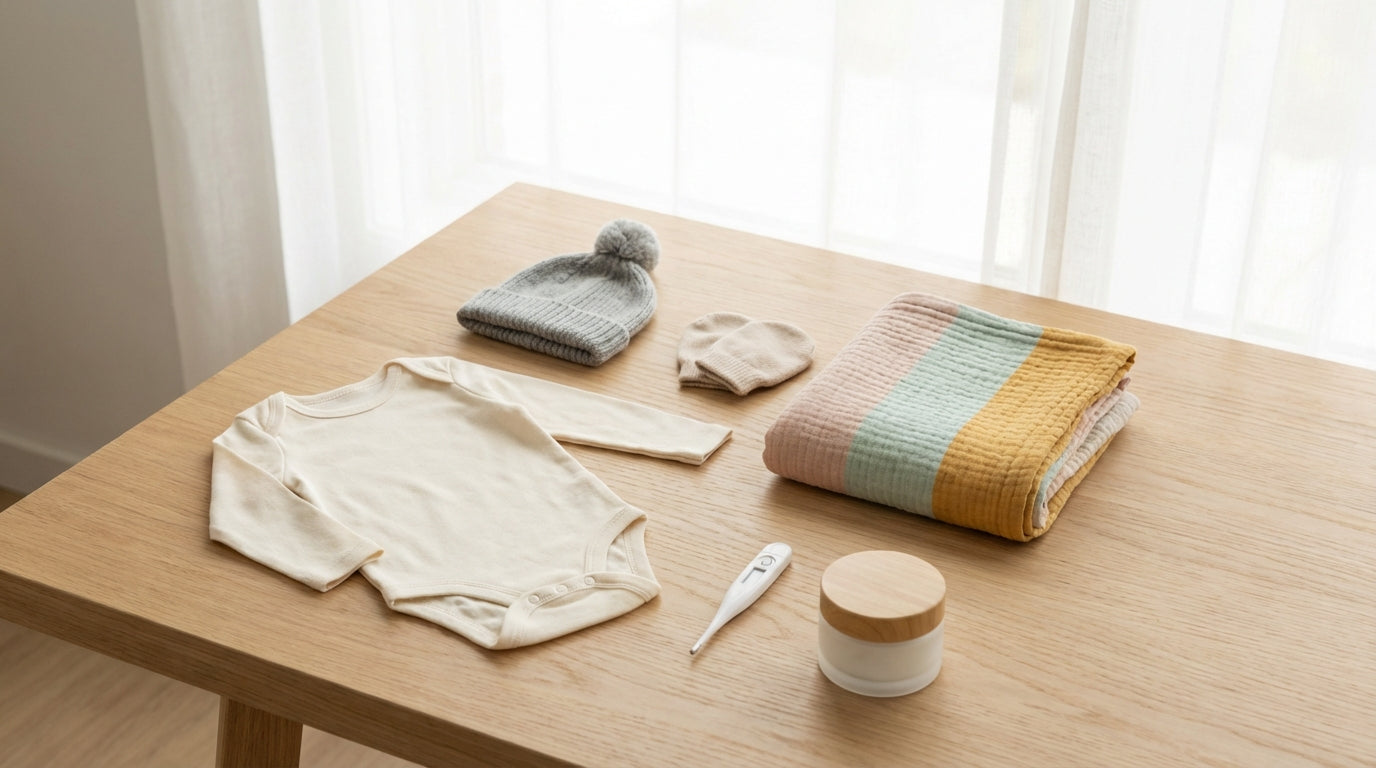
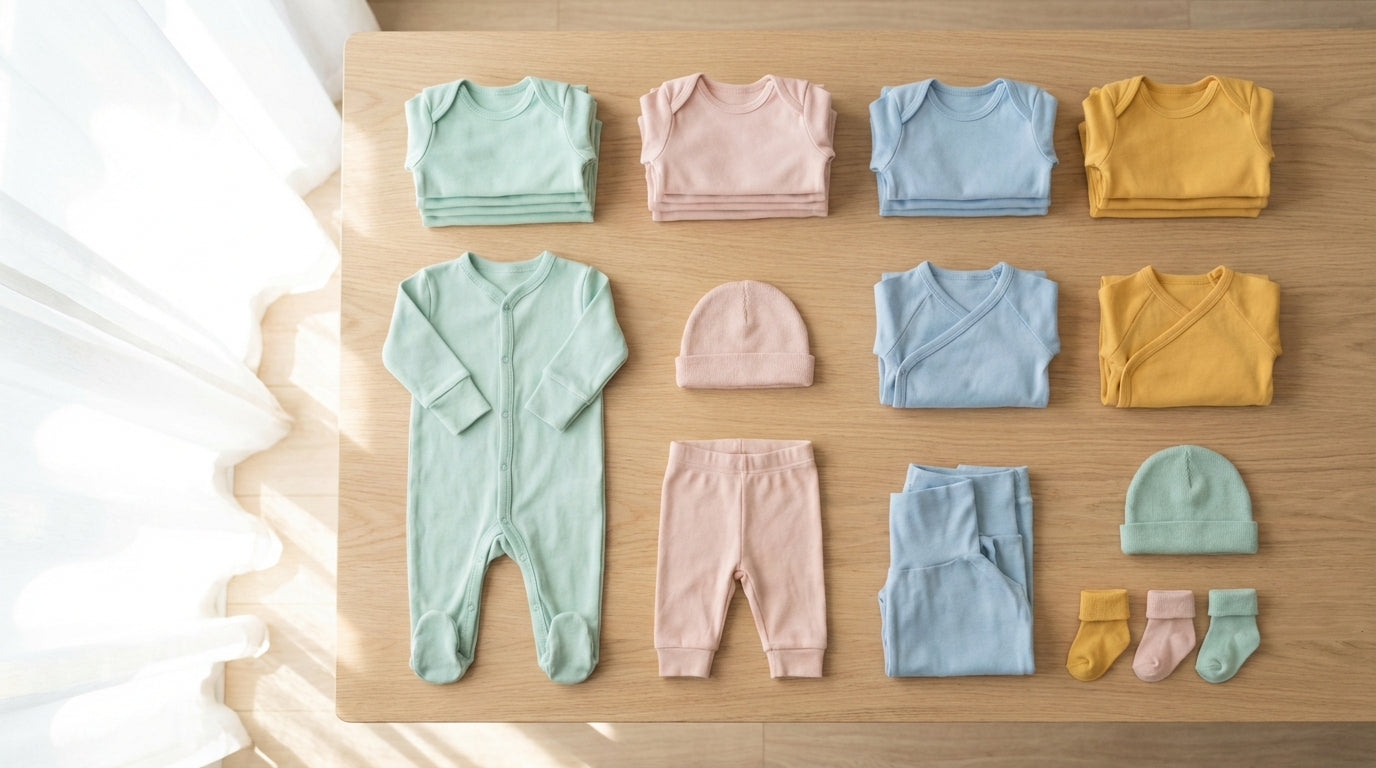
- 6–8 bodysuits (short- and/or long-sleeved depending on the season)
- 6–8 sleepsuits/pajamas (preferably footed, so socks don't keep escaping)
- 2–3 cardigans/jackets (to pop on top, instead of getting out the thick snowsuit indoors)
- 2–3 pairs of pants with a wide waistband (optional – many babies do great with a sleepsuit + bodysuit)
- 2–3 pairs of socks (or footed sleepsuits – saves your nerves)
- 1–2 little hats for outdoors (usually unnecessary indoors)
- 6–12 burp cloths/muslin cloths (strictly speaking not clothing, but practical "on the baby")
A piece is only good if you can handle it half asleep. Wrap bodysuits, wide necklines, zippers or a few easy-to-reach snaps aren't luxury wishes in the first weeks postpartum, they're self-defense.
If you'd like to sort out the other basics besides clothing, you'll find a good overall overview in our Newborn Essentials.
Which sizes make sense – without having to buy three times over
Start with a few pieces in 50 and a bit more in 56/62. Many babies only fit into size 50 for a short time – some skip it entirely. That's no drama, but it's annoying when the sweet bodysuit fit for exactly three days and then is only good as a keepsake.

- Size 50: only a few pieces (if any)
- Size 56: the classic for the start
- Size 62: a buffer so you don't have to restock right away
Details that grow with your baby save you time, money and nerves in the end. Fold-over cuffs, stretchy fabrics and rather loose cuts mean fewer "too tight" moments when dressing and fewer clothes that never get worn.
Which clothes belong in your baby essentials – planned around daily life
Plan clothing around situations: sleeping, changing, going out – not around outfits. In the first few weeks, babies rarely have a schedule, but they reliably do this: sleep, feed, get changed, cuddle. Your wardrobe should fit exactly that.
1) Sleeping (day & night)
At night, it's better to adjust than to bundle up. According to the NHS, overheating is a risk factor for sudden infant death syndrome (SIDS); it recommends not dressing babies too warmly and avoiding hats in bed (NHS).
- Basics: bodysuit + pajamas/sleepsuit
- If it's cooler: one additional light layer (e.g. a cardigan) – not "everything at once"
- With a sleeping bag: adjust the clothing underneath to the room temperature
A baby sleeping bag is a wearable blanket that doesn't slip like loose bedding. According to the NHS, a well-fitting sleeping bag can help prevent babies from slipping under a blanket (NHS).
Practical tip: Feel the back of the neck: warm = good, sweaty = too much. Hands and feet are often cool even when everything is fine.
2) Changing (aka "quick, quick")
Changing gets easier when you can get to the bottom half quickly. A zipper or well-placed snaps save you time at night. At the start, wrap bodysuits are more comfortable for many babies because you don't have to pull them over the head.
3) Going out (walk, pediatrician, grandma)
Outdoors, the layering principle counts rather than one thick full-body package. According to the NHS, the rule of thumb is that babies usually wear one more layer than adults – and hats should come off again indoors or in a warm car (NHS).
Layering means several thin layers that you can put on or take off quickly. In everyday life, that's often easier than one piece that "has to do it all".
Safety note: Take off the hat and thick extra layers as soon as you're indoors or in a warm car – according to the NHS, overheating is a real concern (NHS).
Material & care: what really works (without the fabric philosophy)
Soft, breathable and washable matters more than "especially stylish". You'll be washing often, and baby's skin likes things uncomplicated: smooth fabrics, no scratchy seams, no hard labels in the wrong place.

- Cotton: often comfortable and easy to care for
- Wool/silk: can be wonderful, but usually needs more care
- Look for soft cuffs, flat seams, simple fastenings
A little parent trick: buy two of "the one comfortable kind" rather than ten experiments. You'll quickly notice what your baby tolerates well – and what you never want to put on again at 3:12 a.m.
Practical tip: Set up an "emergency drawer": 2 bodysuits, 2 sleepsuits, 2 burp cloths. Then you don't have to search at night.
If you're sorting out your baby essentials in general right now, our overview will help too: Baby Essentials: The Ultimate List & Checklist for Parents.
Seasons: what changes for winter, summer & in-between?
The quantity often stays similar – the layers are adjusted seasonally. So you rarely need "more", but rather "more suitable": warmer outdoors in winter, lighter and airier in summer, flexible in between seasons.
Baby clothing essentials in winter
In winter you don't need twice as many pieces, just smarter layers. Indoors, the same still applies: don't overdo it. According to the NHS, babies should not be dressed too warmly; overheating increases the risk of SIDS (NHS).
- In addition to the basics: 1 warm cardigan, possibly 1–2 warmer pairs of pants (if you use pants)
- For outdoors: a warm hat; depending on the weather, booties/mittens
- Stroller: better to add a blanket/liner as needed rather than "already dressed thickly underneath"
For winter babies, a short extra checklist helps you more than an additional shopping trip. If you want to dive deeper: Newborn Essentials for Winter Babies: What Do You Really Need?
Baby clothing essentials in summer
In summer, "less" is often exactly right – the main thing is that your baby doesn't overheat. According to the NHS, a single layer of lightweight, breathable material is often enough in hot weather; babies under 6 months should also be kept out of direct sunlight (NHS).
- During the day: bodysuit or light one-piece
- Outdoors: light head covering and shade; no thick blanket "as sun protection"
- At night: very light depending on room temperature – sometimes a bodysuit or just a diaper is enough
In plain terms: if you're sweating, your baby probably is too. Better to check the back of the neck once more and take off a layer.
Between seasons (spring/autumn)
In between seasons, layering saves you from the constant "too warm/too cold" switching. Fresh in the morning, sun at midday, wind in the afternoon – that's already a guessing game for adults.
- Basics as always: bodysuit + sleepsuit
- On top: a cardigan/jacket that's quick to take off and put on
- For outdoors: pack a hat, but take it off again indoors
Washing & changing routine: how to stay relaxed (even without a dryer)
A small laundry routine matters more than "one more outfit" when it comes to baby clothing essentials. Because even with the perfect list, babies don't stick to plans. With a simple routine, you don't have to keep buying more.
- Laundry basket rule: Anything that's "damp or stained" goes straight out – not "just on the bed for a moment" (spoiler: it stays there).
- Set laundry days: e.g. a load of baby laundry every 2 days. Then the quantities above are usually plenty.
- Light sorting: bodysuits/sleepsuits together, burp cloths/muslin cloths together. You don't need more order than that at the start.
- Pack a change set: 1 bodysuit + 1 sleepsuit + 2 burp cloths in a bag – ready for the pediatrician, grandma, a walk.
If you want to save yourself work: put the same sizes together in one drawer. Then you won't grab the wrong thing half asleep and wonder why the bodysuit is suddenly "so short".
Twins & "multiple changes": how to keep your cool
With twins the list stays the same – you just need more spare pieces and better organization. When two little people spit up at the same time, it's not a character test, it's simply Tuesday. Plan for extra bodysuits/sleepsuits rather than lots of "special" pieces.
A mini system helps: same models, same sizes, same drawer. Then you won't spend forever searching for "the one matching" piece while the other baby already has new plans.
If that's your situation: Newborn Essentials for Twins brings together suitable basics for the double pack.
Short & honest: what you often DON'T need at the start
You don't need a mini fashion collection – you need spare clothes that work. A few things are cute, but surprisingly often end up unworn in the closet:
- Too many outfits with complicated buttons
- Shoes (socks or booties are often enough)
- Loads of accessories (cute, yes – practical, well…)
If you want to leave something out: skip whatever you can't wash quickly and put on quickly. That's the most honest rule in the early postpartum weeks.
Why we care so much about "simple & safe" at Bieco
We're a family business from Hamburg – and we've been making baby products for 66 years. That doesn't mean we know everything better, but we've seen quite often what really gets used in everyday life: durable basics, uncomplicated handling, and when it comes to materials and workmanship, we'd rather be open and honest than "talk it up".

For us, safety transparency means: rather say clearly what something is intended for. With babies especially: comfortable, well-fitting, no overheating – and when it comes to sleep & warmth, rather stay pragmatic.
FAQ
How many bodysuits do I really need?
6–8 bodysuits are usually enough if you do laundry every 2–3 days. If your baby spits up a lot or you'd like to wash less often, 8–10 bodysuits are more relaxed. It's better to have more of the basics you like putting on than lots of "special pieces" that end up just taking up space.
Which size at birth – 50 or 56?
For many families, 56 is the best start, with a few pieces in 50. Some babies only fit into 50 briefly or skip the size. With 56 you're often on safer ground, and a small stock in 62 prevents you from having to go shopping again right after the first few days.
How do I dress my baby properly at night?
Often a bodysuit plus pajamas is enough – adjusted to the room temperature. According to the NHS, your baby should not overheat; hats in bed are not recommended, and overheating is considered a risk factor for SIDS (NHS). Check at the back of the neck: warm is good, sweaty is too much.
What's better: lots of thin layers or one thick snowsuit?
Lots of thin layers are more flexible and quicker to adjust. Layering helps with temperature changes: outdoors, in the warm car, going in and out. A thick snowsuit can be practical outside, but often gets too warm indoors – and then the undressing ballet begins.
How much extra clothing do I need for a winter baby?
Usually you need an additional warm layer for outdoors rather than twice as many pieces. A warm cardigan, hat and possibly booties are enough for many families. According to the NHS, babies should not be dressed too warmly indoors and in a warm car; hats come off again then (NHS).
How do I pack a small change bag for on the go?
Pack 1 bodysuit, 1 sleepsuit and 2 burp cloths – that's often enough. Plus diapers and wipes (of course), and a light cardigan if it's cool. That way you're prepared for the typical "oops" moments without carrying half a dresser around.
If you're now thinking "Okay, I can do this" – that's exactly how it should be. And if you'd like the basics collected alongside the clothing, take a look at our Newborn Essentials – clear, practical, no frills.