Are Mobiles Good for Babies? Benefits, Safety & Everyday Tips
At a glance
- Are mobiles good for babies? Yes – as a short, calm activity during the day.
- Above the crib: out of reach, firmly attached, and keep the sleep space as clear as possible.
- Rule of thumb: just a few minutes at a time, and only briefly overall throughout the day.
- Music only quietly and briefly – constant sound tends to make many babies more alert.
- Take it down as soon as your baby can push up or reach for it.

Mobiles are good for babies when they are hung safely and only used for short periods. They give young babies something calm to look at, help with focusing, and turn “I'm just lying here” into a little voyage of discovery. The important thing is this: a mobile is not non-stop entertainment, and it should be placed so your baby cannot grab it – and at the sleep space, “less is more” very often applies. Here you get a practical overview: effects, age, safe mounting, music, distance – and when the mobile should come down again.

Ulli & Flo
Owners of bieco · Hamburg · parents themselves
We liked mobiles best as a calm focal point for short breaks – not as an all-day program. With safe mounting, things get much more relaxed for baby and parents alike. Feel free to browse our Mobile collection.
Are mobiles good for babies – and what exactly are they for?
Yes: a mobile can gently occupy babies and guide their gaze. Especially in the first months, “looking” is real work: recognizing shapes, following movement, telling contrasts apart. A slowly turning mobile is like a small, slow-motion cinema – no popcorn, but plenty of wonder.
For parents, a mobile is often a mini break, but not a babysitter. It can help your baby stay content for a few minutes while you, say, get the diaper ready or grab a sip of cold coffee. (Hot coffee in the first year of parenthood is more of a rumor, after all.)
At the sleep space, the rule is: simple and safe beats “the more the better.” According to the American Academy of Pediatrics (AAP), the sleep environment should be free of soft objects and loose bedding to reduce risks during sleep. AAP Safe Sleep
What effect does a baby mobile have on development?
A mobile mainly supports vision, attention and visual tracking. When babies follow a slow movement, they practice focusing and “following with their eyes.” That's not magic, simply practice through repetition.

A mobile offers stimulation – it is not a guaranteed development booster. Closeness, talking, carrying, tummy time, free play: these remain the foundation. A mobile is more the icing on the cake for quiet moments, not the engine behind milestones.
Definition: A baby mobile is a hanging focal point that moves slowly. In practice, it helps babies fix their gaze on something calm, without the whole world shouting “hello” all at once.
Definition: Visual stimulation means that babies sort and follow visual impressions. In practical terms: contrasts and slow movement can help bring the gaze together – especially when there's otherwise a lot going on.
Practical tip: If your baby gets wound up by the mobile instead of calming down: switch it off, turn it away, or use it only during the day. Some babies become more alert from movement and music.
From what age is a mobile useful for babies – and for how long per day?
A mobile can suit a baby from birth if it is calm and simple. Newborns still see blurrily at first; clear shapes and strong light-dark contrasts are often more interesting than a whole circus in pastel.
Many babies find it really interesting from the first few weeks. You'll often notice that their gaze lingers longer, they follow the movement, and they “tell” the mobile all about their day. (And yes, the mobile never answers. Very conflict-averse.)
On duration: short and often is better than long stretches. A practical rule of thumb is a few minutes per round and, overall, rather short sessions spread across the day – and as soon as your baby looks away or gets restless, it's break time. Babies show quite clearly when they've had enough.
At the sleep space, a safe environment matters more than any ritual. The AAP recommends a firm, flat sleep surface and a sleep environment without loose or soft objects. AAP Safe Sleep
If you like things sorted by month: in our article From what age is a mobile useful for babies? All answers & tips you'll find a quick overview – easy to read even with a tired head.
Mobile above the crib: distance, mounting and “when does it have to go?”
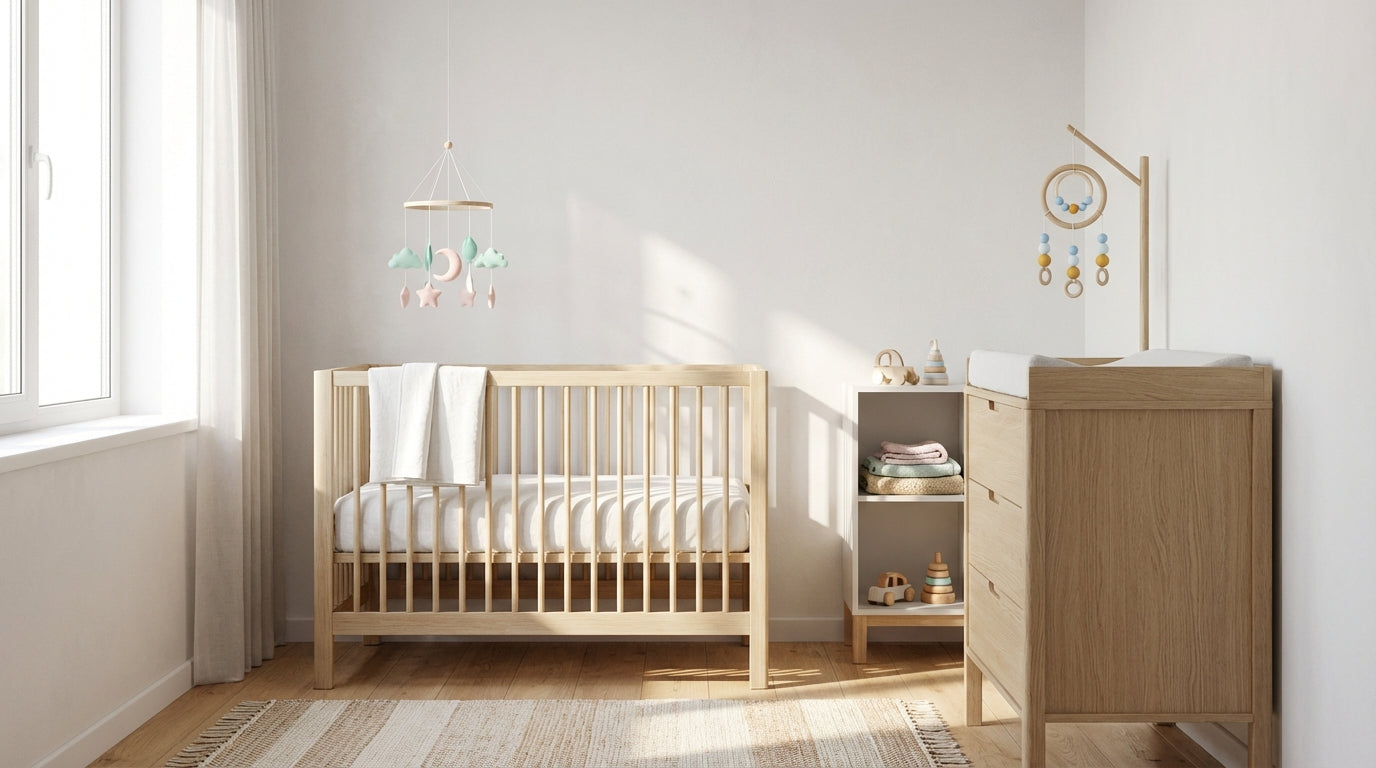
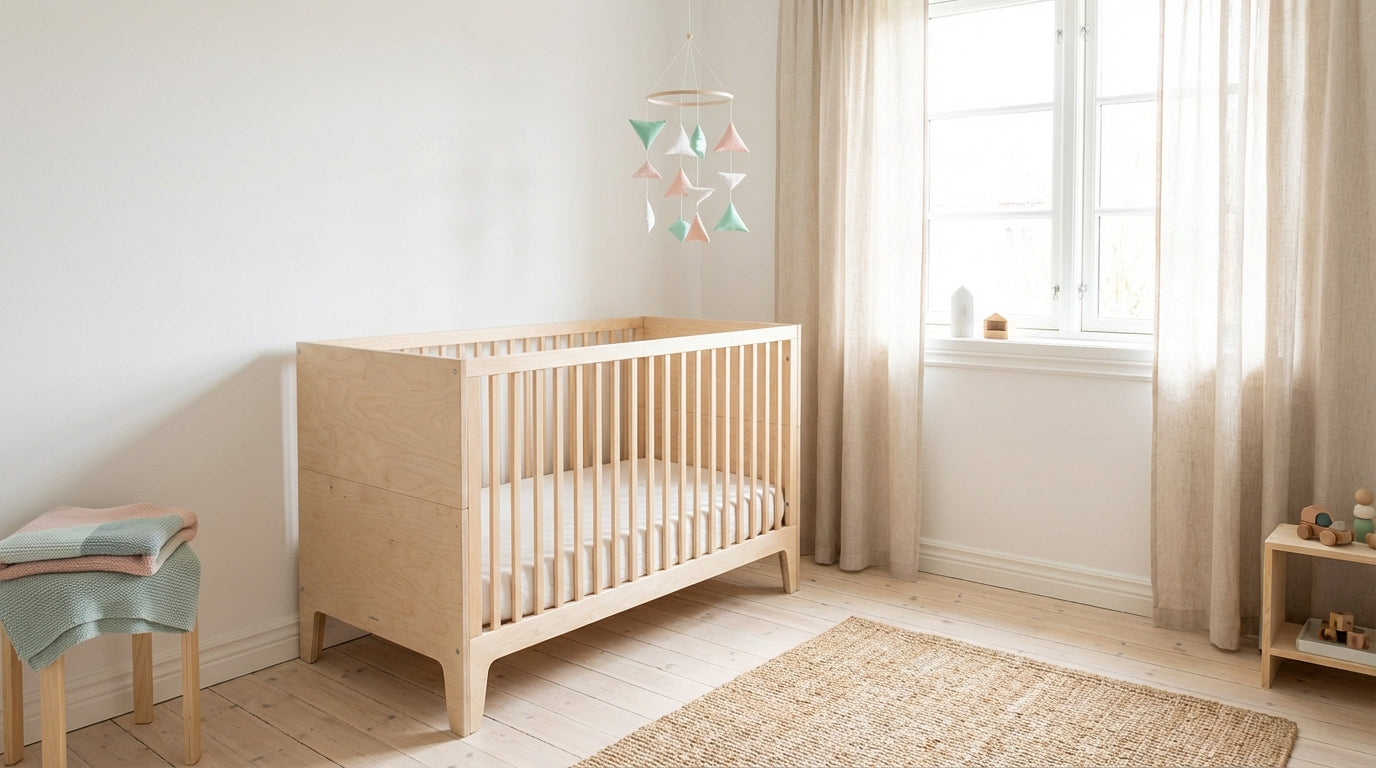
Above the crib, the rule is: hang the mobile only so that your baby cannot reach it. A mobile is meant to be looked at. As soon as your baby can get to it, “decor with a purpose” quickly turns into “tug toy with a risk.”

The most important factor is distance: out of reach, even when kicking. There is no universal centimeter value that fits every crib and every child – what matters is that your baby cannot grab the mobile, pull it, or get it toward their face. Check this not only while your baby is lying still, but also when they stretch or roll onto their side.
Safety note: Do not leave any strings, ribbons or cords hanging within reach in the sleep area. The AAP advises keeping hanging strings and cords away from the sleep space because of the risk of strangulation.
When should a mobile come off the crib? As soon as pushing up or grabbing becomes possible. The U.S. Consumer Product Safety Commission (CPSC) advises removing toys attached to the crib once a baby can push up on hands and knees (or at around 5 months), because of the risk of entanglement. CPSC Safety Alert
Strings are a concern outside the crib too, not just in the nursery. The German Social Accident Insurance (DGUV) raises awareness of strangulation risks from strings and cords and advises consistently avoiding such risks. DGUV KinderKinder
Mounting rule for everyday life: “rock solid” beats “it'll probably hold.” Whether it's a clamp, a screw or a stand: give it one firm tug (just like a baby will later, only with less patience). If you're already skeptical while doing it, that's a good sign to solve it differently.
Mobile at the changing table: why it's often worth its weight in gold
A mobile at the changing table can really help during diaper changes and dressing. Many babies find changing… let's say: debatable. A calm focal point above the changing spot can mean hands and legs “have a say” a little less.
At the changing table, it can be a bit more exciting – after all, you're right there. The big advantage: you don't leave your baby alone there. Still, the same applies here: nothing within grabbing reach with strings, no loose small parts, and attach it so that nothing can fall down.
If you'd like to look at some options: in our overview Mobile for changing table you'll see different types – simply as inspiration for what works well in everyday life.
Practical tip: Don't hang the mobile directly over the face, but offset slightly toward the tummy and legs. This often feels less “overwhelming” – and you can reach the snaps more easily.
Musical mobile: volume, duration and when it gets to be too much
A musical mobile can soothe if it is quiet and only plays briefly. Many children like repetition: same melody, same order, same routine. That can help with winding down – but it won't work for every baby.

Quiet and predictable is usually the best combination. If a musical mobile plays for a long time (or even blinks), it can keep babies more awake. A short song as a ritual (“now it's time to get calm”) often makes more sense than constant background sound.
For the sleep space, the rule remains: nothing may reach into the crib or fall into it. According to the AAP, the sleep environment should stay free of loose or soft objects; the mounting should be chosen so that nothing can come loose. AAP Safe Sleep
If you'd like to browse: in our collection Musical mobiles for babies you'll find various options. Treat it like salt: you can always add more, but you don't have to.
Material & care: wood, fabric, plastic – what suits your everyday life?
The best material is the one that is safely made and easy to clean. In baby life, dust, drool and “what on earth is that now?” are guaranteed. So it's worth quickly checking how easy-care the mobile is before hanging it up.

Wood often feels calm and long-lasting, but it needs smooth edges and firm connections. Make sure nothing splinters, nothing wobbles and no small parts are loose. When you wipe down a wooden mobile, use a slightly damp cloth rather than soaking it.
Fabric elements are soft, but collect dust faster. It's handy if parts can be removed or carefully cleaned. Important: follow the manufacturer's care instructions so that seams and fastenings don't suffer.
Plastic is often light and wipeable, but should also be cleanly made. Especially with moving parts, it's worth a look: does it run smoothly? Does it rattle? Are there sharp edges? If you find it annoying yourself, your baby will probably find it all the more fascinating.
DIY or buy? An honest comparison
Making one yourself can be wonderful – if safety and attachment are truly solid. A DIY mobile has charm and makes a lovely gift. But babies are ruthlessly honest: whatever is loose gets tested. Whatever is within reach gets pulled.
If you craft one, three things are crucial: a stable suspension, no long strings, no small parts. Anything that can come loose is, when in doubt, in a mouth faster than you can say “Wait!” And above the crib, extra caution is called for.
When buying, transparency helps: materials, testing and clear usage instructions. We are a family business from Hamburg and have been doing this for 66 years – so we'd rather talk openly about material choices, standards and tests than pretend everything is automatically safe. Parents (Ulli & Flo included) don't need fairy tales, but clear information.
FAQ
Are mobiles good for babies?
Yes, mobiles are good for babies when they are securely attached and used briefly. They can be a calm activity and help direct the gaze toward slow movement. It's important that the mobile hangs out of reach and is taken off the crib in good time, as soon as your baby can grab for it.
From what age is a mobile useful?
A mobile can suit a baby from birth if it is simple and calm. Many babies react much more strongly to it from the first few weeks, because they can then focus for longer. Make sure it doesn't overwhelm: if your baby looks away, fusses or gets restless, that's a clear “thanks, that's enough.”
How long per day should a baby look at a mobile?
A few minutes at a time, and several times a day if needed. A mobile is best thought of as a short, calm “looking break.” If your baby turns away, yawns, fusses or becomes frantic, that's usually the sign to switch it off or turn it away – babies are quite clear about this.
Is a mobile above the baby's crib safe?
It can be safe if it is firmly attached and out of reach. At the sleep space, the AAP recommends an environment that is as clear as possible, without loose or soft objects; a mobile must not be able to reach into the crib or fall down. Check the attachment regularly and take it down as soon as your baby could reach it.
When does a mobile have to come off the crib?
As soon as your baby can push up or reach for it, it should come down. The CPSC advises removing toys attached to the crib when babies can push up on hands and knees (or at around 5 months). CPSC Safety Alert
Does a musical mobile help with falling asleep?
It can help if it is quiet and serves as a short ritual. Some babies become calmer through music and movement, others more alert. It's best to test it during the day or while you're keeping your baby company as they settle. If your baby “stares themselves awake,” less music often means more calm.
Bottom line: mobiles are a good thing – when they hang safely and don't stay up too long. If you'd like to look at a few options, you'll find a selection of Mobile with us – for the nursery, the changing spot and everything in between. And if you have a moment of doubt while hanging it: take that doubt seriously. Parental instinct is usually the best screw in the toolbox.