When Can Babies Have a Mobile? Timing, Height & Everyday Safety
At a Glance
- When can babies have a mobile? Often from the first few weeks – brief, calm, and at a distance.
- It usually gets most exciting around 2–4 months, when babies start to focus more.
- Hang it so your baby can see it but can't reach it.
- Once grabbing or pushing up begins: hang it higher or take it down completely.
- DIY works well: lightweight, securely knotted, no small parts, no long loops.

For many babies, a mobile is a calming focal point from the first weeks of life – as long as it is securely attached and hangs out of reach. In the beginning, it's not about "action" but about gentle looking: a little ritual during diaper changes or while winding down. Here you'll find a simple timeline by age, clear safety rules (including a mounting checklist) and a DIY guide that also works in real family life.

Ulli & Flo
Owners of bieco · Hamburg · parents themselves
We've learned first-hand: a mobile is best when it makes daily life quieter – not louder. With some distance, short use and a good gut feeling, you'll usually get along most relaxed. Feel free to browse our Mobile collection.
Table of Contents
When can babies have a mobile?
A mobile often makes sense from the first weeks, as long as it hangs still and your baby can look at it calmly for a short while. In the first few days, the ceiling alone can be exciting enough (honestly), but many babies enjoy gentle movements and clear shapes quite early. Important: short "looking times" are completely enough.
As a rule of thumb: the smaller the baby, the simpler and shorter the mobile program. Babies don't develop by the calendar, but this rough guide helps put things in perspective:
- 0–6 weeks: let them look for 1–3 minutes, choose calm shapes, not too colorful, not too close.
- from approx. 2–3 months: babies follow movements better, and the mobile becomes more interesting.
- from approx. 3–4 months: many babies grab more purposefully; according to Apotheken Umschau, "purposeful grasping" happens at around 3.2 months on average (Apotheken Umschau).
- from approx. 5–6 months: grabbing and pulling get stronger; things get "tested" (and thoroughly).
- once they prop up/push up/sit up: hang the mobile higher or take it down so it can't be reached.
Practical tip: If your baby quickly gets startled during diaper changes, hang the mobile slightly off to the side – not directly above the forehead. This often feels calmer.
How high to hang it – and how far away?
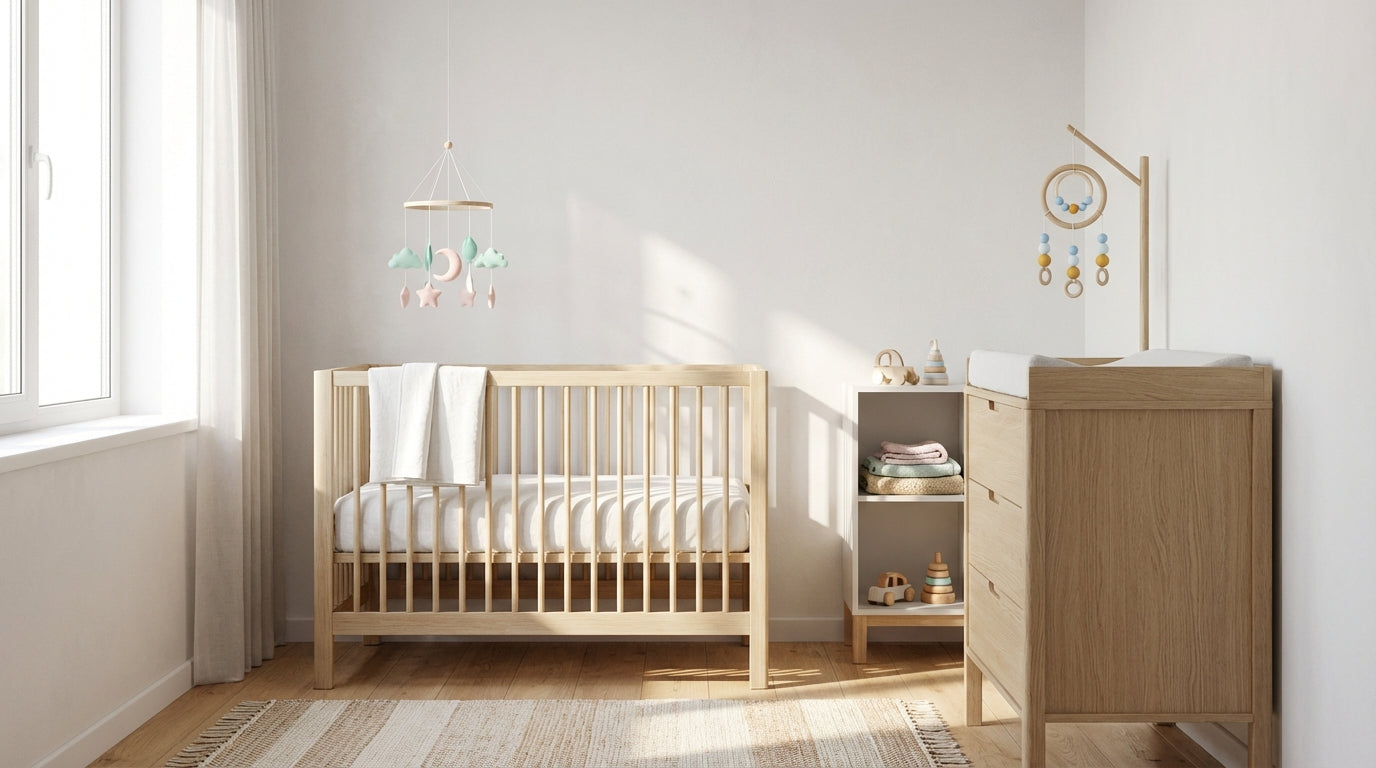
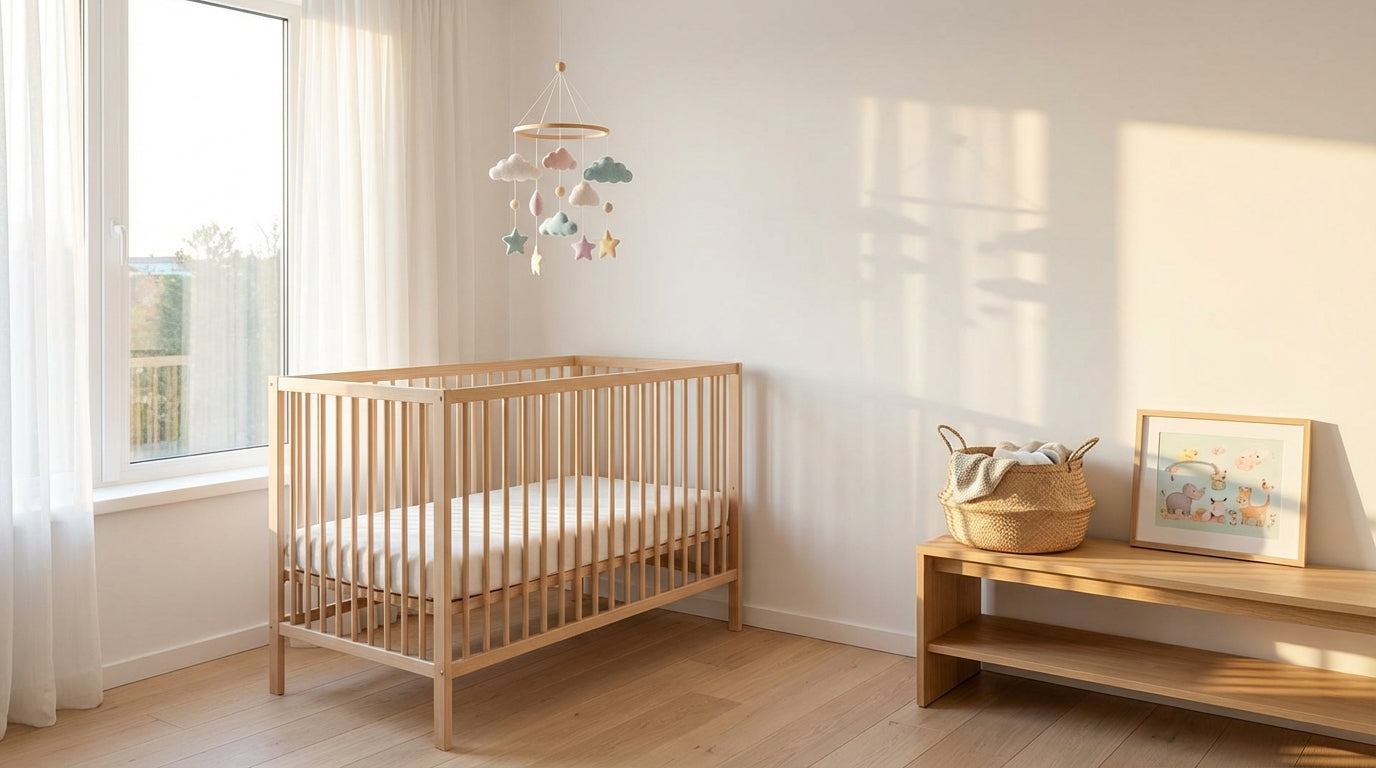
A mobile hangs safely when your baby can see it but cannot touch it. The exact height depends on the crib, changing area and mount – which is why "out of reach" is the most important rule that works in everyday life.
Reach is not a fixed number but a moving target. Today your baby still lies there cozily, tomorrow they suddenly do the "mini cobra push-up" and reach further than you thought.
Safety note: As soon as your baby can grab purposefully, prop themselves up or push up, nothing they can grab should dangle above them – hang it higher or take it down.
A good test is the "pull-and-reach check". Hold your hand where your baby's hands could realistically get to (with kicking, propping up, turning) – if you can reach the mobile, your baby soon will be able to as well.
CE marking and warning labels are essential signals for purchased mobiles. According to the European Commission, toys in the EU must meet basic safety requirements and be CE-marked accordingly (European Commission).
Mobile vs. play gym: what fits when?
A mobile is for "looking up", a play gym is for "doing down below". That sounds simple – and that's exactly why it's so helpful in everyday life.
A baby mobile is a hanging focal point that babies explore mainly with their eyes. It's well suited to quiet moments: diaper changes, brief wonder, a little ritual.
A play gym (baby gym) is a frame with hanging elements for grabbing and kicking. It's perfect for awake times on a safe surface, when movement is explicitly welcome.
Many babies start reaching for hanging things more purposefully from around 3–4 months. This development is also described in the IFP Family Handbook on motor development (IFP Familienhandbuch).
Crib, changing table, play mat: the best spot
The location decides whether a mobile soothes or overstimulates. Here's a practical breakdown:
- Above the crib: rather calm, few elements, gentle movement. If your baby wakes up because of it: better to use it during the day.
- At the changing table: great as a distraction – but placed so your baby can't reach for it and twist around in the process.
- Above the play mat: a play gym is often a better fit here, because grabbing and kicking are explicitly part of the fun.
If you'd like to see which options are out there, an overview sometimes simply helps. These pages are handy for that: Mobile, Mobile for changing table and Musical mobiles for babies.
[Image: Baby looking up, mobile hanging offset to the side]
Alt: Baby looking calmly at a mobile hung off to the side at the changing area
DIY: making a baby mobile (materials & instructions)
A DIY mobile works well when it's lightweight and hangs truly securely. And yes: it's a lovely project – even for grandparents' hands that like to "knot it properly one more time".
A DIY mobile is decoration and a focal point, not a grabbing toy. That's the most important decision when crafting: anything that could come loose will come loose sooner or later. Babies are very consistent about that.
Materials list: what you need
Choose materials that are too light rather than too heavy. Light means less impact in case something does move or bump.
- Mobile ring made of wood or metal (smooth, without splinters/edges)
- Felt or fabric elements (lightweight, without loose small parts)
- Tear-resistant yarn/cord (not elastic, no stretchy bands)
- Optional: firmly fixed wooden beads (only if they can't slip or come off)
- Scissors, measuring tape, needle/thread if needed
Avoid small parts and long loops – both quickly become risky. According to the EU Toy Safety Directive, risks such as swallowing and strangulation should be minimized in toys, especially for children under 36 months (Directive 2009/48/EC).
Step by step: how to build your mobile
Build the elements first, then the suspension – that keeps things tidy. And you won't have to re-knot three times because "one more little star is missing".
- Choose a theme: 3–5 elements are often enough. Fewer usually looks calmer.
- Sew/shape the elements: use double-layer felt, close it neatly, leave no loose threads.
- Cut the threads: better to start a bit longer and shorten later.
- Attach to the ring: distribute evenly so nothing hangs crooked.
- Check the balance: lift the ring and see whether it stays level. If not, adjust the lengths slightly.
- Attach the suspension: bring three or four threads together at the top, knot securely, keep the ends short.
- Pull test: give it a firm pull and shake. If this makes you nervous, take it as a sign.
Practical tip: Take a photo of the finished mobile before it goes up. If something shifts later, you'll see right away what's no longer right.
Safety note: No adhesive pads or improvised hooks above the baby – use only fasteners designed for this purpose that hold securely.
Checklist: mounting safely (just before hanging)
These five points will save you a lot of second-guessing later.
- Does the mobile hang out of reach (even when your baby props up)?
- Is the suspension stable and suitable for the load?
- Are there no long loops, open knots or loose ends?
- Are all elements lightweight and free of detachable small parts?
- Will the mobile be taken down as soon as grabbing/pushing up starts?
Musical mobile: soothing or does it just keep them awake?
A musical mobile can soothe when used quietly and briefly as a ritual. Some babies get sleepy from it – others find it so great that they throw a little private party first. Both are normal.
Less is often more here: on briefly, then quiet again. That way music stays a signal to switch gears and doesn't become constant background noise.
- For falling asleep: a short sequence, then off – and see what your baby makes of it.
- For diaper changes: can distract, as long as your baby doesn't get wound up.
- For awake times: if music tends to energize, it fits better during the day.
When to take the mobile down
At the latest when your baby can reach the mobile or pull on it, it has to go. That's the point where "looking" very quickly turns into "pulling, twisting, testing".
The timing is individual, but it reliably comes. Milestones like sitting and crawling offer guidance; Apotheken Umschau, for example, lists "sitting freely with support" at around 7.2 months on average and "crawling" at around 8.5 months (Apotheken Umschau).
Safety note: A mobile must never hang in a way that your baby can get tangled in it or pull themselves up on it.
If you'll miss it: the mobile can go on the wall as decoration later. Babies outgrow things – but a lovely piece may stay. (Just not above the "climbing zone".)
FAQ
When can babies have a mobile?
A mobile often makes sense from the first weeks of life, if it hangs still and your baby only looks at it. It often gets really interesting at around 2–4 months, when babies become more alert and follow movements better. As soon as grabbing or pushing up begins, it must hang out of reach or be taken down.
How high should a mobile hang: how far from the baby must it be?
A mobile should hang so that your baby cannot reach it – not even when kicking, turning or propping up. A fixed number of centimeters doesn't suit every crib and every baby. Do the reach check: if you would "almost" reach it from your baby's position, hang it higher.
How long to use it: how long may a baby look at a mobile?
Short sessions are completely enough – especially in the first weeks. Start with a few minutes and watch your baby: looking away, fussing or frantic kicking are often signs for "that's enough now". Later, a mobile can become part of a little ritual, but it doesn't have to run constantly.
Mobile above the crib safely: what should I look out for?
A mobile is only safe if it is firmly attached and out of reach. Make sure it's mounted securely, with no long loops, no small parts and no improvised adhesive solutions above the baby. For purchased mobiles, CE marking and warning labels help as a guide, as the EU Commission describes regarding toy safety.
When to take the mobile down?
As soon as your baby can grab, pull or push themselves up, the mobile should go. The risk then rises that it becomes reachable or that something comes loose. Many babies become much more mobile in the second half of their first year, but the decisive moment isn't age – it's your child's reach.
Mobile or play gym: which is better?
Both can fit – it depends on the moment. A mobile is more for quiet looking (e.g. diaper changes, a short break), a play gym more for active grabbing and kicking on a safe surface. When your baby wants to "do" something, the play gym is often the better choice.
Finally: a mobile should make your daily life easier, not more complicated. If you'd like some inspiration, you'll find an overview of Mobile in our shop, as well as variants for the changing area and with music. We're a family business from Hamburg and have been doing this for 66 years – and honestly: safety and simple rituals almost always win.