Which Baby Mobile Is the Best? Comparison, Safety & Tips
At a glance
- Which baby mobile is the best? One that is securely mounted and hangs out of reach.
- Choose the spot first: crib, changing table or playpen – that decides a lot.
- For newborns, a few elements, strong contrasts and calm are often worth their weight in gold.
- Check the mounting regularly and take the mobile down as soon as your baby can reach it.
- Look for the CE mark, clear warnings and transparent testing.

The best baby mobile is the one that hangs securely and fits your daily life. Not the one with the most features, but the one you can operate half asleep at night and that doesn’t overstimulate your baby. Here you get an honest comparison: mobile types, where to use them (crib, changing table, playpen), mounting options, a safety check and the important question “when does it come down again?”. Northern German in a nutshell: better solid than spectacular. And yes – we are a family business from Hamburg, we’ve been doing this for 66 years and we know the questions that keep coming up in customer service.

Ulli & Flo
Owners of bieco · Hamburg · parents themselves
With our first child, we underestimated how much a stable mounting can save the day. And how quickly “just looking” turns into very determined grabbing. Feel free to browse our Mobile collection.
Which baby mobile is the best? (Quick comparison by daily life)
The “best” mobile depends less on looks than on location and ease of use. Ask yourself three questions: Where should it hang (crib/bedside crib, changing table, playpen)? Should it play music – or is movement enough? And: who will actually operate it (you, grandma, the tired partner)?

| Location | What works well | What to look out for |
|---|---|---|
| Crib/bedside crib | Calm mobile with few figures and gentle movement | Out of reach, sturdy arm, take it down in time |
| Changing table | Mobile for distraction (high-contrast is great) | Attach it so nothing dangles in your baby’s face; never leave your baby unattended |
| Playpen/play area | Mobile/spiral/play-arch-style activity | Within reach is more acceptable here – but only if designed for it |
| Bedtime routine | Musical mobile/music box with a short, quiet melody | Can be switched off, no need for constant sound |
Definition: A baby mobile is a hanging toy for visual engagement. It offers movement and shapes to look at and can (optionally) play music.
If you’d like to browse first: under Mobile you’ll find different variants and styles.
Mobile types: classic, musical, DIY & more
There isn’t just “the” mobile, but several very different designs. And they really feel different in daily life – especially when you switch them on and off ten times a day.
- Classic mobile (without music): Little technology, often calmer, less background noise.
- Musical mobile: Handy for a routine, if the melody is short, quiet and can be switched off.
- Cradle/stroller mobile: Light, compact, more suited for on the go (depending on the model).
- Changing table mobile: Focused on distraction during changing, not on falling asleep.
- DIY mobile: Lovely and personal – but please take an extra close look at safety (weight, strings, attachment).
Definition: A musical mobile is a mobile with a music box or music function for a routine. It is most useful when volume and playing time are easy to control.
If music is a topic for you: in musical mobiles for babies you’ll find an overview.
Buying criteria that really matter (safety, stimulation level, material)
A mobile is only “good” if it is securely attached and out of reach. Everything else is pretty – but potentially risky. In the EU, the Toy Safety Directive applies to toys; among other things, it regulates requirements for safety, labeling and warnings. According to EUR-Lex on Directive 2009/48/EC, toys must bear the CE mark and state warnings clearly and understandably (EUR-Lex).

Safety note: Hanging toys belong out of reach and should be removed as soon as your baby pushes up, sits up or can actively reach for them. According to the American Academy of Pediatrics, the sleep environment should be free of objects that increase the risk of entanglement/strangulation (AAP).
Stimulation level: For many babies, “less” is much more relaxing at the start. A few clear shapes, gentle movement, not too much jingling – that is often a better foundation than a light show plus soundtrack. And honestly: you don’t want to “update” the mobile at night before things calm down.
Material & testing: Good manufacturers are transparent about what is tested. In Europe, the EN 71 series of standards is an important reference point for toy safety; it covers mechanical/physical requirements, flammability and chemical aspects, among other things. According to DIN, DIN EN 71 helps reduce hazards that are not immediately apparent (DIN).
Chemical safety matters because babies put things in their mouths. The German Federal Institute for Risk Assessment (BfR) describes that substances from toys can be released and absorbed through skin contact and especially when put in the mouth (BfR).
Which mobile for newborns? (0–3 months)
For newborns, a calm mobile with few elements is usually the right choice. In the first weeks, it’s mostly about looking: contrasts, simple shapes, gentle movement. Music can be nice – but it’s not a must. If music, then please quiet, short and switchable off.
- Look: 3–5 elements are often perfectly enough.
- Movement: slow and steady (no frantic spinning).
- Position: so your baby can see it but can’t reach it.
- Daily life: One-handed operation is pure gold.
Practical tip: If your baby gets “wound up” by the mobile instead of calming down: use it for looking during the day – and in the evening, for falling asleep, scale it back (darker, quieter, less movement).
Which mobile is best for babies? (3–6 months)
From around 3 months, “looking” often becomes “wanting to grab”. Babies become more coordinated and surprisingly inventive when something exciting dangles. In this phase, mobiles are great for keeping them busy – but only as long as they stay safely out of reach (or are expressly designed as grasping toys).
- Reach check: As soon as your baby actively reaches for it, check the distance and take it down if necessary.
- Stability: The holder must not wobble or twist.
- Sleep area: Don’t keep loose items in the crib itself.
For sleep, the rule is: keep clear anything that could cause entanglement. The AAP recommends keeping the sleep environment free of objects that can contribute to entanglement/strangulation (AAP).
Crib vs. changing table vs. playpen: Where does a mobile help most?
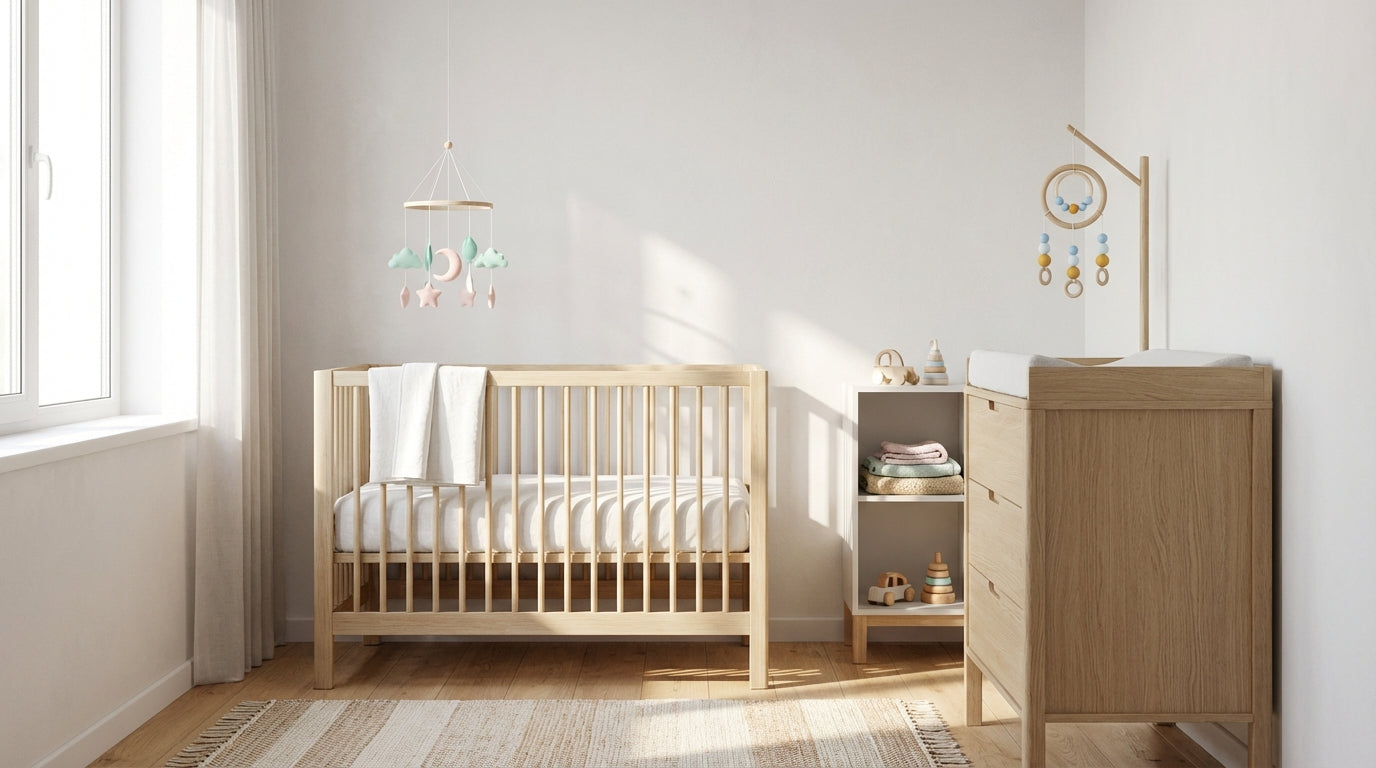
At the changing table, a mobile often brings the biggest relief in daily life. Over the crib it looks lovely and can soothe – at the changing table it is sometimes the little joker when nobody feels like changing diapers (so… most of the time).
Mobile at the crib/bedside crib
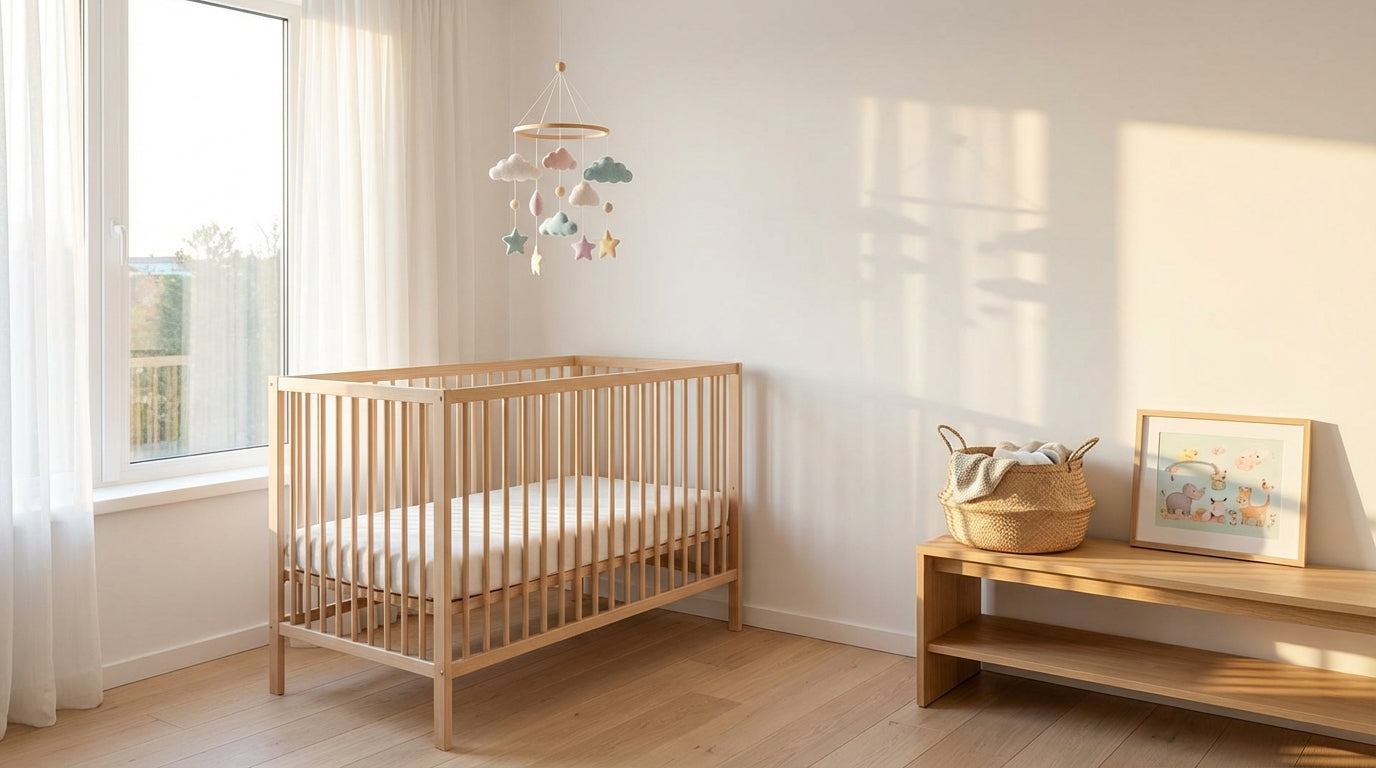
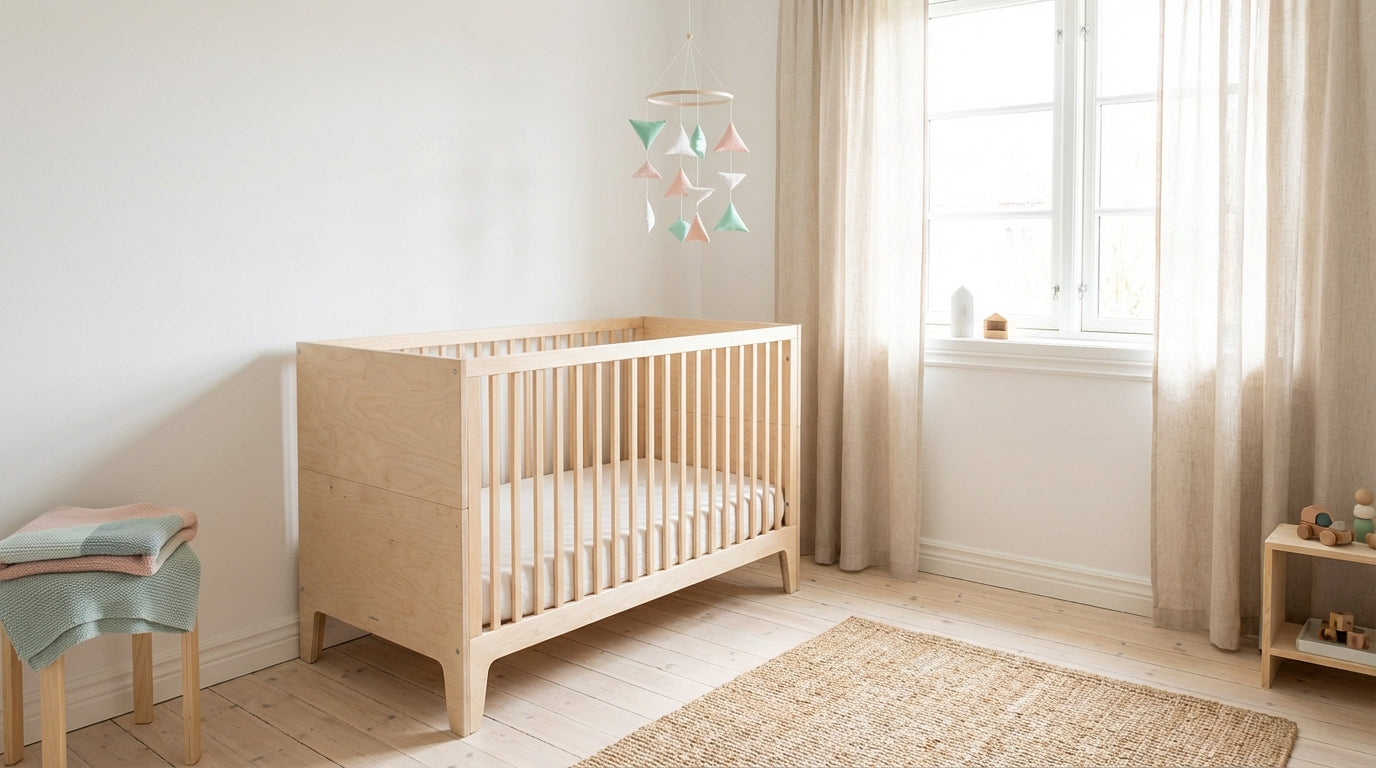
Over the crib, calm plus consistent distance is what counts. If the mobile hangs too low or is too exciting, a “sleep aid” quickly turns into a “mini cinema”. Models you can stop easily, without fumbling for a switch in the dark, are practical.
Mobile at the changing table
While changing, it can be a bit more “entertaining”. The goal isn’t falling asleep, but this: your baby looks – and you have two hands free. When that works, it feels like a small holiday in the middle of a Tuesday.
If that is your main use: under mobiles for changing tables you’ll find suitable options.
Safety note: At the changing table, the rule is: keep a hand on your baby. A mobile may distract, but it does not replace supervision – babies can roll faster than you can say “baby wipes”.
Mobile at the playpen/play area
In the play area, “keeping busy” matters more than “calming down”. Many families prefer to use grasping toys, spirals or arches there that are expressly meant to be touched. If you use a mobile there, pay special attention to whether it is suitable for being within reach and how stable the attachment stays.
Mounting options: clamps, screws, hooks – what makes sense?
The best mounting is the one that stays stable and doesn’t “turn along”. And yes: this is the part everyone would rather skip. But this is exactly where it’s decided whether you’ll have peace of mind later.

- Clamp mount: Quick to install, handy for flexible switching. Important: firm fit, suitable edge thickness, retighten regularly.
- Screw mount: Often very stable, but less flexible. Important: correct tools, clean installation following the instructions.
- Ceiling hook: Can work well if properly installed. Important: height/distance, no long strings within reach.
Practical tip: After mounting, do the “wobble test”: give the arm a good shake (without force). If anything comes loose or turns: re-attach it before your baby lies underneath.
From what age a baby mobile – and when to take it down again?
A mobile can make sense from birth, but it has a clear end. Many families start early because babies love to look. The most important moment is taking it down: as soon as your baby pushes up, sits up or can reach it.
Go by development, not by calendar weeks. As a rule of thumb: when your baby gets “higher” in the crib (pushing up/crawling/sitting), the mobile is removed. Safety guides likewise advise removing mobiles when babies sit or stand and could reach them (BabyCentre).
If you want to dig deeper into timing: From what age is a mobile useful for babies? All answers & tips.
DIY mobile: sweet, personal – but please keep safety in mind
A DIY mobile is only a good idea if it is truly built to be child-safe. Homemade is wonderful – especially as a gift. But for anything hanging over a baby, the rule is: better to check once more than to curse once too often later.

- No long strings: Keep them short and mount them so your baby can’t reach them.
- Light weight: The lighter, the better – and still securely attached.
- Firm connections: Nothing that could come loose and be swallowed.
- Check regularly: Knots, rings, hooks – everything gets “tired” over time.
FAQ
Which baby mobile is the best?
The best baby mobile is the one that is securely mounted and fits your daily life. For many families, that means: a calm look, few elements, a stable holder and (if it plays music) a quiet function that can be switched off. Look for the CE mark and clear warnings in line with EU requirements (EUR-Lex).
How do I attach a mobile securely to the crib?
It is secure when the holder sits firmly and the mobile stays out of reach. Mount it strictly according to the instructions, check the fit (wobble test) and regularly check whether anything has loosened. It is also important that no strings hang where your baby could grab them.
Mobile for the crib or rather for the changing table?
If you only want one, the changing table is often the more practical spot. There it helps as a distraction while changing, whereas over the crib calm matters more. Many families use something simple (or nothing at all) at the crib and something more “exciting” at the changing table.
When should you take a mobile down again?
As soon as your baby can push up, sit or actively reach for it, the mobile should come down. From then on, the risk increases that your child pulls on it or gets tangled. Go by developmental milestones, not just age. You’ll also find guidance on this in safety guides (BabyCentre).
Is a mobile in the crib safe?
It can be safe if it is stably mounted and consistently out of reach. The sleep environment should be free of objects that can contribute to entanglement or strangulation. The American Academy of Pediatrics recommends keeping such objects out of the sleep area (AAP).
How can I tell whether a mobile is “safe” as a toy?
Look for the CE mark, understandable warnings and transparent manufacturer information. In the EU, the Toy Safety Directive 2009/48/EC sets requirements for labeling and warnings (EUR-Lex). In addition, EN 71 is an important reference point; according to DIN, it helps reduce hazards that are not immediately apparent (DIN).
If you want to choose now: decide on the location first – then everything automatically gets clearer. To browse, you’ll find our overview under Mobile. And if you’d like to understand “from what age and for how long” in more detail: From what age is a mobile useful for babies? All answers & tips helps with planning – without stress and without a wagging finger.