Buying a Matryoshka: Checklist, Age & Play Ideas for Kids
At a glance
- A matryoshka works best when its size and the recommended age fit together.
- For toddlers, what counts: easy to open, easy to grip, cleanly made.
- Wood feels classic, while silicone is often everyday-friendly and “drop-proof”.
- With 5–7 play ideas, “open/close” quickly becomes a favorite ritual.
- Important: give it a quick check regularly and clean it according to the manufacturer’s instructions.

A matryoshka is a good choice when your child can open it safely and without frustration. In this guide you’ll get a clear checklist, an age guideline and simple play ideas that work in a real living room (including the “child throws everything on the floor” reality). And yes, we’ll keep it relaxed – because sometimes it’s already a big win when you get to drink your coffee while it’s still hot.

Ulli & Flo
Owners of bieco · Hamburg · parents themselves
We like matryoshka toys because they work without any fuss: open, close, in, out – and your child is happily busy. If it stays stress-free along the way, we’re in. Feel free to browse our Matryoshka collection.
At Bieco you can currently find silicone matryoshka variants in their own collection. If you’re looking for a soft nesting doll, this is a good place to start: Matryoshkas.
What is a matryoshka (nesting doll)?
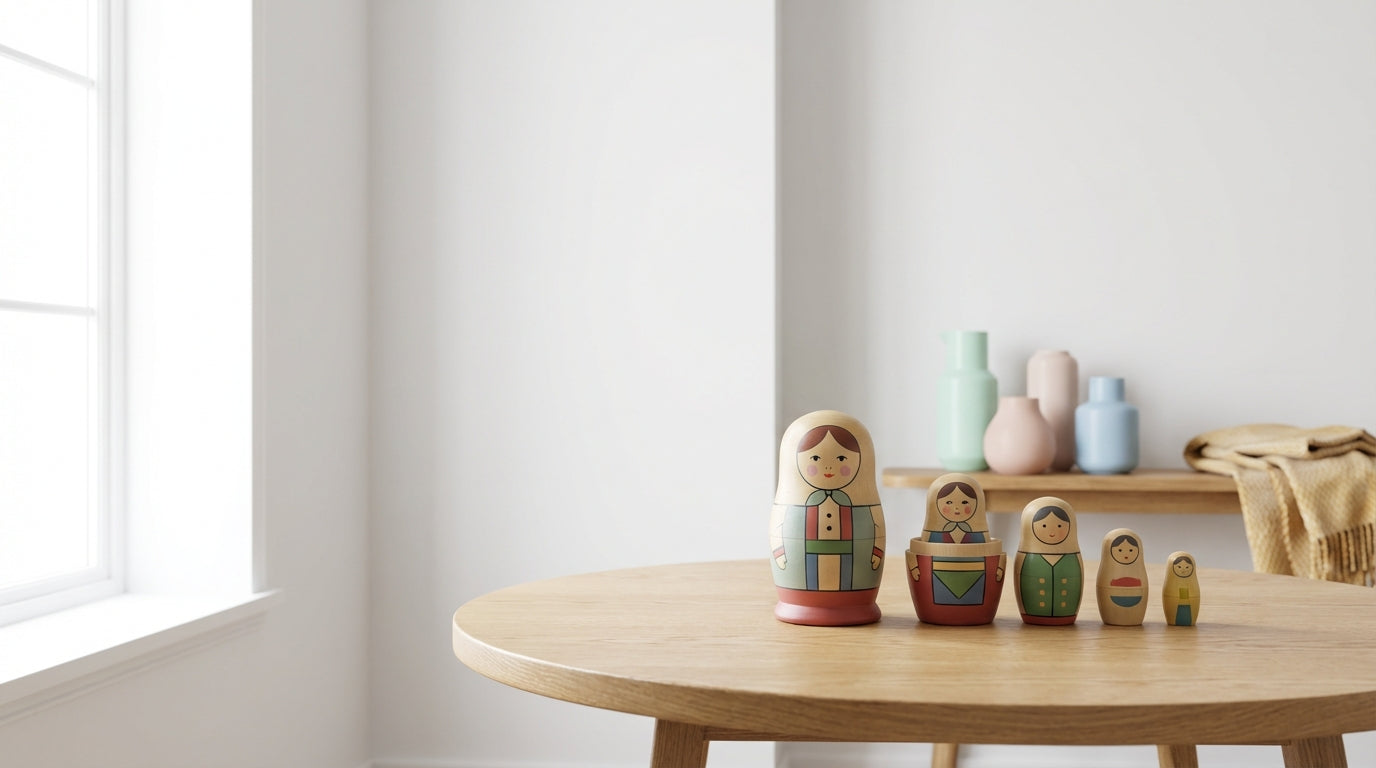
A matryoshka is a set of figures that fit inside one another in descending size. The classic version is painted wooden dolls that open in the middle – inside is the next one, then the next, all the way down to the smallest. According to the Encyclopaedia Britannica, matryoshkas (Russian “nesting dolls”) have been known since the late 19th century and became popular in Russia. (Encyclopaedia Britannica)

A nesting doll is a toy that combines “in and out” with sorting by size. That’s handy, because children practice sequences along the way, without you having to read out long instructions.
Nesting dolls is simply the English term for matryoshka figures. If you stumble across gift lists, it means the very same principle, just in another language.
Buying a matryoshka: the short checklist
The best matryoshka is the one where you don’t have to keep shouting “Wait, stop!” Here’s the quick shopping list that has proven itself in everyday life:

- Recommended age: Does it really suit your child – and not your wish that they “can do it already”?
- Size of the smallest pieces: The smaller the inner pieces, the more likely it turns into a “mouth test” for little ones.
- Opening & closing: Can it be opened in a child-friendly way – without force and without pinched fingers?
- Workmanship: No sharp edges, no loose parts, no noticeable cracks.
- Material & smell: A sharp, unpleasant smell is not a good sign – better to leave it on the shelf.
- Care instructions: Can you realistically keep it clean, given what your everyday life looks like?
Practical tip: Try the “phone-is-ringing test”: can you put the matryoshka down for 10 seconds without things getting tricky right away? Then it usually fits well.
Buying a matryoshka: material, age, safety, cleaning (in detail)
Material: wood or silicone?
Wood is classic, while silicone is often more forgiving with falls and small hands. Wooden matryoshkas are often very pretty, but depending on the fit they can sit quite snugly. Silicone variants are usually softer, grippy and more forgiving when something sails off the table (it happens, doesn’t it?).
Toy materials must meet certain chemical requirements. According to the European Commission, the EU Toy Safety Directive 2009/48/EC sets out essential safety requirements for toys, including chemical properties. (EU Toy Safety Directive 2009/48/EC)
Age: What really suits my child?
The recommended age isn’t decoration, it’s a practical guide to risk. Especially under 3 years, things quickly end up in the mouth or wandering around the home. And yes: that’s normal – it’s how children learn.
- Around 12 months: Larger, easy-to-grip versions often work better than small, snug wooden dolls.
- Around 2 years: Many children begin to sort by size on purpose, and “I do it myself” becomes a hobby.
- From 3 years: Role play (“family”, “animal babies”) and storytelling often join in.
Safety: What you can look out for in everyday life
Safety means: the right size, good workmanship and a regular quick check. You don’t need a lab for it – but open eyes and a bit of routine help.
Safety note: According to the European Commission, toys in the EU must meet the requirements of the Toy Safety Directive 2009/48/EC; this also includes warnings and protection against risks such as swallowing. (EU Toy Safety Directive)
A quick everyday check is faster than an evening drama. Now and then, look for cracks, chipping paint, sharp edges or parts that could come loose – especially if the toy gets a lot of use.
Cleaning: How does the matryoshka stay hygienic?
Always clean the matryoshka according to the manufacturer’s instructions, not by gut feeling. Wood is usually wiped with a damp cloth and dried well, while silicone is often simpler – but what matters is what the manufacturer specifically recommends.
From what age does a matryoshka make sense?
A matryoshka makes sense as soon as your child can grip securely and curiously play “in/out”. It’s less a question of being “smart enough” and more about motor skills, interest and the specific design (size, material, small parts).

If you’re looking for a soft version, the manufacturer’s age information is a helpful guide. At Bieco, the collection is here: Matryoshkas – you’ll find the age information right on each product.
What do children learn when playing with a matryoshka?
Playing with a matryoshka combines dexterity, sequences and concentration all in one. And the best part: it happens along the way, without you having to announce “now we’re practicing”.
- Fine motor skills: Gripping, twisting, pulling apart, fitting together.
- Sequence & sizes: “Which one goes where?” is a natural spark for thinking.
- Cause & effect: Opening shows “there’s something else in there”, closing means “gone” – fascinatingly simple.
- Language: You can casually narrate along: big/small, in/out, “again”.
Practical tip: If your child sorts “wrong”: let them. Rather say: “Show me how you want to do it.” The right order often comes by itself.
7 play ideas with a matryoshka (no crafting required)
With a matryoshka you don’t need a program – two minutes are enough, then your child takes over. Here are ideas that are easy to adapt:
- Open – close – again: You open it slowly, your child looks inside, and you close it again. Then your child gets a turn.
- Find the little one: Put the smallest figure under a cloth and let your child search. Simple wins.
- Bigger – smaller: Lay everything side by side and sort by feel. You comment in a friendly way, without correcting.
- Playing family: Every figure gets a name. “Grandma” on the outside, “baby” on the inside – role play is under way.
- Hide-and-seek around the room: A figure briefly “parks” on the sofa, on the shelf, under the table. Your child finds it again.
- Color hunt: Look for objects that match the color of a figure.
- Tidy-up ritual: “Let’s snuggle everyone back in” – and suddenly tidying up is part of the game.
How we test in everyday life (honest & Hamburg-style)
We don’t just look at paper, but also at what gets on your nerves in family life. Ulli & Flo here – we’re parents, and yes: at our place, toys also end up under the table, in the hallway and in the mouth. That’s why, when choosing, we pay special attention to grip, easy opening, clean edges and whether a toy “causes stress” or not.
As a family business from Hamburg, we’ve been doing this for 66 years – with a healthy respect for safety. When manufacturer information on care or use is available, we follow it, and we prefer clear, understandable instructions over fine print.
Storage: so the smallest figure doesn’t wander off
Everything stays together best when the matryoshka has a fixed place. That can be a small box, a basket or a spot on the shelf that little hands can reach, too.

If you’re looking for a simple solution, a toy box in the nursery helps. At Bieco you can find inspiration for tidying up here: Nursery.
FAQ
Which matryoshka for a 1-year-old?
For about 1 year, larger, easy-to-grip matryoshka variants without tiny inner pieces are usually the best fit. Pay attention to the manufacturer’s recommended age and make sure your child can open it without much force. If you’re unsure: it’s better to go “one size up” and start with less stress.
Wood or silicone: which is better?
The better material is the one that suits your everyday life and your child’s age. Wood is classic and often decorative, but it can sit snugly or be more delicate. Silicone is often softer, grippy and more forgiving with falls. What matters are workmanship, care instructions and the recommended age.
How do I clean a matryoshka properly?
Clean it according to the manufacturer’s instructions and then let it dry well. Wood is often only wiped with a damp cloth and shouldn’t stay wet for long. Silicone is often simpler, depending on the product. Important: don’t “forget” the inner surfaces – crumbs and dust like to collect there.
How can I tell if a matryoshka is safe?
A safe matryoshka is cleanly made, sturdy and has a suitable recommended age. Look for smooth edges, no cracks, no detachable small parts, and make sure opening and closing works without force. According to the EU, toys are covered by the Toy Safety Directive 2009/48/EC with essential safety requirements. (EUR-Lex)
What if my child only takes the matryoshka apart?
That’s a completely normal way to play – and often exactly the starting point. Many children begin with “open, out, in, again”. You can accompany them with a few words (“in/out”, “big/small”) and every now and then playfully show how to nest the pieces again. Without pressure, it usually goes faster.
How do I stop pieces from constantly disappearing?
Make putting things away a closing ritual, not a punishment. Call it “putting the family to bed” and nest the figures together again before you start something new. A fixed place (box/shelf) helps, too – especially when visiting children join in the play.
If you’d like to keep browsing: the collection shows different matryoshka ideas at a glance. Take a look here: Matryoshka and for the soft versions here: Matryoshkas.
Bottom line: a matryoshka is a small toy with big “Again!” potential. When age, size and workmanship fit, you have something that keeps up with everyday life for a long time. And if you’d like some inspiration, at Bieco you’ll find the matryoshka collection and matching variants to click through.