Activity Baby Toys: How to Support Senses & Motor Skills Without Stress
At a Glance
- Activity baby toys work best when they accompany one small developmental step.
- Choose roughly by age: a few stimuli at first, more elements to grab later on.
- Safety check: firm seams, no loose parts, clear labelling.
- Short bursts of play are often enough: 3–10 minutes is perfectly fine.
- Variety often works better with rotation than with “ever more features”.

Activity baby toys make sense when they let babies discover things on their own – without non-stop entertainment. You lay it down (or hang it up in a suitable spot), your baby grabs, feels, listens, looks – and you simply watch whether it feels right at the moment. In this guide you'll get practical, everyday orientation: which types exist, how to choose by age, how to recognise safety, and how to avoid overwhelming your little one. Plus a DIY idea that works without craft chaos.

Ulli & Flo
Owners of bieco · Hamburg · parents themselves
We've found that activity toys work best when playtime is short and pressure-free. A few minutes are often completely enough – and that's good news. Feel free to browse our Baby Toys collection.
What Are Activity Baby Toys – and What Do They Really Offer?
Activity baby toys bundle several sensory and grasping stimuli into a single toy. Typical features include crinkle panels, little rings, mirrors, different fabrics or a teething element – designed so that babies can explore independently.
The benefit is “learning by doing” – in small, manageable portions. Grasping, turning, shaking or listening supports hand-eye coordination, attention and the first finer hand movements, without you having to “train” anything.
Activity doesn't mean “more is better”, but “the right dose”. If your baby turns away or suddenly fusses, that's often just an honest “thanks, that's enough” – and no drama.
What Types of Activity Toys Are There?
The best choice depends on what your baby can do well and enjoys right now. A rough overview still helps, so you don't accidentally bring the fairground into your living room.

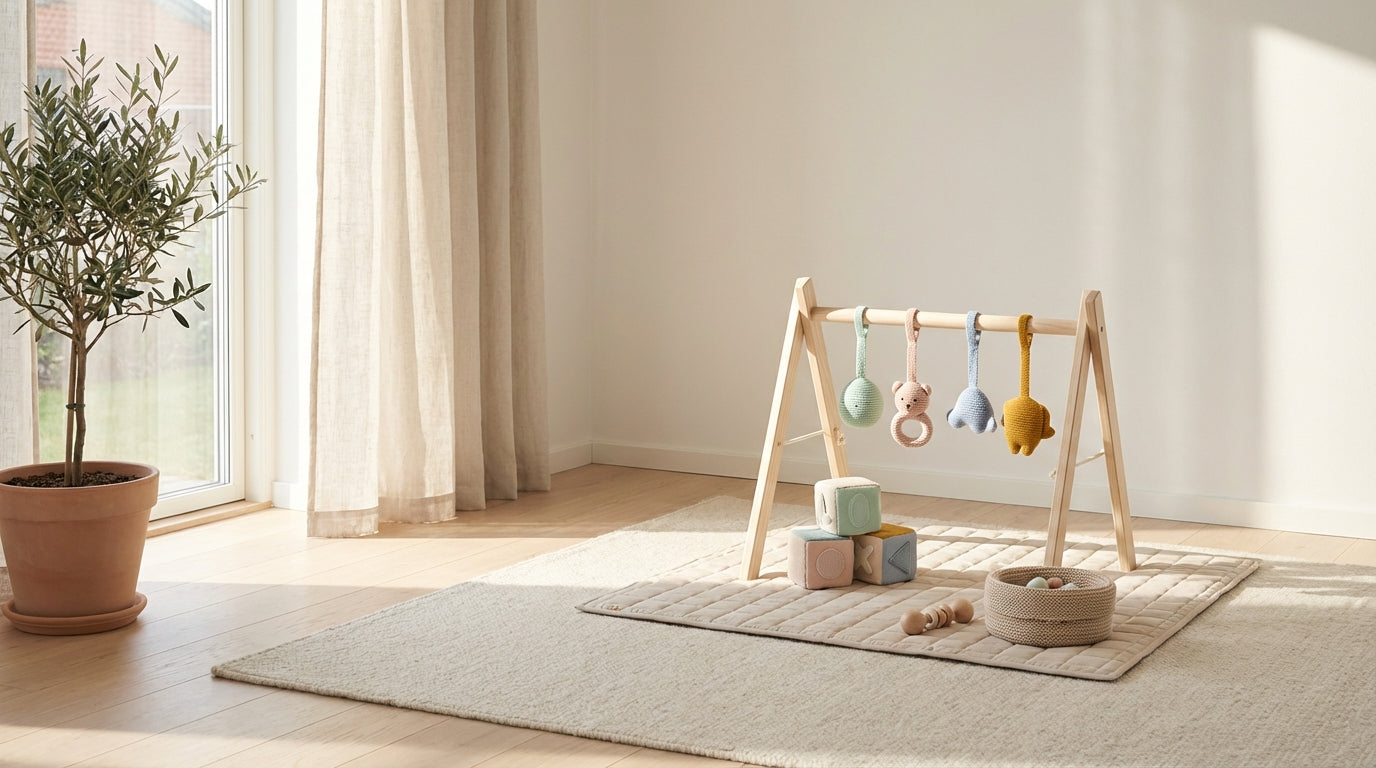
- Activity blanket / play arch: Lots to look at and kick, often with hanging toys. Great for lying on the back, and later for tummy time too.
- Activity cube / soft activity toy: Several sides with textures, crinkle and touch elements.
- Activity spiral: For the pram or car seat – handy on the go, as long as it's securely attached and you're right there.
- Teether / rattle / crinkle toy: Small, light, often the first step – and ideal for “just a quick moment”.
- Cloth book / touch-and-feel book: Turning pages, crinkling, feeling – later wonderful for little rituals.
Practical tip: If you're unsure, go for a toy with 2–3 clear functions. You can always step things up – turning them down is harder.
Activity Toys for Babies: How to Choose by Age (0–12 Months)
The younger the baby, the simpler the stimuli and shapes can be. Babies only gradually bring their vision, grasping and coordination into sharp focus.
| Age (approx.) | What babies often enjoy | What to look out for |
|---|---|---|
| 0–3 months | Contrasts, calm sounds, soft fabrics | Lightweight, not too many dangling bits, easy to reach |
| 3–6 months | Grasping & bringing things to the mouth, crinkles, rattles | Easy to grasp, securely sewn, saliva-resistant material |
| 6–9 months | Turning over, shaking, pulling, “aha” effects | Sturdy connections, nothing that can come loose |
| 9–12 months | Cause and effect, flipping pages, more targeted grasping | Robust, easy to clean, clear age information |
When teething is an issue, “suitable for the mouth” suddenly matters more than anything else. In that case, it's better to use a teething or grasping element designed for it, rather than letting your baby chew on something that isn't meant for that.
If you like to go by developmental stage: our overview helps you get your bearings. In Sensible Baby Toys by Age: Recommendations from 0 to 12+ Months you'll find calm guidance on what often fits well at each stage.
How Can I Recognise Safe Activity Baby Toys?
Safe means sturdily made and traceably labelled. Especially with activity toys that have several elements, it's worth taking a quick “once-over” moment.

Safety note: Quickly check seams, ribbons, rings and hanging toys before every use. If something is loose: don't think “it'll be fine” – get rid of it.
In Germany, the EU Toy Safety Directive is implemented through the 2nd ProdSV (Product Safety Ordinance). According to the German Federal Ministry for the Environment (BMUKN), this includes requirements for safety and labelling, among other things. (BMUKN: Safe Toys)
The EN 71 series of standards describes tests that are frequently relevant for toys. These include mechanical/physical requirements (EN 71-1), flammability (EN 71-2) and chemical requirements for the migration of certain elements (EN 71-3), as DIN explains it for consumers. (DIN on DIN EN 71-3)
Chemical substances in toys are also assessed – not just judged by “gut feeling”. According to the German Federal Institute for Risk Assessment (BfR), phthalate plasticisers, PAHs and allergenic fragrances in toys, among others, have been assessed for health risks. (BfR: Health Assessment of Toys)
If you want a quick checklist: we've put one together properly. In Safe Baby Toys: The Ultimate Checklist for Parents you can go through it point by point – without having to open three tabs first.
How Do I Play With Activity Toys Without Overwhelming My Baby?
The best rule of play is: offer, observe, pause. You place the activity baby toy so that your baby can reach it – and then they get to try it out for themselves. You're there, but you don't have to be a one-person show.
Recognising Overstimulation (Without the Guilt)
Turning away, fussing or frantic flailing often means: “Break, please”. Some babies are “full” of impressions very quickly, others can stay with it longer – both are normal.
How It Works in Everyday Life: Step by Step
- Start calmly: Show just one element first (e.g. a crinkle panel) and wait.
- Slow down: Repetition isn't “getting stuck”, it's learning.
- Swap instead of stacking up: When your baby is “done” with it, swap the toy – instead of piling on more and more features.
- Watch body signals: Restlessness = break, not “now more than ever”.
- Use mini rituals: 5 minutes after a nappy change or after waking up is often completely enough.
Practical tip: Put 2–3 items into a rotation (e.g. in a basket). Swap them every two days – they feel brand new, without any shopping trip.
Fine motor skills mean targeted movements of the hands and fingers in everyday life. For babies, these are things like grasping, holding on, passing from hand to hand or pressing on purpose.
Sensory processing is the way we take in sensory stimuli such as touch, sound, light and movement. Activity toys deliver such stimuli in measured doses – it's ideal when your baby can stay calm while exploring.
On the Go: Pram & Car Seat – What's Practical?
On the go, what counts is: short, securely attached and not in the way. An activity spiral or a small hanging toy can make waiting times easier – but please make sure your baby can't get tangled up and that you can see them at all times.
What Works Well on the Go
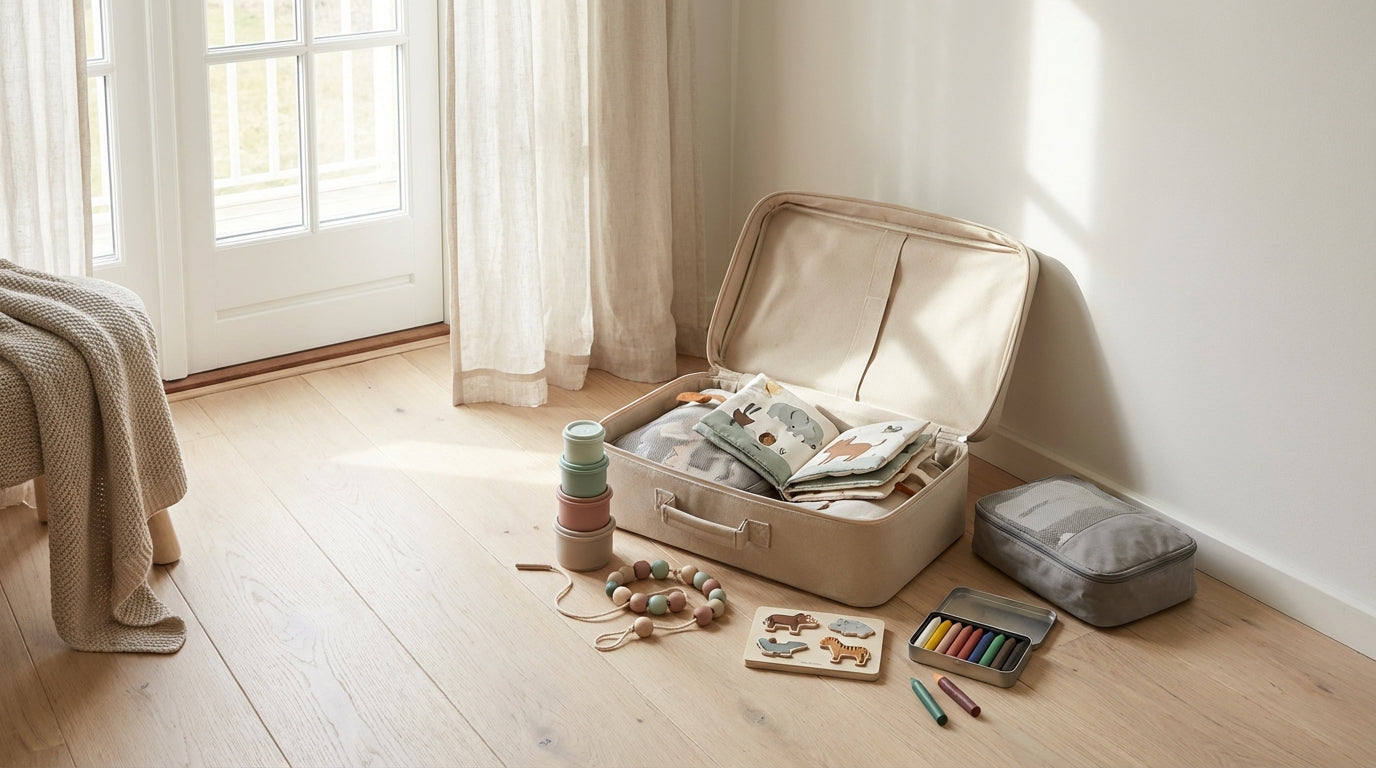
- Small & light: A teether or crinkle toy that doesn't constantly fall down (or that you can easily find again).
- Easy to clean: Everything is a little… stickier outdoors.
- Few elements: In the pram, less is often more, because there's already a lot going on.
When I'd Rather Leave It Out
When your baby is tired, “nothing” is sometimes the best toy. Then it's better to offer calm, gentle rocking and time to look around – and you save yourself the picking up, too.
Cleaning & Care: Keeping Activity Toys Practical for Everyday Life
Keeping things clean is less about “perfection” and more about “regular and pragmatic”. Because babies put everything in their mouths, a fixed routine is worthwhile – and a quick look at the care label.
3 Simple Routines
- Quick weekly check: Seams, loops, rings – is everything still firm?
- Clean when needed: Visibly dirty or chewed a lot = clean it promptly.
- Let it dry well: Babies don't like damp fabrics – and neither do you.
Washable vs. Wipeable
Washability is worth its weight in gold when it's been “milk plus banana”. Wipeable surfaces are handy on the go, washable parts for everyday life at home – both have their place.
Materials: Wood vs. Plastic vs. Fabric – What Suits When?
There's no such thing as “the best material”, only what fits well right now. What matters is that it's safely made, feels good to hold and suits your daily life.
Fabric & Soft Toys
Soft toys are often a relaxed way to start, because they're light and cuddly. Especially at the beginning, many babies like soft surfaces and quiet sounds such as rustling.
Wood
Wood is sturdy and feels pleasantly “real” to many children. It's often a bit heavier – which can be great later on, but at the beginning, depending on your baby, it may be too much weight in the hand.
Plastic
Plastic can be practical if it's light and easy to clean. Pay particular attention to clear manufacturer information and make sure nothing is sharp-edged or loose.
DIY Idea: Mini Activity Game (No Craft Stress, No Small Parts)
You can create activity moments without a craft box and without small parts. The goal isn't “Pinterest”, but a short, safe stimulus for hands and senses.
“Touch Station” on the Sofa
- You'll need: 2–3 different, clean fabrics (e.g. a cotton cloth, a terry washcloth, muslin) and a soft cushion as a base.
- How it works: Lay the fabrics side by side on the cushion. Place your baby next to it on their back or tummy (depending on their stage). Let them stroke their hands over the fabrics.
- Play prompt: Briefly say what's happening: “That's soft”, “That's smooth” – and then bring calm back in.
Safety note: No loose ribbons, no buttons, no beads. And only under supervision – in the excitement, fabric can slip awkwardly over the mouth or nose.
If you prefer “ready-made and well thought-out”: that's completely okay. Good activity toys are made to withstand typical baby tests such as pulling, chewing and throwing in everyday life.
A Word About Us: Hamburg, Family Business, for 66 Years
We're a family business from Hamburg and we think about toys from the perspective of real everyday life. Ulli & Flo write here as parents for parents – and at Bieco we've been doing this for 66 years: designing things so that they stand up to little hands and don't put extra strain on parents' nerves.
It's important to us to talk openly about safety and materials – no smoke and mirrors. If something only makes sense under supervision, we'll say so – straight-talking, northern German style.
FAQ About Activity Baby Toys
What Are Activity Baby Toys?
Activity baby toys combine several play stimuli such as touching, grasping and listening in one item. Typical features are crinkle panels, rings, mirrors or different fabrics. The advantage: babies can try things out for themselves, without you constantly having to “show them how”. Offer briefly, observe, done.

From What Age Do Activity Toys Make Sense for Babies?
Activity toys can make sense from the first months, as long as they are appropriately simple for the age. For the very little ones, contrasts and soft materials are enough. Later, grasping and sound elements are added. What matters less is the month on the calendar than this: can your baby reach it easily and explore it safely?
How Long Should a Baby Play With Activity Toys?
Often 3 to 10 minutes is enough, because babies have to process impressions quickly. If your baby looks away, fusses or gets frantic, that's usually a signal for a break. It's better to have several short rounds spread throughout the day than one long session that stresses everyone out.
How Can I Recognise Safe Activity Baby Toys?
Look for clear age labelling, sturdy construction and traceable safety information. According to the BMUKN, Germany implements the EU Toy Safety Directive through the 2nd ProdSV, which includes requirements for safety and labelling, among other things. Notes on relevant standards (e.g. EN 71) also help. (BMUKN)
Are “More Features” Automatically Better in Activity Toys?
No, for many babies less is actually better, because it stays easier to take in. A toy with a few clear stimuli is often explored for longer and with more focus. If you want variety, rotate two to three items instead. In everyday life, it feels surprisingly “new”.
Which Is Better: Activity Blanket or Teether?
Either can work – it depends on whether your baby currently prefers lying back or grasping with purpose. A blanket with an arch is good for “looking, kicking, touching by chance”. A teether is ideal when your baby wants to grasp deliberately and bring things to the mouth. Many families use both at different moments.
Conclusion: How Activity Toys Become Truly Helpful
Activity baby toys are at their best when they take the pressure off you instead of adding to it. A few minutes of discovering on their own, then a break again – that's often already the whole magic. If you'd like to browse now: in our Baby Toys collection you'll find calm, practical ideas for different stages. And if your coffee goes cold today anyway: welcome to the club.