Safe Baby Toys: A Checklist for Parents & Gift-Givers
At a glance
- You can spot safe baby toys with a 60-second check: read, feel and pull.
- For children under 36 months, detachable small parts and brittle surfaces are a clear no.
- CE marking is mandatory in the EU, but it is no substitute for your own everyday check.
- Labelling (manufacturer, address, warnings) helps with questions and recalls.
- Copy-and-paste checklist at the end: save it once, use it again and again.

The quickest way to recognise safe baby toys is by their labelling, their workmanship and whether anything can come loose. You don't need a lab for this, just two alert eyes and a few quick parent moves: sniff, pull, feel all the way around and read the warnings. In this guide you'll get a practical step-by-step walkthrough, plus a checklist you can copy. It helps parents, grandparents and anyone looking for a gift, without having to play detective in the living room later.

Ulli & Flo
Owners of bieco · Hamburg · parents themselves
We wished for a list like this ourselves back then: short enough for everyday life, strict enough for peace of mind. Feel free to keep it as a note and save yourself the late-night worrying. Have a browse through our Baby Toys collection.
1) The 60-second check: how to sort out toys right away
In one minute you can tell whether a toy will cause stress in everyday life. Pick it up and go through these points once, and don't feel guilty about being strict:

- Smell: Does it sting your nose with a chemical odour? Then better leave it on the shelf.
- Pull: Give eyes, buttons, ribbons, rings and appliqués one good tug.
- Feel: Are there sharp edges, splinters, hard points or burrs?
- Shake: Is something rattling loose inside, or visibly wobbling?
- Read: Are the age recommendation, warnings, manufacturer and contact details there?
Practical tip: Try the "sofa test": if you can check the toy quickly in dim light, it will work in real everyday life too.
2) CE, the EU Toy Safety Directive and DIN EN 71: what matters for you?
CE marking on toys is mandatory in the EU, and a good starting point. The legal basis is the EU Toy Safety Directive 2009/48/EC; it sets out safety requirements and labelling obligations, which you can read at EUR-Lex (EU).
CE means the manufacturer declares compliance with EU requirements. That helps, but it doesn't spare you from looking at use, ageing and real everyday play (saliva, the washing machine, siblings, the dog, you know how it goes).
DIN EN 71 is a series of standards for toy safety. In practice this means that many details (e.g. mechanical risks such as small parts) are assessed using defined test methods, and you can follow the same basic ideas in everyday life: nothing detachable, nothing sharp, nothing that can get tangled.
CE marking is a legally required conformity marking in the EU. It shows that the manufacturer places the product on the market in line with EU requirements.
An age recommendation is a safety and developmental guideline for children. It helps you avoid risks (e.g. small parts) and overstimulation or frustration.
3) Under 36 months: small parts, the classic that sadly never goes out of fashion
For children under 3 years, detachable small parts are a real risk. Whether something counts as a small part is assessed, among other things, with a test cylinder; according to the Bavarian consumer portal, a cylinder with Ø 31.7 mm is used.

The warning "Not suitable for children under 36 months" is not decorative text. The EU Toy Safety Directive requires warnings for toys that may be dangerous for children under 36 months (e.g. because of small parts); see the overview at EUR-Lex.
Safety note: If something can be loosened with your fingers (even "just a little"), sort it out immediately. With babies, a single moment often decides everything.
Here's how to spot small parts in everyday life without any measuring tools. Simply ask yourself: Does it fit in the mouth? And: Can it come loose? If both answers are "yes", it's usually not a good idea for babies and young toddlers. How such tests generally work is also explained by LAVES Niedersachsen.
4) Cords, ribbons, loops: fewer worries, more peace of mind
For babies, short, firm connections are better than long loops. Not because parents are inattentive, but because everyday life is just everyday life: changing a nappy, the phone, siblings, the parcel courier, and the baby rolls off.
- Ribbons & loops: short, firmly sewn, no knots that can come undone.
- Rings & chains: no cracks, no brittle spots, no sharp transitions.
- On the pram: attach so that nothing can get near the neck and nothing comes loose.
Northern German rule of thumb: if it already looks tangled when you look at it, it will be. And then you don't have a "lovely toy" but a little side project, which nobody wanted.
If you're looking for suitable categories, take a look at things to grasp and chew. For browsing (and to get a feel for shapes and sizes), you can look at Teething Rings or Grasping Toys.
5) Workmanship & durability: seams, edges, surfaces, one honest look all around
Good workmanship is safety work, just without the drama. Look at toys the way someone would who has searched for a loose seam at three in the morning. You know what I mean:
- Textile: tight seams, no filling coming out, appliqués ideally embroidered or very firmly fixed.
- Wood: smooth, splinter-free, no cracks, no flaking spots.
- Plastic: no sharp burrs, no cracks, nothing "crumbly".
Toys age, and that's normal. Sun, saliva, washing, being dropped: that's why a mini-check is worthwhile whenever you're tidying up anyway. It takes less than 30 seconds, but can easily save you a whole afternoon of worrying.
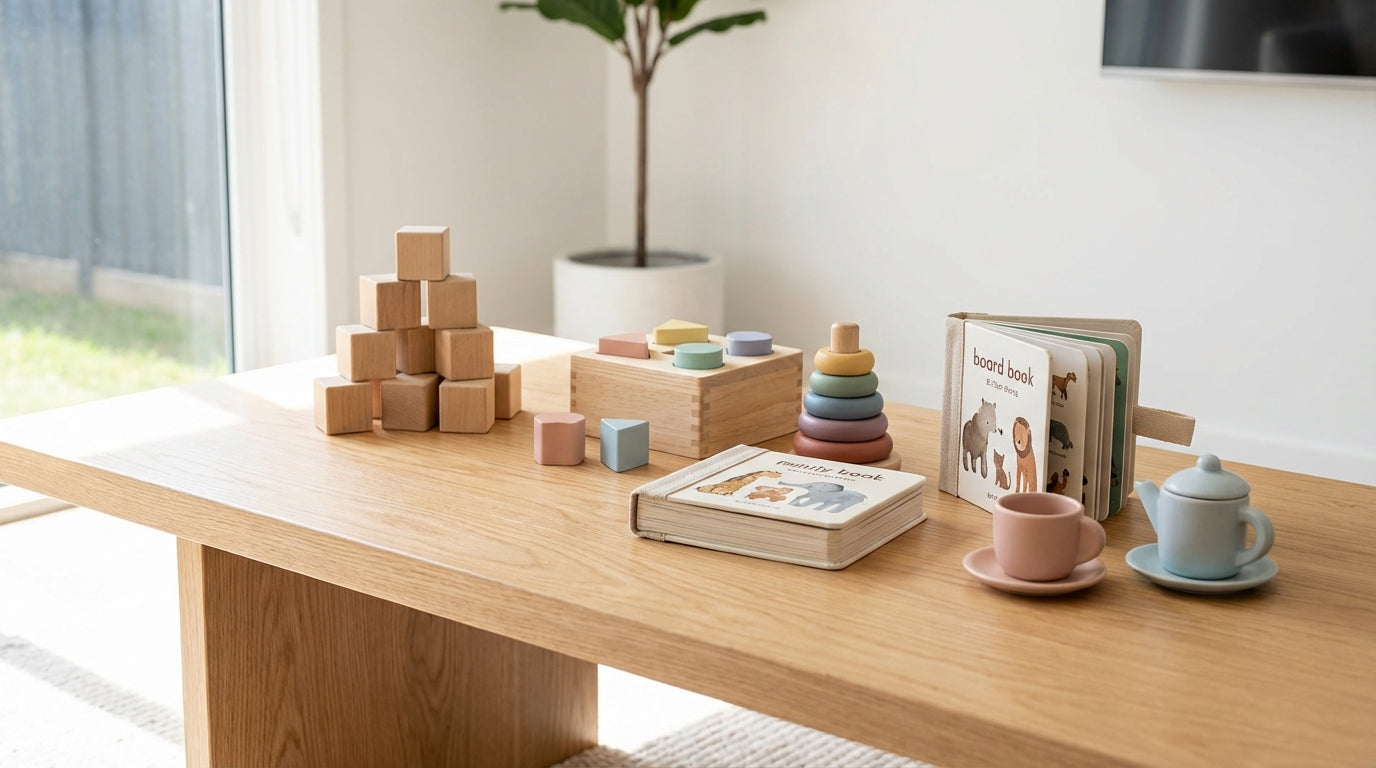
Wooden toys are often robust, but they need a smooth, intact surface. If you're looking for wood that feels good and is easy to check, you'll find inspiration in the Wooden Toys category.
6) Chemical requirements & smell: what you can realistically check
A strong, pungent smell is a warning sign, even without a chemistry degree. According to the BMUKN (German Federal Ministry for the Environment), the EU Toy Safety Directive also contains chemical requirements (including for certain substances and fragrances).
Here is what you can sensibly do at home without driving yourself crazy.
- Smell test: "new" is okay, "solvent-like" is not.
- Colour transfer: If colour visibly rubs off or a coating comes away, sort it out.
- Mouth contact: Anything that will surely end up in the mouth should be especially unobtrusive and sturdy.
Practical tip: If it's washable, wash or wipe it once according to the manufacturer's instructions. That reassures your baby, and your own nerves along with it.
7) Labelling & traceability: the little label is your friend
Good labelling helps you react quickly in case of questions or recalls. Look on the product, packaging or instructions for the manufacturer's name, contact address, an identifying feature (e.g. type/batch) and warnings. It's your "who made this?" note, just in case.
A practical tip for gift-givers: keep the packaging for a short while so you can look things up. Two or three weeks are often enough to know whether it stays a favourite toy or gets passed on.
8) What we pay attention to at Bieco: from a parent's perspective, not a glossy brochure
We are a Hamburg family business and have been doing this for 66 years. And yes: above all, that means we've learned how little time parents have for complications.
Safety transparency means we take labelling, materials and testing seriously. When we talk about toys, we do so with an eye on what really happens in everyday life: toys get sucked, thrown, washed and sometimes mistaken for a "teething aid". That's why we pay particular attention to clean workmanship, clear instructions and to products being designed for the appropriate age group, without you having to study a manual first.
Copy-and-paste checklist: safe baby toys in everyday life
This list is there so that you actually use it, not so that it looks pretty. Copy and paste it into your notes, onto the fridge or into the family group chat (maybe someone will even read it there).
| Checkpoint | Yes/No | Note |
|---|---|---|
| Age suitable? Warnings read (especially "under 36 months") | □ | |
| No detachable small parts (pull, shake, wobble) | □ | |
| No sharp edges/splinters/burrs (feel all around) | □ | |
| No long, loose ribbons/loops | □ | |
| Smell unobtrusive (not pungent/chemical) | □ | |
| Surface stable (nothing rubs off, nothing flakes, no cracks) | □ | |
| Cleaning possible (washing instructions/wipeable) | □ | |
| Labelling present (manufacturer, contact, identification, warnings) | □ | |
| Storage sorted (broken items out, little bits put away) | □ |
In closing: stay relaxed, and still be consistent
If you follow this list, you're already doing very well in everyday life. And if you just want to collect ideas, take a look at the overview of Baby Toys or keep reading with Sensible Baby Toys by Age. For pram walks, you'll also find inspiration in Pram Chains, and then your coffee might even stay warm.

FAQ: Frequently asked questions about safe baby toys
How can I spot small parts most quickly?
Small parts are anything small that can come loose. Give appliqués a quick tug and shake the toy. If something falls off or wobbles, it's off-limits for babies. As a guide: the test cylinder used to assess small parts has Ø 31.7 mm, according to the Bavarian consumer portal.
Is CE a quality seal?
CE is not an independent quality seal, but a mandatory marking. It shows that the manufacturer declares compliance with EU requirements. You'll find details on toy safety and Directive 2009/48/EC at EUR-Lex. It's still important for you to check condition, age suitability and everyday use.
Why does "Not suitable for children under 36 months" appear so often?
Because certain features can be dangerous for small children, mostly small parts. The EU Toy Safety Directive provides for warnings on toys that may be risky for children under 36 months. Take the warning as clear guidance, especially if you're giving a gift and don't know the child well yet.
How often should I check baby toys?
Short and regular is better than rare and with a guilty conscience. A good rhythm is whenever you tidy up: one look and feel all the way around. And always straight away if something seems "off" (open seam, crack, a part coming loose). It's best to take defective toys out of the room right away.
What is especially important with wooden toys?
Wooden toys must be smooth, splinter-free and without flaking spots. Run your hand over edges, drilled holes and corners. If you feel splinters or see cracks, it's better to sort the toy out. Wood is often long-lasting, but babies are very thorough testers (with their teeth).
What should I do with second-hand toys from the family?
Second-hand toys can be great, as long as you check them strictly. Do the 60-second check and pay particular attention to brittle plastics, worn-out seams and detachable decorations. If labelling or warnings are missing and you're unsure, it's better to use the toy only under supervision or pass it on rather than give it to the baby.