Learning Toys from Age 1 to 6: The Complete Guide
At a Glance
- Learning toys for age 1: big pieces, grasping, posting, sorting.
- From 2–3 years: matching, first puzzles, role play and short rules.
- From 4 years: patterns, patience, finer hand movements – but please without overwhelming them.
- From 5–6 years: projects, strategy, longer games and “I can do it myself.”
- Safety first: take age recommendations & warnings seriously, especially when it comes to small parts.

Learning toys for age 1 are a good fit when your child gets stuck in and does things on their own. That means grasping, posting, sorting, stacking – and collecting small moments of success along the way, without you constantly having to “help.” In this guide you’ll find clear age guidance from 1 to 6 years, including ideas for types of play, typical learning steps in everyday life and a few relaxed parenting tricks. And yes: we’re Ulli & Flo from Hamburg, parents just like you – and we’ve been making toys for 66 years. Still, there’s no pressure here. Family life already hands that out for free.

Ulli & Flo
Owners of bieco · Hamburg · parents themselves
We’ve noticed ourselves: the best learning toy is often the one that keeps getting pulled out again and again without any big announcement. With this age overview, you’ll find those hits faster. Feel free to browse our learning toys collection.
What are learning toys – and how can you tell they’re the right fit?
Learning toys are toys that let children practice specific skills while they explore. The trick isn’t “smart early,” but “easy to reach”: your child can do something, sees an effect and keeps going.

A good sign is when your child starts on their own and comes back to it again. If you turn into an entertainer after two minutes, it’s often too hard, too flashy or simply not the right phase right now.
An “aha game” has a clear task and a clear result. That could be a shape sorter (the shape fits or it doesn’t) or a puzzle (the piece fits or it doesn’t) – the main thing is that the feedback is easy for children to understand.
Montessori toys are usually simple and support independent play. They’re designed so that children can concentrate on one task instead of blinking side attractions.
How to choose learning toys by age (without searching for hours)
The best shortcut is three questions: ability, interest, frustration tolerance. Age helps as a rough guardrail – but children are more like weather than clockwork: sometimes stormy, sometimes sunny, rarely on schedule.

- Ability: What already works reliably (e.g. stacking, turning, threading)?
- Interest: What magically draws your child in (vehicles, animals, “cooking,” building)?
- Frustration tolerance: Do they stick with it or quickly tip into “this is silly!”?
Practical tip: Put out only 6–10 toys where your child can see them and rotate them every 1–2 weeks. That saves you chaos and makes them feel “new.”
Which learning toys for age 1?
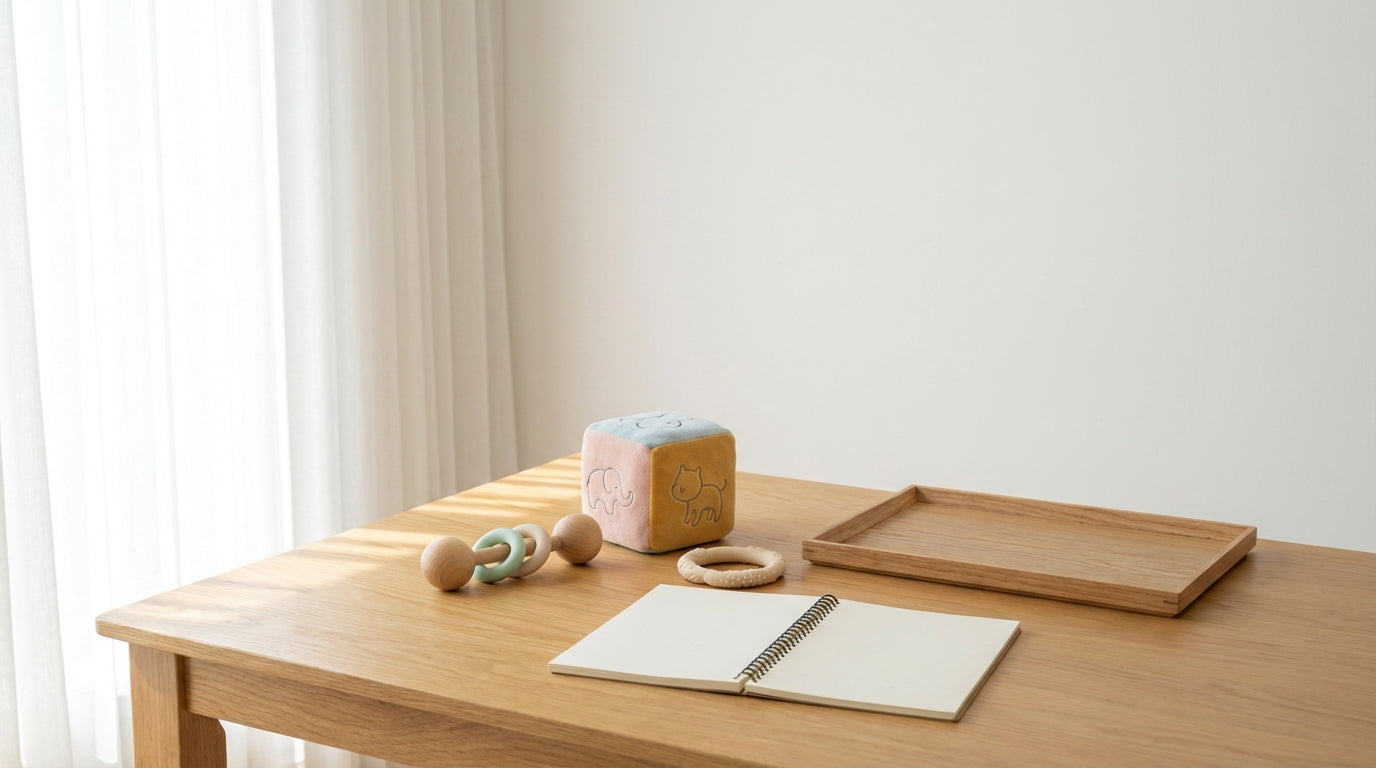
At 1 year old, big, sturdy toys that reward grasping and posting are ideal. Many children are right in the middle of “when I do this, something happens” – and that’s exactly where learning toys for age 1 are at their strongest.

Sorting and stacking games are especially fitting because they practice hand-eye coordination. You don’t need complicated tasks for this: a stack of cups can already be a little masterpiece (and yes, it will be knocked over again – that’s part of it).
- Stacking & sorting: cups, rings, shapes – ideally with large openings.
- Pushing & pulling: movement as a reward, but sturdy and easy to grip.
- Motor skills elements: turning, sliding, flipping – ideally with large parts.
An activity cube is handy because it offers several small tasks in one. If you’d like to browse: in our learning toys overview you’ll find plenty of ideas, and on 12m+ learning toys everything is sorted once more through the “from 12 months” lens.
Safety note: For children under 3 years, swallowable small parts are a real risk. According to LAVES, among other things a test cylinder is used to check whether parts could be swallowed.
Which learning toys for age 2?
At 2 years old, “touching” increasingly turns into “matching” and “copying.” Many children can post, turn and sort with more purpose – and they love repetition so much that, as an adult, you may briefly consider ear protection.
- Posting and matching games: shapes, colors, simple sorting tasks.
- First puzzles: few pieces, clear pictures, easy to grip.
- Everyday role play: kitchen, workbench, doctor – language picks up speed.
Wooden toys are often a pleasant choice at this age because they’re sturdy and feel “real” in the hand. If you’d like to browse by age: toys for ages 2+ and from 24 months are good starting points.
Which learning toys for age 3?
From 3 years, more “planning” often works: understanding rules, remembering sequences, playing out stories. Children become more persistent, language gets more important, and “Why?” is now a firm part of family communication.
- Puzzles & matching games with more pieces: ideally with categories (animals, vehicles, everyday life).
- First rule-based games: short, simple, little waiting time.
- Building & constructing: towers, patterns, simple template cards.
A rule-based game is child-friendly when the rules can be explained in 1–2 sentences. Then attention stays with the game – and not with “Wait, let me explain it again.”
Montessori-inspired play materials are often helpful because they offer clear tasks without sensory overload. If that appeals to you, take a look at the Montessori toys selection.
Which learning toys for age 4?
At 4 years old, tasks can get trickier: patterns, sequences, first strategy. Many children can stay with one thing for longer – especially when they get to choose themselves and the goal is visible.
- Patterns & matching: layout games, sequences, “What goes with this?”
- Fine motor skills: threading, screwing, turning – age-appropriate and not too fiddly.
- Role play with rules: “restaurant,” “vet,” “school” – including their own game rules.
Now toys that allow several levels of difficulty are worth it. That way they grow with your child, instead of being “done” after three weeks.
Which learning toys for age 5? (with specific types of play & tips for parents)
At 5 years old, many children love tasks with a result: finished, built, solved. This is the phase where “I’ll do it myself” isn’t just said but actually carried through – sometimes with a very serious expression.
“Pre-learning skills” are everyday foundations that help later on with learning. These include, for example, comparing quantities, recognizing patterns, planning sequences of actions or hearing sounds in words – without you having to “play school.”
- Puzzle & thinking games: tasks in 2–4 steps, ideally with self-checking (“right or not right”).
- More complex puzzles: more pieces, more details, longer concentration.
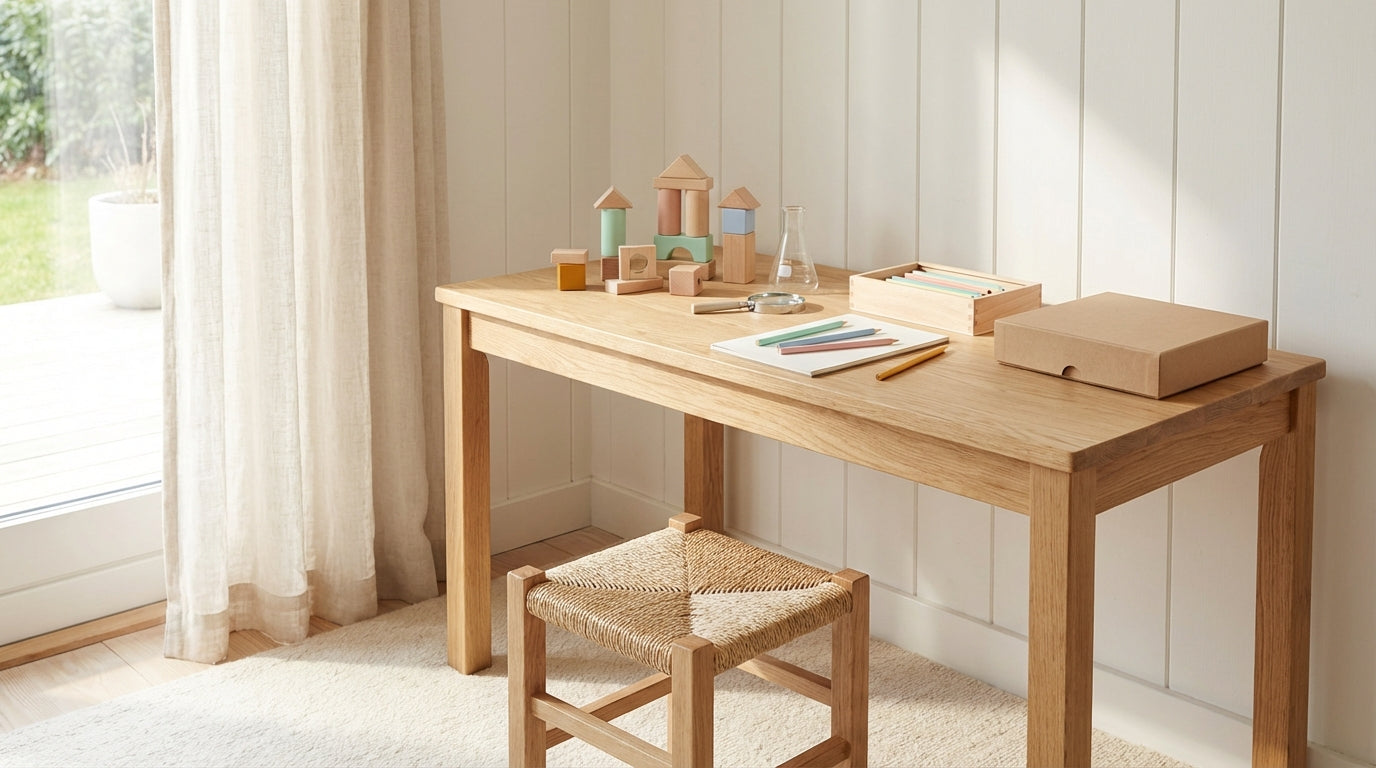
- Construction play: building from a template and then a “free round” (that’s where the magic happens).
- Cooperative games: winning together instead of against each other – that relaxes sibling game time.
Parent tip: Watch for frustration when the task is supposed to become too “perfect.” Some five-year-olds quickly tip into “everything is stupid” when they make mistakes – then short stages help: “just the corners” or “only three tasks, then a break.”
Practical tip: When a game gets too easy, add a mini rule: first sort, then name, then stack by color. Same material, new level.
Safety note: This still applies from age 5: craft or play pieces don’t belong in the mouth. Collect small parts after playing – especially when younger siblings are around.
Which learning toys for age 6? (projects, strategy, school – without school stress)
From 6 years, longer rules, more strategy and real small projects fit well. Many children can now plan, explain and stick with things better – and at the same time they still need movement and silliness. Thankfully.
A project game is a toy that is allowed to “continue” over several days. That could be a construction, a creative set or a game you keep expanding – what matters is that it doesn’t disappear into the closet after one afternoon.
- Strategy & rule-based games: more decisions, but no game that lasts for hours.
- Creative making: drawing, cutting, gluing, building – ideally with templates and their own ideas.
- Worlds of knowledge: cards, pictures, topics (dinosaurs, space, animals) – when your child is passionate about it right now.
- Fine motor skills & patience: tasks where precision counts, but mistakes are allowed.
Parent tip: “School child” doesn’t mean “always focused.” Plan learning toys as a calm island after physical activity – rather than as a mandatory program right after a long day.
Safety & quality: What you should really look out for
The age recommendation isn’t decoration, but a safety and usage guide. Especially for children under 3 years, small parts are critical: according to LAVES, swallowability is assessed using a test cylinder, among other things.
Warnings such as “Not suitable for children under 36 months” have a concrete reason. They typically appear when small parts are included or certain risks exist – and they should really be taken seriously in everyday family life.
The EU Toy Safety Directive 2009/48/EC sets out fundamental safety requirements for toys. You can find the full text on EUR-Lex if you want to know the details: EU Toy Safety Directive 2009/48/EC (EUR-Lex).
You can often recognize quality by transparency: material information, clear notices, clean workmanship. We’re a family business from Hamburg and have been at it for 66 years – and that’s exactly why we prefer honest over loud: What is it, what is it made of, who is it meant for?
Practical tip: When buying gifts, take a quick look at the packaging: age, warnings, small parts. That saves arguments later – and, if in doubt, tears too.
Mini checklist: Finding a gift without overwhelming the child (or the parents)
A good gift hits the next small step – not the one after that. If you’re unsure, “a little challenge, but quick success” is almost always the right call.

- Can the child start it on their own? (Without you immediately becoming a permanent helper.)
- Are there several play ideas? (Then it stays exciting for longer.)
- Does it fit the phase? Mouthing phase/small parts, urge to move, role play, rules.
- Is it practical for everyday life? Is it easy to put away, clean and sort?
Keep reading & browsing (if you have 2 more minutes)
Once you’ve got a rough orientation, a hub helps you keep clicking along at ease. Feel free to start with learning toys. For the very little ones, Learning Toys for Babies: Recommendations & Tips for the Littlest Ones is a good next step – and for “from 12 months” there’s the overview 12m+ learning toys.
FAQ
Which learning toys for age 1 really make sense?
Learning toys for age 1 make sense when they allow grasping, posting and sorting. Large, sturdy pieces and simple tasks work best. Children learn a lot through repetition and cause and effect, which is why stacking cups, shape sorters and simple motor skills elements are often a real hit.
How can I tell if a toy is too difficult?
It’s usually too difficult if your child can’t get started without help. If frustration shows up after a short time, try simplifying: fewer pieces, one step instead of three, or show them once and then hand it over. If it’s still “silly,” it’s simply not time for it yet.
What suits as a learning toy for age 2 if the child gets bored quickly?
Then toys with several ways to play help, instead of just one task. Matching games, simple puzzles and role-play materials are good because you can vary them. Rotation also works wonders: putting one item away and bringing it back later is often more exciting than constantly getting new things.
Which games are suitable for siblings from age 5 without arguments?
Cooperative games are often more relaxed from age 5, because everyone wins together. That takes pressure out of competition and helps with planning together. Aim for short rounds and clear rules – then the mood is more likely to be “again!” than “I don’t want to anymore.”
Which learning toys for age 6 support longer concentration?
Project games are well suited: building, creating or puzzling over several stages. Six-year-olds can often stay with something longer when there’s a visible goal. Plan short, repeatable sections rather than a “giant task” – that fits better into real afternoons.
Where can I find reliable information about small parts and swallowability?
A good, easy-to-understand source is LAVES, with information on swallowability and the test cylinder. It explains why small parts can be dangerous for young children and how testing is done. Here is the link: LAVES: Swallowability of toys.
If you’re now in the mood to browse: feel free to start with the overview and click your way onward. Here’s learning toys – and if you want to dive even deeper into the first months, read Learning Toys for Babies: Recommendations & Tips for the Littlest Ones.