Baby Learning Toys: How to Find the Right Ones – Safe and Sensible
At a glance
- When it comes to baby learning toys, what counts is: easy to grasp, calm, and safety-tested.
- A few pieces are enough: repetition is the real “turbo” for babies.
- Look for an age recommendation, sturdy construction and clear testing information (e.g. EN 71).
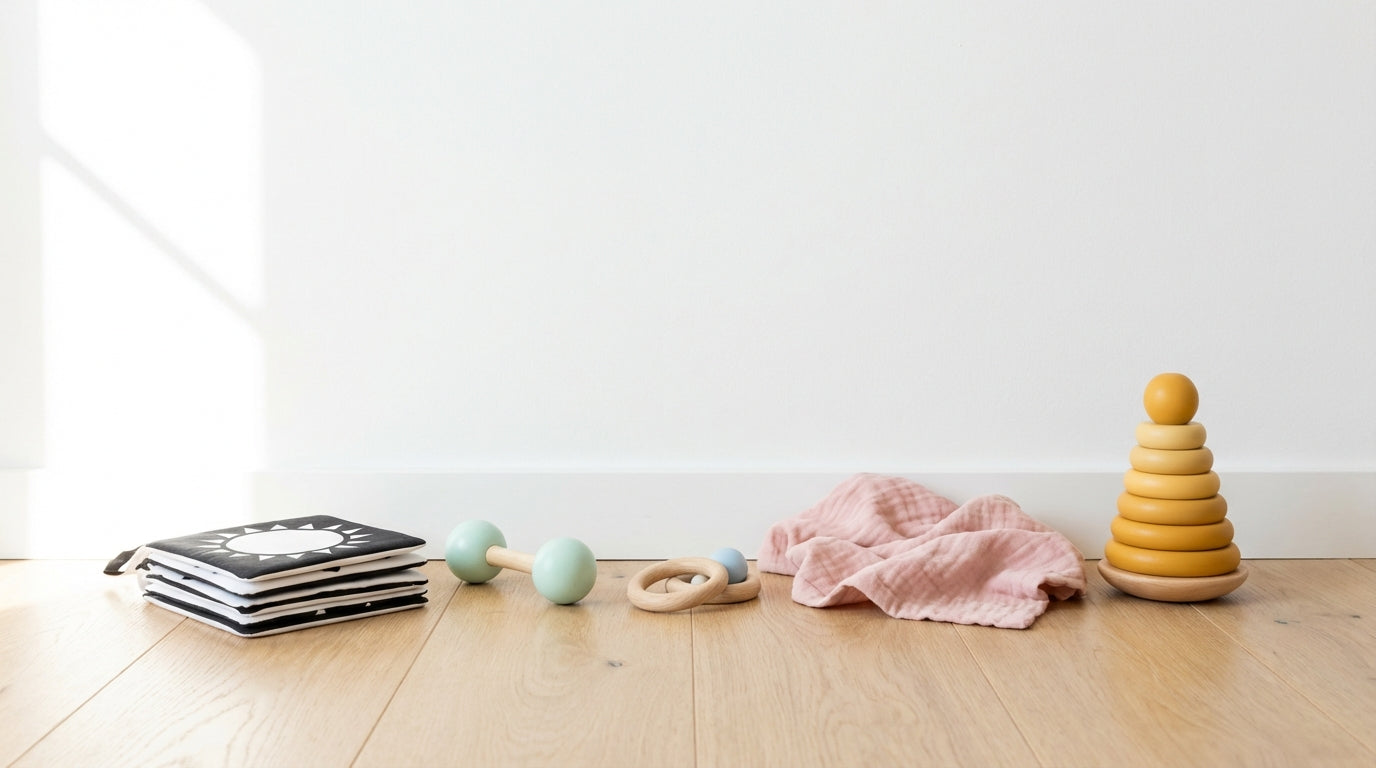
- Grasping, rolling, stacking, in-and-out: these are the basics that really carry you through.
- Practical wins: easy to clean, suited to everyday life, no small parts.

Learning toys for babies are best when they are simple, safe and repeatable. You don’t need a flashing miracle gadget, just a few things your baby can easily grasp, feel and explore (yes, with their mouth too). In this guide you’ll get relaxed orientation: which types of play fit at which stage, what to look for in materials and safety, how much is really enough – and a few DIY ideas in case you’re more of a “crafting at the kitchen table” parent right now.

Ulli & Flo
Owners of bieco · Hamburg · parents themselves
What helped us most with baby learning toys: less stuff, but the right stuff. A few safe basics often make everyday life calmer – for everyone. Feel free to browse our Learning Toys collection.
Are there special learning toys for babies?
Yes: baby learning toys are above all discovery toys for the senses and motor skills. Babies don’t learn through rules, but through repetition: grasping, shaking, rolling, dropping (happily on an endless loop) and having it picked up again (happily by you). Good toys make exactly that possible: a clear function, sturdy build, pleasant to touch.
Fewer stimuli are often more – that’s everyday parenting, not dogma. Many babies quickly get overwhelmed by too many lights, sounds and functions. A grasping toy, a stacking game or a simple “in-and-out” is often the better choice, because your baby is the one in control.
Definition (quotable): Learning toys for babies support sensory perception and movement without overloading the baby with stimuli. It’s not about “early achievement”, but about “discovering well”.
What should you look for in baby learning toys?
Safety matters most: age-appropriate, sturdily made and verifiably tested. Babies explore with their hands and mouths – completely normal. That’s why an age recommendation, clean workmanship and clear information about testing are worth more than any marketing phrase.

Safety note: For children under 3 years, only use toys that are expressly suitable for that age – no small, detachable parts, no long cords, no flaking coatings.
Standards like EN 71 are a helpful compass because they test for key risks. On many products you’ll find references to EN 71-1/-2/-3 (mechanical/physical properties, flammability, migration of certain elements). According to DIN, EN 71-3 is particularly relevant because babies and toddlers also explore toys orally, and the release of certain elements is tested. (Source: DIN)
The EU Toy Safety Directive also sets out concrete requirements and limit values for materials. That sounds dry, but it’s reassuring: under the EU Toy Safety Directive 2009/48/EC, limit values for the migration of certain elements in toy materials are regulated, among other things. (Source: EUR-Lex)
Everyday practicality is a quality feature: easy to clean beats “super fancy”. Drool, mashed food, the floor – that’s their natural habitat. Look for smooth surfaces, clear care instructions and materials that won’t take offense when they’re wiped down with a damp cloth.
Which types of learning toys suit which baby age?
Go by developmental steps – months are only a rough guide. Every baby has their own pace. Age ranges help with orientation, but they’re not a timetable. And if your child would rather study the ceiling right now: that’s research too.

- 0–3 months: contrasts, calm visual stimuli, soft materials, first attempts at grasping.
- 3–6 months: grasping, shaking, feeling – simple grasping toys, fabric elements, gentle sounds.
- 6–9 months: rolling, tapping, simple cause and effect, parts suitable for chewing.
- 9–12 months: stacking, fitting pieces together (big ones!), “in-and-out”, first sorting ideas.
Definition (quotable): Fine motor skills are small, targeted hand movements, such as grasping with thumb and fingers. Simple fitting and stacking games support exactly that – without your baby having to “train”.
Recommendations: What can good learning toys for babies do?
Good learning toys for babies have a clear play idea and reward repetition. That sounds unspectacular, but it’s the heart of it: “Ah, that rolls.” “Oh, that fits.” “Whoa, that makes a sound.” These mini-successes are huge for babies.
These types of play are often a big hit because they don’t overwhelm.
- Grasping and sensory toys: different surfaces, easy to hold, not too heavy.
- Stacking and fitting toys: large pieces, clear shapes, not much frills.
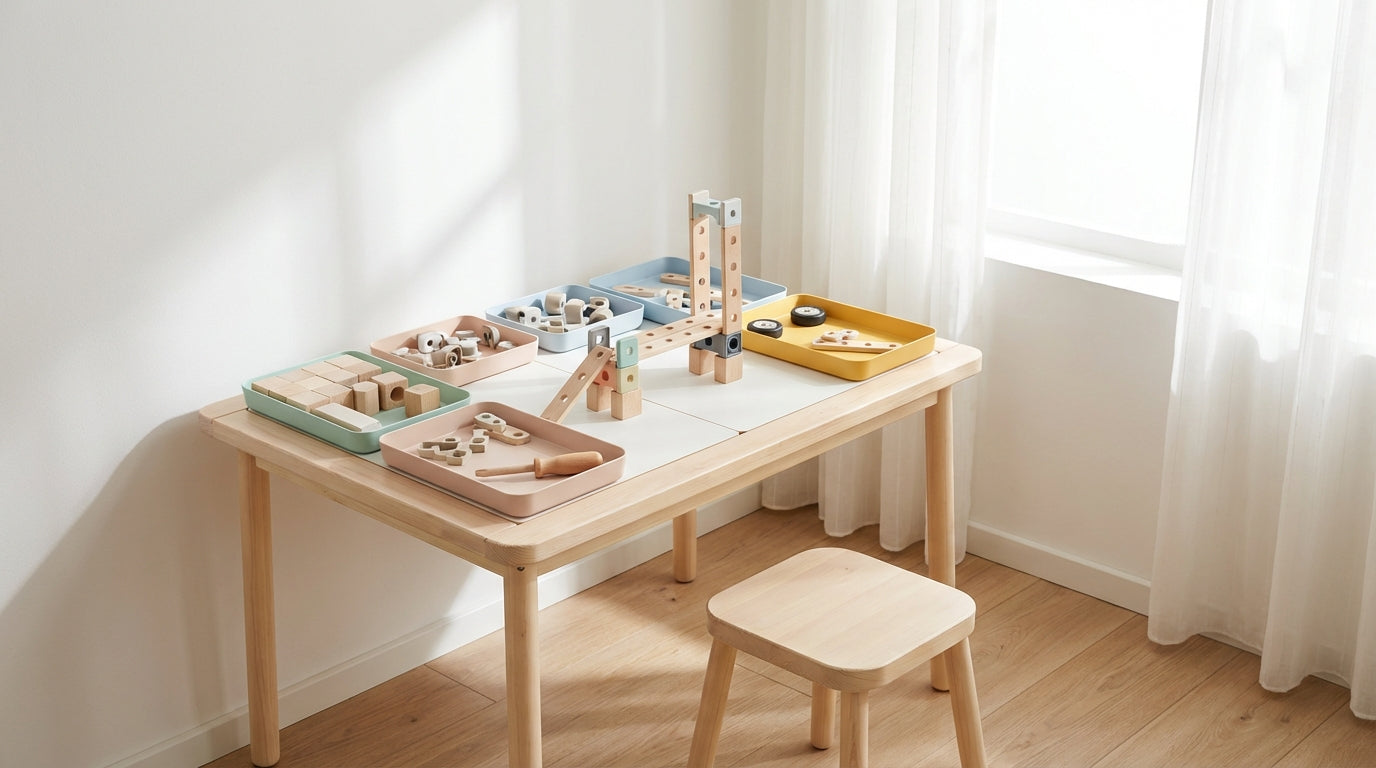
- Motor skills toys (simple): turning, pushing, flipping – ideally with large, easy-to-grasp elements.
- Chew-safe parts: handy when everything is currently being “tested with the mouth”.
Practical tip: If you’re unsure: pick 1 toy and give it a week. Babies need time, not choice.
Pull-along toys usually make sense later, often from around 12 months. At Bieco, for example, the “Pull-Along Dinos” are listed with an age recommendation from 12 months and cite EN 71-1-2-3-9, among others, as well as independent tests. (Source: Bieco product page)
Checklist: Buying criteria that count in real life
With this short checklist you can quickly find out whether a toy “fits”. If you’re giving a gift as a grandparent or friend: the list is also great for quickly asking what’s already in the household.
| Criterion | How to spot it | Why it helps |
|---|---|---|
| Age recommendation | clearly stated | matches size, use and safety requirements |
| Sturdy construction | nothing wobbles, nothing comes loose | babies test consistently (and with no gentle cycle) |
| Easy to grasp | shape, weight, surface | supports independent play |
| Low stimulation | few “extras” | less overwhelm, more focus |
| Cleaning | care instructions are simple | suited to everyday life with drool & mashed food |
If you take away only one thing: safety and graspability beat “cool”. It’s not spectacular, but very reliable – and your living room stays acoustically livable.
Materials & quality: wood, fabric, silicone – which is “better”?
“Better” is the material that is safely made and suitable for the age. Wood can be sturdy and pleasant, fabric is often cuddly and practical in the first months, and silicone is often popular during “everything goes in the mouth” phases. What matters are workmanship, care and suitability for the age.

Wood is great when edges are clean and nothing can splinter. Look for smooth surfaces and parts that are large enough. For very young babies, “light and soft” is sometimes simply more relaxed – for you too, when the toy lands on your toes for the 18th time.
Fabric scores with closeness and feel, but needs clear care instructions. Anything washable makes life easier. And yes: it will be washed. More than once.
Silicone is often practical when there’s a lot of chewing going on – but only if it’s designed for that. Here too, check the age recommendation and make sure nothing can be torn off.
DIY ideas: baby learning toys from household items (without craft stress)
You can often recreate good learning toys for babies with very simple things. This doesn’t replace tested toys, but it can work well as a quick play idea – especially when you don’t feel like ordering anything else.
Safety note: Only use DIY items under supervision and check them regularly: no small parts, no sharp edges, no loose ribbons or foils.
- “Pulling out scarves”: Fill an empty, sturdy tissue or wipes container (without sharp edges) with large fabric cloths. Baby pulls them out, stuffs them in, pulls them out again.
- “Roll & chase”: Roll a soft ball or a large, light toy – your baby decides the speed and direction.
- “Rattle light”: A well-sealed tin with a few large, harmless pieces (that can’t fit out) can make noise. Only if nothing can open and everything is big enough.
Practical tip: Put DIY items away after 5–10 minutes. Short is often better than “exciting for too long”.
Care & cleaning: how to keep learning toys stress-free in everyday life
Cleaning works best when you keep it small and regular. You don’t need a cleaning schedule with spreadsheet charm. A damp cloth, mild detergent according to the manufacturer’s instructions and a fixed spot for drying are often enough.
- Wood: usually wipe with a damp cloth, don’t soak; let dry well.
- Fabric: follow the care label; washable parts are worth their weight in gold in baby life.
- Silicone: clean according to the manufacturer’s instructions; check regularly for cracks.
If something is damaged, it goes – even if it “still works”. Babies are thorough. And you really have enough other things on your plate.
Our Bieco quality, thought through for everyday life (no fuss)
You can tell good quality by the fact that it doesn’t get in the way of family life. We are a family business from Hamburg and have been doing this for 66 years – and honestly: children are the strictest product testers. That’s why we (and thankfully many parents too) focus above all on three down-to-earth points.
Our 3-point quality promise (this is how we see it)
- Material & workmanship: pleasant, sturdy, no nasty surprises.
- Testing & transparency: information on standards/tests and age recommendation is easy to find.
- Everyday practicality: easy to grasp, easy to clean, not overloaded.
If you want details: product pages often list age, care and testing information. With the Pull-Along Dinos example, you’ll find exactly this information gathered in one place. (Bieco product page)
How to use learning toys in everyday life (without an extra program)
The best approach is: offer briefly, observe, put away again. Babies benefit from small play islands spread throughout the day. Five focused minutes are often worth more than half an hour of constant entertainment.

- Start with 1 toy: Place it within reach, don’t “push” it into their hand.
- Show it once: rolling, stacking, pushing – then pause.
- Let your baby try: even if it “doesn’t work”. That’s exactly where learning happens.
- Only switch at real frustration: not when it’s just getting interesting.
For gift-givers: ask about everyday life – not about the “coolest” item. A quiet, easy-to-grasp toy is often used more than the flashing gadget that suddenly shouts “Hello!” at three in the morning. (Yes, those things have timing. Sadly.)
Internal guidance: where to keep browsing at Bieco
If you want to get your bearings on the topic of learning toys, a good overview helps most. There you’ll find play principles, age ideas and inspiration – without having to dig through a thousand individual items.
- Overview: Learning Toys
- Grasping & first hands: Grasping Toys
- Stacking & trying things out: Stacking Toys
- Pushing, turning, tinkering: Motor Skills Toys
FAQ: Baby Learning Toys
Are there special learning toys for babies?
Yes: they are designed for sensory perception, grasping and safe exploration. Babies learn through repetition and bodily experience. That’s why simple grasping, sensory, rolling and stacking ideas often fit better than complex programs. What matters is that the toy is age-appropriate and doesn’t overload your baby with stimuli.
What should you look for in baby learning toys?
Look for an age recommendation, sturdy construction and verifiable testing information. Standards like EN 71 are a good reference point; according to DIN, EN 71-3 is particularly relevant because babies also explore toys with their mouths, and the release of certain elements is tested. (DIN)
Is wooden bab toy always the best choice for babies?
No: what matters are workmanship, weight and suitability for the age. Wood can be sturdy and pleasant, but it must be cleanly made and must not have small, detachable parts. For very young babies, soft materials are often more practical. Check the age recommendation, care instructions and whether the toy is easy to grasp.
How many learning toys does a baby really need?
Usually 3–6 well-chosen pieces are completely enough. Babies prefer to play intensively with a few things instead of constantly getting new ones. A small rotation (for example every 7–10 days) brings variety without turning your living room into a toy warehouse. And yes: that also eases the strain on your nerves.
From what age do pull-along toys make sense?
Often only once your child stands and walks confidently – frequently from around 12 months. Many pull-along products are labeled accordingly. At Bieco, for example, the “Pull-Along Dinos” are listed with an age recommendation from 12 months and cite safety testing according to EN 71. (Bieco)
How can I tell that a toy is overwhelming my baby?
If your baby looks away, gets restless or quickly frustrated, it’s often too much. What helps then: reduce stimuli, offer just one toy and keep play sessions short. Babies need breaks to process impressions. That’s not “bad mood”, but completely normal self-regulation.
Conclusion: Learning toys for babies are truly good when they bring safety and calm. If you now feel like getting your bearings in a relaxed way, take a look at the Learning Toys overview at Bieco. For many families a good start is: first grasping, then stacking, then motor skills – step by step, without stress.