Baby Toys from 3 Months: Smart Ideas Through 12+ Months
At a glance
- Baby toys from 3 months: lightweight, easy to grasp, with simple feedback.
- 0–6 months: just a few pieces are enough – contrasts, textures, crinkles, rattles.
- From 6 months: teethers, stacking, “cause and effect” and lots of experimenting.
- 9–12+ months: posting, sorting, first books, pushing/pulling and bath toys.
- Safety: no detachable small parts, sturdy seams, easy to clean.

Baby toys from 3 months make the most sense when they support grasping, feeling and first “I did it myself” moments. You don't need to open a playroom for that: a small, well-chosen selection is usually plenty. In this guide you'll get a relaxed roadmap from 0 to 12+ months – including mini set ideas, a safety check and a few tricks that really work in everyday family life (even on days with little sleep).

Ulli & Flo
Owners of bieco · Hamburg · parents themselves
We would have loved a simple list back then instead of 100 opinions. With a few well-chosen pieces, things get exciting for your baby – and much more relaxed for you. Feel free to browse our Baby Toys collection.
Why “sensible” often means “less” when it comes to baby toys
Babies don't need a nonstop program, just age-appropriate offerings and breaks. Especially in the first months, toys are more of an invitation than entertainment. When too much is blinking, tooting and dangling all at once, your baby isn't being “stimulated” – they're often just worn out.

Definition: Sensible baby toys are toys that babies can safely grasp, feel or put in their mouths on their own – without overloading them with stimulation.
The Hamburg way, short and sweet: If a toy gets used every day, it has done its job. Everything else can simply go back in the box – no guilty conscience.
Baby toys 0–6 months: less clutter, more meaning
In the first 6 months, 2–4 good pieces are often completely enough. Babies learn mainly through seeing, hearing, feeling – and through you. Toys can accompany them, but they don't have to “perform”.
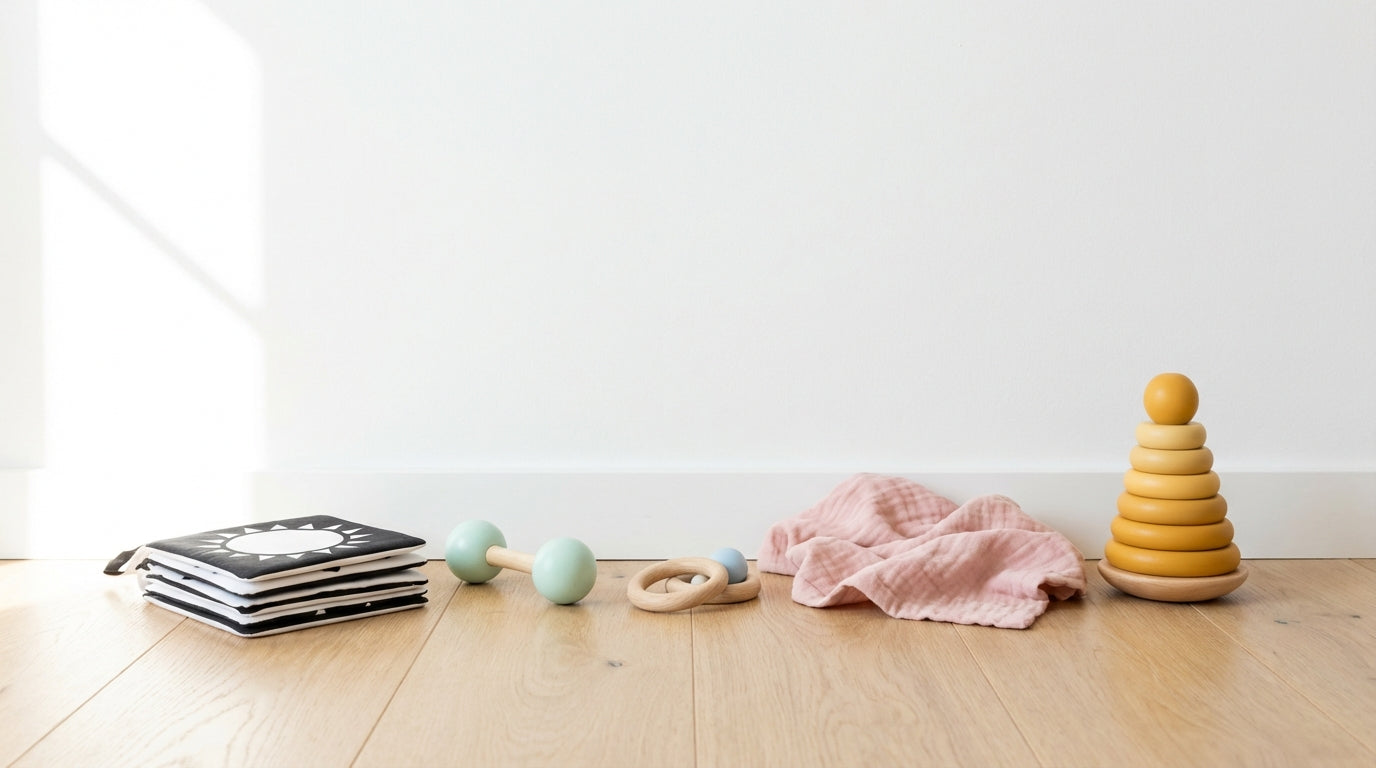
- 0–2 months: Contrasts (black/white), calm sounds, soft materials. Lightweight cloth books, soft figures or a mobile (out of reach) are handy.
- 2–3 months: First attempts at grasping: very light rattles, fabric rings, small comfort cloths. Anything that crinkles is often adored.
- 4–5 months: Grasping becomes more purposeful. Grasping toys, rattles, soft balls, simple tactile elements (bumps, ribbons, different fabrics).
- 5–6 months: The mouthing phase picks up speed: teething and grasping rings, soft pieces that are easy to clean.
Safety note: For children under 3 years, toys must not have detachable small parts; this is assessed, among other things, with a test cylinder, according to the Bavarian consumer portal (described, among others, in DIN EN 71-1).
What often works better than “yet another toy”: a baby-safe mirror, a soft cloth for peekaboo, your voice. Sounds simple – but it's pretty hard to beat.
Baby toys from 3 months: top categories that really land
From around 3 months, grasping, shaking and “I got it!” get really exciting. Many babies can now hold things briefly, bring them to the midline and start exploring toys on purpose.

Baby toys from 3 months work well when they're light and clearly “respond”. That means: it rattles, crinkles, feels interesting or gives gently – without launching a light show right away.
Top categories
- Grasping toys & rattles: ideally with different surfaces (smooth/ridged/fabric).
- Soft sensory toys: stuffed animals or cloths with corners, knots and tags (babies love “fiddly bits”).
- Teething and grasping rings: even if teeth aren't bothering them yet – mouth exploring starts early.
- Play arch/activity hangers: better 2–3 interesting pieces than ten at once.
Practical tip: Pick up the toy and shake it once. If it annoys you right away, it will annoy you both by day three at the latest.
Mini set idea (gift-friendly)
A good baby toy recommendation for 3 months: 1 grasping piece, 1 sensory piece, 1 calming piece. That covers grasping, touching and cuddling – and your home won't look like a clearance warehouse.
- Grasping piece: grasping toy or rattle (light, easy to clean).
- Sensory piece: cloth book or activity cloth with different materials.
- Calming piece: comfort cloth or soft cuddly toy (without hard parts).
Definition: A grasping toy is a lightweight baby toy shaped so that babies can easily take hold of it with still-uncoordinated hands.
Safety check (short, but important)
Good baby toys are sturdily made and stand up to “mouth tests”. Take a quick look at: seams (are they coming loose?), eyes/appliqués (firmly attached?), edges (smooth?), and whether the piece is easy to clean.
If you want to dive deeper into safety: in our guide Safe Baby Toys: The Ultimate Checklist for Parents you'll find a checklist that works in everyday life.
Baby toys from 6 months: now it gets “hands on”
From 6 months, toys that show cause and effect become exciting. Many babies sit (with support), roll, turn – and want to investigate things on purpose: tapping, pushing, throwing (yes, that unfortunately comes with the territory).

A simple rule: The more mobile your baby becomes, the more the toys can “join in” – but please without small-parts chaos.
- Teethers & teething aids: at this stage the gums often start to act up.
- Stacking cups / stacking rings: grasping, turning over, nesting inside each other.
- Soft balls: rolling, crawling after them, finding them again.
- Activity toys: flaps, rings, crinkle surfaces – but please not too much at once.
Context on rules & labeling: According to the German Federal Ministry for the Environment, Nature Conservation, Nuclear Safety and Consumer Protection (BMUV), the EU Toy Safety Directive regulates, among other things, safety requirements as well as labeling and warning notices; in Germany it is implemented through the Toy Safety Ordinance (2. ProdSV).
If you want to support motor skills & senses in a targeted way: take a look at our guide Activity Baby Toys: Supporting Motor Skills & Senses.
Baby toys 7–8 months: turning, pulling, discovering
Between 7 and 8 months, many babies want to “do more” instead of just looking. They often start scooting, crawling (or rolling very determinedly now), and checking objects from every side.
- In-and-out games: putting large pieces into a bowl and tipping them out again (a classic).
- Pull toys (super simple): something that moves when baby nudges or pulls it closer.
- Touch-and-feel and flap books: thick pages, clear pictures, not much “fuss”.
Practical tip: An empty paper towel tube + a few large cloths = pulling game. Important: choose cloths big enough that nothing can be swallowed.
Baby toys 9–10 months: posting, sorting, pushing (when it fits)
At 9–10 months, toys that reward movement and “figuring things out” become interesting. Many babies are now mobile (crawling, pulling up, cruising along furniture) and love tasks: opening, closing, stacking, sorting.
Shape-posting games & sorting
Posting and sorting games are ideal when the shapes are large and easy to grip. Your baby practices hand-eye coordination and notices: “When I do it right, something happens.” And if not: they simply try again (with a very serious look on their face).
- Large posting shapes: circle, triangle, square – less is more.
- Sorting boxes: things in, lid on, lid off – fascinating for hours.
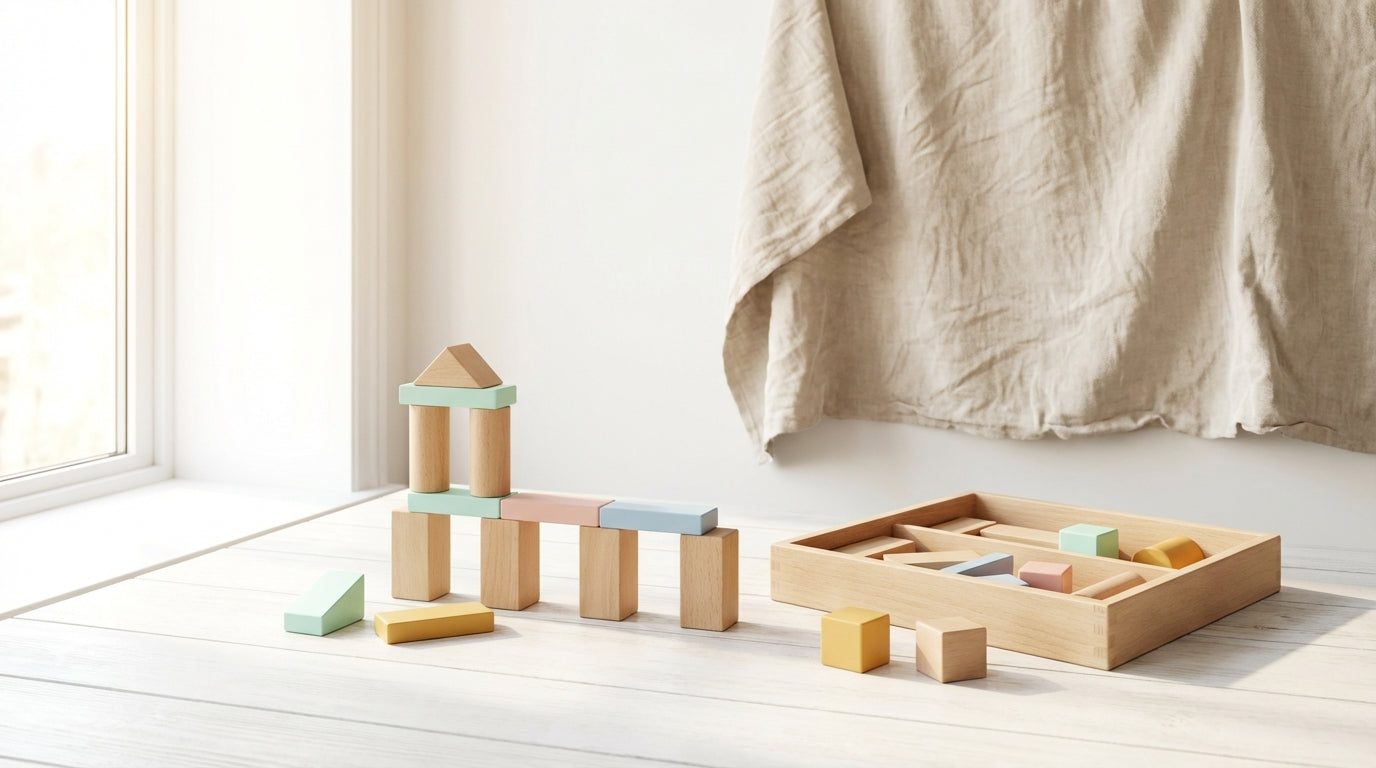
- Stacking and building blocks (large): Knocking them over counts as a building project. Period.
Pushing & pulling
Push or pull-along toys only fit well once your child feels secure with them. Some walk at 10 months, others much later – both are normal. If your child is still wobbly on their feet, sturdy play ideas close to the floor are often more relaxed.
- Pull-along toys: motivate your child to follow once walking has arrived.
- Push toys: can be interesting once your child already cruises confidently along furniture.
First books
Sturdy books are worth their weight in gold now, because page-turning becomes a sport. Thick board pages, clear pictures and short rhymes work well. Touch-and-feel elements are nice – as long as they're firmly attached and don't suddenly become “adventurous”.
Bath toys
Bath toys make sense when they're easy to clean and dry. Water is great – standing water inside a toy, not so much. Make sure you can empty it and dry it thoroughly after bathtime.
Safety note: Toys used in water should be cleaned and completely dried after bathing so that no residue can collect inside.
On standards (short and helpful): The EN 71 series describes safety requirements for toys; EN 71-1 covers mechanical and physical properties, e.g. requirements around swallowable small parts (explanations can be found, among others, on the Bavarian consumer portal).
Baby toys from 12+ months (1 year): little people, big plans
At 12+ months, babies become little explorers with minds of their own. Now toys fit that allow imitating, rolling, sorting and first “mini tasks” – with plenty of moments of success.
- Pull-along toys & first vehicles: for the “I'm just going to walk over there” phase.
- Posting games & simple puzzles (large pieces): moments of success are worth their weight in gold.
- Sorting & stacking: cups, rings, blocks – new every time.
- First books: short stories, clear pictures, lots of pointing and naming.
- Role play light: feeding stuffed animals, putting things in and taking them out (spoiler: this one stays).
And yes: “baby toys from 1 year” are often already more toddler toys. If your child isn't walking yet or is still in a strong mouthing phase, that's not a step back – just a different pace.
Baby toys with music: when it makes sense (and when it doesn't)
Musical toys make sense when they're short, quiet and controllable by the child. Babies like repetition – parents like peace and quiet. Both can be true at the same time.
- Good: quiet tones, clear cause and effect (press = sound), short melodies.
- Tricky: endless loops, very loud speakers, toys that start “by themselves”.
- Everyday tip: If music, then one with volume control or a mute function.
How do I recognize sensible baby toys? (Quick check)
Sensible baby toys are safe, simple and match your baby's current abilities. Three questions usually help right away:
- Can my baby hold it on their own? (weight, shape, surface)
- Is it okay if it ends up in their mouth? (material, workmanship, no detachable parts)
- Does it have one clear main idea? (rattle or stack or feel)
The Hamburg way of saying it: If a toy “can do everything”, it often can't do anything really well – and ends up lying around. That's not a tragedy. Just expensive.
Why we recommend it this way (a quick moment of transparency)
We're a family business from Hamburg and have been making toys for 66 years. Ulli & Flo write here as parents for parents – with an eye on everyday practicality, workmanship and honest safety transparency (materials, labeling, sturdy seams, no unnecessary small parts).

And very practically: If a toy at our house does nothing but gather dust after two days, it goes in the box – it's that simple.
FAQ
Which baby toys from 3 months are really worthwhile?
Lightweight grasping toys, rattles and soft sensory toys with a clear “response” are worthwhile. At that age it's all about grasping, shaking and exploring with the mouth. Look for sturdy seams, materials that are easy to clean, and make sure no small parts can come off.
How many toys does a baby need?
A few pieces are usually enough if they match your baby's stage of development. Many families do well with 4–8 carefully chosen toys that they rotate. Babies also play a lot with everyday items (cloths, cups, bowls) – as long as it's safe and you're right there.
Which baby toy recommendation for 3 months works as a gift?
A small set of a grasping toy plus a comfort cloth is almost always a fitting gift. It's practical, doesn't overwhelm and is often used for a long time. If you're unsure: go for something washable and light – babies are honest, and impractical things get left lying around.
What are good baby toys from 6 months?
Good toys show cause and effect and are robust. Stacking cups, large posting shapes, soft balls or simple activity elements often fit great. Many babies are teething at this time – then teethers and soft, easy-to-clean materials are especially popular.
Which baby toys for 9 months or 10 months?
For 9–10 months, posting games, sorting, large blocks and first push/pull ideas are a good fit. Many babies are mobile and love tasks like in/out or open/close. Large pieces, sturdy workmanship and a toy that the child can control themselves remain important.
Which baby toys from 1 year are really worthwhile?
From 1 year, sorting, pulling along, stacking and first puzzles are especially worthwhile. Children want to imitate and decide for themselves. Posting games with large shapes, pull-along toys and robust books fit well. If your child still puts a lot in their mouth, stick with sturdy, easy-to-clean materials.
One last thought: you don't have to “entertain” every phase – you're allowed to simply accompany it. If you'd like to put together a small, sensible selection, feel free to browse the Baby Toys hub – nice and relaxed, without overload.
Sources for further reading (official & easy to understand): BMUV (consumer protection/product information) and the Bavarian consumer portal (including notes on toy safety and small parts).